Category
Enterprise AI Strategy: The Complete Guide to Building, Owning, and Executing Your Plan
Last updated: June 2026
By David Brennan · Arkeo AI · Building and Deploying Custom AI agents since 2023
The wrong question most CEOs ask about enterprise AI strategy is: what tools should we be using?
The right question is three questions: Which workflow ships in the next 30 days? Who is accountable for it after it goes live? Where does the data live? Those three answers are your strategy. Everything else — the vendor evaluations, the maturity models, the multi-swim-lane Gantt charts — is overhead that delays the first deployed workflow without improving it.
This guide covers everything a business leader needs to build, own, and execute an enterprise AI strategy that produces deployed workflows rather than a portfolio of tests that never ship. Each section below covers a major component of the strategy. Where there is a deeper guide on that component, the link is at the end of the section.
Quick Answer
What it is: A sequenced, owned plan — workflow, owner, data path — anchored to a 30/90/12-month cadence with named owners at every stage.
What it is not: A readiness audit, an ROI calculator, a vendor shortlist, a maturity score, or a 70-slide deck.
Why most programs never ship: No named owner after launch. Data residency decided too late. Wrong first workflow chosen because it was easy to demo.
Next step: The free AI Assessment maps your workflows, picks the first 30-day win, and gives you the sequence in one working session.
Get the sequence before you spend the budget
60 minutes. We map your workflows, name the first 30-day win, and give you the 30/90/12-month sequence grounded in your actual operation. Not a sales demo. Not a deck.
What enterprise AI strategy actually means
An enterprise AI strategy is a sequenced, owned plan. It names what ships first, who runs it, and where the data lives — all in writing, before any code is written. It is not a framework diagram. It is not a list of platforms to evaluate. It is a one-page document with three columns: workflow, owner, data path. Every decision that follows flows from those three columns.
The distinction between strategy and activity matters because most organizations have activity and call it strategy. They have pilots running, vendors evaluated, workshops completed, maturity assessments delivered. None of that is strategy unless it produces a named workflow, a named owner, and a data-path decision. Deloitte's State of Generative AI survey found two-thirds of enterprises expect 30 percent or fewer of their AI experiments to fully scale. That number is not a technology failure. It is a sequencing failure — activity without the three-column document underneath it.
Two documents that are not an enterprise AI strategy: a readiness audit and an ROI calculation. The readiness audit tells you what is currently in your environment. The ROI calculation tells you whether a specific build is worth the investment. The strategy tells you in what order you do all of it, who owns each step, and what the data answer is before you commit money. Get the sequence wrong and neither the audit nor the ROI work saves you.
The operator test: If someone asked you right now which AI workflow ships in the next 30 days and who is accountable for it after launch, do you have a name and a date? If the answer is a category rather than a specific workflow and a specific person, you have interest in AI, not a strategy for it.
Why most AI programs never reach production
Most AI programs that do not reach production fail for the same three reasons, and those reasons almost always appear together.
The Three Failure Modes
01 No named owner after launch
The engineer ships and moves to the next project. The agent runs unsupervised until it breaks. Nobody catches the drift before a client does.
02 Data residency decided too late
The workflow is built on a public model. At the security review, legal flags the data residency clause. Six weeks of build work, restarted on private infrastructure.
03 Wrong first workflow
The team automates the easiest demo — meeting summaries, FAQ bots — instead of the workflow whose success earns board credibility for the bigger build. BCG (Oct 2024): 74% of companies struggle to scale AI value. The failure is almost always selection, not technology.
The pattern that separates the 26 percent who do scale is not better technology. It is a decision made in writing before the build starts: this workflow, this owner, this data path, this measurable result by this date. Organizations that make those four decisions before day one ship. Organizations that defer them to discovery during the build do not.
The operator test: Has your team built a workflow that was compelling to demo but never touched a process your revenue actually depends on? The fix is not a better demo. It is choosing the first workflow by payback math, not by what was easy to show in a Friday meeting.
AI readiness — the diagnostic that comes before the strategy
Before the strategy is written, a current-state map has to exist. The current-state map is not a 50-page maturity assessment. It is a one-hour inventory of every workflow in your operation that a repetitive-task AI agent could replace or substantially accelerate: contract review, invoice processing, brief generation, data extraction, customer query classification, proposal drafting, compliance document summarization. The list is longer than most operators expect and shorter than most AI vendors claim.
Each candidate gets scored against three criteria: volume (how many times per week), pain (what does the manual version cost in time, headcount, or error rate), and data-readiness (is the data in a format and location the business can approve for AI access). Most maps produce ten to fifteen candidates before scoring. After scoring, three to five survive. The top candidate is the workflow the strategy is built around. The AI readiness diagnostic is not a gate that delays the strategy. It is the first hour of building it.
Workflow Scoring Criteria
Volume — How many times does this task occur per week? High-volume tasks compound savings faster.
Pain — What does the manual version cost in time, headcount, or error rate? High-pain tasks have the clearest ROI baseline.
Data-readiness — Is the data in a format and location the business can approve for AI access today? A high-volume, high-pain workflow that fails this test is a year-two project, not year one.
The operator test: Can you name your top three workflow candidates right now, with the volume, pain, and data-readiness score of each? If the answer is a category — sales, operations, customer service — rather than a specific workflow, the current-state map is not done yet.
→ Deep dive: AI Readiness Assessment Guide
The AI strategy framework — five components that produce deployed workflows
The wrong AI strategy framework is the one that ends with a slide deck. The right one ends with a deployed workflow, a named operator, and a board metric that moved. Five components produce that outcome.
The Five-Component Framework
1. Current-state map — Scored inventory of every workflow candidate, ranked by volume, pain, and data-readiness.
2. Prioritized workflow list — Top three candidates ranked by scoring criteria, with the first workflow chosen and documented before any build begins.
3. Data-path decision — Cloud or private, in writing, signed by legal or security, before the build starts.
4. Owner registry — Every workflow paired with a named person accountable for its production performance. Not a team. A person.
5. Sequenced roadmap — The order in which workflows are built and deployed, with gate questions between phases that must be answered before the next phase begins.
Frameworks that skip any of the five produce the same output: a workflow that launches and then drifts, or a strategy document that earns a board presentation and then sits unused while the team runs another test. All five have to be written down, in the same document, before the first line of code is written.
→ Deep dive: AI Strategy Framework: Five Components That Produce Deployed Workflows
Corporate AI strategy — what boards get wrong
The wrong question most boards ask about corporate AI strategy is: are we doing enough? The right question is: which of our initiatives is actually in production, and who owns it? Those two questions produce completely different conversations. The first produces a status update on activity. The second produces accountability for outcomes.
Corporate AI strategy at the board level has four organizational requirements that most governance frameworks underspecify: a named operational owner for every initiative (not a sponsor — the person running it Monday morning), an operating model that defines how AI workflows are reviewed and retired (not just launched), data sovereignty decided at board level before any vendor security review, and documented kill criteria for every initiative before the build starts.
The IBM IBV CEO Study of 2,000 CEOs found 54 percent already hiring for AI roles that did not exist a year ago. The organizations hiring without the four governance requirements in place are building a workforce for a program that has no operating model. The four requirements do not need a new hire. They need a decision, in writing, before the first build begins.
→ Deep dive: Corporate AI Strategy: Four Organizational Fixes That Get Initiatives Into Production
AI strategy for business leaders — the seven decisions that separate testing from shipping
The wrong question business leaders ask about AI is: are we behind? The right question is: which workflow ships in the next 90 days, and who owns it when it does? Every leader benchmarking progress against a competitor's press release or a consultant's maturity model is measuring the wrong thing.
The Seven Questions Every Leader Must Answer
1. Which workflow ships in the next 90 days?
2. Who owns it — by name and job title?
3. Where does its data live?
4. What is the manual baseline the AI workflow is measured against?
5. What is the kill date if it fails?
6. Who runs it on a Monday morning?
7. What does the board see at the end of Q1?
A leader who can answer all seven in one sentence each has an AI strategy. The ones that cannot be answered in one sentence are exactly the decisions currently blocking the program.
→ Deep dive: AI Strategy for Business Leaders: 7 Questions That Separate Pilots from Production
AI strategy methodology — how the plan is built
The methodology behind a working AI strategy is not complicated. It is sequenced. The mistake most organizations make is collapsing strategy and implementation into one project, then discovering at the vendor security review that the workflow has to be rebuilt on a different data path. Strategy answers what order, who owns it, and where the data lives. Implementation answers how to build it. Strategy has to be complete before implementation begins.
The correct sequence: map the workflows, make the data-path decision, then select the vendor that fits both. Vendor selection is the last strategic decision, not the first. Most organizations reverse this — they select a platform, run a pilot, and then discover at month four that legal will not approve the data-handling terms. That sequence error costs a full quarter every time it happens.
→ Deep dive: AI Strategy Methodology: How to Build a Plan That Ends with a Deployed Workflow
Practical AI strategy — the operator's first three workflows
A practical AI strategy for a mid-market business is not a document. It is three workflows, one owner, and four governance items in place before the first agent goes live.
Three Workflow Categories That Pay Back in Year One
Unstructured document processing
Invoices, contracts, lab reports. Data is already in the building, task is bounded, failure mode is recoverable. Typical payback: month 4 to 6.
Customer service triage
Response drafting and sentiment routing on inbound queues. Saves top-of-funnel time without removing the human from the final reply. Typical payback: month 4 to 6.
Internal knowledge search
SharePoint, Confluence, SOPs, policy PDFs. Finds the answer already in the building so people stop reinventing it. Typical payback: month 4 to 6.
The minimum governance before any agent touches production data is four items: a written data classification, human-in-the-loop rules, an audit log, and a kill switch — one named person who can turn the agent off in 30 seconds without filing a ticket.
→ Deep dive: Practical AI Strategy for Business: Three Workflows, One Owner, Four Governance Items
AI strategy for business — the three-part plan after the assessment
The wrong place to start an AI strategy for your business is with a vendor shortlist. The right place is the current-state map. The vendor shortlist follows from the map. Most businesses that begin with a vendor evaluation select a platform, run a pilot on synthetic data, and then discover that the data path their security team will approve does not match the one the vendor assumed. Two quarters of work, restarted.
The three-part plan corrects the sequence. Part one: current-state map — score every workflow candidate by volume, pain, and data-readiness, and choose the top candidate. Part two: data-path decision — cloud or private, in writing, signed before the build starts. Part three: first deployment — one workflow, one owner, in production within 90 days, with a measured baseline and documented kill criteria from day one. What comes after is compounding — the second and third workflows ship faster because they inherit the infrastructure the first one built.
→ Deep dive: AI Strategy for Business: The Three-Part Plan After the Assessment
The 12-month AI roadmap — four quarters, four gate questions
The wrong document for a board AI review is a seven-swim-lane Gantt chart. It shows activity, not outcomes. The right document is a one-page roadmap with four quarters and four gate questions — one gate per quarter that must be answered yes before the next quarter's budget is released.
12-Month Roadmap: Four Gate Questions
Q1 — Assess & Decide
Current-state map done. Data-path decision in writing. First workflow chosen. Owner named.
Gate: Is the workflow brief on one page, owner named, data path approved, baseline measured?
Q2 — Build & Beat
First custom workflow agent built and tested on real data against the measured baseline.
Gate: Does the agent beat the manual baseline on real documents with a documented failure-mode list?
Q3 — Deploy & Operate
Workflow in production. Named operator running weekly reviews. Override rate tracked.
Gate: Is the agent in production with real volume, real monitoring, and a real operator who checked it this week?
Q4 — Scale
Second and third workflows shipping, reusing Q1-Q3 infrastructure.
Gate: Are the second and third workflows shipping faster than the first?
→ Deep dive: 12-Month AI Roadmap: Four Quarters, Four Gate Questions
The 90-day AI implementation plan — one workflow in production by day 90
The wrong question at day zero of an AI implementation is: how many use cases should we explore? The right question is: which one workflow can we have in production by day 90, with a named operator who runs it on a Monday morning? The 90-day plan has one goal: a deployed workflow with a measured result.
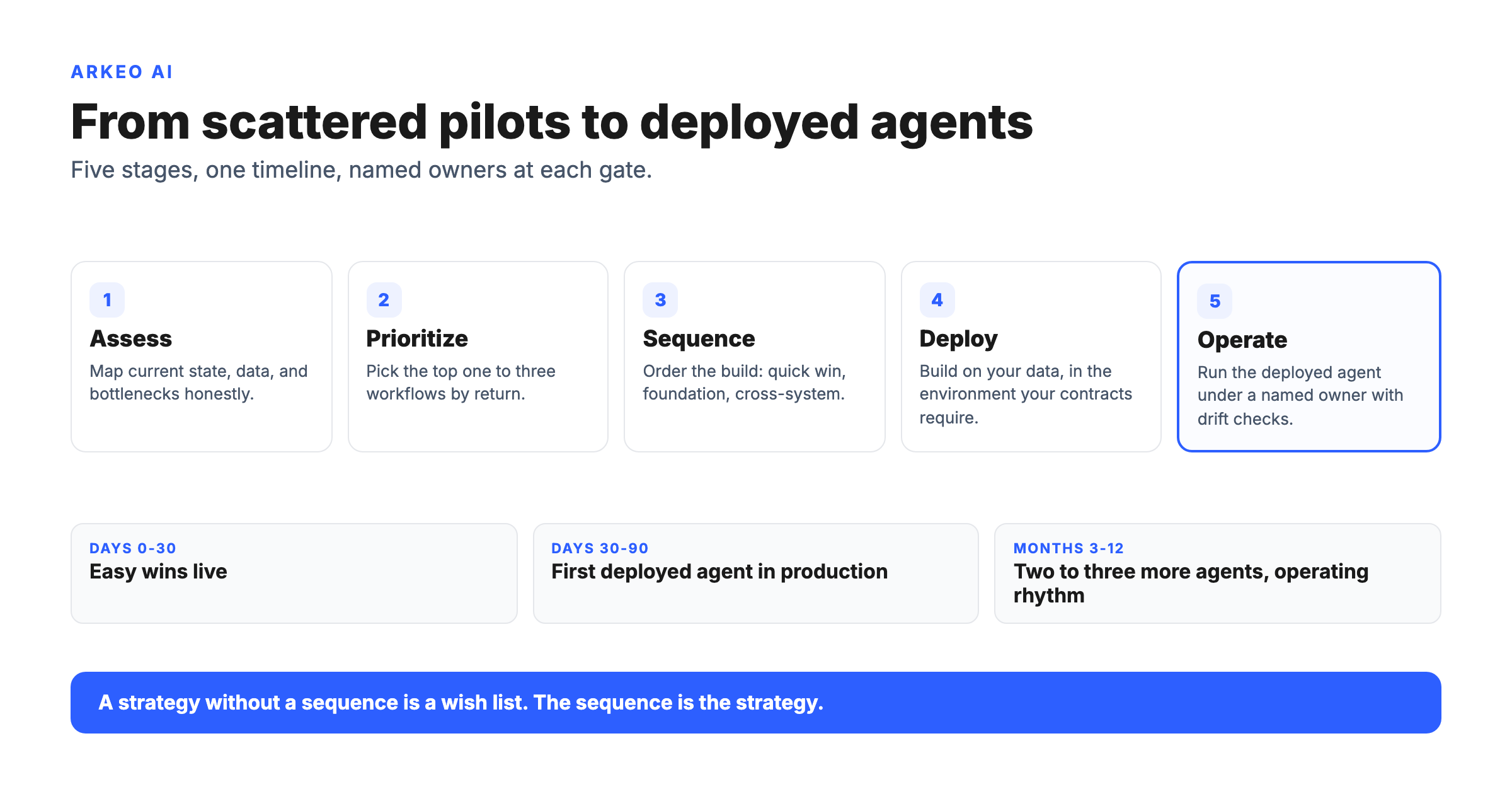
Days 1 to 30: assess — current-state map, data-path decision, workflow brief, baseline measured, kill criteria documented. Days 31 to 60: build — agent built on approved data, tested against the baseline, failure modes documented. Days 61 to 90: deploy — agent in production, operator running weekly reviews, override rate tracked. One kill rule: if the baseline is not beaten on real documents by day 60, the build halts. An initiative that runs kill criteria and halts cleanly at day 60 costs $15,000 to $40,000 and produces a clear diagnostic. One without kill criteria runs until a senior leader writes it off — usually at month 14, at four to six times the cost.
→ Deep dive: AI Implementation 90-Day Plan: One Workflow in Production by Day 90
AI implementation challenges — what breaks and why
The most common AI implementation challenges are not technology failures. They are organizational ones: data in a system IT has not approved, an owner who left in month two and was never replaced, kill criteria too vague to enforce. "The agent should perform well" is not a kill criterion. A specific number by a specific date is.
The second category is sequencing errors — cross-system agents built before single-workflow agents were stable, integration layers that required IT coordination not on the build timeline. Each is solved at the strategy stage, not worked around at the build stage. The third category is drift: models update, data schemas change, upstream workflows get modified without flagging the dependency. Without a weekly review by a named operator, a deployed agent becomes a liability within six to twelve months.
→ Deep dive: AI Implementation Challenges: What Breaks and How to Prevent It
Map the sequence before the first dollar moves
The free AI Assessment produces the 30/90/12-month sequence, the first named workflow, and the data-path decision before anything is built. One working session. No deck.
AI strategy consultant vs. in-house — how to decide
The wrong question at month two of an AI initiative is: should we hire an internal AI lead or bring in a consultant? The right question is: what specific decision are we stuck on, and does the person who unblocks it need to be on payroll? Most programs in year one are not stuck because they lack a full-time hire. They are stuck because a specific decision — data path, workflow prioritization, vendor selection — has not been made by the right person with the right authority.
When to Use a Consultant vs. When to Build In-House
Use a consultant when:
The data path is open but nobody internal has built on it • The workflow shortlist is a committee with no clear owner • The board needs an outside voice to greenlight the budget • Vendor selection has stalled for lack of technical depth to evaluate it
Build in-house when:
The first workflow is in production and needs a full-time operator accountable for drift and scale • One senior leader has 20 hours per week available for 12 months • The data systems already talk to each other
→ Deep dive: AI Strategy Consultant vs. Internal: A Decision Guide for Operators
Sequencing AI implementation — why order determines outcome
The order in which AI workflows are built and deployed is not a project management question. It is a strategy question. The wrong sequence — cross-system agent before single-workflow agent, ambitious integration before stable foundation — compounds failure. The right sequence builds on stable foundations and earns political room at each stage for the next build.
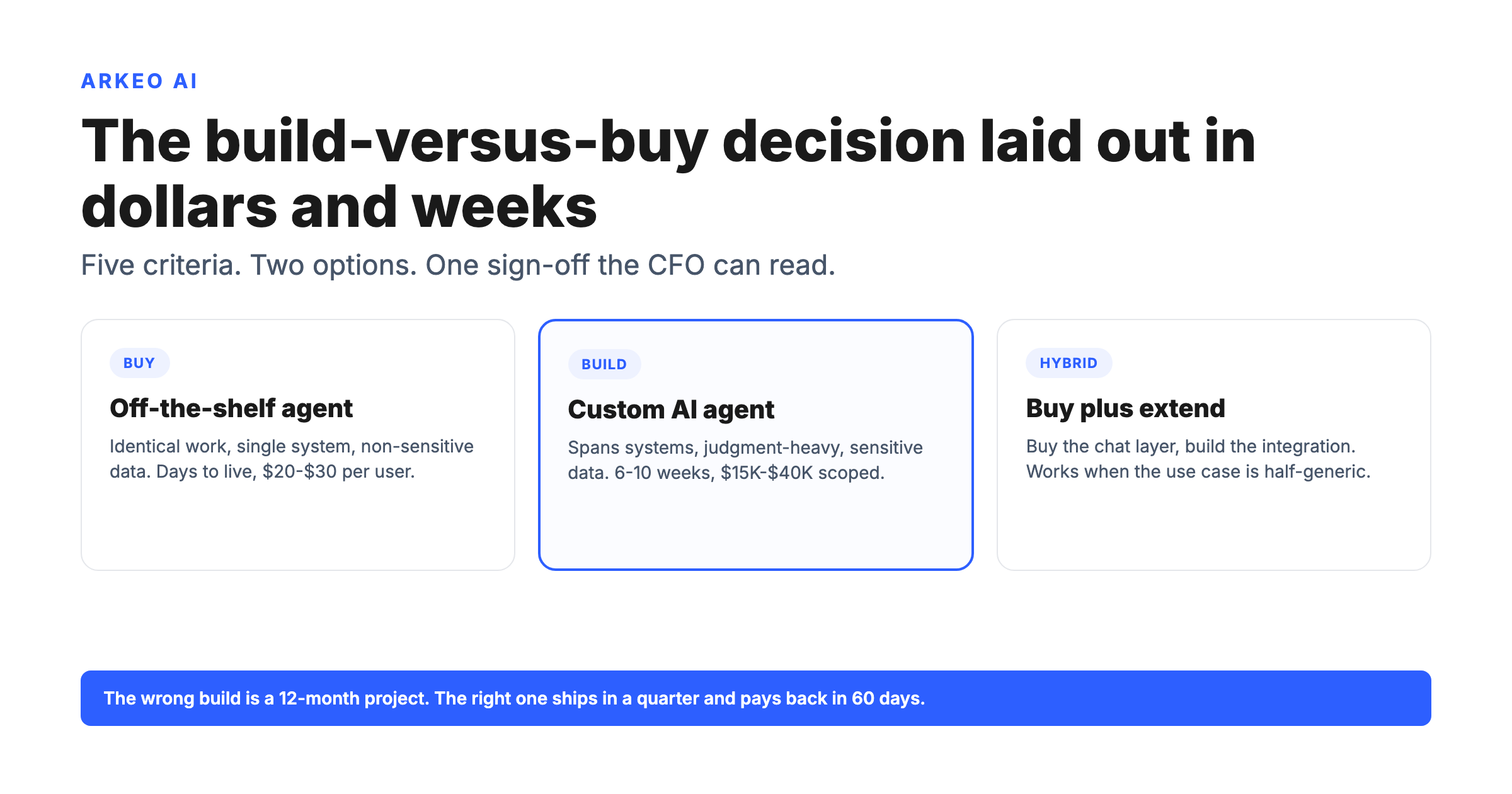
The sequence that consistently produces results: off-the-shelf copilots in the first 30 days to generate early wins and test change management assumptions. Then the first custom agent on the top-scoring workflow. Only after that is stable and monitored does the program add the second workflow, reusing the data path and monitoring infrastructure the first build established. Cross-system orchestration belongs in year two — or late year one for organizations that have already shipped two stable single-workflow agents.
→ Deep dive: Sequencing AI Implementation: Why Order Determines Whether Your Program Ships
How Arkeo runs enterprise AI strategy under Assess, Deploy, Manage
The Arkeo Model
Assess
A 60-minute working session that surfaces the highest-ROI workflow already in your operation, makes the data-path decision, and names the owner — all before any build begins. The output is a one-page brief the build team can act on without a follow-up meeting. This is the free AI Assessment.
Deploy
Private AI workforce on your infrastructure. Data never leaves the building. $15,000 to $40,000 and 6 to 10 weeks on a cloud path; 8 to 12 weeks on a private path. Arkeo runs its own operations on the same private agents it deploys for clients.
Manage
Monitoring, drift detection, exception review, rebuild when the underlying workflow changes. The stage most vendors omit. The PwC AI Agent Survey (May 2025) found 66% of AI agent adopters reporting measurable productivity gains — that result only shows up when Manage is owned, not assumed.
Frequently Asked Questions
Start with the sequence, not the tool
The free AI Assessment gives you the 30/90/12-month sequence, the first named workflow, and the data-residency answer — all before you spend anything. One working session, one page, ready to act on.