Category
AI Strategy for Business: The Three-Part Plan After the Assessment
Last updated: June 2026
By David Brennan · Arkeo AI · Building and Deploying Custom AI agents since 2023
The wrong place to start an AI strategy for your business is with a vendor shortlist.
The right place is the current-state map: the inventory of every workflow in your operation that a repetitive-task AI agent could replace or substantially accelerate. The vendor shortlist follows from the map. The map does not follow from the vendors.
This is the plan after the assessment. If you have done the diagnostic work — or if you are ready to do it now — here is the three-part AI strategy that takes a business from scattered interest to a deployed workflow in production.
Quick Answer
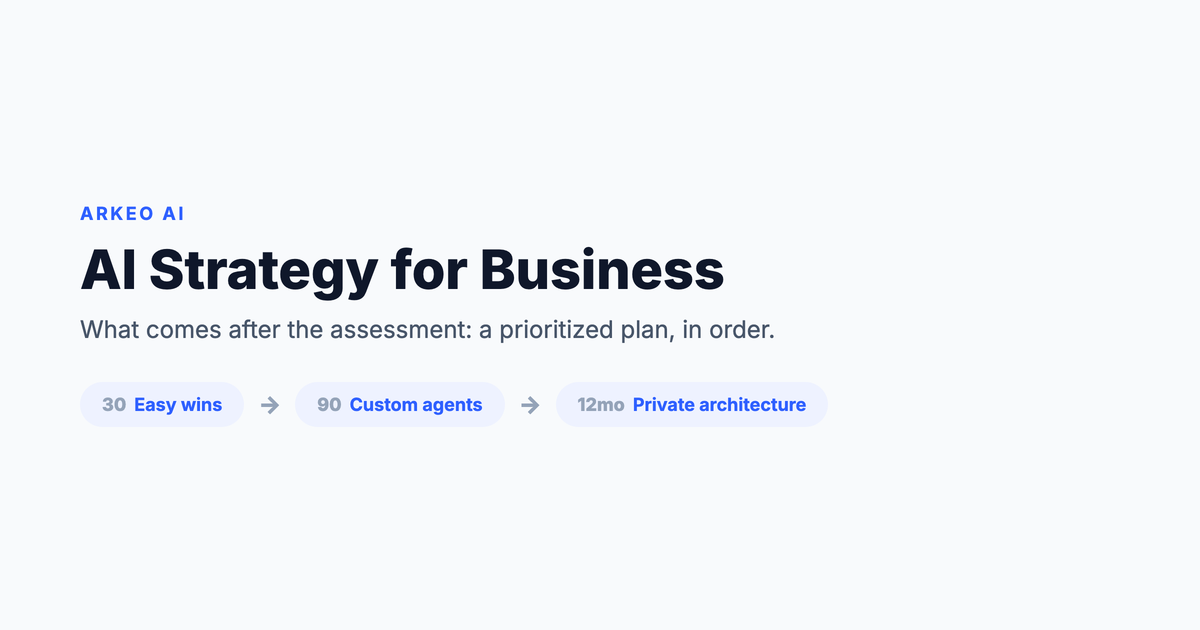
The three-part plan: Map your workflows (which tasks are candidates). Make the data-path decision (cloud or private, in writing, before the build). Ship the first agent (one workflow, one owner, in production in 90 days).
What comes after: The pattern from the first deployment — data path, security review, monitoring setup — gets reused on the second and third workflows. That is when the compounding starts.
Next step: The free AI Assessment runs part one in a single working session and delivers the workflow shortlist and data-path brief your build team needs to start.
The free AI Assessment produces the current-state map, the workflow shortlist, and the data-path decision in one working session. Your build team can start the pilot the following week.
Book Your Free AI Assessment →Why most AI strategies for business produce pilots instead of production
The failure mode is sequence. Most businesses begin with a vendor evaluation, select a platform, run a pilot on synthetic data, and then discover that the data path their security team will approve does not match the one the vendor assumed. Two quarters of work, restarted.
The correct sequence is reversed: map the workflows, make the data-path decision, then select the vendor that fits both. The vendor selection is the last strategic decision, not the first. BCG found 74 percent of companies struggling to capture AI value. The Deloitte State of Generative AI study found more than two-thirds of organizations expecting fewer than 30 percent of their AI experiments to scale. The pattern is not bad vendors. It is the wrong starting point.
The enterprise AI strategy article covers the full methodology behind the sequence. The AI strategy framework is the five-component structure that drives it. This article is the three-part plan for an operator who has done the diagnostic or is ready to do it now.
Part 1: Map your workflows
The current-state map identifies every workflow in your operation that a repetitive-task AI agent could handle: contract review, invoice processing, brief generation, data extraction, customer query classification, proposal drafting, compliance document summarization. The list is longer than most operators expect and shorter than most AI vendors claim.
Score each candidate against three criteria. Volume: how many times does this task occur per week? Pain: what does the manual version cost in time, headcount, or error rate? Data-readiness: is the data in a format and location the business can actually approve for AI access under the data-path decision you will make in part two?
Most current-state maps produce ten to fifteen candidates before scoring. After scoring, three to five candidates survive all three criteria. The top candidate on that scored list is the workflow you build first. The second and third are backups for the kill-criteria scenario. The scoring methodology is in the AI readiness guide.
A common mistake in the mapping exercise is to score against volume and pain without scoring against data-readiness. A high-volume, high-pain workflow that requires data the security team will not approve for a cloud model is not a pilot candidate in year one. It is a negotiation that belongs in year two after the data governance framework is in place.
The operator test: Can you name the top three workflow candidates right now, with the volume, pain, and data-readiness score of each? If the answer is a category (sales, operations, customer service) rather than a specific workflow, part one is not done.
Part 2: Make the data-path decision
The data-path decision is binary and it must be made in writing, signed off by legal or security, before the build starts. Cloud means the data leaves the building and is processed under a vendor's terms and data-handling agreements. Private means the model runs on the organization's own infrastructure and the data never leaves.
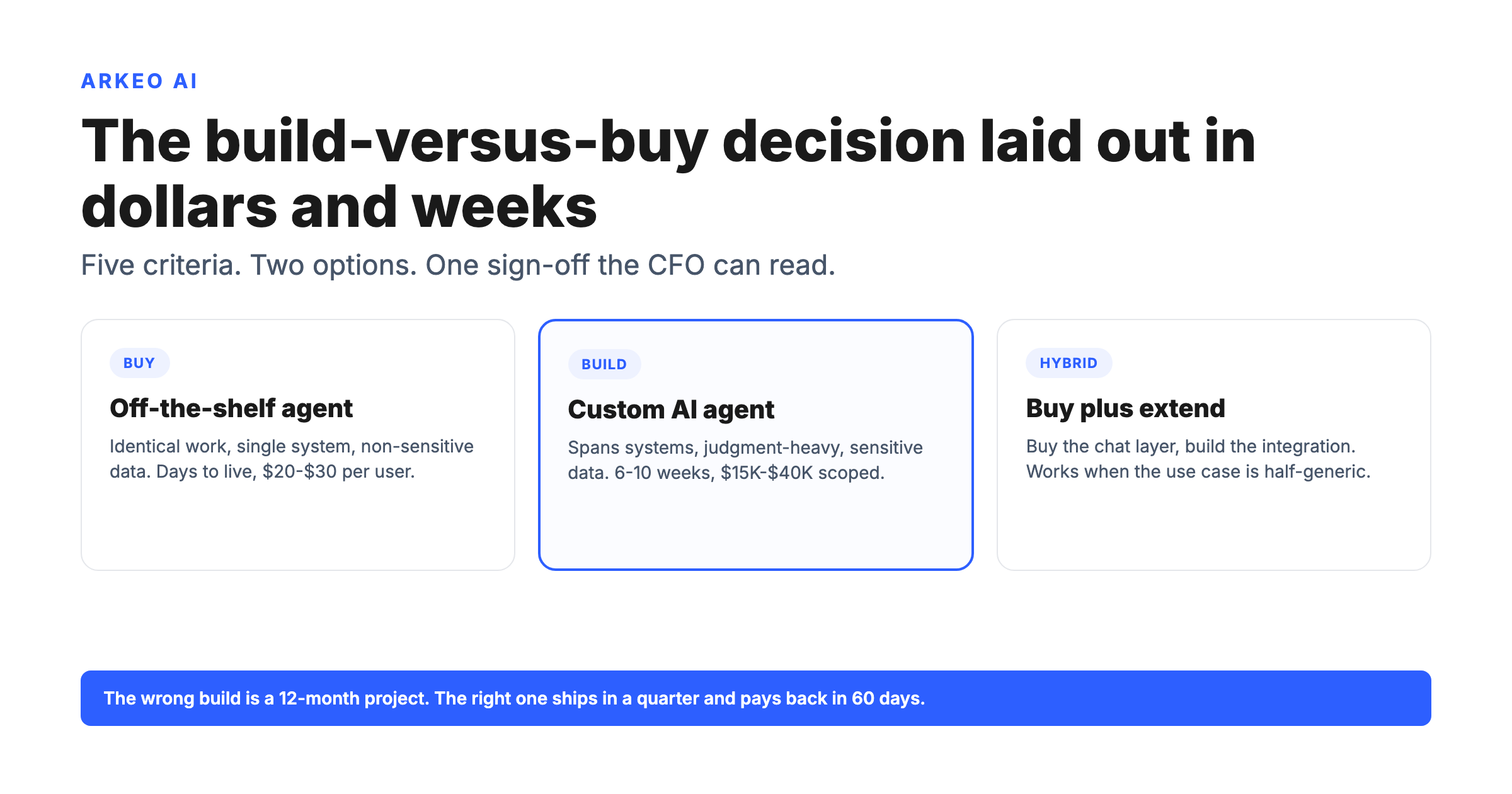
In Arkeo's build experience, a scoped single-workflow agent runs $15,000 to $40,000 and reaches production in six to ten weeks on a cloud path, or eight to twelve weeks on a private path. That two-to-four-week difference on the private path is the overhead of configuring private infrastructure. For most businesses in regulated industries, it is a trade-off they make once and reuse for every subsequent workflow. For unregulated businesses with no data sensitivity constraints, the cloud path is often the right call in year one.
The IBM Cost of a Data Breach 2025 report found 97 percent of AI-model breaches involved organizations lacking proper AI access controls. The data-path decision is not a compliance detail. It is the decision that determines the legal exposure of every AI workflow the business deploys. Made at the strategy table, it costs a meeting. Made at the vendor security review after 90 days of build work, it costs a full quarter and a re-platform.
Arkeo deploys its own operation on the same private agents it builds for clients. The decision is documented and the trade-off is real. We do not recommend one path over the other without knowing the specific data environment. What we do insist on is that the decision is made before the build starts.
Part 3: Ship the first agent
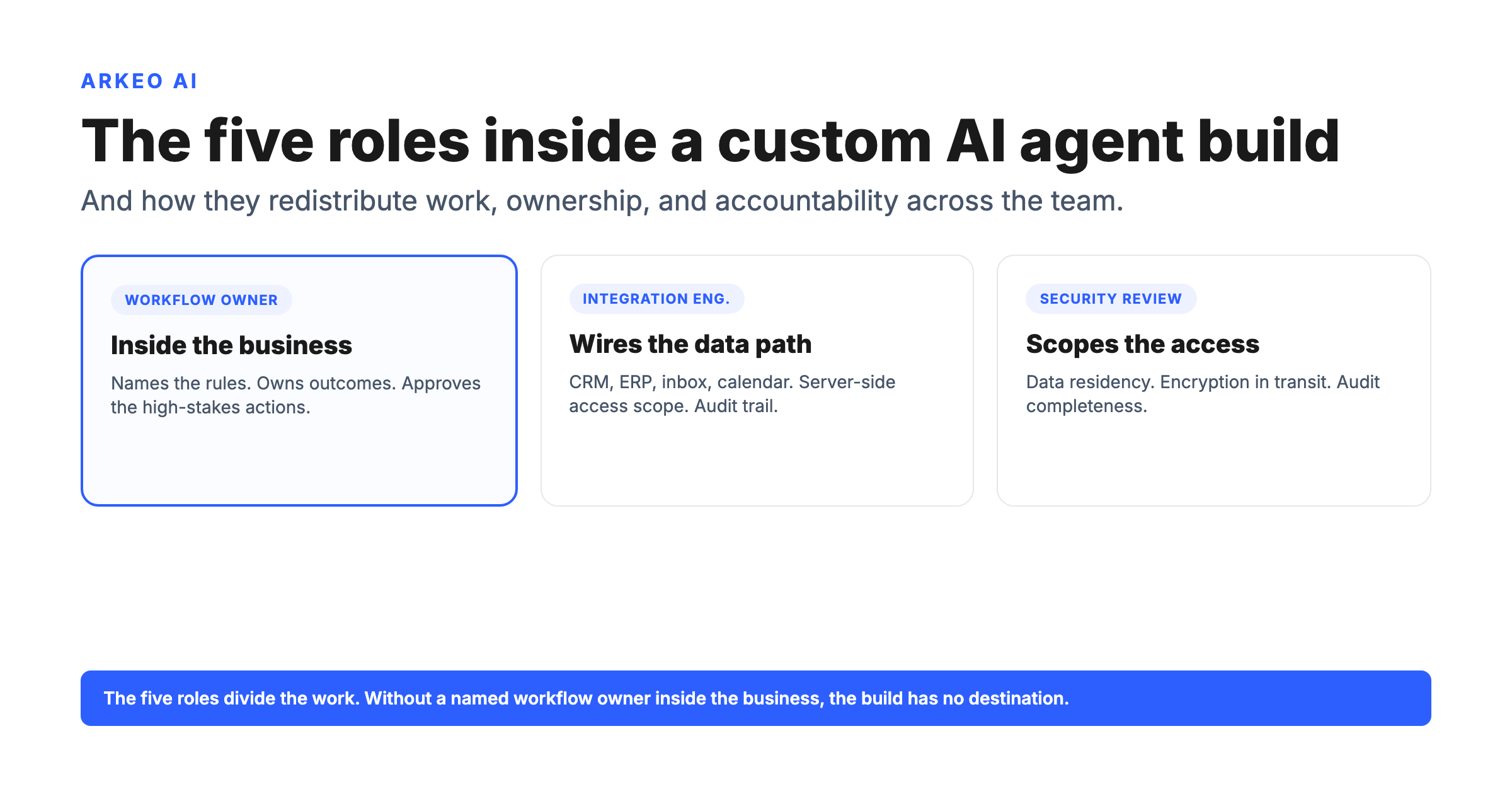
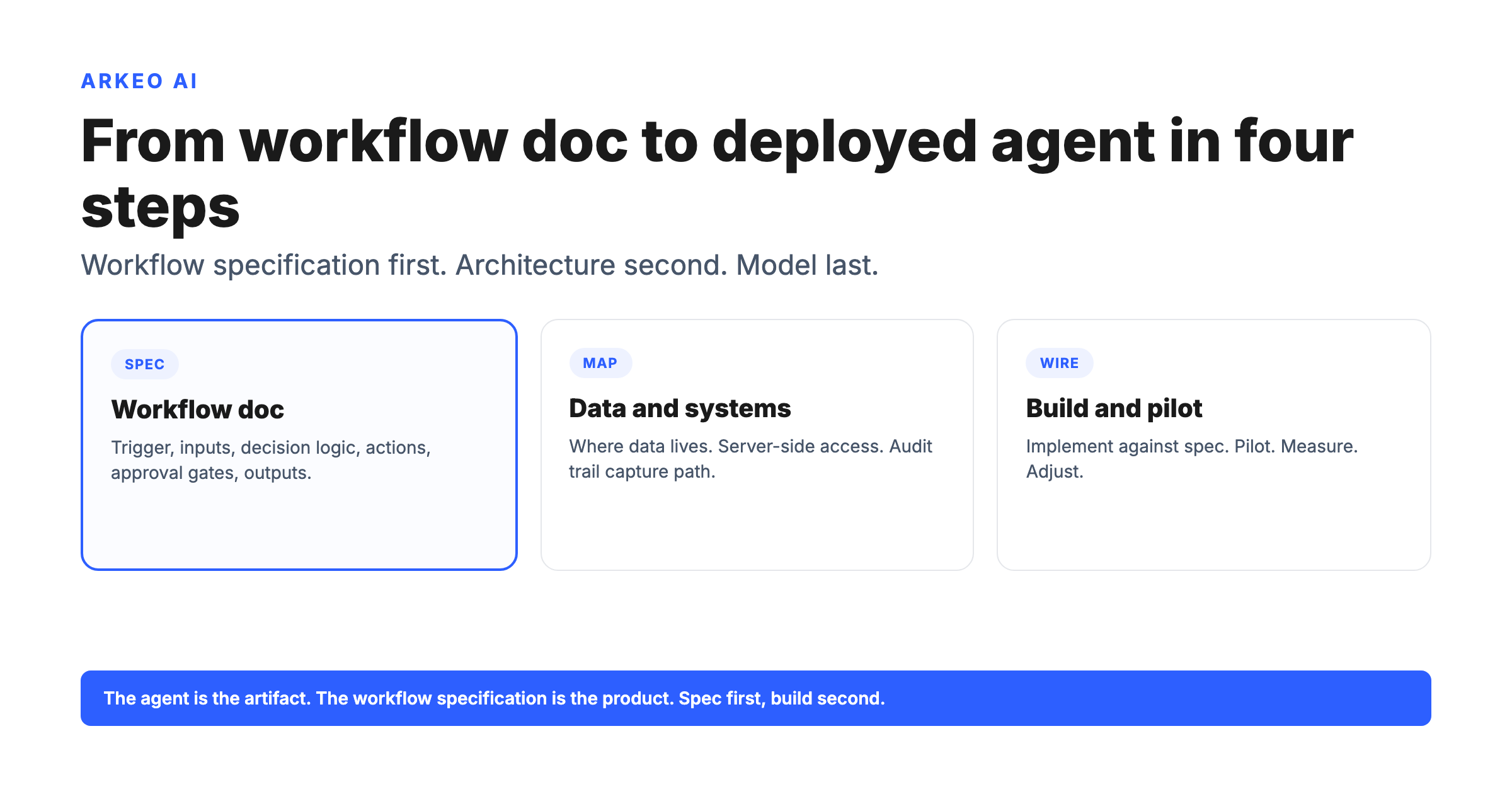
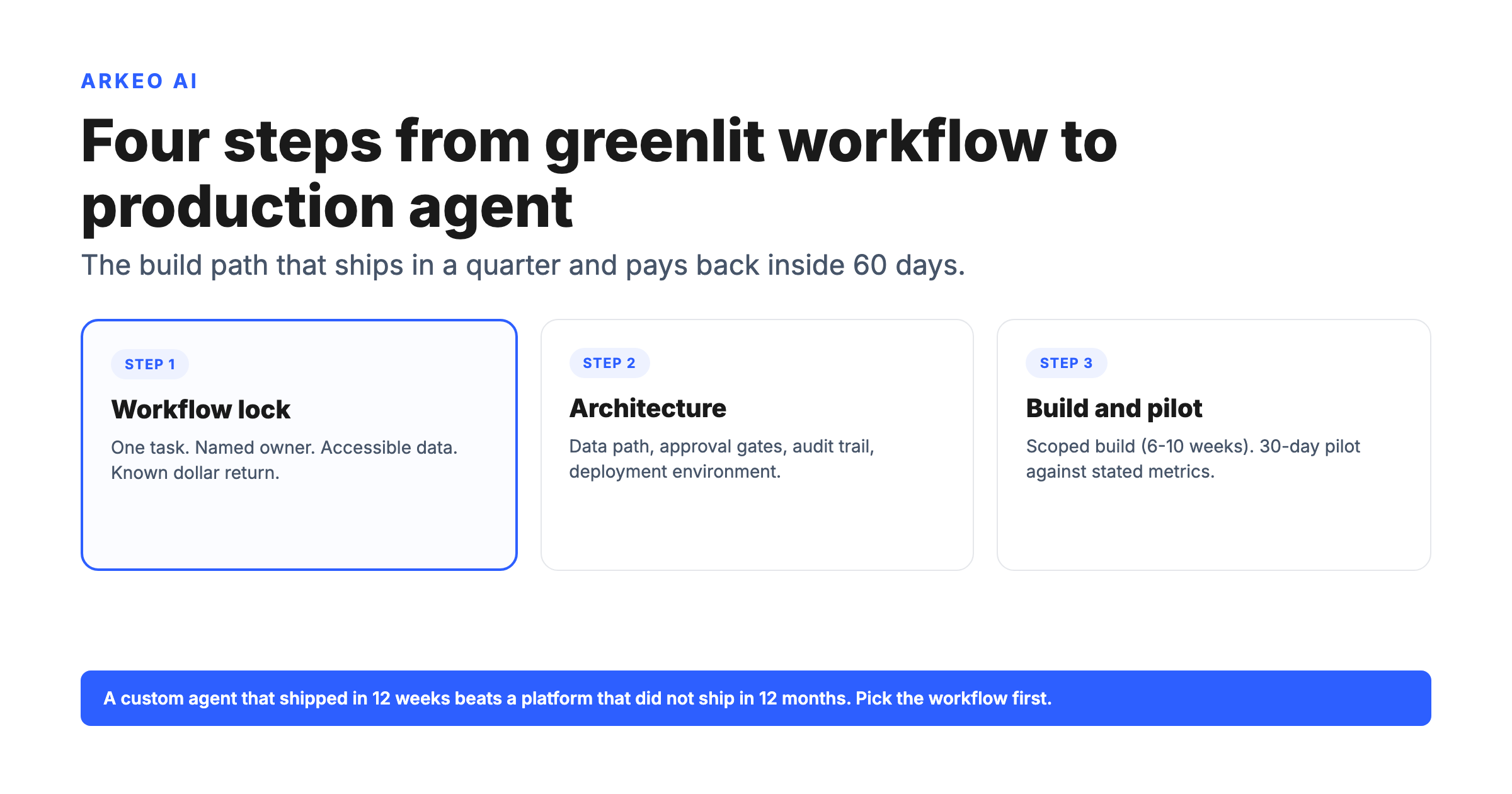
The first agent is built against the top workflow candidate from part one, on the data path decided in part two, with a named owner from the registry documented before the build starts. The build phase runs 30 days. The baseline comparison runs against real documents, not synthetic data. The kill criteria are documented before day 31. The deployment phase is 30 more days, ending with the workflow in production, the operator running weekly reviews, and the override rate monitored.
That is a 90-day cycle from the end of part two to a workflow in production. The PwC AI Agent Survey found 66 percent of agent adopters reporting measurable productivity gains. The operators in that 66 percent share one trait: someone ran the 90-day cycle with kill criteria and a named owner rather than letting the pilot run indefinitely.
The detailed mechanics of the 90-day cycle are in the 90-day implementation plan guide. The 12-month calendar that places the first deployment in Q1 and scales to three workflows by Q4 is in the 12-month roadmap guide.
The operator test: For part three — is the build team starting from a workflow brief (workflow named, owner named, data path approved in writing) or from a verbal agreement in a meeting? If the brief does not exist in writing, part two is not done.
What comes after the first deployment
Day 91 is the start of the compounding. The first deployment established the data path, the security review, the monitoring setup, and the operating rhythm. The second and third workflows reuse all of it. Each subsequent workflow ships faster than the first. At day 365, a business that ran the three-part plan has three workflows in production, a named owner running a documented operating rhythm, and a board metric that has moved.
That is the plan after the assessment. The assessment is part one. If you have not done it yet, it is the next step.
The free AI Assessment runs the current-state map, produces the workflow shortlist, and resolves the data-path question. Your build team can start the pilot the following week.
Book Your Free AI Assessment →Frequently Asked Questions
The free AI Assessment runs the current-state map, produces the workflow shortlist, and closes the data-path decision. Your build team starts the pilot from a one-page brief, not a meeting.
Book Your Free AI Assessment →