Category
12-Month AI Roadmap: Four Quarters, Four Gate Questions
By David Brennan · Arkeo AI · Building and Deploying Custom AI agents since 2023
The wrong document to bring into a board AI review is a seven-swim-lane Gantt chart.
The right document is four quarters, one gate question each, and one board metric per quarter that proves the quarter shipped. That is a 12-month AI roadmap. Generic timelines do not survive the first finance question. Sequenced decisions do.
Here is the roadmap operators actually execute — and the gate questions that decide whether you advance or halt and fix.
Quick Answer
What it is: A 12-month AI roadmap is four sequenced quarters — Assess, Pilot, Deploy, Scale — with one gate question and one board metric per quarter.
Budget shape: $50K to $200K in year one for an operation that finishes all four quarters, weighted toward Q2 build and Q4 expansion.
Why it matters: A roadmap that does not ship a gate question every quarter becomes a wish list. The board needs decisions, not meeting calendars.
Next step: The free AI Assessment populates Q1 with a real diagnostic, shortlisted workflow, and gate questions for Q2 through Q4.
The free AI Assessment populates Q1 with a real current-state diagnostic, a shortlisted workflow, and the gate questions for Q2 through Q4, ready to put on the board document.
Book Your Free AI Assessment →Why generic Gantt charts fail as AI roadmaps
A Gantt chart is a calendar of tasks. An AI roadmap is a calendar of decisions. The Gantt promises that work will happen on certain dates. The roadmap promises that, by the end of each quarter, one specific question will be answered in writing and one board metric will move.
That distinction matters because the pressure on operators is not to ship activities. It is to ship decisions. The PwC AI Agent Survey of 300 senior US executives found 88 percent raising AI budgets in the next twelve months. Boards know the money is moving. What they want from the operator is not a project tracker. It is a sequenced set of decisions with evidence.
The cluster on enterprise AI strategy covers the methodology behind the roadmap. The 90-day AI implementation plan walks the first quarter at day-level resolution. The sequencing guide covers which workflow goes first. This article is the twelve-month calendar that wraps all of them.
The operator test: Before your next board presentation, can you say which question will be answered in writing at the end of each quarter, and what the board metric is that proves it? If the answer is a Gantt chart with tasks, you have not built a roadmap yet.
The four quarters of a 12-month AI roadmap
Each quarter has a deliverable, a gate question, and a single board metric. Skip the gate and the next quarter inherits the problem the budget cannot solve.
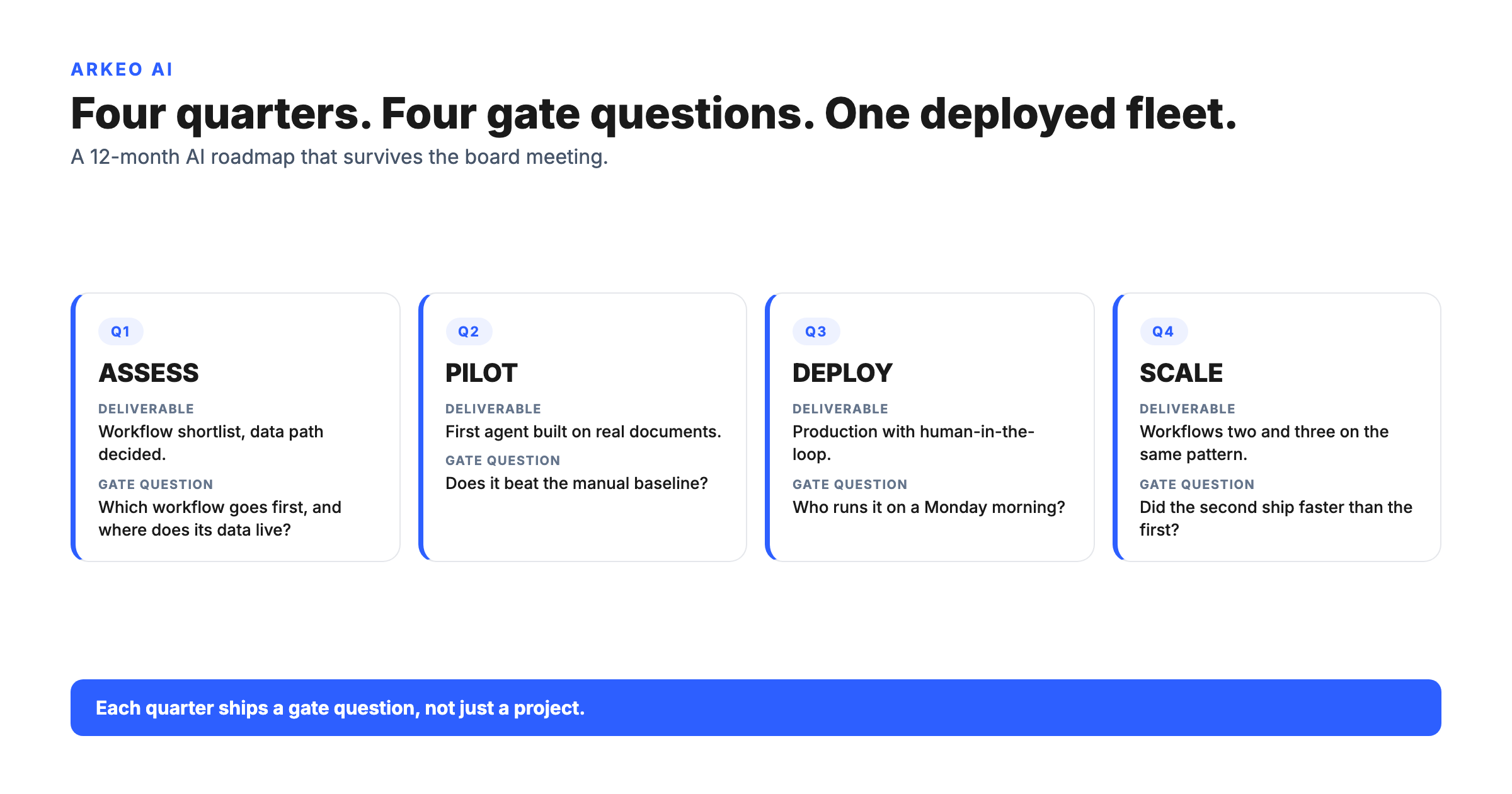
THE ROADMAP
Four quarters, four gate questions
Each quarter ships a deliverable, a gate question, and a board metric. Skip the gate and the next quarter inherits a problem the budget cannot fix.
Q1
ASSESS
Current-state diagnostic. Shortlist of three to five candidate workflows. Data sovereignty decision signed off by legal and security.
Gate question: Which one workflow do we take to pilot, and where does its data live?
Board metric: Workflow chosen, named owner, data path approved in writing.
Q2
PILOT
First agent built in a controlled environment against a real document set. Integration plan drafted.
Gate question: Does the agent beat the manual baseline on the two metrics that matter, on real data?
Board metric: Measured time or error delta versus the baseline, plus a go or no-go decision.
Q3
DEPLOY
Agent in production with human-in-the-loop review. Named operator. Monitoring live against gate metrics.
Gate question: Who runs this on a Monday morning when it drifts, and what is the escalation path?
Board metric: Volume of work executed by the agent and human override rate.
Q4
SCALE
Workflows two and three on the same pattern, same data path, same governance. Security review reused not repeated.
Gate question: Did the second and third workflows ship faster than the first, because the pattern held?
Board metric: Number of workflows in production and average time-to-deploy per workflow.
Each quarter ships a gate question, not just a project.
The Q1 work is the most under-budgeted and the most consequential. The deliverable is not a slide deck. It is a one-page inventory of candidate workflows, a documented shortlist of three, and a data sovereignty decision. That decision drives every contract, security review, and architecture choice in Q2 and Q3. Made up front, it costs a quarter. Made at week 30, it costs a year.
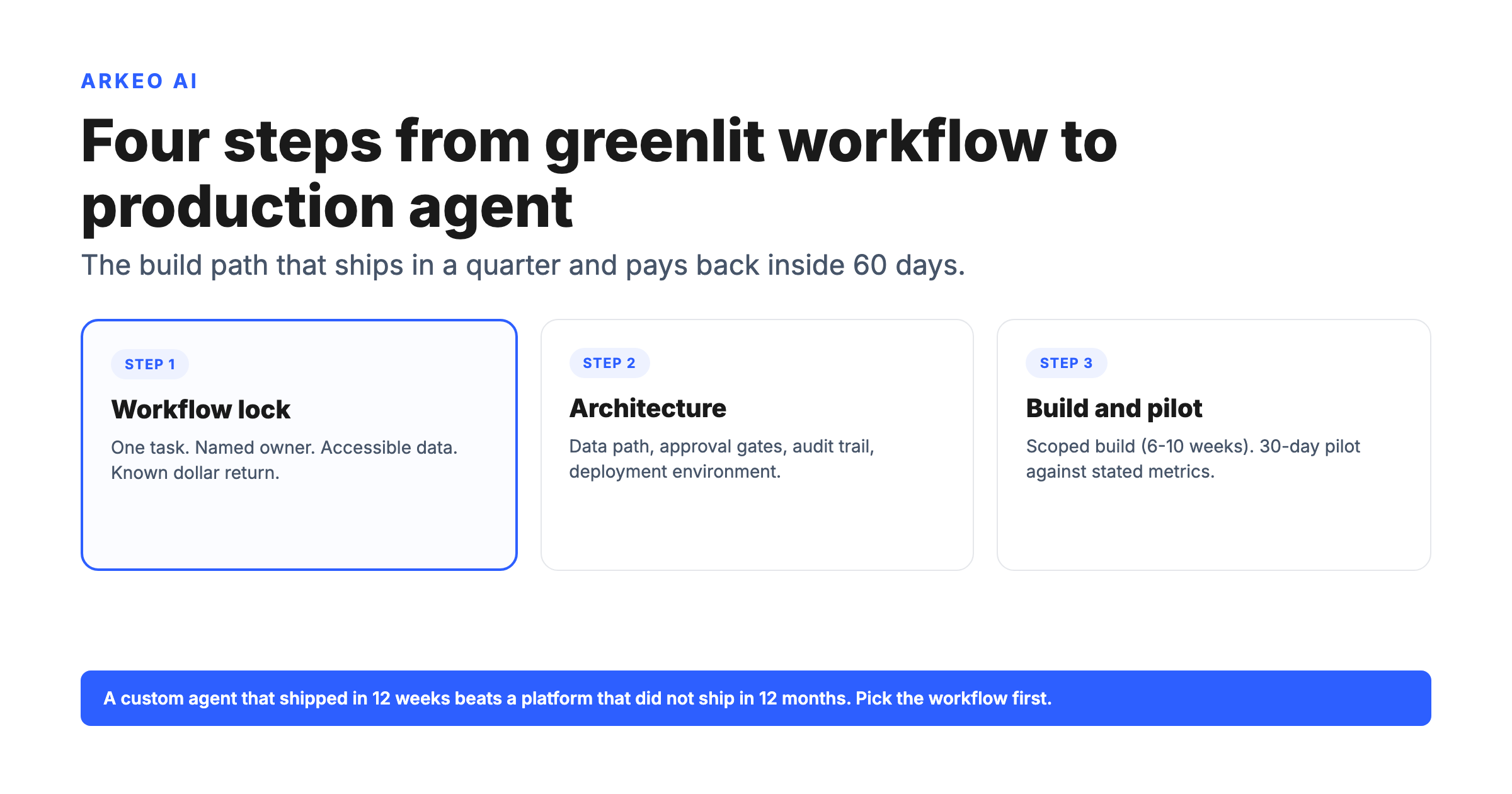
In Arkeo's build experience, a scoped single-workflow agent runs $15,000 to $40,000 and reaches production in six to ten weeks, or eight to twelve weeks when the deployment is private. The Q2 pilot is built against real documents, not synthetic data. The PwC AI Agent Survey found 66 percent of agent adopters reporting measurable productivity gains. That gain is conditional on the Q1 gate being answered honestly.
The operator test: For each quarter in your current AI roadmap, can you state the single gate question that determines whether the quarter ships? If the answer is a list of milestones rather than one binary decision, your roadmap is a Gantt chart.
What halts progression from one quarter to the next
The roadmap is gated by evidence, not by calendar. A quarter does not graduate because the date arrived. It graduates because the gate question has a written answer the board can read and the operating team can act on.
Q1 does not graduate to Q2 if the data sovereignty decision is still open. Wiring a pilot to a public model while the contract review is in flight buys a security re-platform later and loses a full quarter. The Deloitte State of Generative AI study found two-thirds of enterprises expect 30 percent or fewer of their AI experiments to scale. The most common quiet reason is a Q1 gate waved through to keep the calendar moving.
Q2 does not graduate to Q3 if the pilot did not beat the manual baseline on real data. The honest move is to halt the pilot under the kill criteria, return to the shortlist, and pick the second-best candidate. Sunk cost is not a reason to deploy a workflow that did not clear the gate. It is the reason most pilots stall before they reach production.
Q3 does not graduate to Q4 if there is no named operator on a Monday morning. A workflow that goes live without an on-call rotation is a demo that has been left running. The IBM CEO Study found 54 percent of CEOs already hiring for AI roles that did not exist a year ago. The operator is part of that workforce, named before go-live, not after.
Budget shape across the 12 months
The budget shape across four quarters is not flat. Q1 is the smallest line and the highest leverage. Q2 carries the build cost. Q3 is operations and integration. Q4 funds two more workflows on the same pattern. Misreading the shape — front-loading Q1 with $200K of strategy work, or back-loading Q4 because the executive sponsor expects pricing to fall — is the single most common reason year-one totals come in at twice the credible estimate without producing more deployed workflows.
THE BUDGET SHAPE
Spend pattern across the year
Year-one totals range from $50K to $200K for an operation that finishes all four quarters.
Q1
INVEST
A scoped assessment that names workflows, data path, and owner, plus a small off-the-shelf copilot rollout.
Typical spend: Diagnostic plus $20 to $30 per user per month for a copilot pilot.
Q2
BUILD
First custom workflow agent built against real data, on the data path Q1 approved.
Typical spend: $15K to $40K per scoped workflow agent, 6 to 10 weeks (8 to 12 if private).
Q3
OPERATE
Production deployment with human-in-the-loop, monitoring, on-call rotation, plus integration work.
Typical spend: Run-rate operations cost plus integration work against the existing stack.
Q4
EXPAND
Workflows two and three on the same pattern, reusing the data path and security review.
Typical spend: Two more workflow builds at the Q2 unit cost, with reduced security and integration overhead.
$50K to $200K year one for an operation that finishes all four quarters.
The shape implies a tactical move most operators miss in Q1: keep the assessment spend honest and use the savings to fund a small copilot deployment in the same quarter. The copilot is not the destination. It gives the executive team a felt sense of the technology before the Q2 build kicks off, which dramatically improves the quality of the Q1 gate decision. Arkeo runs its own operation on the same private agents it deploys for clients. We use what we sell.
The operator test: Is Q1 in your current roadmap scoped to produce a workflow decision and a data-path decision — or is it scoped to produce a strategy deck? The former costs 10 to 20 percent of year-one budget. The latter often costs the same and produces nothing the build team can execute against.
The free AI Assessment names the one workflow worth piloting first, the data sovereignty decision behind it, and the operating model that carries it from Q2 build into Q3 production.
Book Your Free AI Assessment →Frequently Asked Questions
The free AI Assessment produces the Q1 diagnostic, the workflow shortlist, and the gate questions for Q2 through Q4. One working session.
Book Your Free AI Assessment →