Category
Sequencing Your AI Implementation Roadmap
Last updated: June 4, 2026
By David Brennan · Arkeo AI · Building and Deploying Custom AI agents since 2023
If you are the operator staring at a whiteboard with four to six AI workflows that all seem equally urgent, the sequencing problem is not which one has the highest projected ROI on a spreadsheet. The sequencing problem is which one is safe to lose. The team that picks their first build on ROI projection alone runs into the wall that every similar team runs into: the workflow with the highest projected ROI is usually the one with the deepest integration and the most sensitive data, which means the first build becomes the hardest build, which means the organization learns AI on its most unforgiving use case first. This guide gives you the four-criterion ranking rubric that Arkeo uses with every mid-market deployment, the three forced re-ordering dependencies that override any rubric score, and the one characteristic that separates the right first build from the highest-ROI build.
AI implementation sequencing works best when it is done from a completed strategy, not from a shortlist of ideas. A free AI Assessment gives you the strategy before the sequencing decision. If you want the broader execution framework, see the enterprise AI strategy pillar.
Quick Answer
• What it is: AI implementation sequencing is the discipline of deciding which workflow to build first, and in what order, based on explicit criteria and forced dependencies.
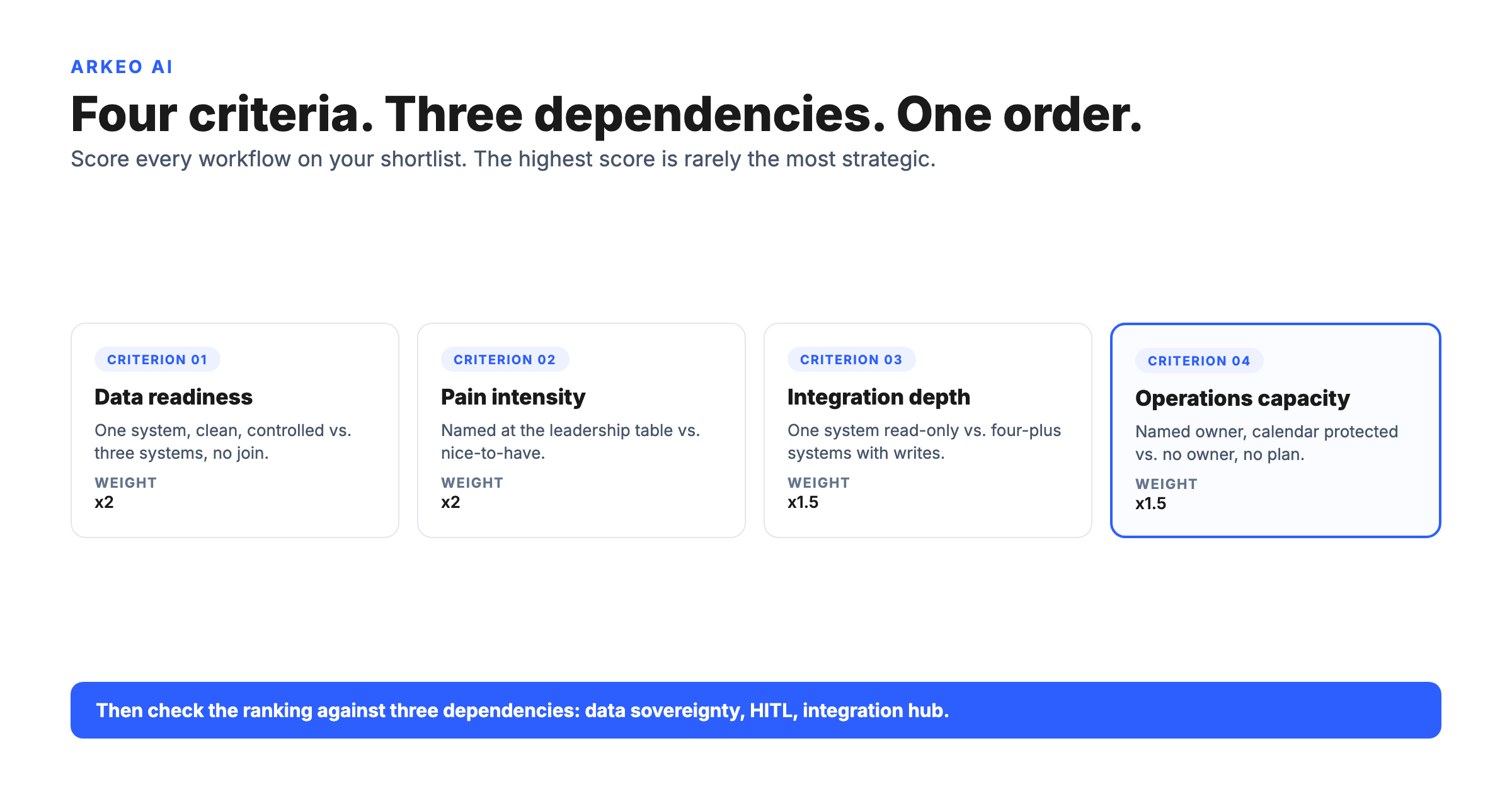
• The rubric: Data readiness (x2), pain intensity (x2), integration depth (x1.5), and operations capacity (x1.5). Score each candidate on 1-5 scale per criterion, multiply by weight, add total.
• The forced dependencies: Three conditions that override a rubric score and move a workflow later in the queue regardless of how well it ranks.
• The honest part: The highest-ROI workflow on paper almost never scores highest on this rubric. That is the point.
Why does sequencing matter, and why does ROI-first fail?
AI implementation sequencing is the discipline of deciding which workflow to build first, and in what order, based on explicit criteria rather than projected ROI, executive enthusiasm, or vendor feature availability. The problem with ROI-first sequencing is not that projected ROI is wrong. It is that the workflows with the highest projected returns are structurally the hardest ones to execute first: they touch the most systems, the most sensitive data, and require the most operational change from the teams that have the least AI experience. The BCG Where's the Value in AI report from October 2024 found 74 percent of companies struggle to capture AI value. The Deloitte State of Generative AI Wave 4 study of 2,773 C-suite respondents found more than two-thirds expect 30 percent or fewer of their generative AI experiments to scale. Sequencing by difficulty before ROI is how the remaining minority beat that rate.
What is the four-criterion ranking rubric?
The rubric scores each candidate workflow on four criteria, weights them, and produces a total. The two most important criteria are data readiness and pain intensity. The two secondary criteria are integration depth and operations capacity.
RANKING RUBRIC
Four criteria for sequencing the first AI build
Score each workflow 1–5 on each criterion. Multiply by the weight. Add the total. Higher scores go earlier in the queue.
CRITERION 01 · WEIGHT ×2
Data readiness
Is the data the agent needs clean, labeled, and accessible today, without a parallel data-cleanup project? Score 5 if yes on all three. Score 1 if the team needs to build a data pipeline before the agent can train.
Weight ×2 because no data means no agent. Everything else is secondary.
CRITERION 02 · WEIGHT ×2
Pain intensity
Does the workflow cause measurable, felt operational pain today? Score 5 if the operator who runs this workflow can name the pain in dollars or hours per week without prompting. Score 1 if the pain is theoretical or future-state.
Weight ×2 because felt pain guarantees an operator who will adopt and defend the agent.
CRITERION 03 · WEIGHT ×1.5
Integration depth
How many systems does the agent need to touch to complete the workflow? Score 5 if it reads from one system and writes to one system. Score 1 if it needs to touch six systems with different auth layers and data schemas.
Weight ×1.5 because integration depth is the primary source of scope creep in the first build.
CRITERION 04 · WEIGHT ×1.5
Operations capacity
Does the team that owns this workflow have the bandwidth to onboard an agent in the next 90 days? Score 5 if the operator has unblocked time and organizational will. Score 1 if the team is already running at or over capacity on other initiatives.
Weight ×1.5 because a workflow with no available operator is a workflow that will never reach Run.
The right first build is the workflow that ranks high on data readiness and pain, has shallow integration, has a named operator, and triggers none of the three dependencies.
The operator test: Take your current shortlist of candidate workflows. Score each one on the rubric right now. Do the two highest-rubric scorers trigger any of the three forced dependencies? If yes, they are not your first build.
What are the three forced re-ordering dependencies?
The three forced dependencies are conditions that move a workflow later in the queue regardless of how well it scores on the rubric. They are not disqualifiers. They are sequencing signals. A workflow that triggers a forced dependency does not get cancelled. It gets moved behind the builds that do not trigger one.
THREE FORCED DEPENDENCIES
Conditions that override the rubric score
Check these for every candidate before finalizing the queue. One trigger means the workflow moves behind those that do not trigger.
DEPENDENCY 01
Data sovereignty
The workflow requires an on-premise or private-cloud deployment because the data cannot leave the building under current policy or contract. Forced dependency because the infrastructure that supports a private deployment must exist before the first agent on that infrastructure can train. Pretend this does not exist and your sequencing collapses on contact with the first deployment.
DEPENDENCY 02
HITL operating model
The workflow requires a human-in-the-loop checkpoint that does not exist in the current org design. Forced dependency because the HITL checkpoint must be designed, staffed, and trained before the agent reaches Walk. Skipping this means the agent either runs without oversight (compliance risk) or gets suspended mid-deployment while the org design catches up.
DEPENDENCY 03
Integration hub
The workflow requires an integration layer (middleware, API gateway, or data broker) that must be built before the agent can connect to the systems it needs. Forced dependency because the integration hub is not an agent feature. It is a precondition. Building the agent before the hub means the first sprint is blocked by infrastructure that was not scoped.
How do the rubric and the dependencies work together on a real shortlist?
Picture a 380-person regional distribution company with five candidate workflows: automated freight bill auditing (data ready, deep integration, high pain), inbound order confirmation (data ready, shallow integration, moderate pain), supplier communication triage (data not ready, shallow integration, moderate pain), regulatory filing summary (data ready, deep integration, high pain with sovereignty trigger), and inventory exception flagging (data ready, moderate integration, high pain). Score them. Regulatory filing goes last because of the data sovereignty trigger regardless of its pain score. Supplier communication triage goes last-plus-one because data is not ready. The remaining three rank by their weighted total. Inbound order confirmation wins. It has data, it has pain, it has shallow integration, and it has a named operator with bandwidth. The team builds on their easiest case first and brings AI literacy into the org before they attempt the hardest one.
A free 60-minute AI Assessment applies this rubric to your actual workflow shortlist and delivers the sequence, the forced dependencies, and the rationale in writing, before any development starts.
Book Your Free AI Assessment →Why does the highest-ROI workflow almost never go first?
Because ROI projection and sequencing difficulty are inversely correlated at the mid-market level. The highest-ROI workflow is usually the one that requires the most integrations, the most sensitive data, and the most organizational change. It is not a bad workflow. It is a bad first workflow. The right first build creates AI literacy in the org, surfaces the real cost of deployment (not the spreadsheet cost), and trains the team on gate discipline before the stakes are high. The organization that learns AI on its easiest appropriate workflow first is ready to attempt the hardest one in quarter two. The organization that does it in the other order is usually explaining why the first agent is still in Crawl twelve months later.
The operator test: Look at the workflow your team has been calling the highest-ROI opportunity. What is its integration depth score? What is its data readiness score? If integration depth is below 3 and data readiness is below 3, you are planning to learn AI on your hardest case first.
A free 60-minute AI Assessment defines the right first build for your operation and gives you the sequencing rationale in writing, so the decision is documented before development starts.
Book Your Free AI Assessment →