Category
AI Implementation 90-Day Plan: One Workflow in Production by Day 90
Last updated: June 2026
By David Brennan · Arkeo AI · Building and Deploying Custom AI agents since 2023
The wrong question at day zero of an AI implementation is: how many use cases should we explore?
The right question is: which one workflow can we have in production by day 90, with a named operator who runs it on a Monday morning?
That framing eliminates about 80 percent of the planning work that stalls AI deployments. It replaces a platform question with an operations question. The next 90 days are not about discovering the full landscape of AI opportunity. They are about shipping one thing that works, in production, with a human on the other end of it who owns the outcome.
Here is how operators run the first 90 days without producing a pilot that never ships.
Quick Answer
What it is: A 90-day AI implementation plan is three 30-day phases — Assess, Build, and Deploy — each with a gate question that must be answered before the next phase starts.
Output at day 90: One AI workflow in production with a named operator, a documented escalation path, and a measured baseline comparison.
What it is not: A scope that covers multiple workflows, a platform decision, or a multi-year roadmap. Those belong in a different planning horizon.
Next step: The free AI Assessment populates day one through day 30 with a real current-state diagnostic, shortlisted workflow, and gate questions for days 31 through 90.
The free AI Assessment identifies the one workflow worth building first, resolves the data sovereignty question behind it, and gives you the gate questions for all three phases, ready to put in front of the team.
Book Your Free AI Assessment →Why 90 days is the right planning horizon for first AI deployments
Twelve-month AI roadmaps are the right instrument for board presentations and annual budget cycles. They are the wrong instrument for a team that has never shipped a production AI workflow.
The reason is sequencing risk. A 12-month plan assumes you know which workflows are worth building, what the data path looks like, and who will operate the output. Before you have shipped one workflow, you do not know any of those things. The plan is built on assumptions that a 90-day cycle is specifically designed to test.
The PwC AI Agent Survey of 300 senior US executives found 66 percent of agent adopters reporting measurable productivity gains. The Deloitte State of Generative AI study found two-thirds of enterprises expect 30 percent or fewer of their AI experiments to scale. The gap between those two numbers is almost entirely explained by whether the first deployment was treated as a learning exercise with a 90-day gate or as a platform investment with a 12-month runway.
The enterprise AI strategy article covers the full methodology behind workflow selection and sequencing. The 12-month AI roadmap places this 90-day plan in the longer-term context. The sequencing guide covers the decision logic for which workflow goes first. This article is the day-level operating plan for the first 90 days.
The operator test: Can you name, right now, the one workflow you would have in production by day 90, the person who would own it, and the data path it would run on? If the answer is a platform or a tool rather than a workflow, an owner, and a data path, the 90-day plan does not have a starting point yet.
The three phases of a 90-day AI implementation plan
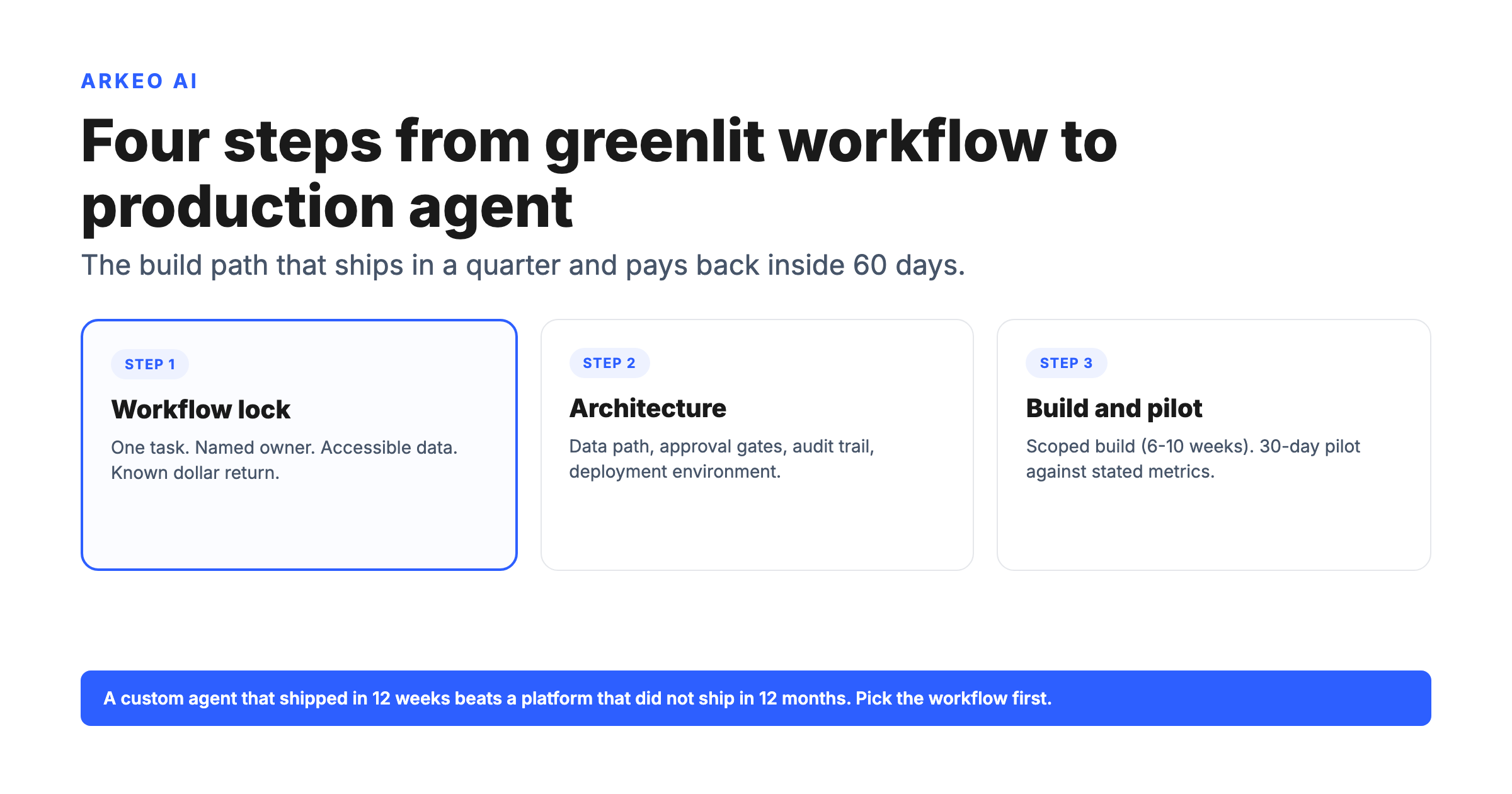
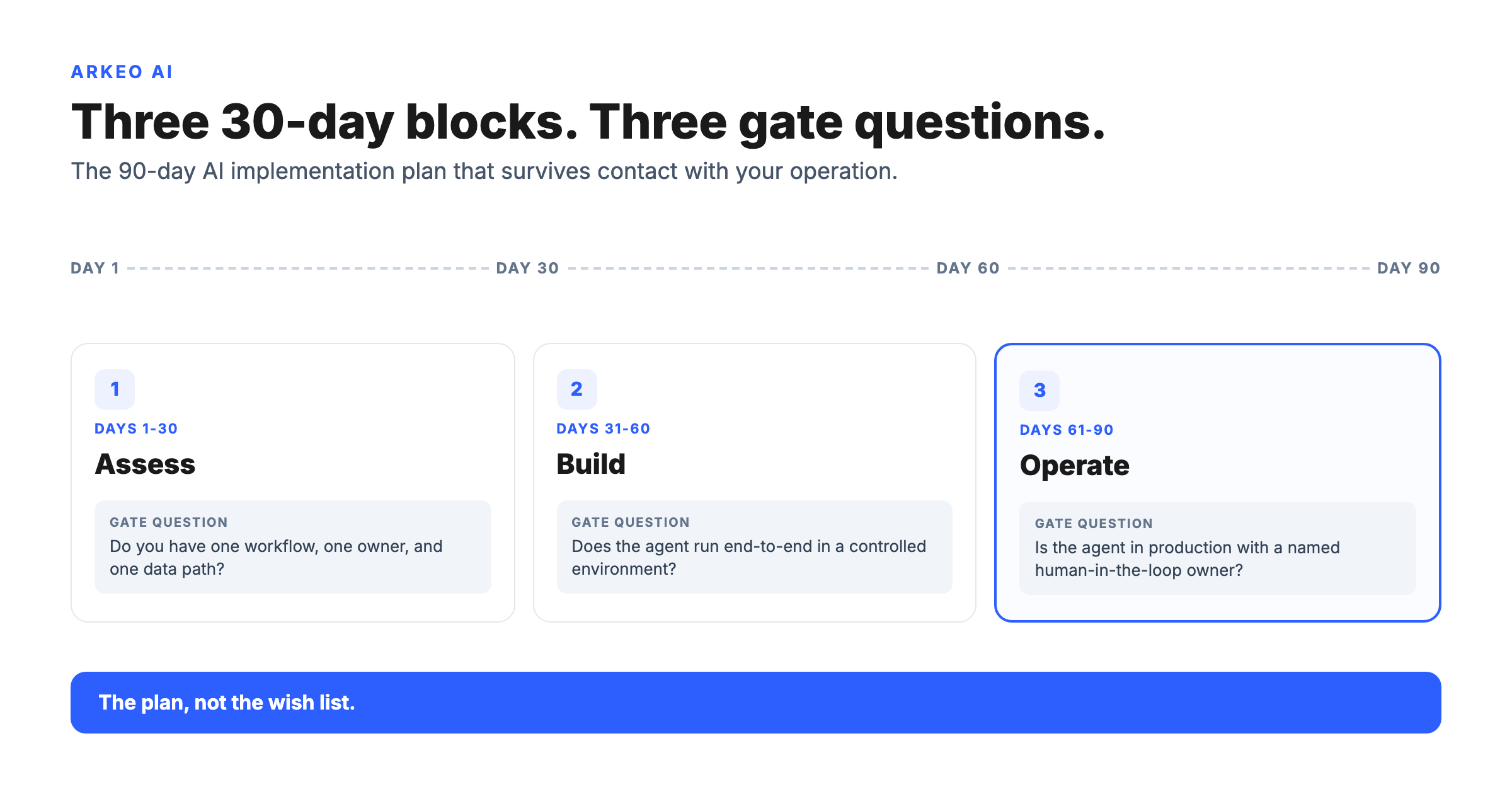
Each phase is 30 days. Each phase has one deliverable and one gate question. The gate question must be answered in writing before the next phase starts. This is not a soft rule. It is the reason the 90-day plan produces deployed workflows when 12-month plans produce pilots.
THE THREE PHASES
Days 1–30: Assess. Days 31–60: Build. Days 61–90: Deploy.
Each phase ends with a gate question answered in writing. The gate decides whether the next phase starts or the plan halts and resets.
DAYS 1–30
ASSESS
Current-state map. Candidate workflow shortlist. Data sovereignty decision signed off by legal and security. Named owner.
Gate question: Which one workflow do we build first, who owns it, and where does its data live?
Deliverable: A one-page brief with the workflow named, the owner named, and the data path approved in writing by legal or security.
DAYS 31–60
BUILD
First agent built in a controlled environment. Measured against the manual baseline. Kill criteria documented before day 31.
Gate question: Does the agent beat the manual baseline on the two metrics that matter, on real documents?
Deliverable: A scored comparison: agent time or error rate versus the baseline, on a real document set, plus a written go or no-go.
DAYS 61–90
DEPLOY
Agent in production with human-in-the-loop review. Named operator live. Monitoring on. Escalation path documented.
Gate question: Who runs this on a Monday morning when it drifts, and what is the escalation path?
Deliverable: One workflow in production, volume and override rate tracked, operator named, escalation path documented.
A gate question answered in writing at the end of each phase. Not a status update. A written decision.
Days 1 to 30: The assessment phase
The single most underinvested phase of a 90-day plan is days one through 30. Most operators want to skip it and go straight to building. That impulse produces the pilot problem. The two-thirds of AI experiments that never scale almost always share the same root cause: a workflow was chosen because it sounded interesting, not because the data path was clear and the owner was named.
The deliverable from days one through 30 is not a slide deck. It is a one-page brief with three things: the workflow named, the owner named, and the data path approved in writing by legal or security. The brief exists so the build team in days 31 through 60 has a single document to build against, not a meeting to reconstruct.
The current-state map is the instrument that produces the brief. An effective current-state map identifies every workflow that touches AI-candidate tasks — repetitive document review, classification, extraction, summarization, first-draft generation — and scores them against three criteria: volume (how many times does this happen per week), pain (how costly is the manual version), and data-readiness (can we run this on the data path the business will actually approve). That third criterion is where most shortlists get cut. A workflow that runs on data the security team will not approve for a cloud model is not a workflow candidate. It is a negotiation. Negotiations do not ship in 90 days.
In Arkeo's build experience, a scoped single-workflow agent runs $15,000 to $40,000 and reaches production in six to ten weeks on a cloud path, or eight to twelve weeks on a private path. That range is the Q2 build cost, which means the Q1 data-path decision is also a $15,000 to $40,000 decision. Made at day 15, it costs a meeting. Made at day 45, it costs a re-scope and a quarter.
The operator test: At the end of day 30, can you hand someone a one-page brief that names the workflow, the owner, and the data path? If the output of the first phase is a presentation rather than a brief, the build team does not have what it needs to start day 31.
Days 31 to 60: The build phase
The build phase has two jobs: ship the agent against real data, and be honest about whether it beats the baseline.
The most common failure in the build phase is the synthetic data problem. An agent that performs beautifully on curated test documents and then drifts on the first real-world document set is not ready for day 61. The baseline comparison must be run against real documents, not a polished test set. The comparison must measure the two metrics that matter for the specific workflow — time to complete, error rate, or escalation rate — and the result must be written down as a go or no-go before day 61 starts.
The kill criteria belong in a written document drafted before day 31, not improvised at day 55 when the pilot is already in flight. The kill criteria answer the question: at what performance level do we halt this pilot, return to the shortlist, and pick the second candidate? Operators who skip this step find themselves at day 58 with a pilot that is below baseline and an executive sponsor who has already announced the launch internally. The kill criteria are the document that makes an honest halt possible.
Integration decisions belong in this phase too. The agent does not need to be fully integrated into the existing stack at day 60. It needs to be integrated enough that the operator in days 61 through 90 is running a real workflow, not a simulation. The difference is whether the input documents arrive through the actual channel and whether the output goes to the actual destination. Everything else is configuration that can wait for day 91 and beyond.
Days 61 to 90: The deploy phase
The deploy phase is where most operators underinvest in staffing and overinvest in technology. The agent is built. The gate question at day 60 was answered with a go. The temptation is to flip a switch and call it deployed. The switch flip is not the deployment. The named operator, the on-call rotation, and the escalation path are the deployment.
A workflow goes live on day 61 with a human-in-the-loop review configured. The operator reviews outputs at a cadence that matches the volume of the workflow — for high-volume workflows, that is a daily or intra-day check; for lower volume, a weekly review with an alert threshold on the override rate. The IBM CEO Study found 54 percent of CEOs already hiring for AI roles that did not exist a year ago. The operator is one of those roles, but in a 90-day plan, the operator is almost always someone already inside the business who gets a new accountability, not a new hire.
The monitoring instruments are simple. Volume of work executed by the agent, human override rate, and escalation count. For most workflows, these three numbers on a shared dashboard — even a simple spreadsheet — are enough for the first 90 days. Elaborate monitoring platforms belong in quarter three and four of the 12-month roadmap, after the business knows which workflows are in production and which metrics matter. Deploying a full observability stack on a 90-day plan is a way to spend the budget that should have gone to building a second workflow in Q4.
The operator test: On day 91, if you are on vacation and the agent drifts, does the person whose name is on the escalation path know exactly what to check and who to call? If the answer requires your presence to answer, the deploy phase is not done.
The free AI Assessment populates the Assess phase with the current-state diagnostic, the workflow shortlist, and the data sovereignty brief, so the build team can start day 31 on day 15.
Book Your Free AI Assessment →What to do if the 90-day plan stalls
Stalls happen at predictable points. The most common is the data sovereignty decision that does not get signed off by legal in the first two weeks. The fix is to book legal or security into the current-state map conversation, not to wait for a written briefing to travel up the approval chain. The second most common stall is the owner accountability gap: the workflow has a sponsor but not an operator. The sponsor wants it to ship. The operator is the person who will run it on a Monday morning. They are not the same person, and confusing them is how a workflow ends up stalled at day 75 with no one to escalate to.
The common AI implementation challenges article covers the seven failure patterns in detail. For the 90-day plan, the three that matter most are the data-path gap at day 15, the kill-criteria gap at day 35, and the operator-accountability gap at day 65. Catching each one before it becomes a stall is what the gate questions are designed to do.
If the gate question at the end of any phase cannot be answered with a written yes, the honest move is to halt the phase, answer the gate question, and then re-enter the next phase. This feels slow. It is not. A 30-day halt at day 30 to resolve a data-sovereignty question costs 30 days. A 30-day halt at day 75 because the same question was never resolved costs the entire deployment plus the cost of the build work that has to be refactored against a different data path.
Frequently Asked Questions
The free AI Assessment compresses the assessment phase. You walk away with the workflow named, the owner named, and the data path approved — in one working session rather than 30 days.
Book Your Free AI Assessment →