Category
AI Implementation Challenges and How to Beat Them
Last updated: June 2026
By David Brennan · Arkeo AI · Building and Deploying Custom AI agents since 2023
The BCG statistic that 74 percent of companies struggle to capture AI value is not a technology failure rate. It is a decision failure rate. The technology works. The decisions that make the technology useful in a specific operation are the ones that fail.
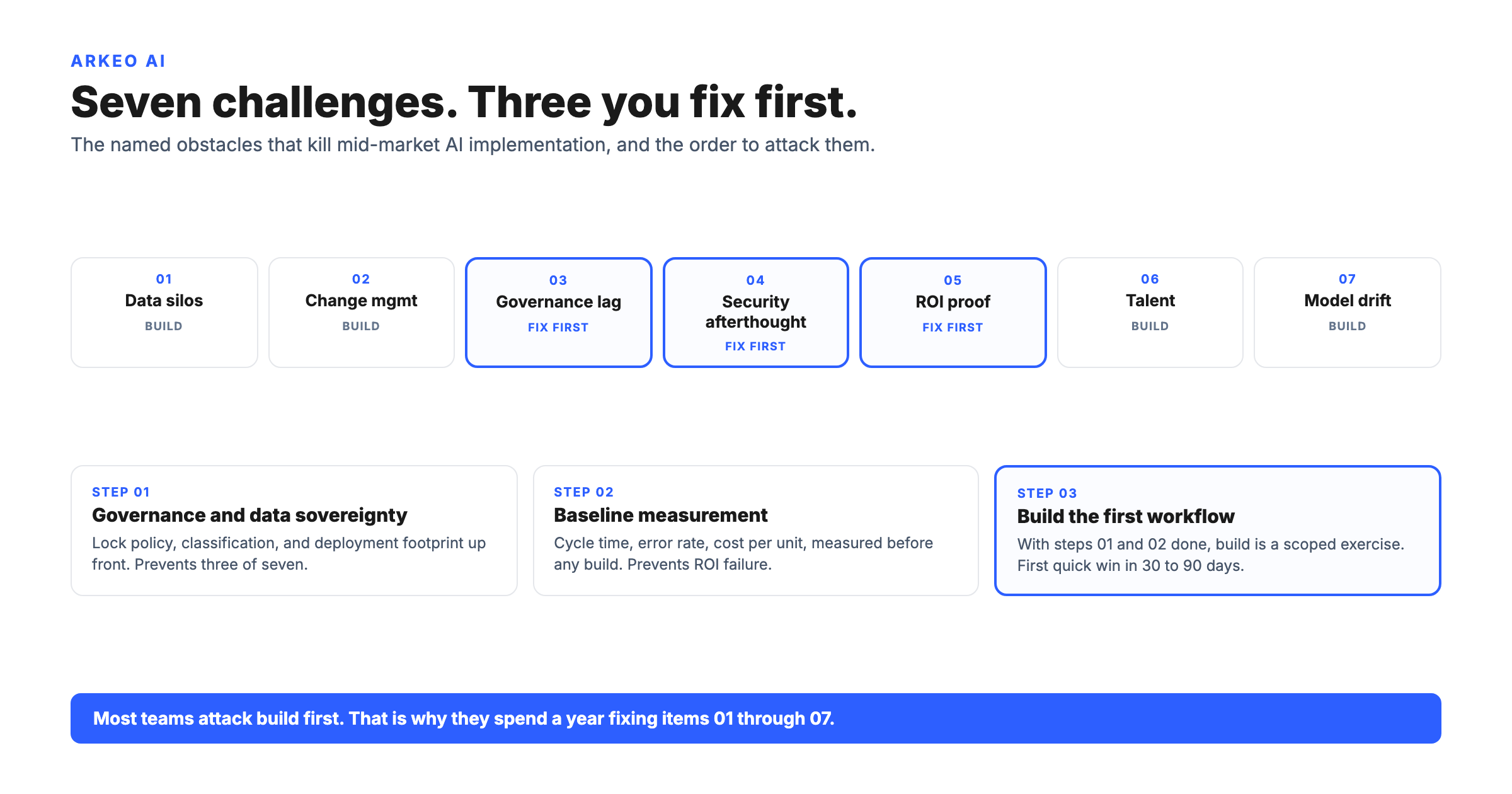
There are seven specific challenges that account for most AI implementation failures in mid-sized and enterprise operations. Each has a diagnostic question, a root cause, and a fix. The fix is not a better vendor. It is a specific written decision made at a specific point in the process.
Quick Answer
The seven challenges: Deferred data-path decision. Missing owner registry. Synthetic baseline. No kill criteria. Governance vacuum. Platform before workflow. Indefinite pilots.
What they have in common: Each is a decision that was avoided before the build started, not a technology failure that emerged during it.
Next step: The free AI Assessment runs the pre-build checklist that closes challenges one through five before the build starts.
The free AI Assessment produces the data-path decision, the owner registry, the real-data baseline, and the kill criteria in one working session. You start the build with the five structural decisions already made.
Book Your Free AI Assessment →THE 7 CHALLENGES AT A GLANCE
Challenge 1: Deferred data-path decision
The diagnostic question: is the data-path decision (cloud or private) documented in writing, signed by legal or security, before the build started?
The root cause of deferral is that the data-path decision is uncomfortable. It requires a legal or security person to make a binding statement about data handling before the build demonstrates value. That person's instinct is to defer until there is something to evaluate. The build team's instinct is to start building and resolve the data-path question "in parallel." The two instincts combine to produce a build that reaches scoping review and discovers a data-path incompatibility that requires a full platform change.
The fix: the data-path decision is a blocking prerequisite for the build brief. The brief is not complete until the data-path decision is signed. The IBM Cost of a Data Breach 2025 report found 97 percent of AI-model breaches involved organizations lacking proper AI access controls. The data-path decision is the access control decision. It is not a compliance detail appended to the build plan. It is the first line of the build plan.
Challenge 2: Missing owner registry
The diagnostic question: are the executive owner (budget and escalation authority) and the operational owner (runs the workflow on Monday morning) named in writing before the build started?
The root cause is that ownership conversations are difficult in organizations with unclear accountability structures. The build team often absorbs the ownership role by default: they built it, so they maintain it. But the build team's role ends at deployment. If no operational owner is named before the build starts, the workflow runs without governance from day one.
The fix: the owner registry is a two-line document completed before the build brief is signed. Executive owner: name and title. Operational owner: name and title. Escalation path: the operational owner contacts the executive owner within 24 hours when the override rate exceeds the documented threshold. The registry exists before the build starts or the build does not start. This is the structural rule that prevents the most common post-deployment failure: a deployed agent running without anyone accountable for its performance.
The operator test: Can you name the operational owner of each deployed AI workflow in your business right now? If any workflow's operational owner is "the IT team" or "the vendor," that workflow has no owner. The governance gap is already open.
Challenge 3: Synthetic baseline
The diagnostic question: was the pre-deployment performance baseline measured against real documents from the actual workflow, or against synthetic data created for the pilot?
The root cause is convenience. Real documents from production workflows often contain confidential information. Creating a synthetic dataset avoids the data governance question. The synthetic dataset produces a baseline. The baseline looks good. The agent performs well in the pilot. Deployment reveals that real documents have edge cases, formatting variations, and ambiguous language that the synthetic dataset did not include. Override rate in production is three times the pilot rate.
The fix: the baseline must be measured against real documents. The data-path decision (Challenge 1) is what makes real-document testing possible without a security incident. When the data-path decision is made before the baseline is collected, the baseline is real. When the data-path decision is deferred, synthetic data fills the gap and the baseline is wrong. Challenge 1 and Challenge 3 are structurally linked. Fixing Challenge 1 prevents Challenge 3.
Challenge 4: No kill criteria
The diagnostic question: before the build started, did the build brief contain a written statement of the conditions under which the deployment would be paused or terminated?
The root cause is optimism. Kill criteria feel like planning for failure. The team is confident the workflow will succeed. Writing kill criteria is uncomfortable because it names the failure conditions explicitly. The result is a deployment with no documented threshold for intervention. The override rate climbs. The team adjusts the threshold informally. The threshold drifts. Six months after deployment, no one can state what the acceptable performance boundary is for the workflow.
The fix: the kill criteria are a two-sentence statement in the build brief. "If the override rate exceeds [X percent] in any rolling 30-day period, the workflow is paused for a root-cause review. If the root cause cannot be resolved within [Y days], the workflow is terminated and the backup candidate from the shortlist enters the build phase." Both sentences go in the brief before the build starts. The Deloitte State of Generative AI study's finding that most AI experiments do not scale is, in many cases, a kill-criteria failure: deployments that should have been paused continued running at unacceptable performance levels because no one had written down the pausing condition.
Challenge 5: Governance vacuum
The diagnostic question: does the deployed workflow have a monthly review schedule with the executive owner, a documented override-rate threshold, and a named operational owner conducting daily monitoring?
IBM's AI adoption data found 54 percent of enterprises citing AI governance as a primary adoption barrier. The governance vacuum is the specific form that barrier takes in production: the workflow is running, but no one is watching the override rate on a schedule, no one is reviewing whether the metric-link estimate is tracking to actuals, and the executive owner has not attended a review since the deployment kickoff.
The fix: the governance structure is the review cadence from the AI roadmap alignment article: monthly for the first two quarters, quarterly thereafter, with a fixed 30-minute agenda and the executive owner present. The governance structure does not require a new platform, a new team member, or a new vendor. It requires one calendar entry and one committed executive.
97%
of AI-model breaches involved organizations lacking proper AI access controls. The data-path decision is the access control decision.
Source: IBM Cost of a Data Breach 2025
54%
of enterprises cite AI governance as a primary adoption barrier. The governance vacuum is how that barrier shows up in production.
Source: IBM AI Adoption Study
Challenge 6: Platform before workflow
The diagnostic question: did the business select an AI platform before completing the current-state map?
The root cause is vendor-led sequencing. Vendors prefer to present the platform first. The platform demonstration is designed to generate use case ideas. Those use cases are the vendor's generic use cases, not the business's specific highest-volume, highest-pain workflows. The business buys the platform, then discovers that the workflows the vendor demoed are not the three workflows that would generate the most measurable value in their specific operation.
The fix is sequence reversal: current-state map first, platform selection last. The AI strategy for business article covers the correct sequence in detail. The platform that fits the top workflow from the current-state map may or may not be the platform that gave the most impressive demo. The platform evaluation happens after the workflow shortlist is scored, not before.
The operator test: Was the AI platform your business uses today selected before or after you completed the current-state map? If before, the platform is driving the workflow selection rather than the workflow selection driving the platform choice. That is Challenge 6 in active form.
Challenge 7: Indefinite pilots
The diagnostic question: does the pilot have a written end date and a written decision criterion for whether it advances to deployment or is terminated?
Indefinite pilots are not a failure of ambition. They are a failure of governance (Challenge 5) applied to the pre-deployment phase. The pilot runs. It produces results that are positive but not conclusive. The build team extends the pilot to collect more data. Six months later, the pilot is still running. The business has invested in a workflow that has not entered production and may never.
The fix is the same structure as the kill criteria (Challenge 4): a written statement in the build brief specifying the pilot end date, the performance threshold that advances the pilot to deployment, and the performance threshold that terminates it. A pilot that reaches its end date without meeting the deployment threshold is terminated. The backup candidate from the shortlist enters the build phase. The pilot is not extended unless the extension has a new written end date and a new written threshold. Without that structure, pilots become the default home for AI initiatives that the organization is not ready to commit to.
The free AI Assessment runs the pre-build checklist for your specific operation. You leave with the data-path decision, owner registry, real-data baseline plan, kill criteria, and governance structure documented before your build team starts.
Book Your Free AI Assessment →Frequently Asked Questions
The free AI Assessment runs the pre-build checklist and closes the five structural challenges that are available to fix before the build starts. You leave with a brief the build team can act on without a clarifying conversation.
Book Your Free AI Assessment →