Category
AI Strategy Framework: Five Components That Produce Deployed Workflows
Last updated: June 2026
By David Brennan · Arkeo AI · Building and Deploying Custom AI agents since 2023
The wrong AI strategy framework is the one that ends with a slide deck.
The right AI strategy framework is the one that ends with a deployed workflow, a named operator, and a board metric that moved. The difference between those two outcomes is not the quality of the analysis. It is whether the framework is structured around decisions or around documentation.
Here is the five-component framework operators use to turn AI interest into production deployments.
Quick Answer
The five components: Current-state map. Prioritized workflow list. Data-path decision. Owner registry. Sequenced roadmap. Each component produces one document, not a committee discussion.
What the framework produces: The one workflow worth building first, the person who owns it, and the date by which it will be in production.
What it does not produce: A multi-year vision, a vendor landscape, a technology audit, or a competitive analysis. Those are strategy accessories. The framework is the engine.
Next step: The free AI Assessment runs components one through three in a single working session and delivers the output as a one-page brief the build team can act on.
The free AI Assessment runs the current-state map, builds the workflow shortlist, and resolves the data-path question. You leave with a one-page brief the build team can use to start the pilot.
Book Your Free AI Assessment →Why most AI strategy frameworks do not produce deployed workflows
The failure is structural. Most AI strategy frameworks are adapted from digital transformation playbooks that were designed to produce alignment across large organizations, not to ship software. They prioritize comprehensiveness over specificity. They produce consensus documents rather than the five decisions an operator needs to start building.
The Deloitte State of Generative AI study of 2,773 leaders found more than two-thirds expect 30 percent or fewer of their AI experiments to scale. BCG found 74 percent of companies struggling to capture value. The pattern is not a shortage of AI strategy documents. It is a shortage of AI strategy frameworks that terminate in a specific workflow, a specific owner, and a specific ship date.
This framework does not compete with comprehensive transformation methodologies. It is a five-component decision engine for operators who need to ship the first workflow in 90 days and have the board metric to show for it.
The enterprise AI strategy article covers the broader context that gives this framework its operating logic. The 90-day implementation plan is the calendar version of the same five components. This article is the framework itself.
The operator test: Does your current AI strategy framework produce a named workflow, a named owner, and a named data path at the end of it? If the output is a strategy document rather than those three decisions in writing, the framework has not produced what it needs to produce.
Component 1: The current-state map
The current-state map is the inventory of every workflow in the business that touches a task AI can perform: repetitive document review, data extraction, classification, summarization, first-draft generation, structured data matching. The map does not require a technology audit. It requires a one-hour conversation with the three or four people who run the most labor-intensive processes in the business.
The output of the current-state map is a list of candidate workflows, scored against three criteria: volume (how often does this task happen per week), pain (what does the manual version cost in time or error rate), and data-readiness (is the data in a format and location the business can actually approve for AI access). The scoring does not require a spreadsheet model. It requires honest estimates and a willingness to cut the list to the three candidates that survive all three criteria.
Most current-state maps produce eight to fifteen candidates before scoring. After scoring against all three criteria, three to five candidates remain. That shortened list is the input to component two.
Component 2: The prioritized workflow list
The prioritized workflow list takes the scored candidates from component one and ranks them against a fourth criterion: data sovereignty. A workflow that scores well on volume, pain, and data-readiness but requires data the security team will not approve for a cloud model is not a pilot candidate. It is a negotiation. Negotiations do not ship in 90 days.
The output of component two is a shortlist of three candidates in priority order, with the data sovereignty status of each documented. The top candidate is the one the business will take to pilot. The second and third candidates are backups. If the top candidate fails the kill criteria in the build phase, the team picks candidate two without having to restart the prioritization exercise.
The prioritization logic for AI workflows is covered in detail in the AI readiness guide. The sequencing decisions that determine which cluster of workflows to build across the 12-month horizon are in the sequencing guide.
The operator test: Can you name the top three AI workflow candidates in priority order, with the data sovereignty status of each documented? If the shortlist is still in a committee, component two is not done.
Component 3: The data-path decision
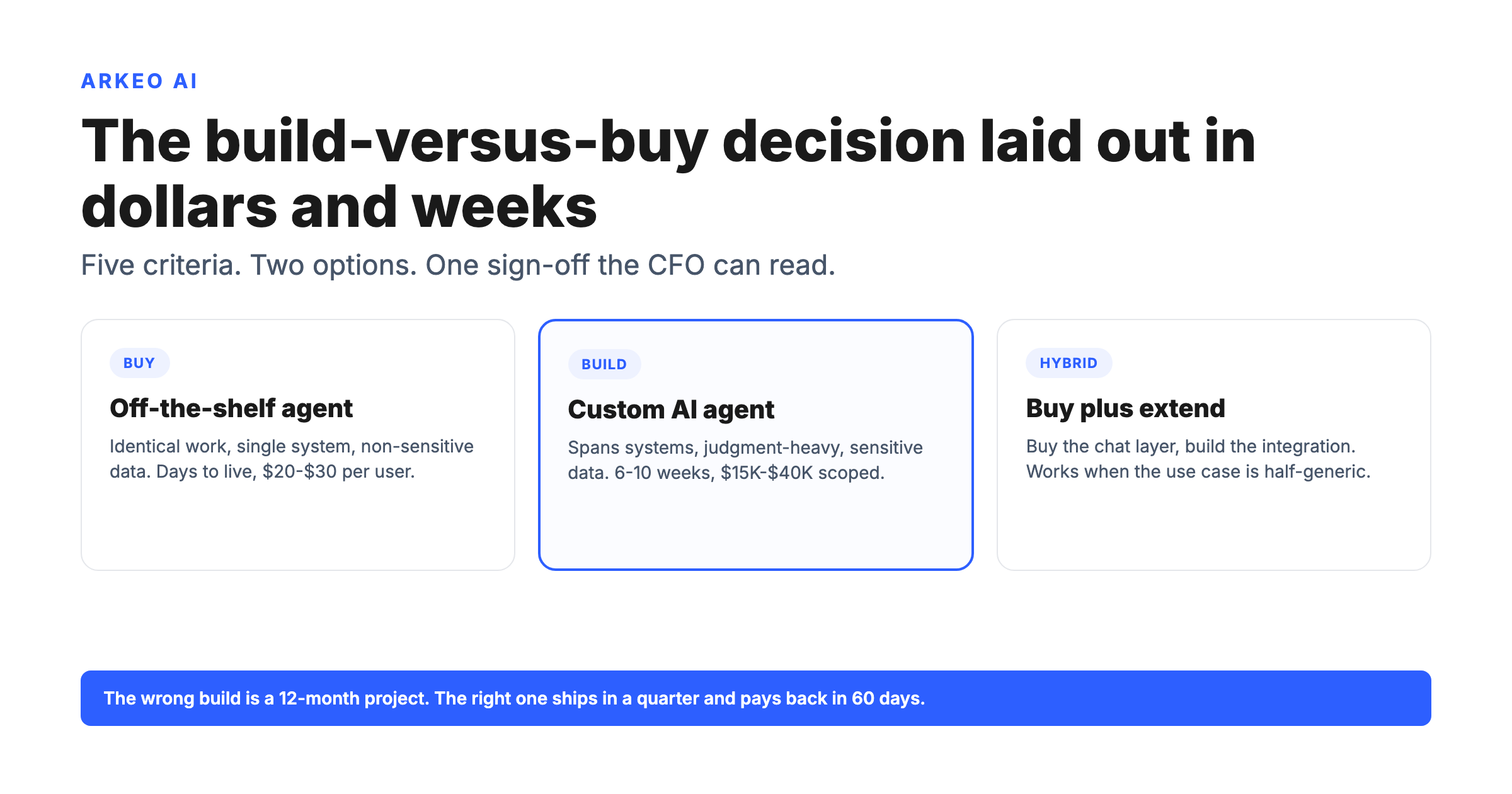
The data-path decision is binary: cloud or private. Cloud means the data leaves the building and is processed by a hosted model under the vendor's terms. Private means the model runs on the organization's own infrastructure and the data never leaves. The decision determines the security review, the contract terms, the build timeline, and the unit cost of every AI workflow the business deploys in the next 12 months.
In Arkeo's build experience, a scoped single-workflow agent runs $15,000 to $40,000 and reaches production in six to ten weeks on a cloud path, or eight to twelve weeks on a private path. That eight-to-twelve-week window on a private path is not a penalty. It is a data compliance trade-off that most regulated businesses make once and then reuse for every subsequent workflow. The IBM Cost of a Data Breach 2025 report found 97 percent of AI-model breaches involved organizations lacking proper AI access controls. The data-path decision is not an IT detail. It is the compliance decision that underlies the entire framework.
The data-path decision must be made in writing, signed off by legal or security, before the build starts. A decision made verbally in a meeting and then re-litigated at the vendor security review is not a decision. It is the source of the two-quarter cost overrun.
Component 4: The owner registry
The owner registry is a one-page document with two names: the executive owner and the operational owner. The executive owner is the COO, CIO, or operator with line authority to reassign people and budget if the initiative stalls. The operational owner is the person who runs the deployed workflow on a Monday morning — who checks the output, manages the escalation path, and catches drift before a client does.
The IBM CEO Study found 54 percent of CEOs already hiring for AI roles that did not exist a year ago. The operational owner role is one of them, but for most organizations under 500 people in year one, it is an existing employee with a new accountability rather than a new hire. The registry documents both names, both accountabilities, and the escalation path between them. It is written before the build starts, not added after the first workflow goes live.
The corporate AI strategy article covers the four organizational decisions the owner registry supports, including the kill criteria that the executive owner is responsible for enforcing.
Component 5: The sequenced roadmap
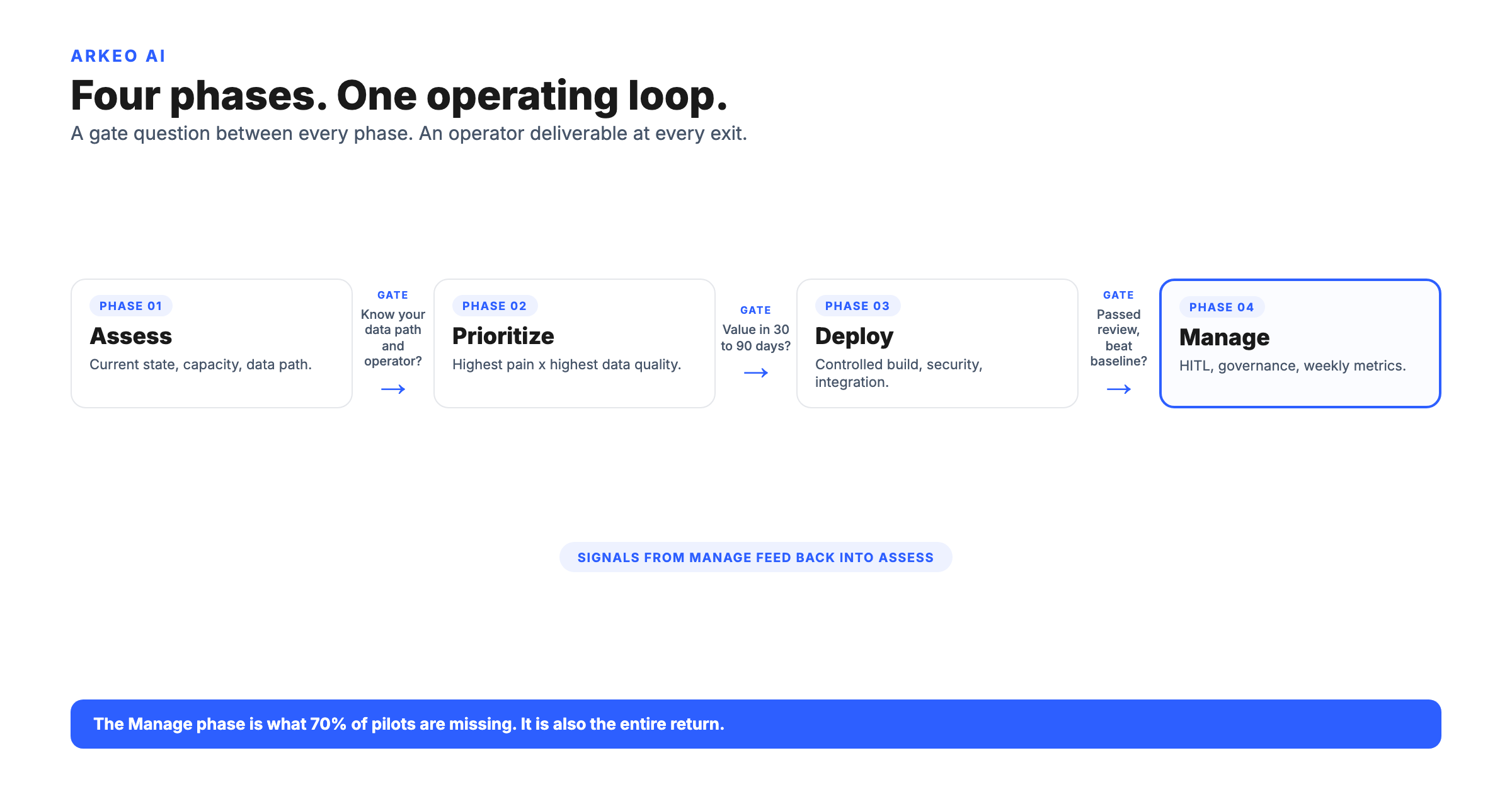
The sequenced roadmap is a four-quarter calendar with one gate question and one board metric per quarter. It is the output of the first four components applied to a 12-month horizon. The roadmap does not contain swim lanes, project task lists, or delivery milestones. It contains four questions and four metrics. The questions are answered in writing at the end of each quarter. The metrics are presented to the board.
The detailed mechanics of the four quarters are in the 12-month roadmap guide. The 90-day calendar version for the first quarter is in the 90-day plan guide. This component is the output — the document — not the methodology. The methodology is the four components above it.
The operator test: If you handed the five components to your build team tomorrow — the workflow shortlist, the data-path decision, the owner registry, and the four-quarter roadmap — could they start building without asking you a clarifying question? If not, one of the five components is still incomplete.
The free AI Assessment completes components one through three — current-state map, workflow shortlist, and data-path decision — and gives you the one-page brief the build team needs to start on day one.
Book Your Free AI Assessment →Frequently Asked Questions
The free AI Assessment runs the current-state map, builds the workflow shortlist, and resolves the data-path question in one working session. You leave with a brief the build team can act on.
Book Your Free AI Assessment →