Category
Corporate AI Strategy: The Four Decisions That Move Pilots to Production
By David Brennan · Arkeo AI · Building and Deploying Custom AI agents since 2023
The wrong question most boards ask about corporate AI strategy is: are we doing enough?
The right question is: which of our pilots is actually in production, and who owns it?
If your honest count is six pilots running and zero in production, you are not facing a model problem. Your AI program is stuck in testing. The four failure modes that put you there are organizational, not technical. Here is how to name yours and get out.
Quick Answer
What corporate AI strategy is: The sequenced, owned operating plan that turns scattered pilots into deployed AI agents. One named owner. One data-path decision made up front. One kill criteria per pilot.
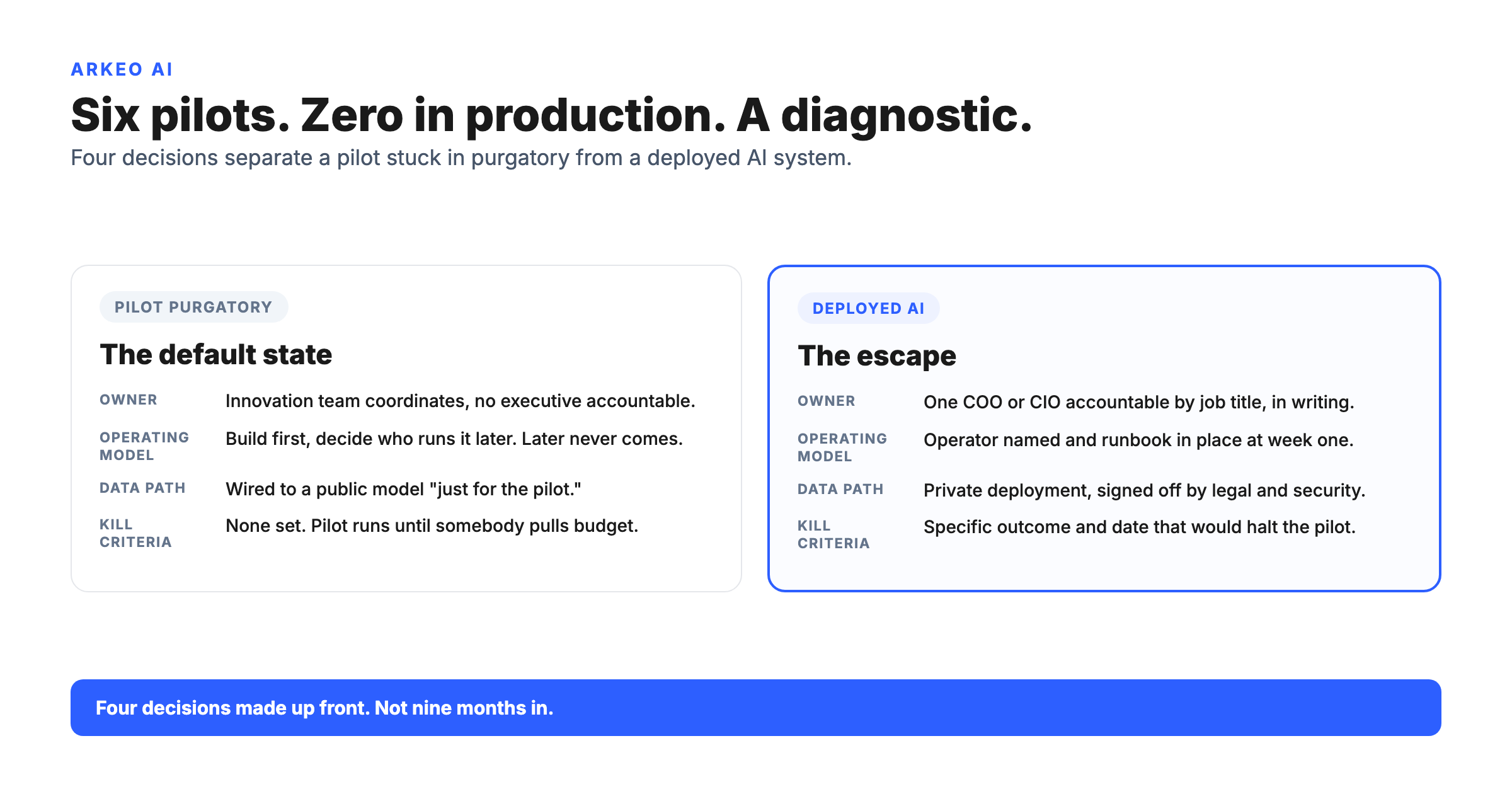
What the problem looks like: Six pilots running. Zero in production. No named owner. No operating model. No data answer. No kill date.
The four organizational fixes: Name a single owner. Design the operating model before the build starts. Decide data sovereignty up front. Set kill criteria at kickoff.
Next step: The free AI Assessment names the failure mode killing your rollout and the one workflow worth taking to production first.
One 60-minute free AI Assessment names the failure mode in your environment, the one workflow worth taking to production first, and the operating model that keeps it running.
Book Your Free AI Assessment →Why AI initiatives stay stuck in testing — and how to get out
The operating state that kills most corporate AI programs is one where pilots launch, demo well, and never reach production because four organizational decisions were never made. No named owner. No operating model. No data path answer. No kill criteria.
The numbers confirm the pattern. Deloitte's State of Generative AI study of 2,773 leaders found more than two-thirds expect 30 percent or fewer of their generative AI experiments to fully scale. BCG's research from October 2024 found 74 percent of companies struggling to capture value from AI. The pilots are not the problem. The four decisions are.
If the strategy slide says six pilots underway but cannot say three are in production with a named operator running weekly reviews, you are in it.
The operator test: Count your active pilots. Now count how many have a named human operator, a documented failure-mode list, and a weekly review on someone's calendar. If that second number is zero, your program is stuck in testing regardless of how many pilots the first number shows.
The four failure modes that cause corporate AI strategy to stall
Each failure mode has a gate question. If nobody on the strategy team can answer it plainly, the pilot is already stuck in testing.
No named owner of AI outcomes. A VP sponsors the pilot after a vendor demo. The engineer ships it and moves to the next project. Nobody is accountable for the drift. When the model updates or the data schema changes, nobody catches it until a client does. The IBM CEO Study of 2,000 CEOs across 33 countries found 54 percent already hiring for AI roles that did not exist a year ago. That gap is the ownership gap stated plainly.
No operating model designed before the build. The team builds a workflow. It ships. Now who runs it? The question was never answered before the build started, so the answer at launch is nobody. An operating model defines who checks the output, what the escalation path is when something goes wrong, and how often the agent is reviewed for drift. Built before the code, it costs a meeting. Built after, it costs months of re-architecting around a live system.
Data sovereignty decided too late. A regulated services company builds a claims-summarization pilot on a hosted public model over 90 days. It demos brilliantly at week eight. At the vendor security review around week twelve, legal flags a regulated data clause and the workflow has to be re-platformed onto private infrastructure. Two quarters of build time, restarted. The IBM Cost of a Data Breach 2025 report found 97 percent of AI-model breaches involved organizations lacking proper AI access controls. The data path decision is a financial decision, not an IT detail.
No kill criteria set at kickoff. A chatbot pilot runs for fourteen months. It has cost approximately $400,000. It has replaced no headcount and deflected no measurable ticket volume. Three internal champions have their reputations tied to it. Nobody defined at kickoff the specific result and specific date that would stop it. Without kill criteria, pilots do not stop. They accumulate.
The operator test: For each of your current pilots, can you answer: who owns it in production, where does the data live, and what is the measurable result that stops it? If any of the three is still a committee, you have found the failure mode.
AI PROGRAM AUDIT
Four gate questions for your active pilots
1. Named owner: Who is the person — not the function — accountable for this pilot's production performance?
2. Operating model: Who runs the agent on a Monday morning when it drifts, and what is the escalation path?
3. Data path: Was the data sovereignty decision made in writing before the build started?
4. Kill criteria: What is the specific result and specific date that stops this pilot if it fails to perform?
The four organizational fixes that move pilots into production
The fixes mirror the failure modes. Each one has to be installed at kickoff, not added after launch.
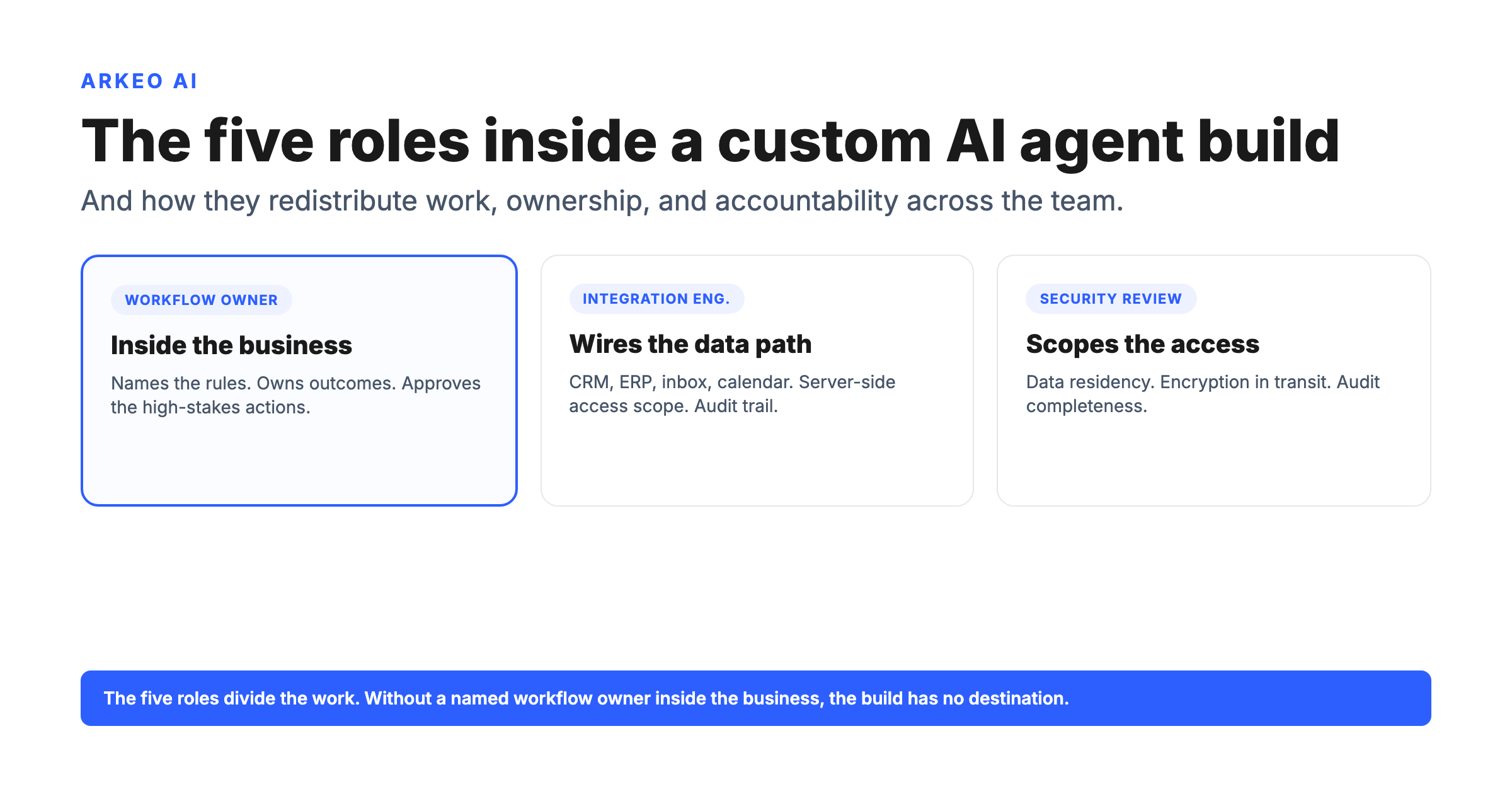
Fix 1: Name a single owner by job title, today. Not an innovation team. Not a committee. A COO or CIO with line authority to reassign people and budget, paired with an operational lead whose variable compensation this year is tied to deployed AI outcomes. Both names in writing before the first build sprint. The detailed methodology for AI ownership is in the AI strategy guide.
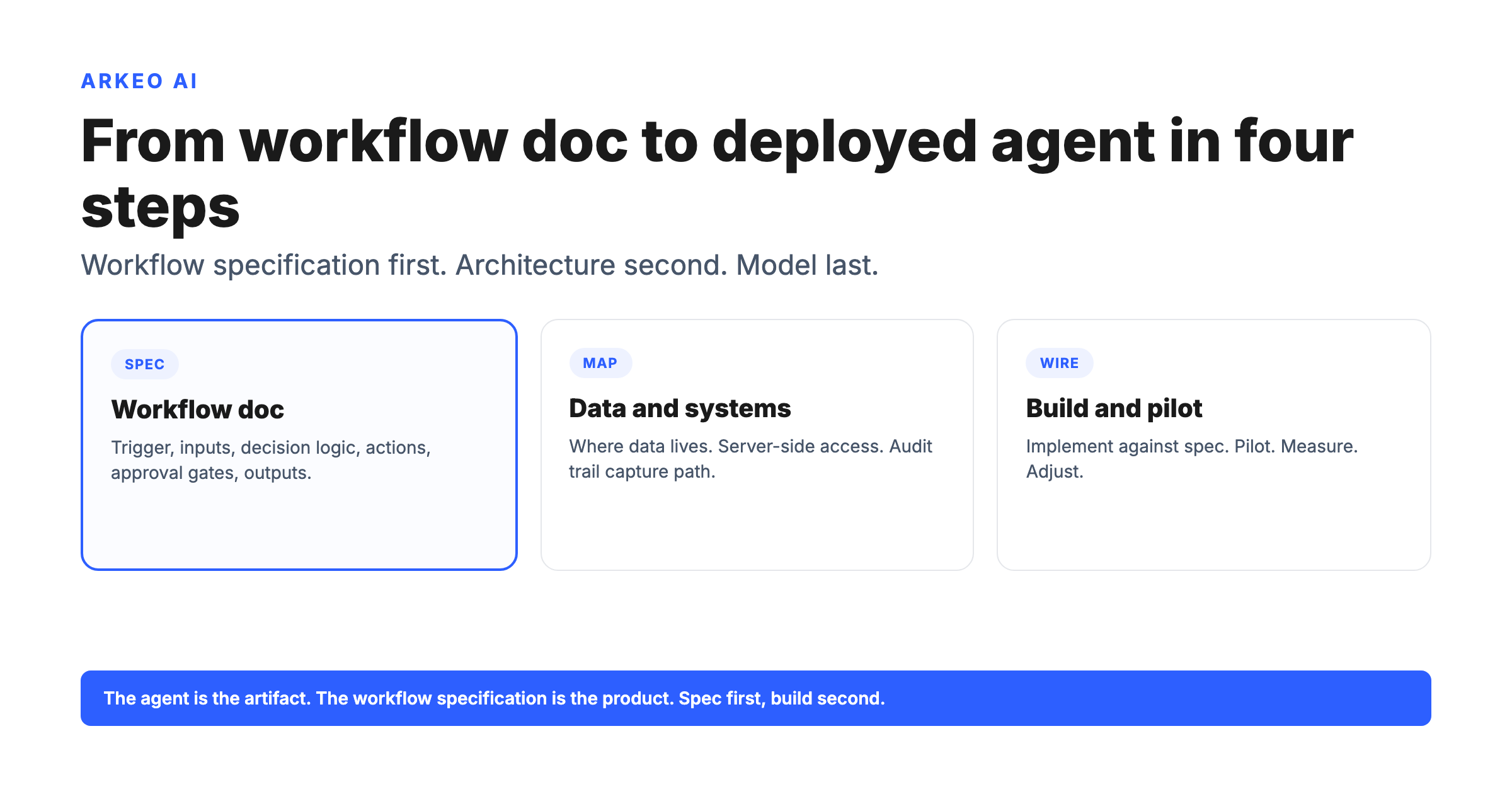
Fix 2: Design the operating model before the build starts. Who reviews outputs. What the escalation path is. How often the agent is checked for drift. How data changes are communicated to the build team. This is a one-page document written in week one, not a discovery deliverable in month three. The recurring traps in this work are covered in the AI implementation challenges guide.
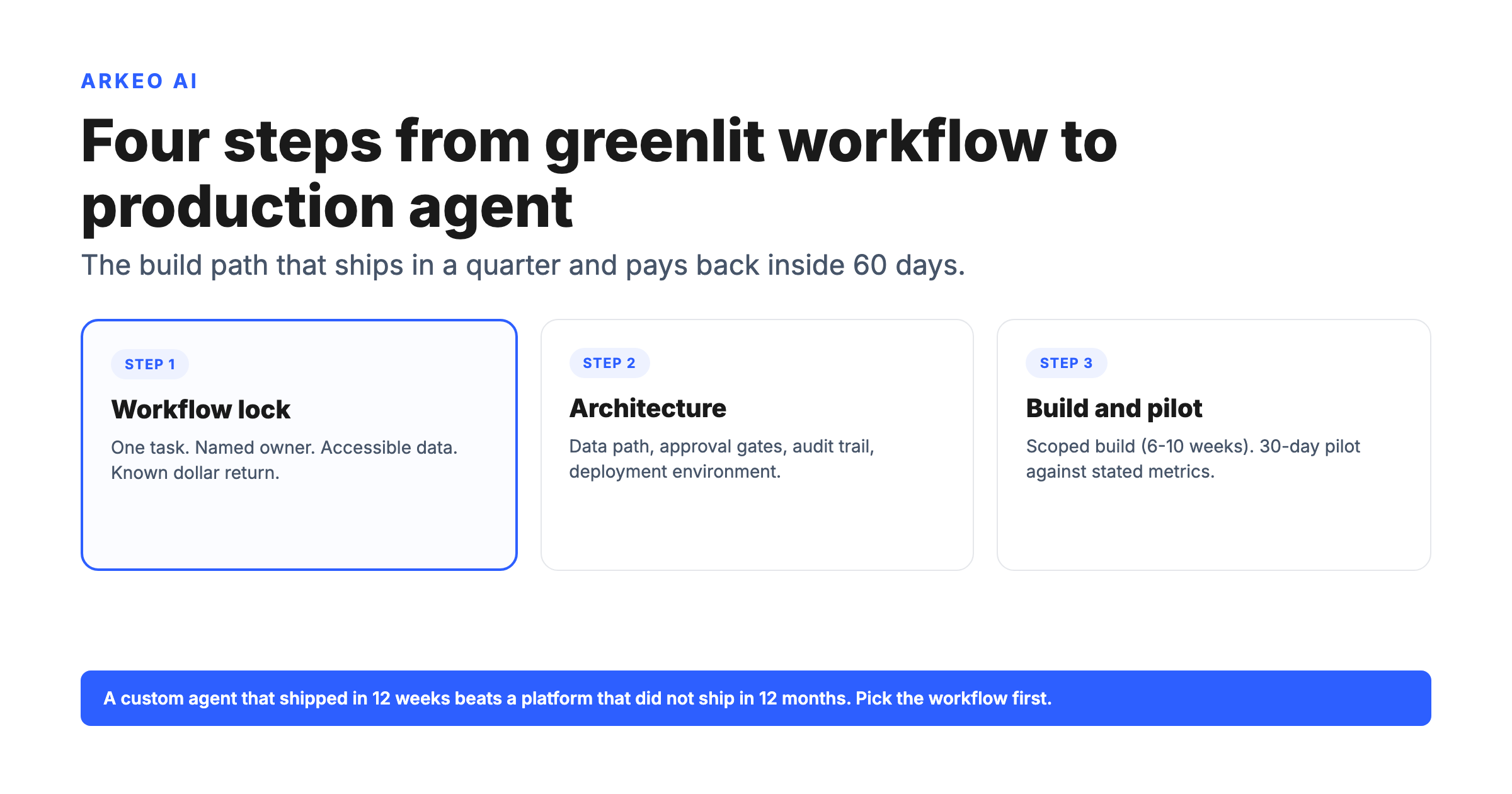
Fix 3: Decide data sovereignty up front. In Arkeo's build experience, scoped single-workflow agents run $15,000 to $40,000 and reach production in six to ten weeks, or eight to twelve weeks when the deployment is private. Private means the data never leaves the building. That decision has to be made at the strategy stage, not at the security review. Arkeo deploys a private AI workforce on client infrastructure under the enterprise AI strategy framework — Assess, Deploy, Manage. The current-state inventory that feeds this decision is covered in the AI readiness guide.
Fix 4: Write kill criteria at kickoff. One sentence: “If this workflow does not achieve [specific measurable result] by [specific date], the pilot halts.” Written at kickoff, agreed by the executive sponsor and the operational owner. This is the hardest fix because it requires acknowledging that the pilot might fail. It is also the cheapest fix. A pilot that can be stopped on evidence costs less than one that runs on sunk cost.
The operator test: Before this conversation ends, can you write the kill criteria for your highest-priority current pilot — a specific result and a specific date? If not, the pilot does not have kill criteria. Add them today.
What getting AI to production looks like at day 90 and day 365
Escape is not a moment. It is a state the program graduates into.
Day 90. One pilot has crossed into production. It has a named operator, a documented failure-mode list, a measurable result against the kill criteria, and an on-call rotation that catches drift before customers do. The other pilots are advancing on the same cadence, halted under the kill criteria, or consolidated into the one that worked. The portfolio shrinks before it grows.
Day 365. Two to three workflow agents are in production under the same named owner, all under the same operating rhythm. The data path from the first pilot is the same private deployment used by agents two and three, so the second and third reused the security review instead of repeating it. The board question is no longer why has AI not paid back. It is which workflow ships next.
The PwC AI Agent Survey found 79 percent of businesses already adopting agents, with 66 percent of adopters reporting measurable productivity gains. That 66 percent share the same trait: someone made the four decisions up front.
The free AI Assessment identifies which of the four failure modes is killing your rollout, names the one workflow worth taking to production first, and gives you the operating model that keeps it running.
Book Your Free AI Assessment →Frequently Asked Questions
The free AI Assessment names the owner, the operating model, the data path, and the kill criteria for one priority workflow. One working session before the next pilot starts.
Book Your Free AI Assessment →