Category
AI Strategy: The Three Decisions That Determine Whether It Ships
Last updated: June 2026
By David Brennan · Arkeo AI · Building and Deploying Custom AI agents since 2023
The wrong question operators ask about AI strategy is: what should we be doing?
The right question is: what is the one workflow we can take to production in the next 30 days, and who owns it after it ships?
If those two answers are not written down, you do not have an AI strategy. You have a hypothesis about AI strategy. Here is how to turn one into the other.
Quick Answer
What it is: An AI strategy is a sequenced, owned plan that names the first workflow, the first owner, and the data path before any build starts. It is one page, not a deck.
What separates it from a plan: A plan describes activities. A strategy makes three binding decisions: what ships first, who owns it in production, and where the data lives.
The most common failure: Strategy meetings happen. Decision meetings do not. Six weeks later the answer to all three questions is still a committee.
Next step: The free AI Assessment makes those three decisions in one working session, grounded in your actual workflows.
60 minutes. We map your workflows, surface the highest-return candidate, and give you the sequenced plan that survives contact with the operation. Not a vendor pitch.
Book Your Free AI Assessment →What an AI strategy actually is — and what it is not
An AI strategy is not a technology roadmap. It is not a vendor evaluation. It is not a list of use cases the team brainstormed on a Friday.
An AI strategy is the document that answers three questions before any code is written: which workflow ships first, who owns it in production, and where the data lives. Every other AI decision flows from those three. Get them wrong and the rest of the plan inherits the mistake.
The organizations that have deployed AI agents that actually earn back revenue share one visible trait: they answered those questions early. Deloitte's State of Generative AI study found two-thirds of enterprises expect 30 percent or fewer of their AI experiments to fully scale. That is not a technology gap. That is a strategy gap — specifically, a failure to make the three binding decisions before the build started.
An AI strategy also is not the same as an AI readiness audit. The readiness audit tells you what is currently in your environment. The strategy tells you what you do with that picture. They are separate documents. Do the audit first, then the strategy, then the implementation plan.
The operator test: Write down the answers to these three right now — first workflow, named owner, data path. If any of the three is still a committee or a placeholder, you are in strategy planning, not strategy.
Why most AI strategies do not produce deployed AI
The pattern is consistent. A leadership team decides to pursue AI. A committee forms to develop the strategy. The committee produces a framework with use cases and priorities. The priorities get assigned to functional leads. Six months later the program has a strategy deck and a vendor relationship and zero agents in production.
Three specific failures drive this.
The use case list replaces the decision. Generating a list of potential AI applications feels like progress. It is not a decision. A strategy decides which one goes first and who is responsible for making it work. The list defers both.
The strategy does not include a named owner. Workflows need a person, not a function. "Operations" does not run an AI agent. A person with a name and a calendar does. The BCG study published in October 2024 found 74 percent of companies struggling to capture value from AI. In the cases where the failure mode is visible, it is almost always absence of a named owner.
The data question gets deferred. Every AI build has a data question: is this workflow safe on a hosted public model, or does the data require private deployment? That question needs to be answered at the strategy stage, not at the security review six weeks into the build. A data-residency surprise mid-build costs months, not days.
The operator test: Who on your team has the authority to commit a workflow to production and is accountable when it drifts? If that person does not have an agreement with you in writing, the strategy depends on a hand-shake.
AI STRATEGY QUICK DIAGNOSTIC
Does your AI strategy make all three binding decisions?
1. Which one specific workflow is shipping in the next 30 days — not a category, the actual workflow?
2. Who is the named human owner of that workflow after it goes live — with a job title and a name?
3. Is the data path decision written down: public-model-safe or private deployment required?
The five-component AI strategy that survives contact with the operation
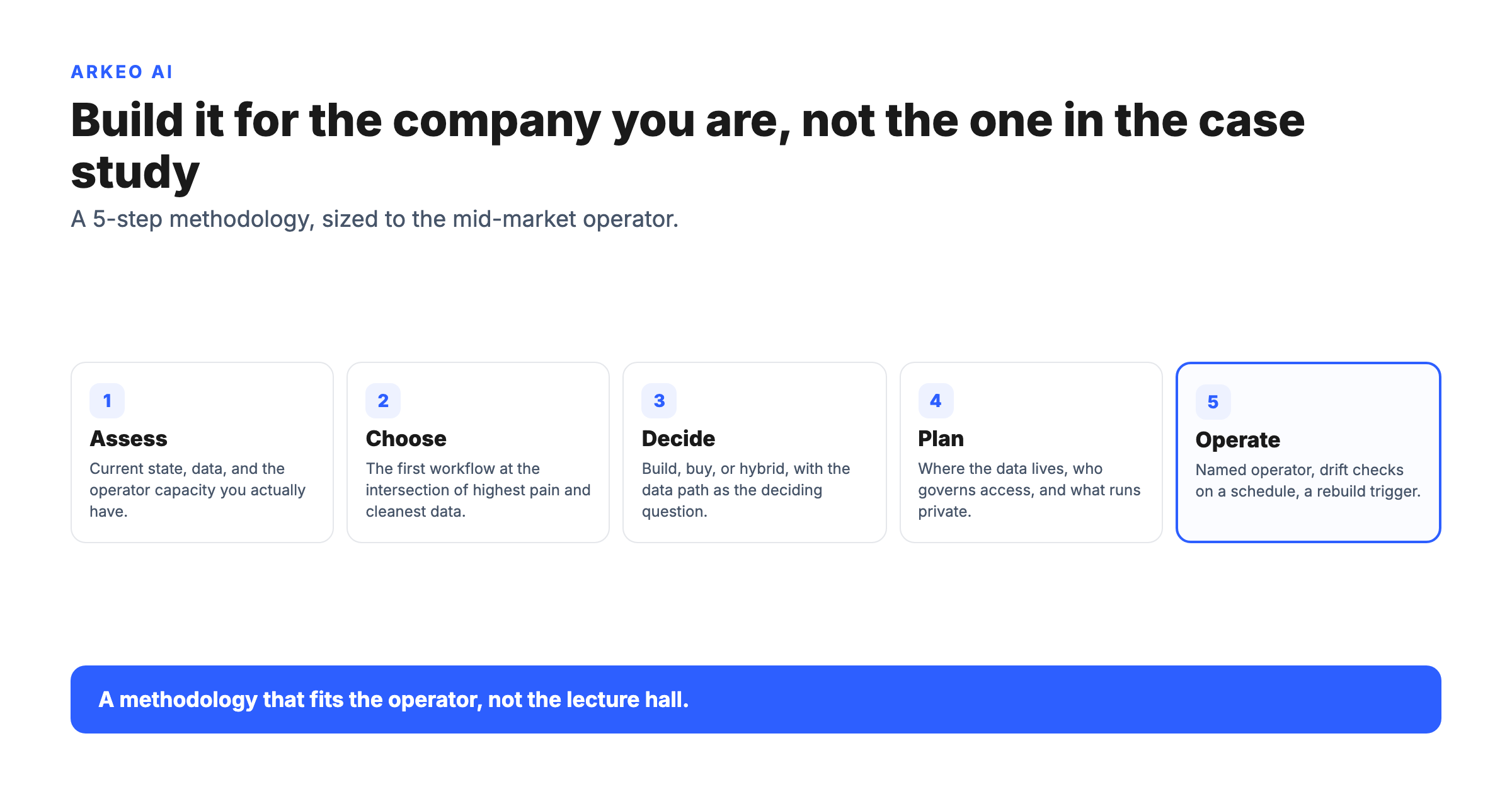
A workable AI strategy has five components. None of them take more than a page. Together they form the document that answers the board's questions and keeps the implementation from stalling.
Component 1: Current state map. A one-page picture of your existing workflows, data systems, and team capacity. Not a 50-page audit. A picture that surfaces the two or three workflows where AI can produce an obvious, measurable result in 30 days. The AI strategy framework guide covers the methodology for building this map without a six-week consulting engagement.
Component 2: Prioritized workflow list. A shortlist of three candidates ranked by expected return, not by ease of demo. The top candidate is the one that is repetitive, high-volume, and rides on data you already have access to. The second and third are queued for months three through twelve.
Component 3: Data-path decision. A written determination of whether the first workflow is public-model-safe or requires private deployment. This is a legal, security, and contract question as much as a technology question. Get it wrong in the strategy document and the build team inherits a re-platform mid-sprint.
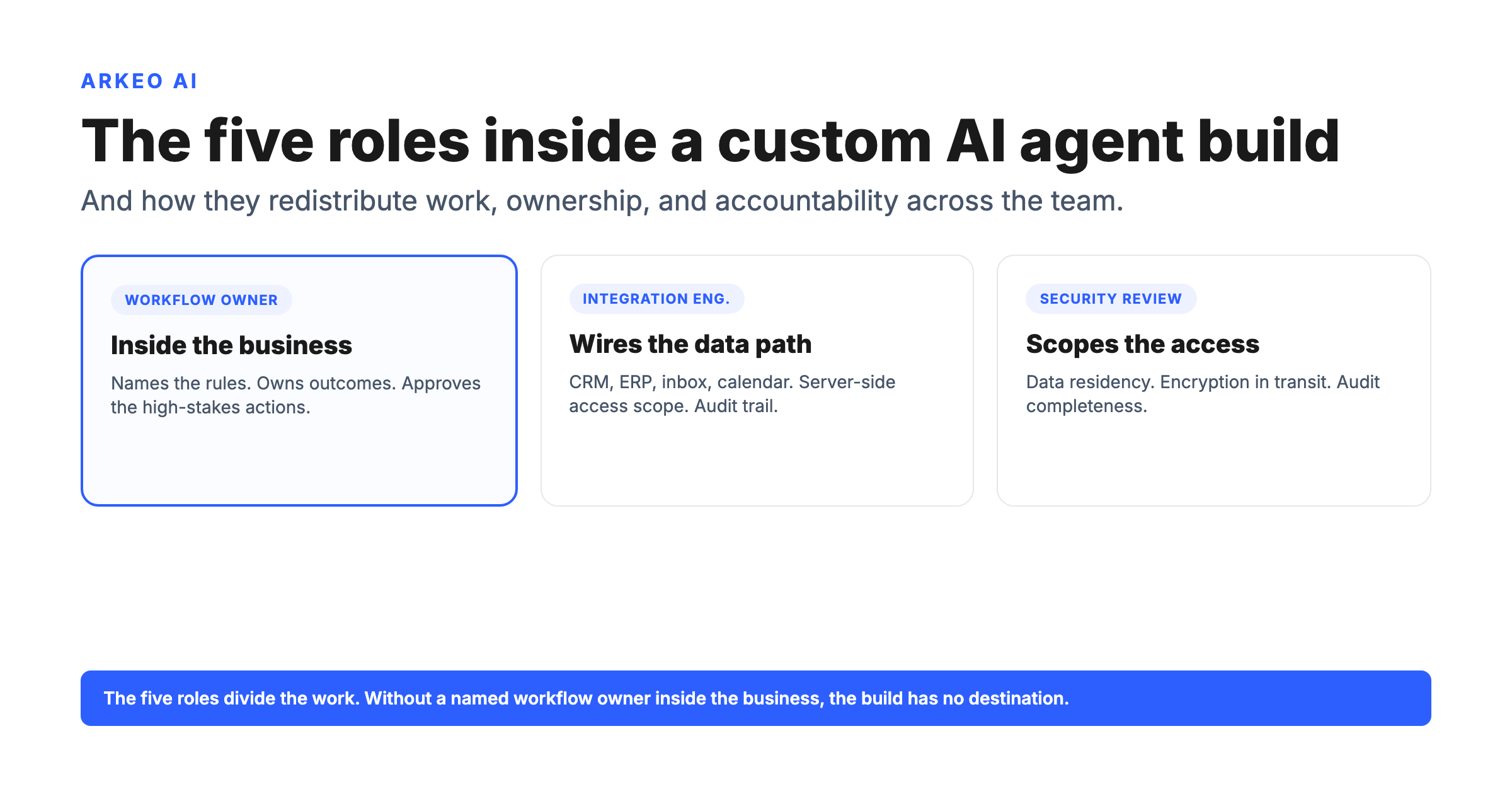
Component 4: Owner registry. A named person for each of three roles: the executive sponsor who controls budget, the operational owner who runs the workflow in production, and the build partner who is accountable for what ships. All three in writing before the build starts. An AI strategy without this registry is a strategy that depends on luck.
Component 5: Sequenced 30/90/12-month roadmap. The timeline that shows what ships in the next 30 days, what is in production by day 90, and what the 12-month picture looks like. The enterprise AI strategy guide covers this cadence in detail. The roadmap without the four components above it is a Gantt chart. With them, it is a strategy.
How to build an AI strategy without a six-week consulting engagement
Most operators do not need a six-week discovery engagement to build a workable AI strategy. They need a working session that makes the three binding decisions and produces a one-page document the team can execute against.
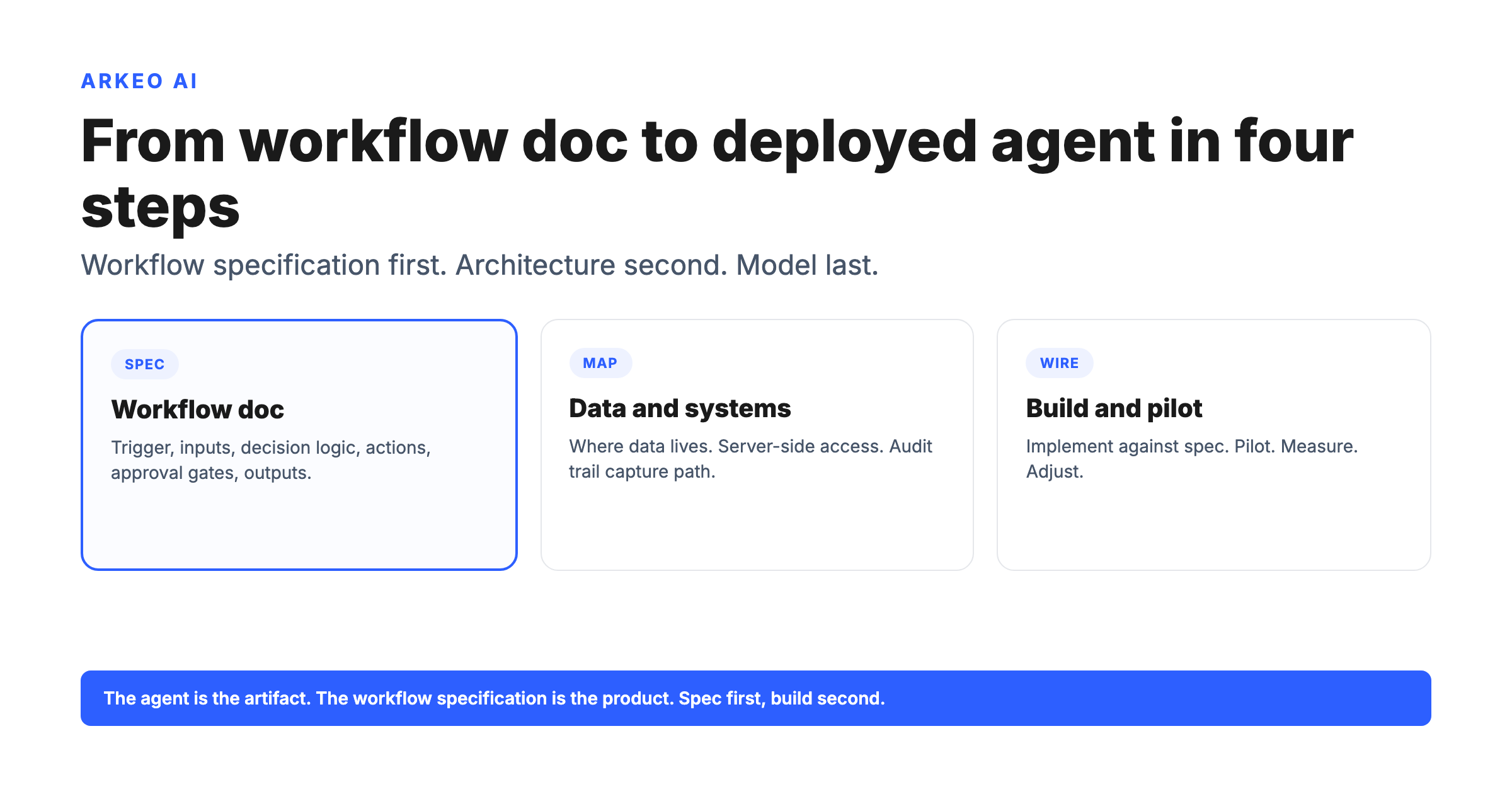
The structured path: start with the free AI Assessment. This is not a vendor evaluation. It is a one-session working session that runs through the five components, surfaces the top workflow candidate, makes the data-path decision, and gives you the 30/90/12-month roadmap before you commit money. The assessment is the strategy.
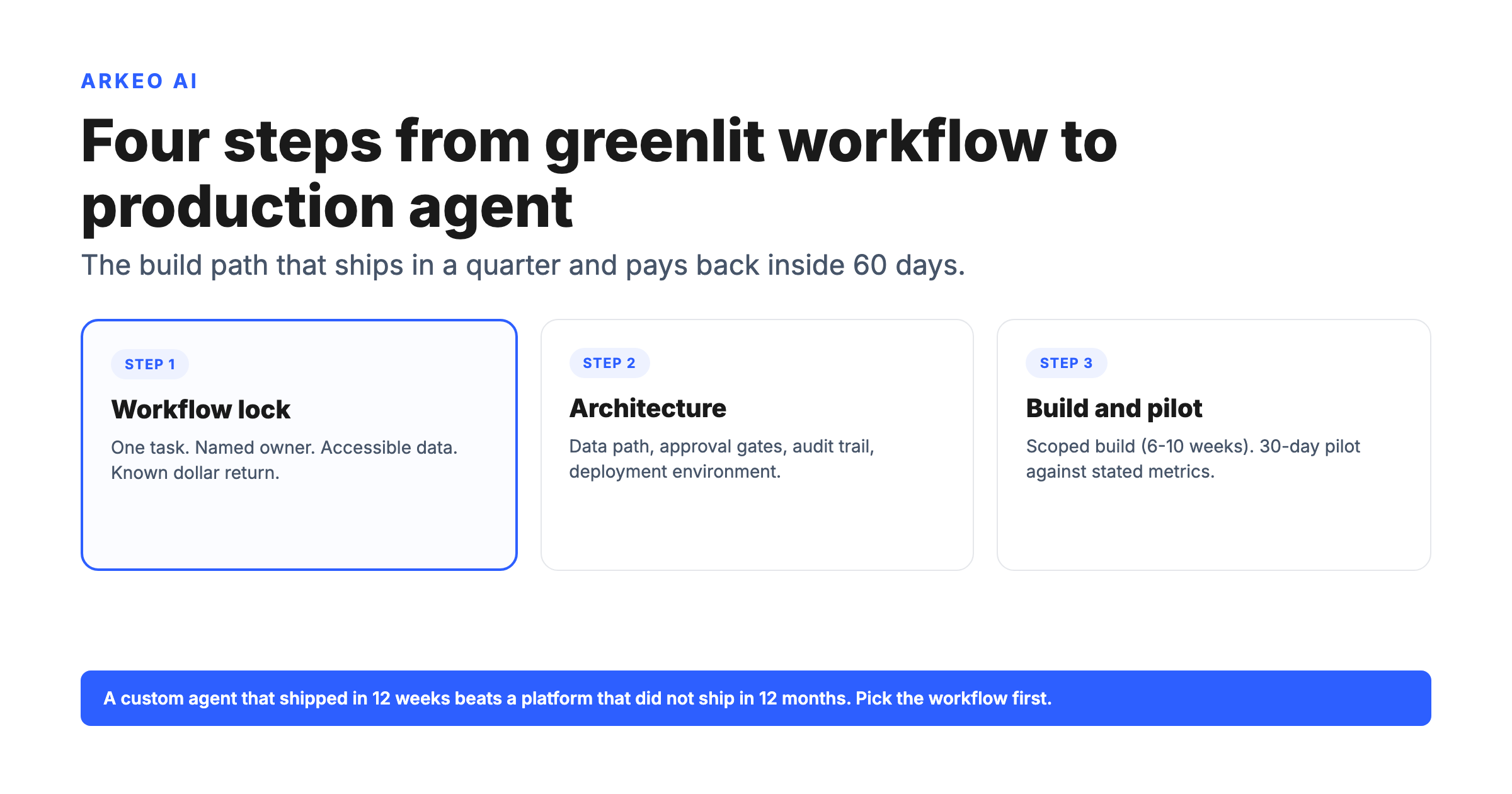
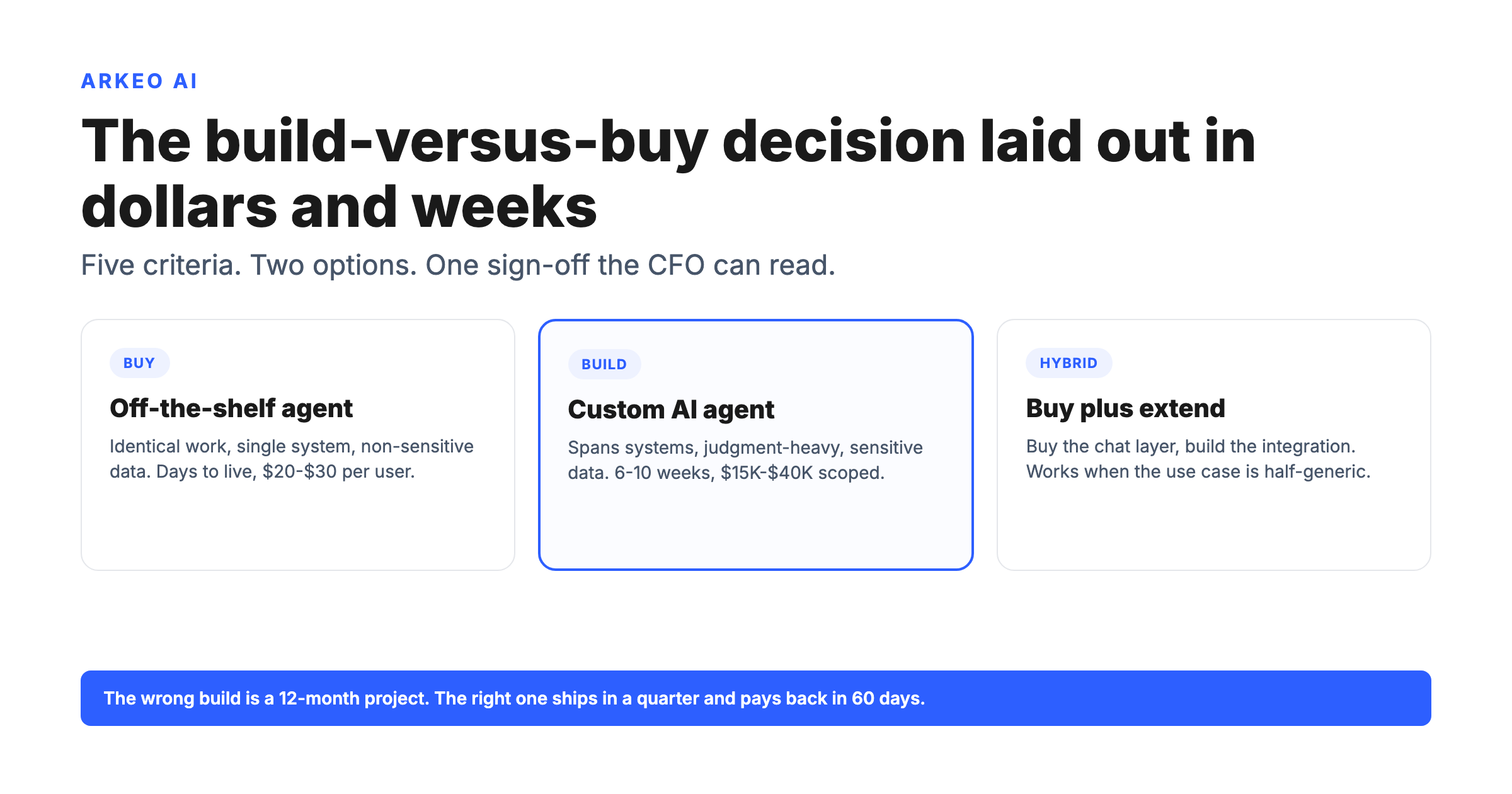
For the build itself, the typical scoped single-workflow agent runs $15,000 to $40,000 and reaches production in six to ten weeks. Private deployments add two to four weeks. That is the budget shape. The strategy document tells you whether the math justifies the investment before the build starts.
The choice between building in-house and using a partner comes down to one question: does someone on your team currently have 20 hours a week available to own this deployment for the next 12 months? The consultant vs. in-house guide walks through the build-versus-hire decision in detail. The short answer: if no one has 20 hours a week, the partner model is faster and cheaper than hiring into the gap.
The operator test: Before you hire a consultant for a six-week strategy engagement, can you answer the three binding decisions yourself in an afternoon? If yes, the assessment is the strategy. If no, find out what is blocking you before paying for a deck.
The free AI Assessment produces the five-component strategy document — workflow, data path, owner registry, and 30/90/12-month roadmap — grounded in your actual operation. One session. No retainer.
Book Your Free AI Assessment →What a working AI strategy looks like six months in
Six months from a real AI strategy: one workflow agent in production, a named operator running weekly reviews, a second workflow in the build phase, and the board update showing production volume numbers rather than a use case list.
A creative services company with 83 team members across design functions used a three-month strategy-to-production cycle to get their first brief-processing agent live. Six months in, that agent was running production volume every day with a named operator doing weekly drift checks. The second agent, for client-feedback routing, was in the build phase. The strategy document — one page — was the same document they had at month one. They executed it.
A health and wellness company with distributed operations used the same five-component structure to get a member-intake summarization agent live in 90 days. Their data-path decision at the strategy stage moved the deployment to private infrastructure, which prevented a contract re-platform that would have cost them three additional months.
Both examples share the same output: the strategy made the three binding decisions early, the build executed against them, the operator owned the result. No surprises at the security review. No committee debates about data. No anonymous ownership of the deployed workflow.
Frequently Asked Questions
The free AI Assessment produces all five strategy components grounded in your actual operation. Workflow, data path, owner registry, roadmap. One session, no retainer.
Book Your Free AI Assessment →