Category
AI Strategy Consultant vs. Internal: A Decision Guide for Operators
By David Brennan · Arkeo AI · Building and Deploying Custom AI agents since 2023
The wrong question when you are 60 days into an AI initiative is: should we hire an internal AI lead or bring in a consultant?
The right question is: what specific decision are we stuck on, and does the person who unblocks it need to be on payroll?
Most operators frame this as a build-versus-buy choice for talent. It is actually a sequencing question. The answer changes depending on where you are in the deployment cycle. A consultant is the right call at one point. An internal owner is the right call at a different point. Confusing the two wastes money in both directions.
Quick Answer
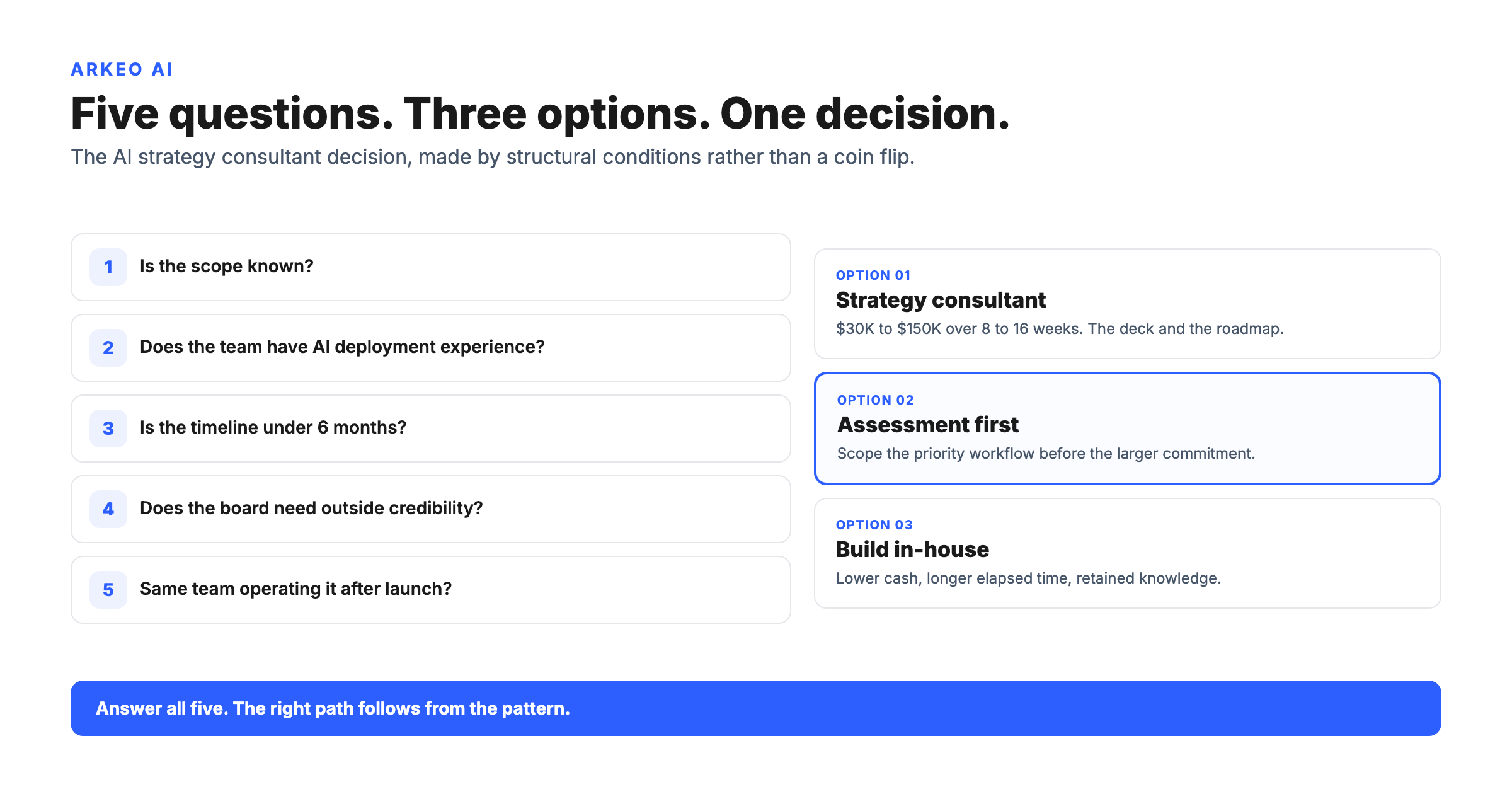
The decision rule: Hire a consultant to unblock a specific decision you cannot make internally. Hire an internal owner to run what ships. You typically need both, sequenced correctly.
Consultant signals: Data path still open. No workflow shortlist. Security review stalled. Board needs an outside voice to approve the budget.
Internal owner signals: First workflow is in production. Someone needs to run the Monday-morning review. You are deploying workflow two and three on the same pattern.
Next step: The free AI Assessment identifies whether you need outside help to unblock a decision or an internal operator to run what you have already built.
The free AI Assessment identifies the specific decision blocking your deployment, then tells you whether that decision needs an outside consultant or an internal operator to resolve it.
Book Your Free AI Assessment →What an AI strategy consultant actually does — and what they cannot do
An AI strategy consultant is paid to resolve a specific category of decisions faster than the internal team can. The decisions fall into four buckets: workflow prioritization, data architecture, vendor selection, and board communication. A good consultant closes one or two of those buckets in a defined engagement and hands the output to the internal team to execute.
What a consultant cannot do is own the outcome. Accountability for a deployed AI workflow requires organizational authority — the ability to reassign people, change processes, and hold an operator accountable on a Monday morning when the agent drifts. That authority cannot be contracted out. A consultant who is still on-site 18 months in, making decisions that should belong to an internal owner, has not delivered. The engagement has become a dependency.
The IBM CEO Study of 2,000 CEOs across 33 countries found 54 percent already hiring for AI roles that did not exist a year ago. That hiring surge is not replacing consultants. It is happening after the consultant engagement closes. The pattern is: consultant unblocks, internal owner runs. The question is whether the operator knows when to hand off.
The enterprise AI strategy article covers the full methodology for building that internal ownership structure. This article is specifically about the decision of when to bring outside help and when to build internally.
The operator test: What is the specific decision your AI initiative is stuck on right now? Name it in one sentence. If you cannot name it, the problem is not a missing consultant. It is a missing decision process. The AI strategy guide walks the decision structure.
Four signals that a consultant is the right call
Each signal corresponds to a specific type of block. If you recognize one, the consultant engagement should be scoped around unblocking it — not around delivering a broader strategy.
Signal 1: The data path is still open. Your team has identified candidate workflows but cannot get legal or security to make a call on cloud versus private. The decision is political, not technical. An outside firm with regulated-industry references can present the risk comparison in a format the security team will act on faster than an internal memo. Arkeo runs its own operation on private infrastructure and has made this case dozens of times with regulated clients. The data path decision, once made in writing, unlocks six to twelve weeks of build time.
Signal 2: The workflow shortlist is a committee. Six people in a room cannot agree on which workflow to pilot first because each has a functional stake in the answer. An outside prioritization exercise — scored against volume, pain, and data-readiness — removes the politics. The scoring criteria are covered in the AI readiness guide. A consultant running that exercise produces a documented shortlist the committee can ratify rather than a vote they cannot resolve.
Signal 3: The board needs an outside voice. The internal team has done the work and made the recommendation. The executive sponsor needs the board to approve a $150,000 to $500,000 year-one AI budget. An external firm presenting the investment case alongside the internal sponsor materially increases approval rates. This is not about the quality of the internal work. It is about the board's decision process. The PwC AI Agent Survey found 88 percent of senior executives raising AI budgets in the next twelve months. The board knows the money is moving. They want outside confirmation of the direction, not the destination.
Signal 4: The vendor selection is stalled. You have evaluated three build partners and cannot agree on which one to contract. An outside technical review that separates the shortlist on specific criteria — private deployment capability, integration complexity, operator training support — produces a decision document the procurement team can act on rather than a preference the team cannot resolve.
The operator test: Which of those four blocks applies to your current situation? If none of them apply and the initiative is still stalled, the problem is not a missing consultant. It is a missing owner. That is the next section.
Four signals that an internal AI owner is the right call
The signals for an internal hire are different. They appear later in the deployment cycle, when the question shifts from what to decide to who runs this.
Signal 1: The first workflow is in production. You have one agent deployed with a named operator. The next question is who owns the weekly review, catches drift, and escalates. This is an operations role, not a strategy role. It does not require a consultant. It requires an internal operator with a named accountability and a clear escalation path. The 90-day implementation plan covers how to structure that role in the first 90 days.
Signal 2: You are deploying workflow two and three on the same pattern. The first deployment established your data path, your security review, and your monitoring setup. Extending that pattern to the next two workflows is an operations task, not a strategy task. A consultant brought back in for this work is expensive overhead on a problem that should be owned internally.
Signal 3: The board has approved the 12-month roadmap. The consultant's job was to get the roadmap approved. If it has been approved and the internal team is executing, the consultant engagement is done. An internal AI lead — a COO, CIO, or dedicated operator — now owns the quarterly gate questions and the board metrics. The 12-month roadmap guide lays out those metrics.
Signal 4: Vendor and data decisions are locked. Cloud versus private is decided. The build partner is contracted. The security review is signed off. There are no more strategic decisions requiring outside expertise. The remaining work is execution, and execution belongs to an internal owner.
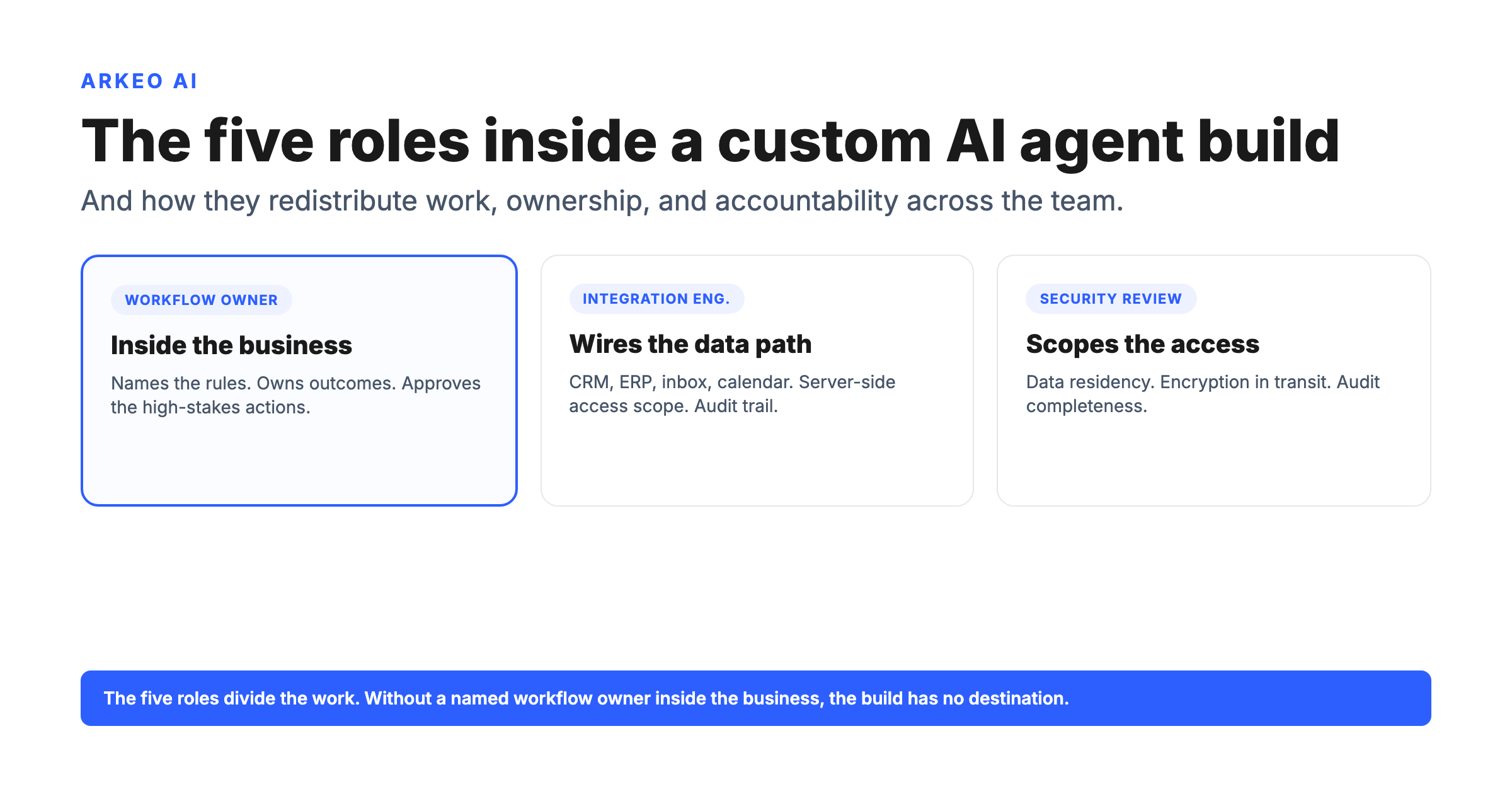
THE SEQUENCING MODEL
Consultant first, internal owner second
PHASE 1 — UNBLOCK
Who: AI strategy consultant
Job: Resolve the specific decision blocking the deployment — data path, workflow prioritization, board approval, vendor selection
Done when: The block is named, the decision is in writing, and the build team can start
PHASE 2 — RUN
Who: Internal AI owner (COO, CIO, or dedicated operator)
Job: Run the deployed workflows, own the Monday-morning review, escalate drift, extend the pattern to workflow two and three
Done when: Three workflows in production, operating rhythm established, compounding
What the engagement should cost and how long it should run
An AI strategy consulting engagement that is scoped correctly runs eight to sixteen weeks and produces one or two of the four decision deliverables: data path decision, workflow shortlist, board approval package, or vendor selection document. Engagements that run longer than sixteen weeks without producing a deployed workflow are not strategy. They are management consulting with an AI label.
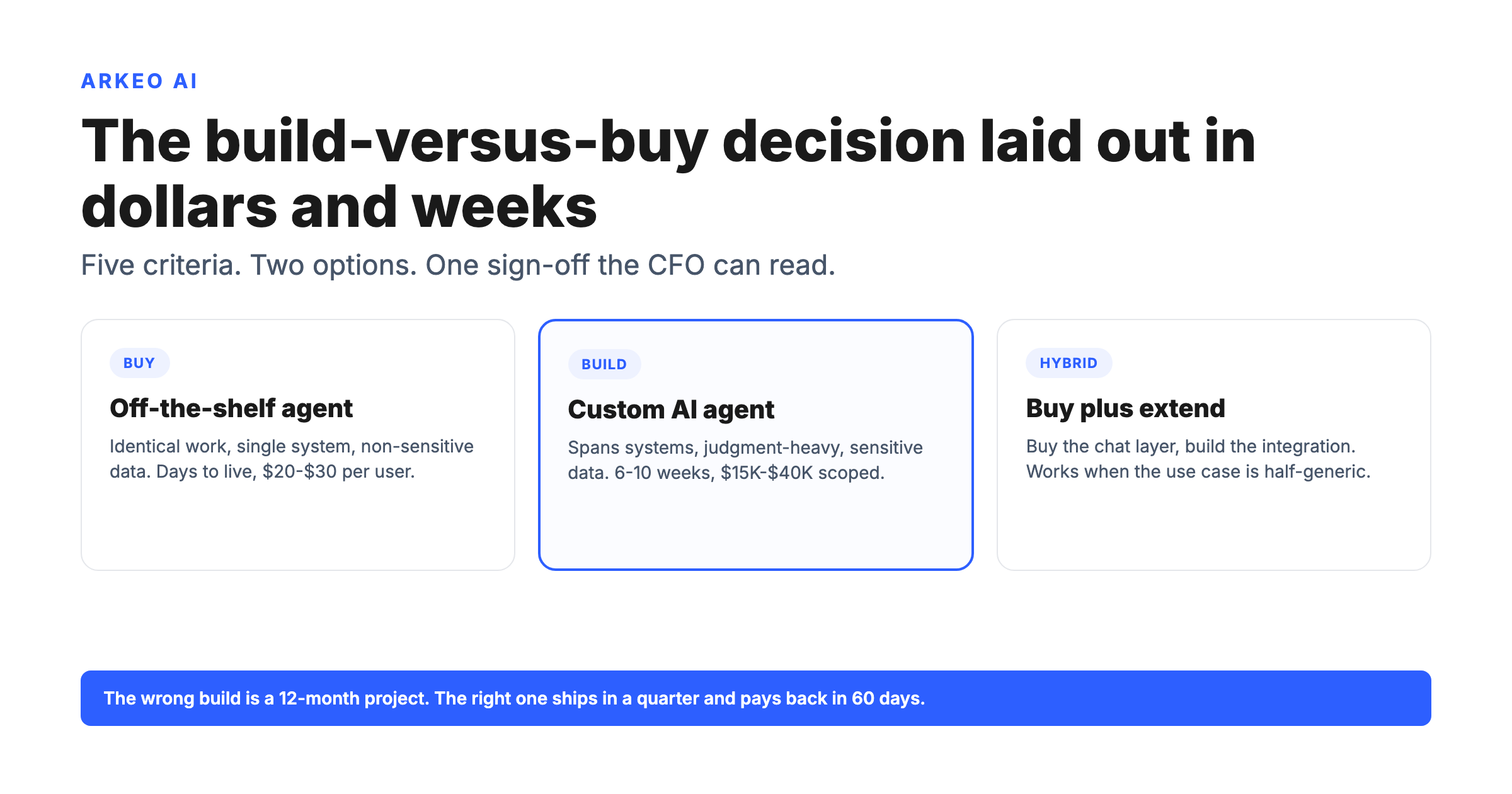
In Arkeo's build experience, a scoped single-workflow agent runs $15,000 to $40,000 and reaches production in six to ten weeks. The strategy work that precedes the build should cost proportionally less and take proportionally less time. A consulting engagement that costs more than the build and produces no deployed workflow has not delivered value. It has produced a presentation.
The internal AI owner role, once the build phase begins, is typically a 20 to 40 percent time allocation for a COO or CIO in the first 90 days. It becomes a smaller allocation as the operating rhythm stabilizes. It does not require a full-time hire in year one for most operations under 500 people. The Deloitte State of Generative AI study found organizations with a named internal AI owner are twice as likely to report a successful deployment as those that keep the accountability in a committee.
The free AI Assessment identifies the specific decision stalling your deployment and whether it requires outside expertise to resolve or an internal operator to own. One working session.
Book Your Free AI Assessment →Frequently Asked Questions
The free AI Assessment surfaces the specific decision stalling your initiative and tells you whether a consultant engagement or an internal owner appointment is the right next move.
Book Your Free AI Assessment →