Category
AI Strategy for Business Leaders: 7 Questions That Separate Pilots from Production
By David Brennan · Arkeo AI · Building and Deploying Custom AI agents since 2023
The wrong question business leaders ask about AI is: are we behind?
The right question is: which workflow ships in the next 90 days, and who owns it when it does?
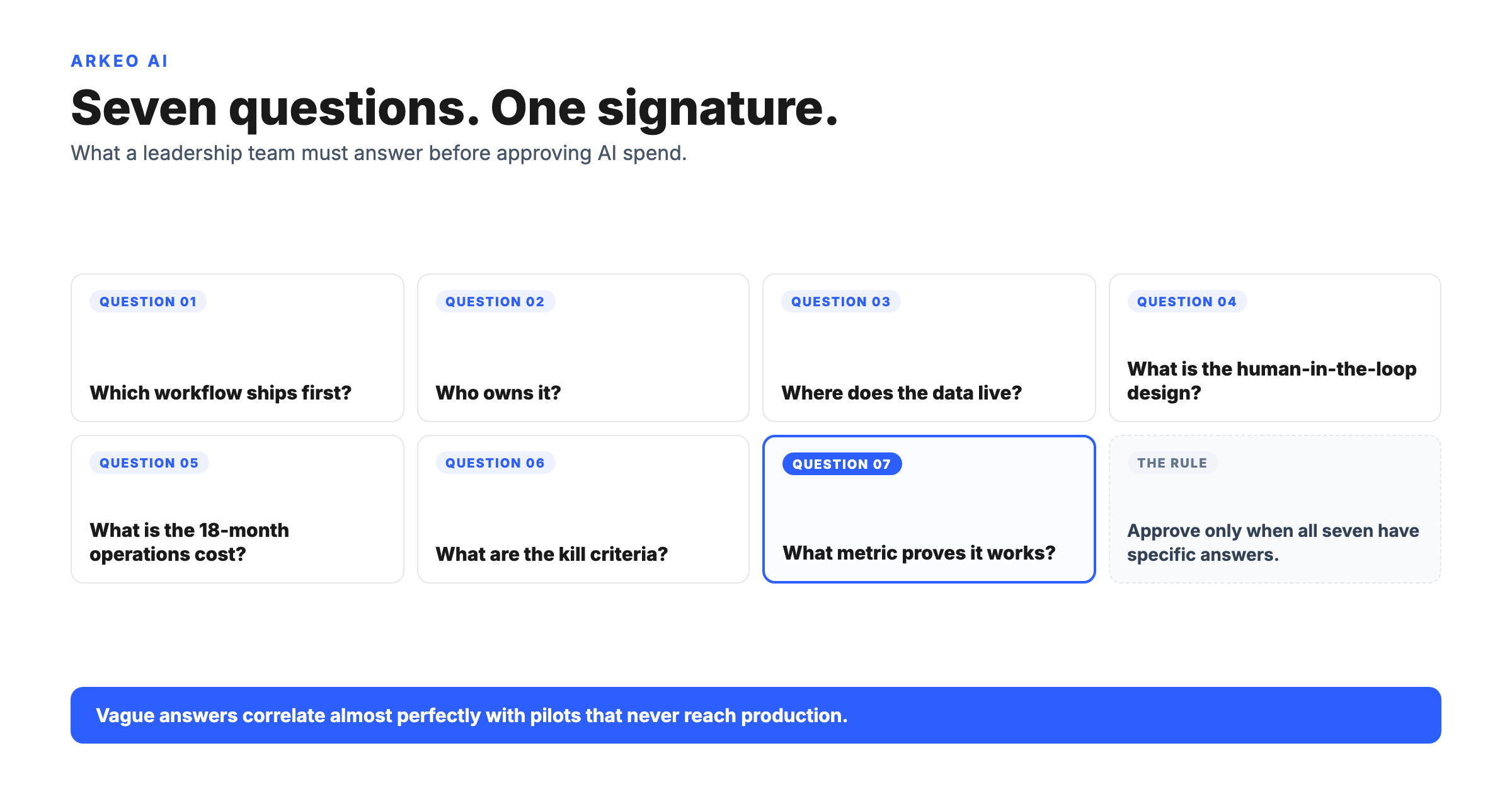
Every leader in a room today is asking the wrong question. They are measuring progress against a competitor's press release or a consultant's maturity model. Neither tells them what to build next. The seven questions below do.
Quick Answer
The seven questions: Which workflow ships in 90 days? Who owns it? Where does its data live? What is the baseline we are beating? What is the kill date if it fails? Who runs it on a Monday morning? What does the board see at the end of Q1?
Why these questions: They are the seven decisions that separate AI initiatives that deploy from those that stay in testing indefinitely.
Next step: The free AI Assessment answers the first three questions in a single working session and gives you the brief your team needs to start building.
The free AI Assessment produces the workflow shortlist, the data-path decision, and the first gate question for Q1. One session, one page, ready to put in front of the board.
Book Your Free AI Assessment →Why AI strategy for business leaders is different from enterprise AI programs
Enterprise AI programs are designed for organizations with dedicated AI teams, multi-year budgets, and the capacity to run fifteen pilots simultaneously. Most businesses are not those organizations. They have operators who need a specific workflow deployed by a specific date, accountable to a board that wants a metric, not a maturity score.
The PwC AI Agent Survey of 300 senior US executives found 88 percent raising AI budgets in the next twelve months. The money is moving. The gap is not ambition. It is a decision structure that converts ambition into deployed workflows. The seven questions below are that structure, compressed for a leader who needs to run a 60-minute board session on AI investment rather than commission a six-month strategy project.
The enterprise AI strategy article covers the full methodology for leaders who want the deep framework. This article is the seven questions that produce the same outcome in a shorter session.
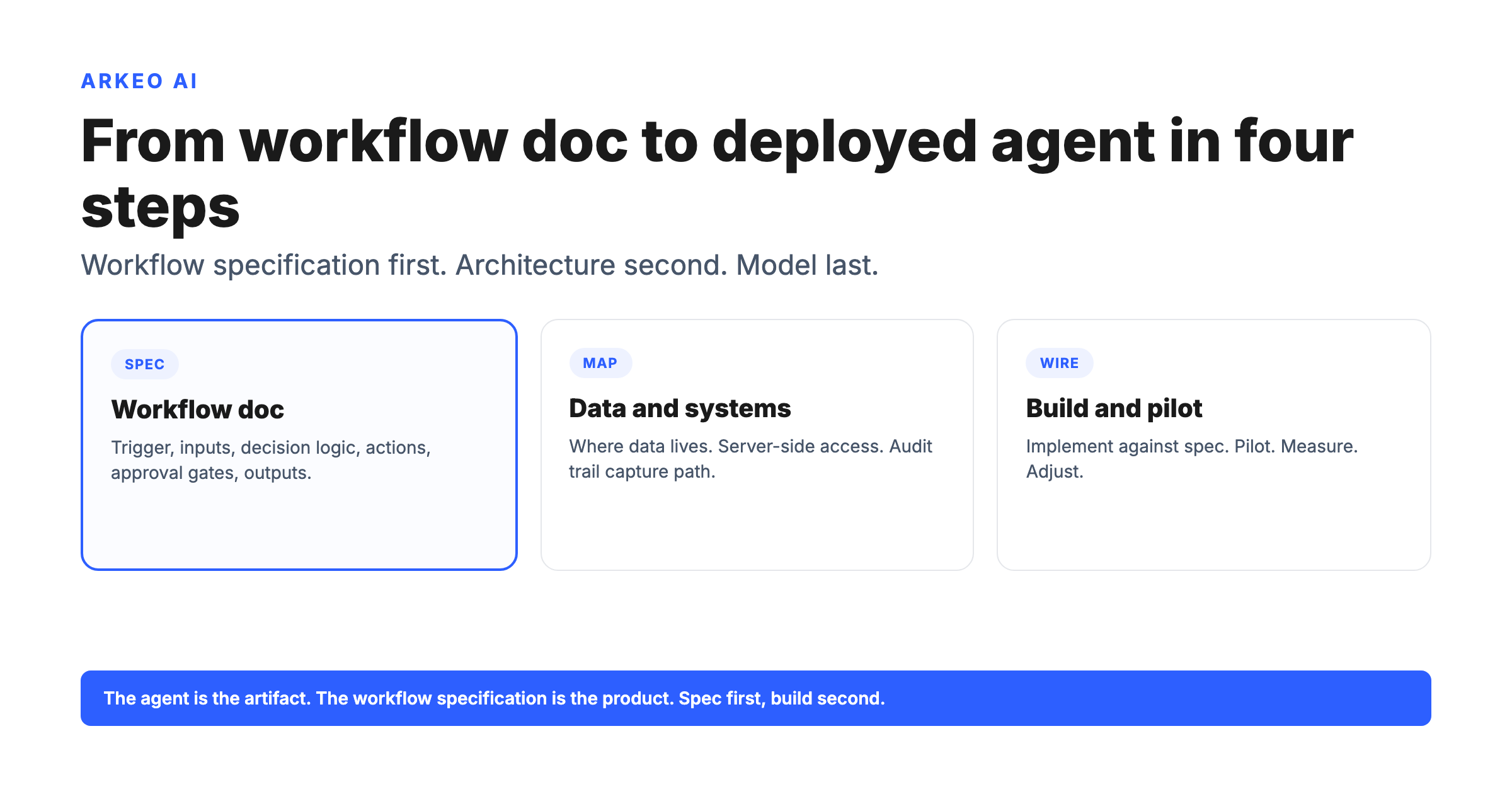
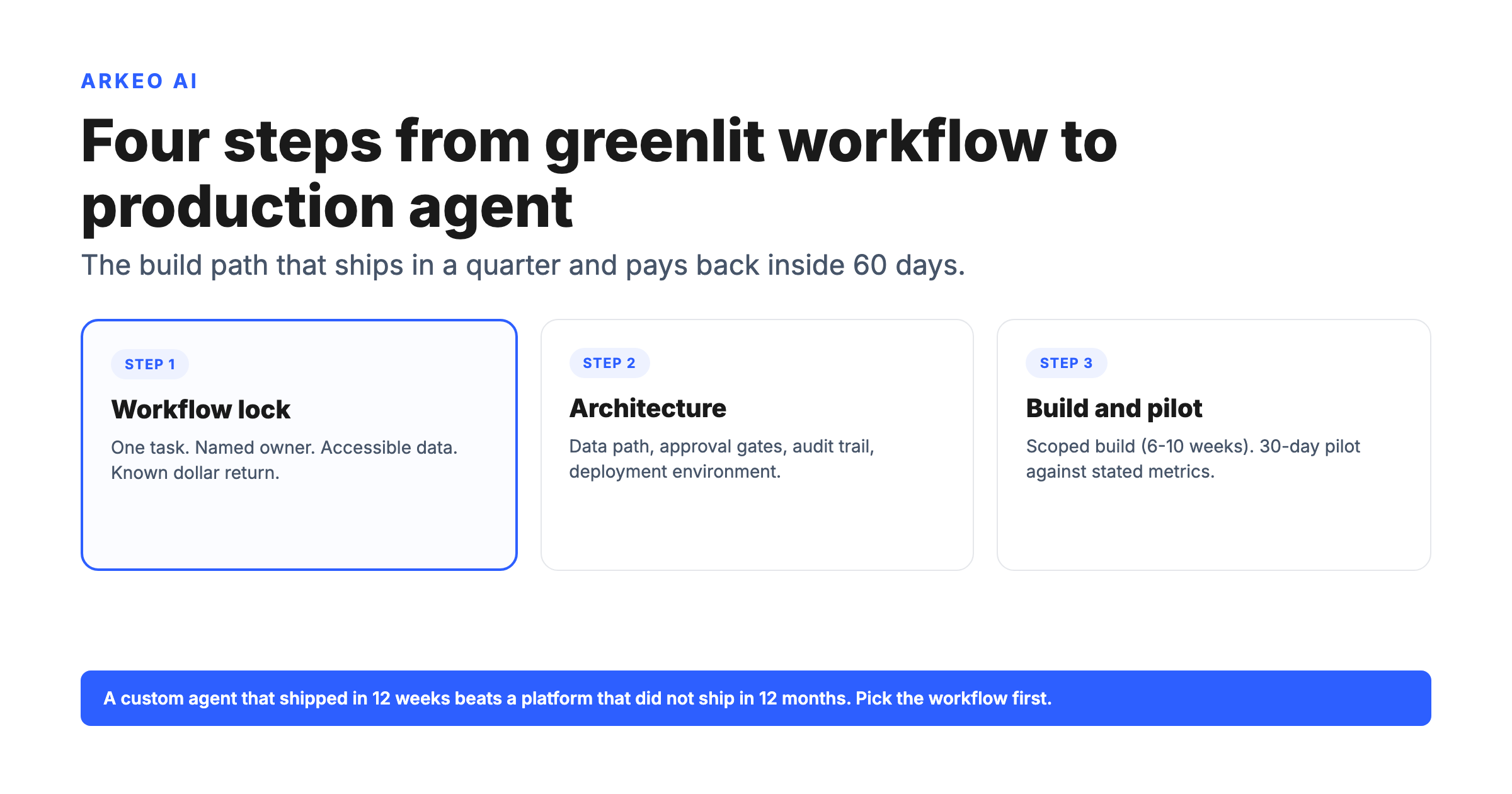
Question 1: Which workflow ships in the next 90 days?
This is the first question because it is the one most leadership teams cannot answer after six months of AI investment. They can name platforms. They can name vendors. They cannot name the one workflow that will be in production on a specific date.
The answer requires a current-state map: a scored inventory of candidate workflows ranked by volume, pain, and data-readiness. The top candidate on that list is the answer to question one. If the list does not exist, the first 30 days of the AI initiative belong to building it. The scoring methodology is in the AI strategy framework guide.
The operator test: Name the one workflow that will be in production in 90 days. If the answer is a category (customer service, operations, finance) rather than a specific workflow (contract review for deals over $50K, invoice matching against three ERP systems, brief generation for the creative team), question one has not been answered yet.
Question 2: Who owns it?
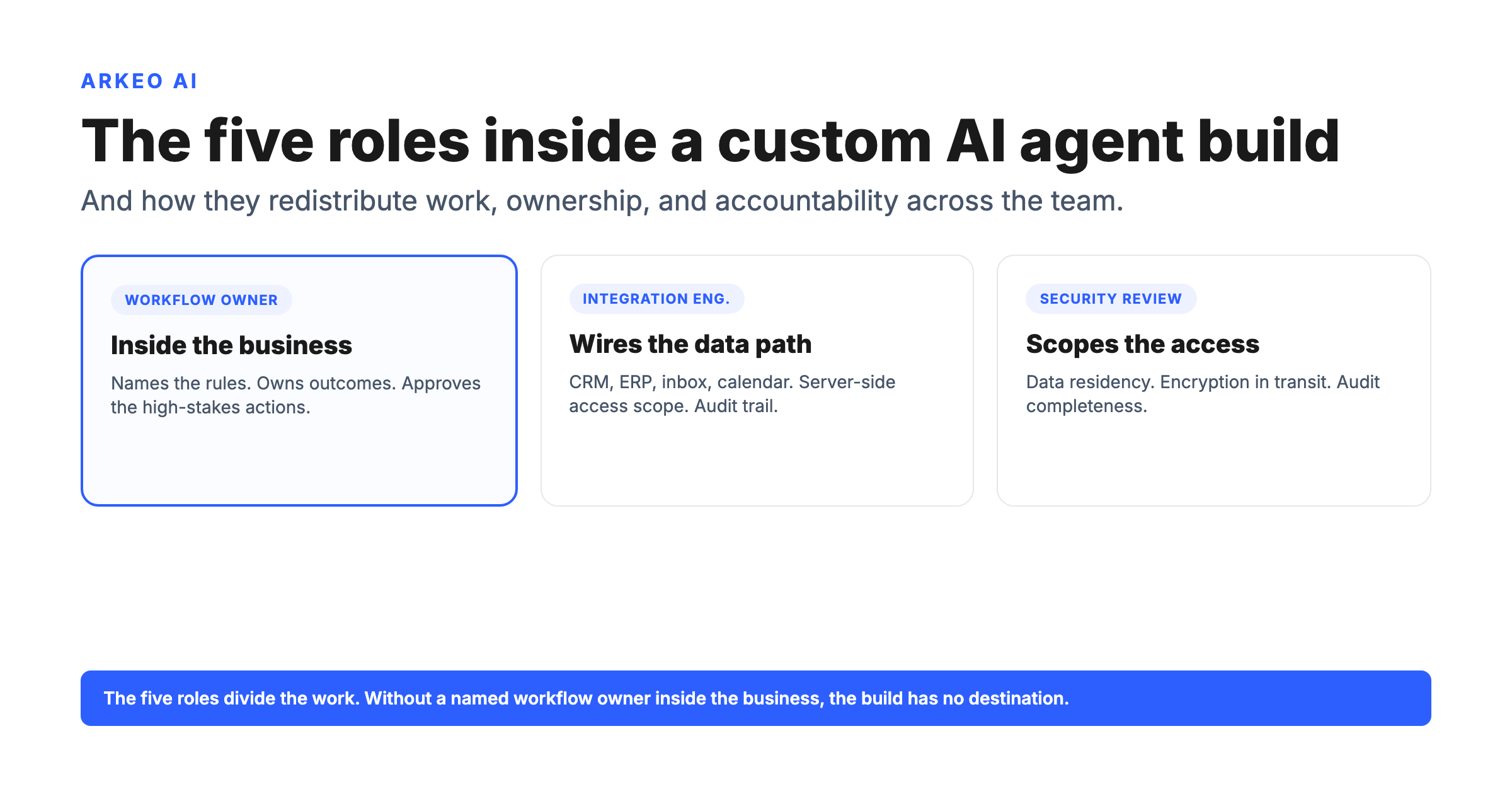
Not which team. Not which function. Which person — by name and job title — is accountable for the production performance of that workflow 90 days from now?
The IBM CEO Study found 54 percent of CEOs already hiring for AI roles that did not exist a year ago. For most businesses in year one, the owner is an existing operator with a new accountability, not a new hire. The name must be in writing before the build starts. A workflow without a named owner has a sponsor. It does not have an owner. Sponsors celebrate launches. Owners run Monday-morning reviews and catch drift before clients do.
Question 3: Where does its data live?
This is the question that kills the most AI initiatives at the vendor security review rather than at the strategy table where it belongs. The answer is binary: cloud or private. Cloud means the data leaves the building. Private means it does not.
The decision must be signed off by legal or security before the build starts. Made at week two, it costs a meeting. Made at week twelve when the pilot is already built against the wrong model, it costs two quarters. In Arkeo's build experience, the data-path decision at week two is the single highest-leverage action a business leader can take in the first month of an AI initiative.
Question 4: What is the baseline we are beating?
The baseline is the manual performance benchmark the AI workflow is measured against. Time to complete the task. Error rate. Escalation rate. The baseline must be measured before the build starts. An AI workflow that is evaluated against an estimated baseline at launch will be re-evaluated six months later when someone questions the ROI. A workflow evaluated against a measured baseline at launch has a defensible result at every board meeting.
The Deloitte State of Generative AI study found organizations that measured a baseline before deployment were three times more likely to report a measurable productivity gain than those that estimated the baseline after. The difference is the rigor of the measurement, not the performance of the model.
The operator test: For the workflow you named in question one, do you have a measured baseline — time, error rate, or escalation rate — that the AI agent will be compared against at day 90? If the baseline is an estimate, the day 90 result will be contested.
Question 5: What is the kill date if it fails?
Kill criteria are the most uncomfortable question in the room and the most important one. A pilot without kill criteria does not end. It accumulates cost until a senior leader with political capital writes it off or a new leadership team inherits the liability.
The kill criteria are one sentence: if this workflow does not achieve a specific measurable result by a specific date, the pilot halts. Written at kickoff, agreed by the executive sponsor and the named owner, signed before the build starts. The sentence costs nothing. The absence of it costs $400,000 and fourteen months on average, based on the pattern Arkeo sees when businesses come to us after a pilot that ran too long without a gate.
Question 6: Who runs it on a Monday morning?
This is a different question from question two. The owner named in question two is the accountability holder. The Monday-morning operator may be a different person: a team lead, a process manager, or a department head who runs the weekly review, checks the override rate, and escalates when the agent drifts.
The Monday-morning operator must be named before go-live. A workflow that goes live without an on-call rotation is a demo that has been left running. The escalation path — who the Monday-morning operator calls when something is wrong, and who that person calls — must be documented in writing. This is not bureaucracy. It is the document that makes a 3 AM drift event recoverable rather than a client-facing failure.
Question 7: What does the board see at the end of Q1?
The board does not need a platform update or a maturity score. It needs one metric per quarter that proves the quarter shipped: workflow chosen and data-path approved (Q1), agent beats baseline on real data (Q2), workflow in production with volume and override rate tracked (Q3), second and third workflows shipping faster than the first (Q4).
The four-quarter board metrics are in the 12-month roadmap guide. The 90-day calendar that populates Q1 is in the 90-day plan guide. Question seven is not a reporting question. It is a discipline question. A leader who can answer it before Q1 begins has a plan. A leader who cannot has a pilot portfolio.
The operator test: Can you answer all seven questions right now, in one sentence each? Write them down. The questions you cannot answer in one sentence are the decisions that are currently blocking your AI initiative.
The free AI Assessment works through the workflow shortlist, the data-path decision, and the Q1 board metric in a single working session. You leave with the answers to questions one, three, and seven.
Book Your Free AI Assessment →Frequently Asked Questions
The free AI Assessment answers questions one, three, and seven in a single session: which workflow ships first, where its data lives, and what the board sees at the end of Q1.
Book Your Free AI Assessment →