Category
Practical AI Strategy for Business: Four Decisions Before the Build Starts
Last updated: June 2026
By David Brennan · Arkeo AI · Building and Deploying Custom AI agents since 2023
A practical AI strategy is not a document. It is a set of decisions that a build team can act on without asking you a clarifying question.
Most AI strategies fail the practicality test. They articulate a vision, map the opportunity landscape, and describe what success looks like at year three. None of that gets a workflow into production. A practical AI strategy does four things: names the first workflow, decides where the data lives, names who runs the deployed workflow, and sets the date by which it is in production. That is it. Everything else is optional at the start.
Here is what that looks like in practice, with the exact decisions at each step.
Quick Answer
What makes an AI strategy practical: It ends with four things in writing — a named workflow, a data-path approval, a named owner, and a ship date. If any of the four is missing, the strategy is not practical yet.
What to do first: Run the current-state map. Score your candidate workflows against volume, pain, and data-readiness. The top candidate is your first workflow.
Next step: The free AI Assessment runs the current-state map, produces the workflow shortlist, and resolves the data-path question in one working session.
The free AI Assessment produces the four things an AI strategy needs to be practical: the workflow, the data-path approval, the owner, and the ship date, in a single working session.
Book Your Free AI Assessment →The gap between AI strategy and practical AI strategy
Most businesses have an AI strategy in some form: a board presentation, an innovation roadmap, a set of vendor evaluations, a list of use cases from a workshop. What most businesses do not have is a practical AI strategy — a set of decisions specific enough to start a build sprint on Monday morning.
The Deloitte State of Generative AI study found more than two-thirds of organizations expecting 30 percent or fewer of their AI experiments to scale. BCG found 74 percent struggling to capture value. The gap is not between aspiration and effort. It is between strategic documents and operational decisions. A practical AI strategy bridges that gap by specifying the four decisions that make building possible.
The enterprise AI strategy article covers the full framework. The AI strategy framework guide covers the five-component decision structure. This article is the ground-level practical guide — the four decisions in the order you make them, with the exact questions to answer at each step.
The operator test: Hand your current AI strategy document to your build team and ask them what to start building on Monday. If they cannot answer without a clarifying conversation, the strategy is not practical yet. The four decisions below are what they need.
Decision 1: Name the first workflow
The current-state map produces this decision. Run a one-hour session with the three or four people who run the most labor-intensive processes in the business. List every repetitive workflow that involves document review, data extraction, classification, summarization, first-draft generation, or structured data matching. Score each candidate on three criteria:
Volume: how often does this task happen per week? A task that happens 200 times a week is a better candidate than one that happens twice. Pain: what does the manual version cost, in hours per week or error rate per run? A task with a 15 percent error rate and four hours of correction time per day is a better candidate than a low-error, low-volume task. Data-readiness: is the data in a format the business can actually approve for AI access, on the data path the security team will sign off on?
The top candidate after scoring all three criteria is the first workflow. Write it down in one sentence. Not a category. Not a domain. A specific workflow: invoice matching between incoming PDFs and the three-ERP environment, brief generation from the creative team's written briefs, or compliance clause flagging on contract drafts over $100K. That level of specificity is decision one.
The sequencing logic for which cluster of workflows to prioritize across the 12-month horizon is in the sequencing guide.
Decision 2: Approve the data path
This is the most consequential practical decision in an AI strategy and the most commonly deferred one. Cloud or private. Made in writing, signed off by legal or security, before the build starts.
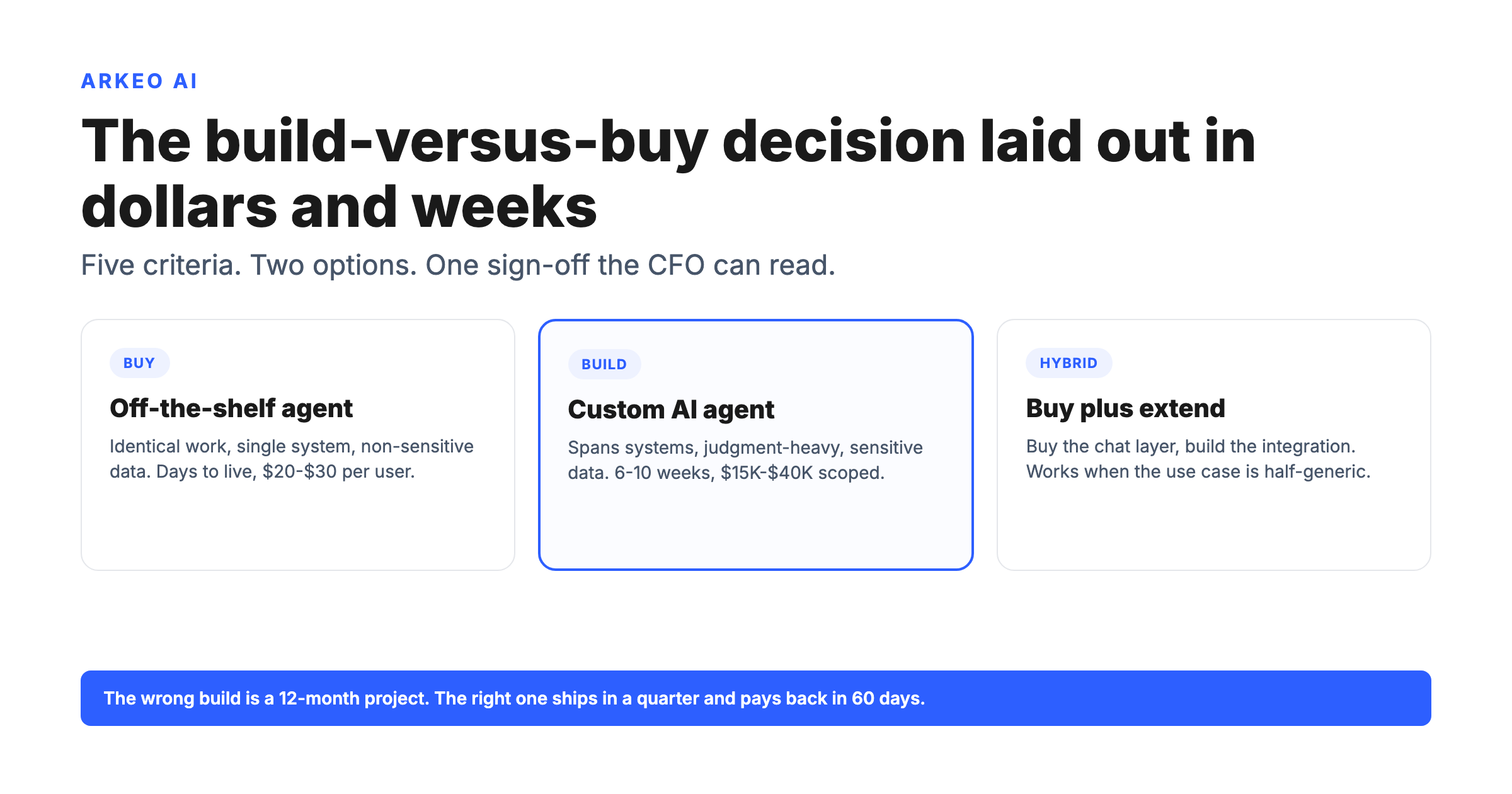
Cloud: the data leaves the building and is processed under the vendor's terms. Lower build cost, faster deployment, higher data compliance risk in regulated environments. Private: the model runs on the organization's own infrastructure and the data never leaves. Higher build cost, slightly longer deployment, lower data compliance risk, reusable security review for every subsequent workflow.
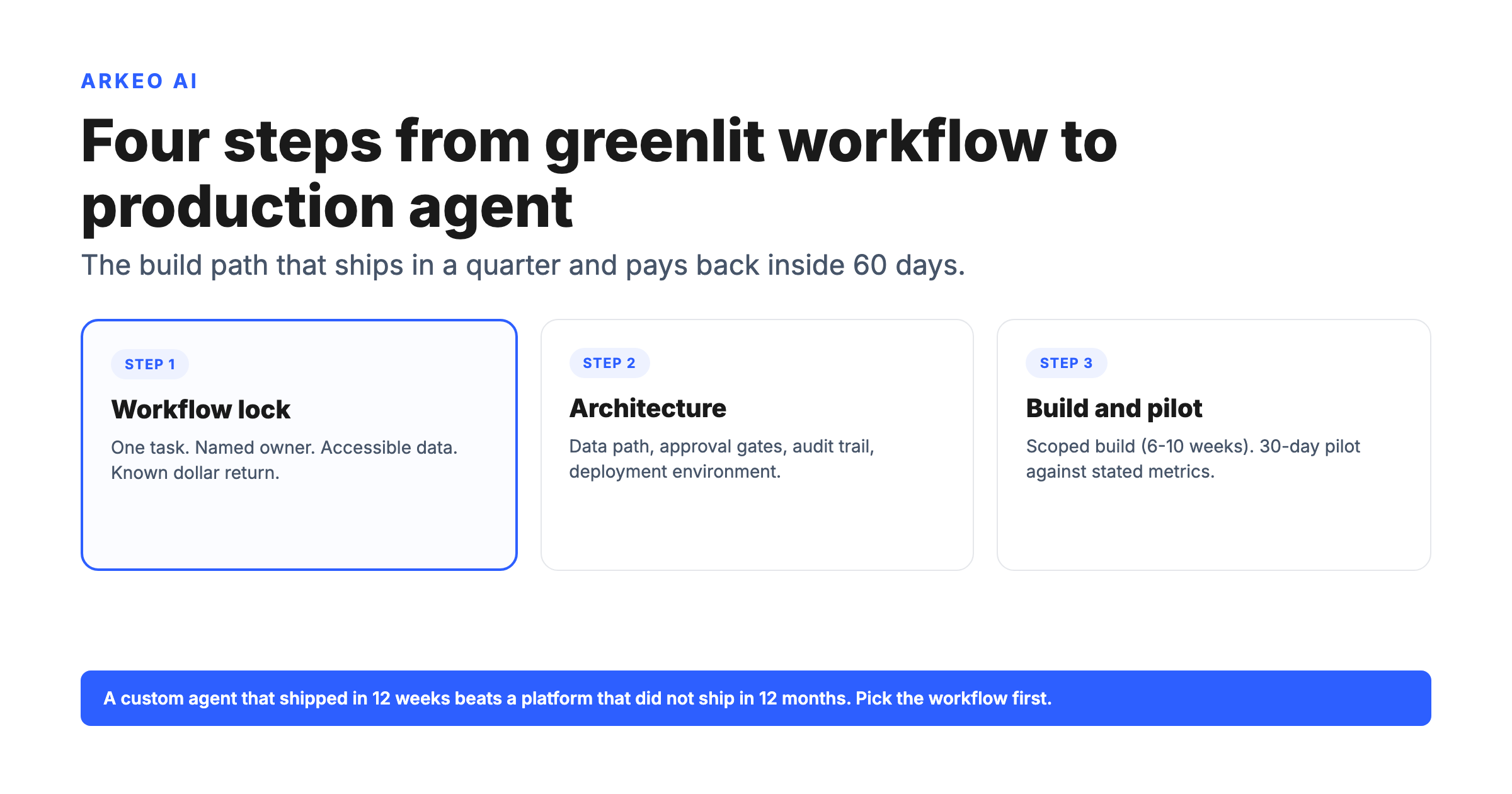
In Arkeo's build experience, a scoped single-workflow agent runs $15,000 to $40,000 and reaches production in six to ten weeks on a cloud path, or eight to twelve weeks on a private path. The practical decision for most businesses is: what is the data sensitivity of the first workflow, and what will the security team actually approve? Build the strategy around the answer to that question, not around the vendor's preferred deployment model.
The IBM Cost of a Data Breach 2025 report found 97 percent of AI-model breaches involved organizations lacking proper AI access controls. The data-path decision is not a detail. It is the decision that determines the compliance posture of every workflow in the business for the next 12 months. Make it at the strategy table. Do not let it surface at the vendor security review.
The operator test: Has the data-path decision for the first workflow been made in writing and signed off by legal or security? If the answer is not a written approval, the build cannot start without introducing re-platform risk.
Decision 3: Name the owner
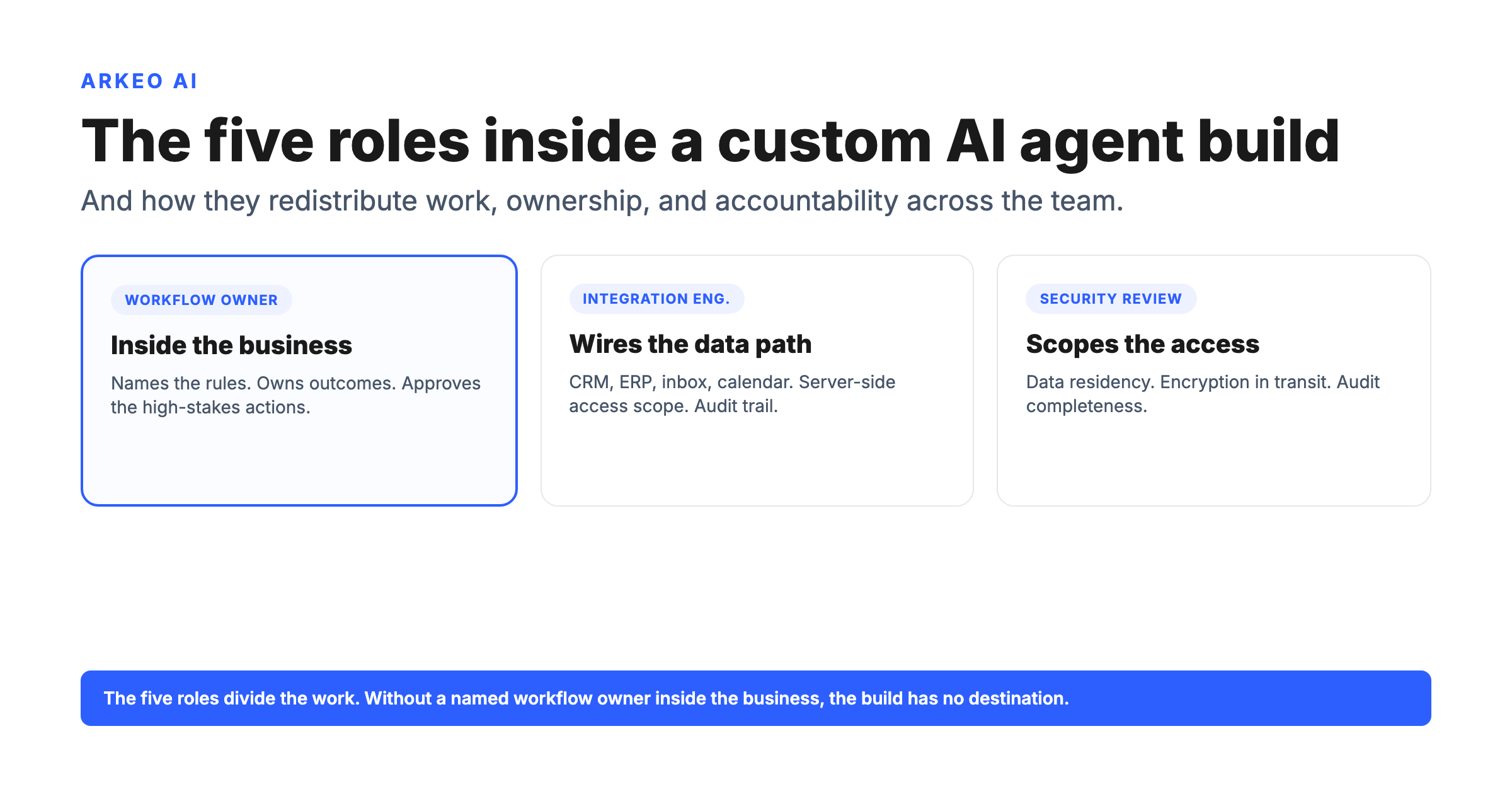
One person. One job title. Accountable for the production performance of the first deployed workflow. Not the innovation team. Not the COO's office. Not a committee. One person whose name is on a document that says: this workflow is in production, I am responsible for its results, and here is what I will do if it drifts.
For most businesses under 500 people in year one, this is an existing operator with a new accountability. It becomes a part-time addition to their current role for the first 90 days, then a smaller ongoing allocation as the operating rhythm stabilizes. The IBM CEO Study found 54 percent of CEOs already hiring for AI roles that did not exist a year ago. That hiring happens after the workflow is in production and the business knows what the operational requirements actually are. Naming the owner before the build is not a hiring decision. It is an accountability decision.
The owner registry structure — executive owner plus operational owner plus escalation path — is covered in the corporate AI strategy guide.
Decision 4: Set the ship date
The ship date is not the go-live date. It is the date by which the workflow is in production with a named operator running weekly reviews and a measured result against the baseline. For a first deployment on a cloud path, that is 60 to 90 days from the end of the data-path decision. For a private path, it is 80 to 100 days.
The ship date also implies the kill date: if the workflow is not in production by this date with a measurable result against the baseline, the pilot halts and the team picks the second candidate from the shortlist. The kill date is written alongside the ship date. Both are in the strategy document before the build starts.
The PwC AI Agent Survey found 66 percent of agent adopters reporting measurable productivity gains. The organizations in that 66 percent ran against a ship date with kill criteria. They did not let the pilot run indefinitely.
THE PRACTICAL CHECKLIST
Four decisions in writing before the build starts
☐ Workflow named: One specific workflow, one sentence, describing the exact task and the volume it runs at.
☐ Data path approved: Cloud or private, signed off in writing by legal or security.
☐ Owner named: One person's name and job title, accountable for production performance.
☐ Ship date set: The date by which the workflow is in production with a measured result, plus the kill date if it is not.
If any of the four boxes is empty, the strategy is not practical yet.
What happens after the four decisions are made
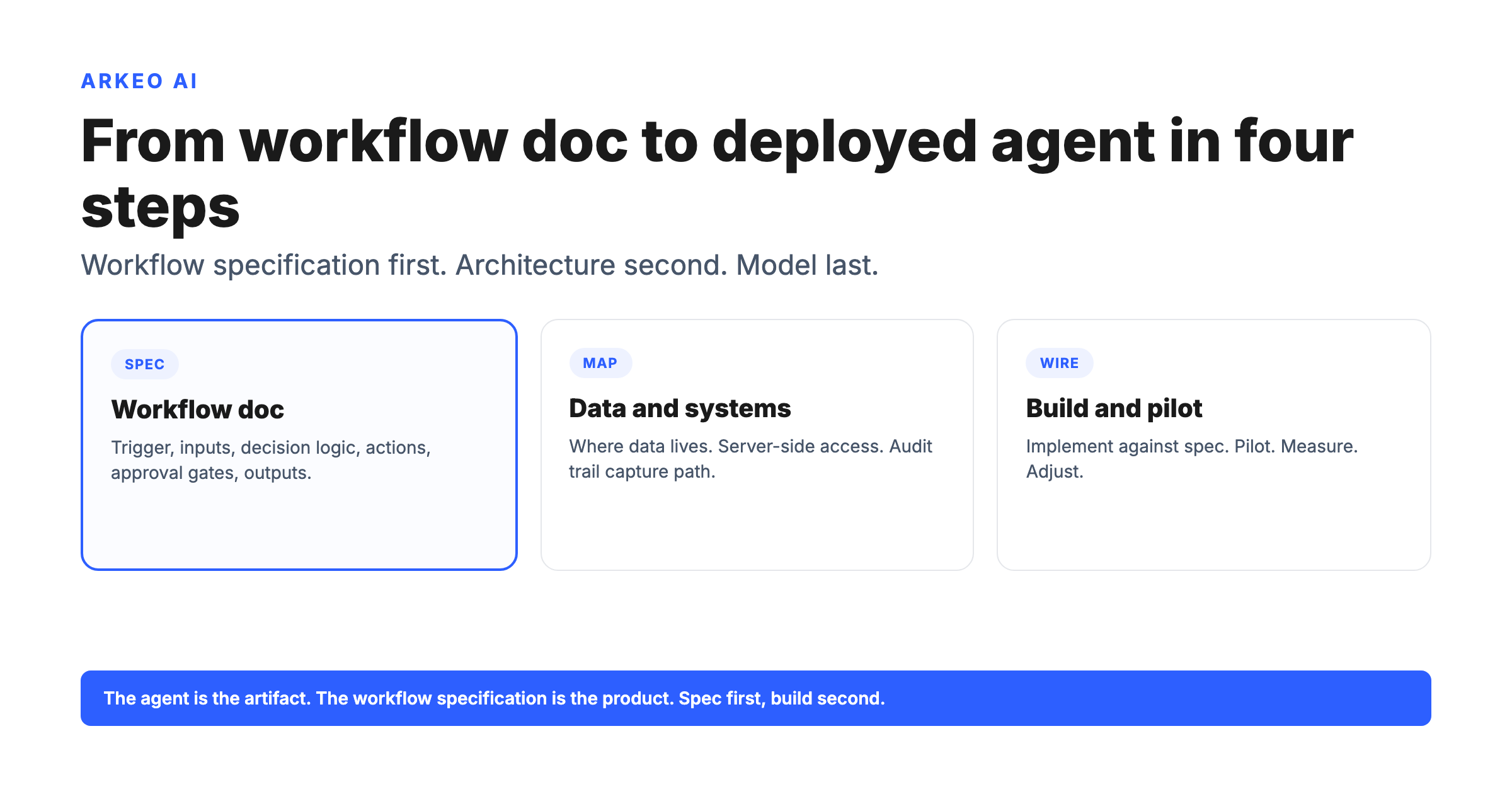
The build team starts. The current-state map from decision one goes to the build partner as the workflow brief. The data-path approval from decision two tells the build partner which model architecture to use. The owner from decision three is notified that they will begin the Monday-morning review protocol on the ship date. The kill criteria from decision four are filed with the executive sponsor.
At day 90, one workflow is in production. The data path, the security review, and the monitoring setup are documented. The second workflow reuses all three. The third workflow reuses them again. Each subsequent deployment is faster and cheaper than the first. That is what a practical AI strategy produces: not a roadmap, not a transformation vision, not a maturity score. It produces the first workflow in production by a specific date, and the pattern that makes the second and third faster.
The free AI Assessment produces the workflow shortlist, the data-path decision, and the first gate questions in a single working session. You leave with the four decisions your build team needs to start Monday.
Book Your Free AI Assessment →Frequently Asked Questions
The free AI Assessment closes the four decisions your build team needs to start: the workflow, the data path, the owner, and the ship date. One working session, one page, Monday-ready.
Book Your Free AI Assessment →