Category
How Is AI Used in Construction? | 2026 Guide for Contractors
Last updated: April 2026
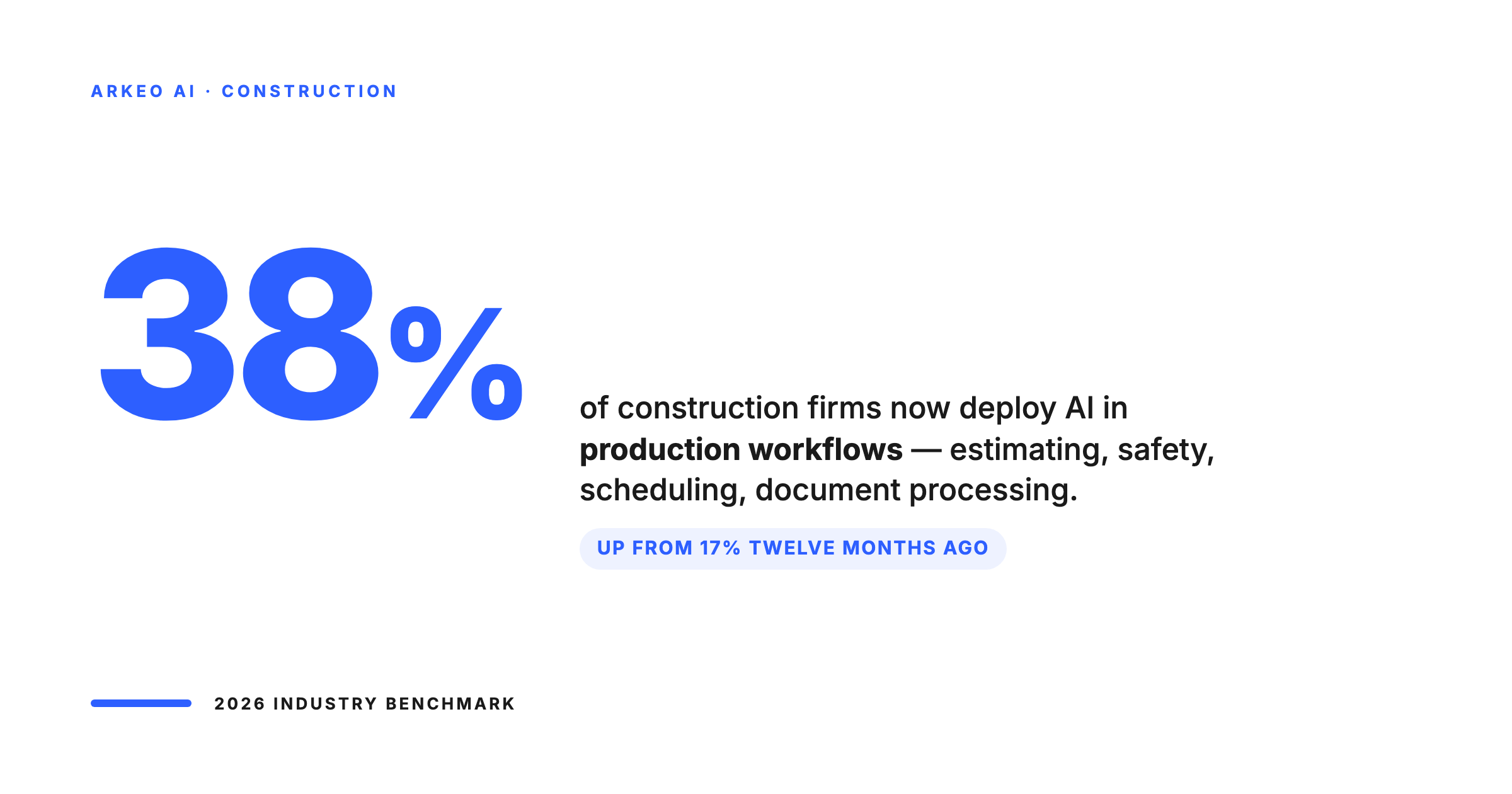
AI adoption in construction doubled in a single year. That is not a forecast. ServiceTitan's 2026 Commercial Specialty Contractor Report puts the number at 38%, up from 17% in 2025. The firms using it are bidding more accurately, catching safety hazards before someone gets hurt, and delivering projects 20% faster. The firms not using it are watching the gap widen while their estimators paste bid details into ChatGPT on personal accounts nobody approved. AI in construction means using machine learning, computer vision, and natural language processing to automate estimating, monitor job site safety, predict scheduling risks, and process documents: turning operational data into decisions that used to require hours of manual review.
Where AI Adoption Stands in 2026
The data tells two stories at once. On one hand, adoption is accelerating faster than anyone predicted. On the other, the vast majority of firms have not started.
An ASCE survey of AEC professionals found that only 27% use AI in their operations. But of that 27%, 94% plan to increase usage in 2026. The early adopters are not experimenting anymore. They are doubling down because the results are measurable.
The AI in construction market reached $2.18 billion in 2026 (Precedence Research), projected to hit $20.6 billion by 2034. That is a 29.4% compound annual growth rate. But market size numbers do not tell the full story. McKinsey's State of AI research adds a sobering qualifier: no more than 10% of companies in any function have actually scaled AI into their core operations. The rest are stuck in pilot mode, running proof-of-concept projects that never make it into daily workflows.
The labour shortage is accelerating the urgency. The United States needs 499,000 new construction workers in 2026. Canada faces a projected shortfall of 108,000 workers, with nearly one in five existing workers expected to retire within the next decade. When you cannot hire enough people, you need to make the people you have more productive. That is not an AI marketing pitch. That is the operational reality for every contractor looking at project backlogs that already stretch eight months.
For contractors running firms with 50 to 500 employees, the question is no longer "should we use AI?" It is "where do we start, and how do we avoid the 90% that never get past the pilot?"
Construction AI adoption more than doubled in twelve months
The share of construction firms using AI in production workflows jumped from 17 percent to 38 percent in the year ending 2026. That is a step-change, not a slow climb.
of construction firms reported any production AI deployment. Most pilots stalled before reaching daily workflows.
deploy AI in production workflows across estimating, safety, scheduling, and document processing.
How AI Is Transforming Construction Estimating
Estimating is where AI delivers the fastest, most measurable return in construction. ServiceTitan's 2026 report found that 24% of construction firms now use AI for cost estimation and 22% for bid management. The reason is straightforward: automated estimating systems are hitting 85% to 90% accuracy compared to manually prepared estimates, and they do it in minutes instead of half a day.
The technology works through computer vision. AI reads architectural drawings, automatically detects and measures quantities (walls, openings, floor areas, pipe runs), and generates baseline cost estimates. Tools like Togal.AI claim to automate 93% of the takeoff process with 97% accuracy. Those are vendor-reported numbers, and your mileage will vary depending on drawing quality and trade complexity. But the direction is clear: what once required a senior estimator and two days now takes a junior estimator and two hours of review.
Varseno's 2026 industry analysis found that AI tools are cutting bid preparation time by 40-60% compared to traditional methods. For a mid-size GC bidding 10 projects a month, that is 20 to 30 hours of estimating capacity recovered. That capacity goes into bidding more projects, tightening accuracy on high-value bids, or freeing senior estimators to focus on the complex scopes where experience and judgment matter most.
Cash flow prediction is the sleeper application. AI systems can forecast revenue timing against expenses and flag problems weeks before they hit, not during the monthly reconciliation when it is already too late.
The blunt truth: Most AI estimating tools still need a human estimator reviewing the output. They are not replacing your estimating team. They are turning a two-day process into a two-hour review. The firms getting the most value treat AI as the first pass, not the final answer. The vendors who claim "fully automated estimating" are either overselling or working in narrow trades where the scope is predictable enough for automation to be trusted. For commercial GCs running complex multi-trade projects, human oversight is not optional.
For a deeper look at what is working, the tools available, and where the accuracy claims hold up, see our guide to AI for construction estimating.
The four-stage loop that compresses a half-day estimate into minutes
Modern construction estimating AI runs the same loop on every drawing set. Each stage replaces what a junior estimator used to do by hand.
Upload
Drawings, RFPs, and spec sheets land in the system. PDFs, DWGs, and BIM models.
Detect
Computer vision finds walls, openings, fixtures, and pipe runs. Quantities measured automatically.
Cost
Quantities mapped to current unit costs, labor rates, and historical project data. Baseline estimate generated.
Review
Senior estimator validates flagged items, adjusts assumptions, and signs off. Human in the loop.
AI-Powered Safety Monitoring on Job Sites
Construction leads all private industries in workplace fatalities. The Bureau of Labor Statistics recorded 1,069 construction deaths in the US in 2024. The Fatal Four (falls, struck-by, electrocution, caught-in/between) accounted for 58.6% of those deaths. These are not abstract risks. They are the reason your safety manager does not sleep well during turnaround season.
AI is changing how firms prevent incidents, not just document them after the fact. Fyld, a platform that analyses short video clips from job sites to identify safety risks and quality issues, reported 82% year-over-year growth in 2025. Contractors using Fyld report reductions in serious workplace incidents of up to 48%. Their customer base now includes Kiewit and Emery Sapp and Sons.
The larger firms are further along. Bechtel has deployed AI from Detect Technologies to identify non-use of PPE across its 18,000-person craft workforce. Skanska uses Hakimo AI for physical security monitoring at job sites. Both firms run these systems as standard operating procedure, not pilot projects.
Here is the part that should get your attention if you run a mid-size firm: as AI becomes more capable of forecasting job site risks, legal experts are arguing that firms that fail to adopt available predictive tools could face greater liability exposure after accidents. The standard of care is shifting. "We did not know" becomes harder to defend when the technology to know was commercially available and your competitors were using it.
The economics are compelling. Construction fatalities average $1.46 million each in total costs, including workers' compensation, legal exposure, and project delays. Serious injuries average $43,000. Safety programs that integrate AI monitoring consistently deliver 4x to 6x ROI. For firms in construction safety-sensitive sectors like oil and gas, where a single lost-time incident can trigger a client audit and jeopardise future contracts, the calculus is not difficult.
Industry data suggests AI-powered safety systems can reduce construction incidents by up to 40%. Combined with the labour shortage, keeping your existing workforce safe is not just a moral imperative. It is an operational one. You cannot afford to lose the people you already have.
From reactive incident reports to predictive intervention
Modern AI safety systems run a three-stage loop on the job site. The goal is not better paperwork. It is fewer of the Fatal Four incidents that account for 58 percent of construction deaths.
Detect
Cameras, wearables, and equipment sensors stream into a vision model that recognizes unsafe postures, missing PPE, and proximity violations.
Predict
Detections feed a risk model that scores the next-five-minutes likelihood of an incident, weighted by task, crew, weather, and prior near-misses.
Prevent
High-risk scores trigger an immediate alert to the foreman and a logged intervention. Patterns roll up to the safety manager for weekly training calls.
Scheduling, Project Management, and Delivery
Large construction projects typically run 20% over schedule and up to 80% over budget. That is not pessimism. That is McKinsey research. The pattern is consistent: a material delay cascades into a scheduling gap, which shifts crew assignments, which blows through a weekly budget target. By the time leadership sees it in the monthly report, the damage is done.
AI-powered scheduling changes the equation by making it dynamic instead of static. The system continuously analyses historical project data, current progress, weather forecasts, supply chain signals, and labour availability to predict where delays will occur before they happen. Autodesk reports that AI-powered platforms improve delivery times by up to 20%.
Consider the typical delay cascade on a commercial project. A material delivery slips by three days. That pushes the framing crew back, which overlaps with the electrical rough-in, which requires rescheduling two subcontractor teams. Traditionally, your PM discovers this during the weekly scheduling meeting and spends the next two days untangling the cascade. An AI scheduling system flags the delivery delay within hours, models the downstream impact automatically, and suggests alternative sequencing options before the PM's next morning standup. The difference is not that AI is smarter than your PM. The difference is speed. The cascade gets caught at three days instead of ten.
Vinci Construction saved 5,200 work-hours across 25 projects by automating progress photo analysis alone. That is not a sophisticated deployment. That is AI looking at site photos and comparing them against the schedule to flag where progress is behind plan. The intelligence is in the pattern recognition at scale, not in the complexity of the technology.
For firms running multiple simultaneous projects, the visibility gains compound. AI aggregates cost and schedule performance across your entire portfolio, identifying systemic issues: consistently underestimated concrete costs, recurring overtime patterns on a specific project type, or seasonal supply chain bottlenecks you did not know you had. That cross-project intelligence is a strategic asset. It means your next bid is informed by every project you have ever completed, not just the ones your estimator remembers.
For a detailed look at how firms are using AI for construction project management and scheduling, see our guide to AI in construction management.
Book a free 30-minute AI Assessment. We will identify your highest-impact AI use cases, estimate the time and cost savings, and outline a phased deployment plan built around your actual workflows. No obligation.
Document Processing and Administrative Automation
This is the quiet ROI machine. Every construction firm drowns in paperwork: RFIs, submittals, contract reviews, field reports, invoices, safety documentation. None of it is exciting. All of it costs hours. And those hours are expensive when your project coordinators and operations managers are already stretched across too many active projects.
Pilot firms report 30-50% decreases in administrative hours through automated field reports, invoice processing, and AI-driven dispatching. That is not a theoretical projection. Those are results from firms running AI in production.
The applications are straightforward. AI reads incoming documents (RFIs, submittals, contracts), extracts key data points, flags items that need human attention, routes documents to the right people, and generates draft responses for review. It does not replace your project coordinator. It handles the sorting, reading, and routing that consumes their first three hours every morning.
Contract review is a particularly high-value application. AI can scan construction contracts and flag non-standard clauses, onerous indemnification language, insurance gaps, and payment terms that deviate from your template. A review that takes your operations manager two hours becomes a 15-minute scan of the AI's flagged items. For a firm reviewing 20-30 contracts per month, that is 30-50 hours of operations manager time redirected to work that actually moves projects forward.
Finance teams see similar gains. Invoice processing, purchase order matching, and expense categorisation tasks that once required manual entry across multiple systems can be consolidated. Firms deploying AI in their accounting workflows report reallocating 60-70% of the time previously spent on data entry to analysis and strategic planning.
For a broader view of what AI agents can handle across business operations, including document processing, reporting, and multi-step workflows, see our guide to what AI agents actually do for business operations.
The Data Problem Construction Firms Are Ignoring
Here is the part nobody else writing about AI in construction wants to talk about: where does all that data go?
Right now, at construction firms across North America, estimators are pasting bid details into ChatGPT. Project managers are uploading schedules to cloud AI tools. Superintendents are feeding site photos into third-party analysis platforms. Every one of those interactions sends proprietary data through external servers. Bid pricing, client contract terms, margin strategies, safety records, and project specifications are flowing through systems your firm does not control and cannot audit.
A 2025 Gartner survey found that 69% of organisations suspect or have evidence that employees use prohibited AI tools with company data. In construction, that means your win rates, your pricing strategy, and your client relationships are potentially sitting on someone else's servers.
The problem is particularly acute for firms bidding on government or institutional projects. Many public sector contracts include data residency requirements that prohibit processing project data on foreign servers. If your estimator is running bid numbers through a US-based AI tool and the contract requires Canadian data residency, you may be in breach before you even submit the proposal. Most firms do not even know this exposure exists until they get asked about it in a pre-qualification questionnaire.
Most firms think the AI risk is that the technology will not work. The real risk is that it works too well, and your team has already adopted it on channels you do not control.
Private AI changes the equation. When AI models run on your own infrastructure, data never crosses your network boundary. There is nothing to leak, nothing to subpoena from a third party, nothing to worry about when a client asks where their project data is processed.
The compounding benefit matters for construction specifically. A private AI system trained on your bid history, your project data, and your cost patterns gets smarter with every project you complete. After 50 projects, it knows your regional market dynamics better than your senior estimator's memory. After 200 projects, it identifies subcontractor pricing patterns, seasonal cost fluctuations, and scope creep predictors that no human could track across that volume. That intelligence belongs to you permanently. It does not get diluted across thousands of other firms using the same cloud platform. It becomes a competitive moat that deepens with every project you complete.
For the full cost analysis of cloud versus private deployment, including hardware specs, break-even timelines, and per-token cost comparisons, see our cloud AI vs on-premise AI comparison.
Where your construction data lives matters more than which model you pick
Two architectures, two very different risk profiles. The drawings, RFPs, bid history, and project financials you feed into an AI either leave your building or they do not.
Sent to a vendor
Stays in your environment
Why Most Construction AI Projects Stall
Despite the results early adopters are seeing, a Bluebeam survey found that 45% of construction firms have no AI implementation at all. The barriers are not primarily financial. Bluebeam CEO Usman Shuja put it directly: "The biggest barriers to AEC technology adoption in 2026 aren't cost. They're complexity, culture, and connection."
Three patterns account for most stalled AI projects in construction:
No executive ownership. AI projects that live inside IT or innovation departments struggle to get the cross-functional cooperation they need. BCG's 2026 survey found that 72% of CEOs now see themselves as the primary AI decision-maker. The firms where AI actually works have a senior leader who ties every initiative to a specific business outcome, not a technology experiment.
Starting too broad. "Let's implement AI across the company" sounds strategic. In practice, it creates complexity, delays, and scepticism. The firms seeing real results start with one high-friction workflow (estimating, safety reporting, or document processing), prove the ROI within a single project cycle, and expand from there.
Ignoring data readiness. AI is only as good as the data it runs on. Firms that skip the foundational work of organising and centralising project data end up with AI that produces unreliable outputs. Unreliable outputs destroy team trust. Dead trust kills adoption. The good news: modern AI systems are designed to work with imperfect data. You do not need a pristine database. You need data that is accessible and consistent enough for the AI to find patterns.
Gartner's research paints a sobering picture of the broader AI failure rate: they project that 40% of agentic AI projects will be cancelled or scaled back by 2027. Construction firms that approach AI as a technology experiment rather than a business integration project are the ones most likely to end up in that 40%. The successful pattern is treating AI as a workflow change that happens to use software, not a software project that happens to affect workflows.
Where to Start: A Practical Framework
The construction firms pulling ahead are not doing anything exotic. They are taking a structured approach that starts small and compounds.
Step 1: Audit your current AI exposure. Before you deploy anything, find out what your team is already using. If estimators are on ChatGPT and PMs are using AI scheduling tools, your data is already flowing through external systems. Understand the scope before you decide the solution.
Step 2: Pick one high-friction workflow. Not three. Not "let's see what AI can do." Pick the task that everyone complains about, that takes too long, and that has measurable output. Estimating, safety documentation, and RFI processing are the most common starting points because the data already exists and the ROI is visible within a single project.
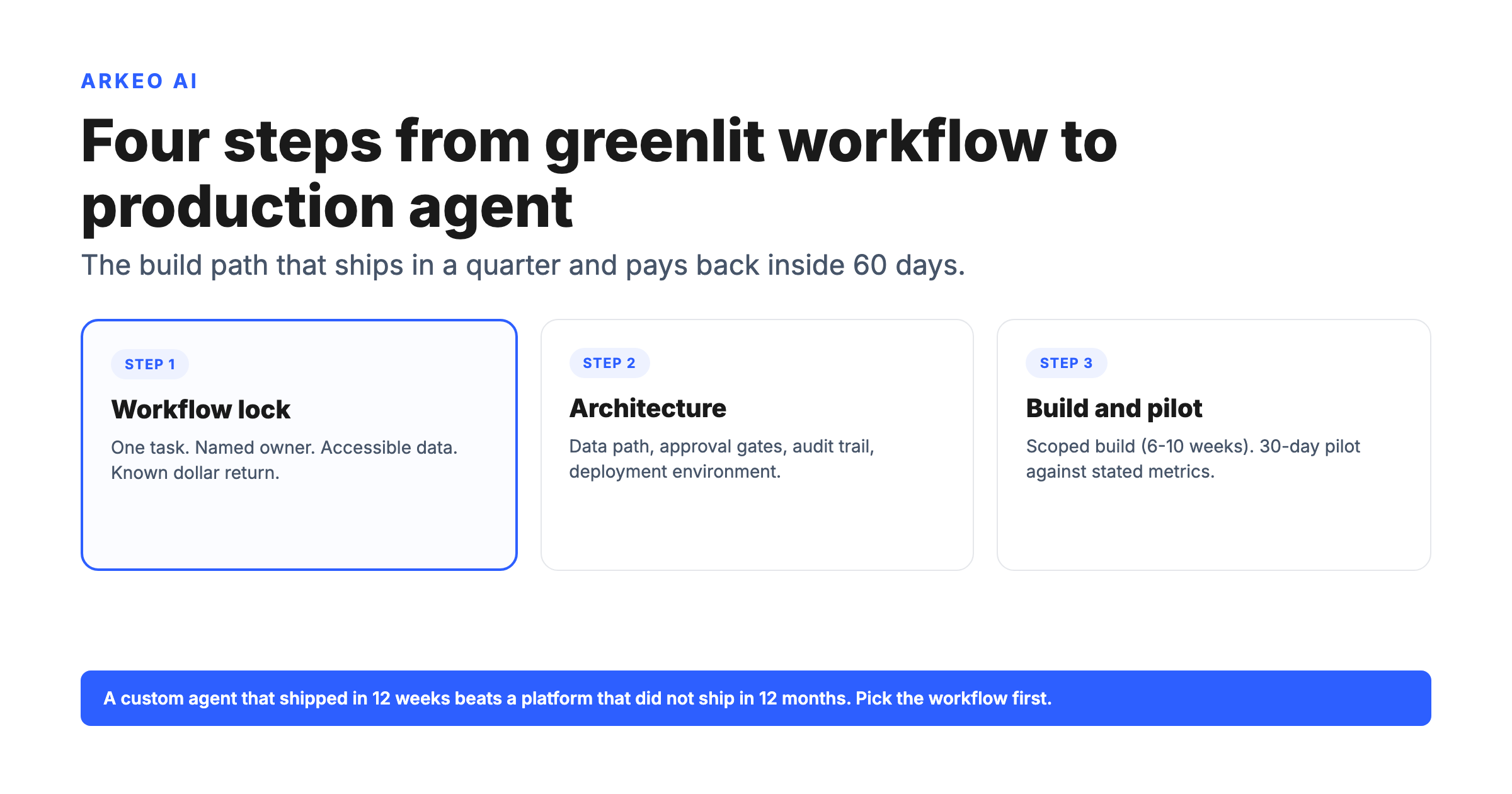
Step 3: Pilot for 30-60 days. Run the AI alongside your existing process. Measure the before and after: time per bid, hours on admin, incidents flagged, documents processed. Use those numbers to build the business case for expansion.
Step 4: Decide cloud vs private. If your data includes client information, bid pricing, or anything competitively sensitive, consider deploying on your own infrastructure. The hardware starts at $79,000, breaks even against cloud API costs in as little as 4 months at steady usage, and your competitive intelligence stays inside your building. For mid-market firms processing AI at operational scale, private deployment is increasingly the default choice.
The firms that execute this framework well share a common trait: they treat AI as a business change project with a technology component, not the other way around. The technology is the easy part. Getting your estimating team to trust the output, getting your PMs to check the dashboard instead of doing manual schedule reviews, getting your safety team to act on AI-flagged hazards with the same urgency as a human report: that is where AI deployment succeeds or fails. The good news is that construction workers are practical people. Show them a tool that saves them two hours of takeoff work or catches a safety issue they would have missed, and adoption takes care of itself.
Arkeo deploys and manages private AI systems for mid-market companies, including construction firms that need their operational data to stay on their own infrastructure. Book a free 30-minute assessment. We will map your highest-impact use cases, size the infrastructure, and give you a realistic timeline.
Book Your Free AI Assessment →
Frequently Asked Questions
Frequently asked question
What is the ROI of AI in construction?
Early AI adopters in construction reclaim 500 to 1,000 hours on critical tasks like scheduling, planning, and document analysis (Bluebeam 2025). AI-powered estimating systems achieve 85-90% accuracy and cut bid preparation time by 40-60%. AI-driven projects complete 15-20% faster than traditional approaches (Autodesk). 89% of early adopters report measurable profitability gains.
Frequently asked question
How much does AI cost for a construction company?
Cloud AI tools charge per use, typically $3-60 per million tokens processed. Private on-premise deployment requires hardware investment ($79,000-335,000 for a production inference cluster) but eliminates per-use costs and keeps your data on your network. At steady operational usage, on-premise infrastructure breaks even against cloud in as little as 4 months and costs up to 18 times less per token over a 5-year lifecycle.
Frequently asked question
Will AI replace construction workers?
No. The US construction industry needs 499,000 new workers in 2026, and Canada faces a 108,000-worker shortfall. AI multiplies existing workforce capacity by automating administrative tasks, improving estimating speed, and enhancing safety monitoring. It does not replace the skilled trades. The firms deploying AI are using it to do more with the people they already have, not to reduce headcount. For a broader perspective, see our analysis of whether AI will take over construction.
Frequently asked question
What are the risks of using AI in construction?
The biggest risk is data exposure from shadow AI: employees using unauthorised cloud AI tools with company data. A 2025 Gartner survey found 69% of organisations suspect this is happening. Other risks include over-reliance on unverified AI outputs (always have a human review), vendor lock-in from proprietary platforms, and the cost of failed implementations that start too broad. Mitigation: audit your current AI exposure, start with one workflow, and consider private deployment for sensitive data.
Frequently asked question
How long does it take to implement AI in construction?
A single-workflow deployment (estimating, safety monitoring, or document processing) takes approximately 2-4 weeks from setup to production. Multi-workflow deployments across several operational areas typically take 2-3 months. The bottleneck is business integration and change management, not technology setup. The recommended approach is starting with one high-impact workflow, proving the ROI within a single project cycle, and expanding from there.