Category
Cloud AI vs On-Premise AI: Which Is Right for Your Business?
Last updated: April 2026
Your team is already using AI. The question is whether you chose that, or whether it just happened. Cloud AI uses external servers and APIs to run models on someone else's infrastructure, while on-premise AI runs models on hardware you own and control inside your building. Sixty-nine percent of organisations already suspect their employees are feeding company data into unauthorised cloud AI tools. That is not a technology problem. That is a data governance crisis you are funding by the token.
⚡ Quick Answer
- Cloud AI: Pay-per-use APIs ($3-60 per million tokens). Fast to start, zero hardware. But costs scale linearly with usage and your data leaves your building.
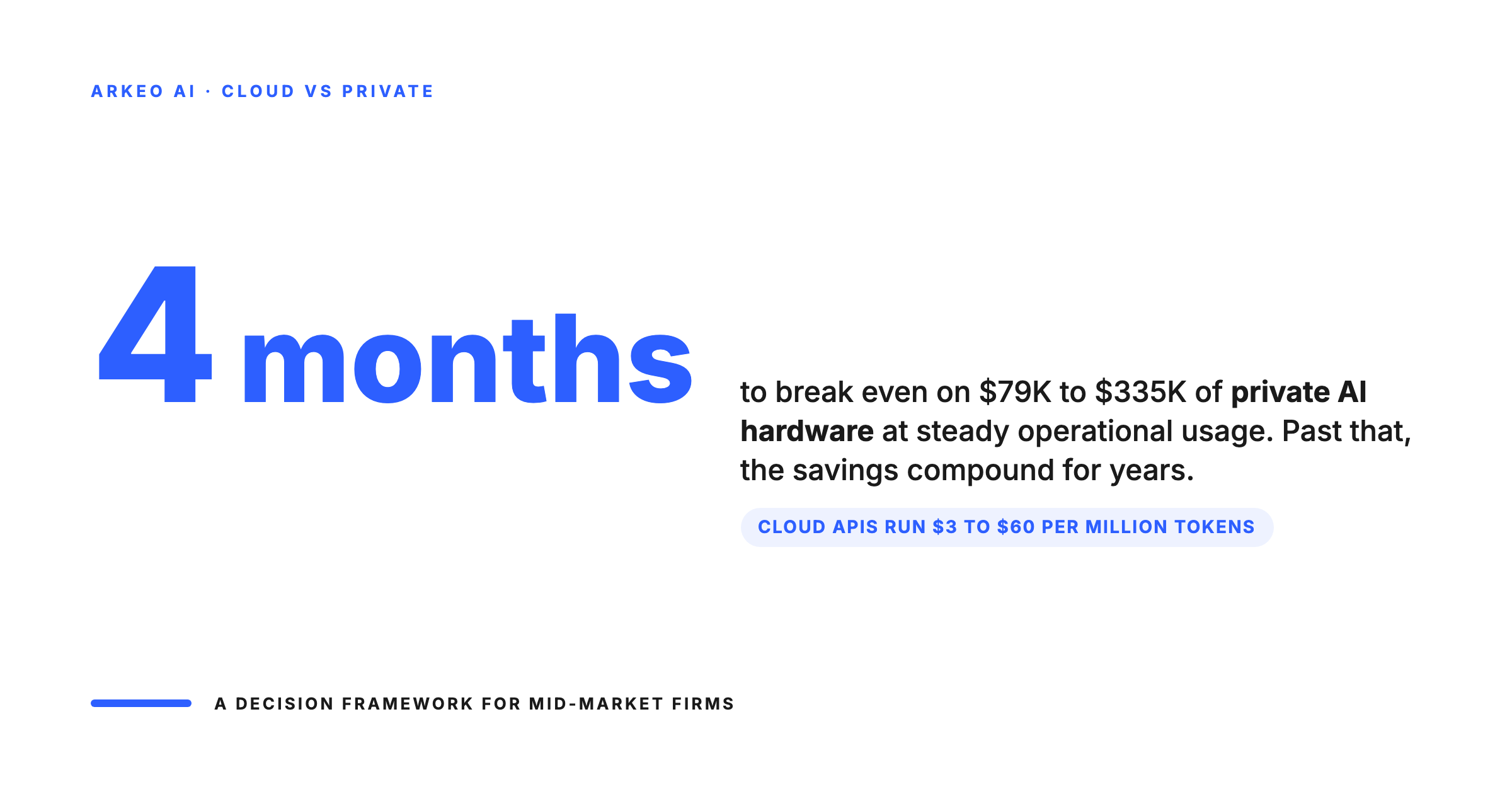
- On-premise AI: Own the hardware ($79,000-335,000 for inference clusters). Higher upfront cost, but breaks even in as little as 4 months at steady usage. Your data never leaves.
- The real question: How much AI will you use? Light, experimental use favours cloud. Steady operational use favours on-premise. Most mid-market companies cross the threshold faster than they expect.
- Hidden cost: Shadow AI (employees using free tools without IT oversight) is the most expensive option of all. You pay in data exposure, not dollars.
Why This Decision Matters More Than You Think
Most businesses treat cloud vs on-premise AI as a technology choice. It is not. It is a financial and data governance decision that compounds over time.
Cloud AI pricing follows the SaaS playbook: low barrier to entry, costs that scale with success. A team processing 10 million tokens per month pays roughly $90-200 depending on the provider. That is manageable. But organisations running AI at operational scale, processing 1-10 billion tokens monthly, face monthly API bills of $9,000 to $200,000. The more value you extract from AI, the more you pay. Every month. Forever.
On-premise reverses that equation. The upfront cost is real, but the ongoing cost per token drops by up to 18 times compared to cloud APIs once the hardware is running. For companies that use AI as an operational tool rather than a novelty, that difference reshapes the business case entirely.
What Does Cloud AI Actually Cost?
Cloud AI pricing is deceptively simple. You pay per token (a unit of text roughly equal to a word). The price per million tokens ranges from $3 for Google's Gemini to $60 for OpenAI's most capable models. The spread across providers is over 6x, which means provider selection alone can cut your costs in half.
Here is where it gets uncomfortable. Most businesses start with a small pilot: a chatbot, a document summariser, a drafting assistant. Monthly cost: a few hundred dollars. Then usage grows. Departments adopt it. The operations team needs it. Finance wants it. Suddenly you are processing billions of tokens, and the monthly bill looks like a lease payment on a building.
Enterprise-grade usage (5-50 billion tokens per month) translates to $45,000 to $1,000,000 per month in API costs alone. That is not a typo. And unlike a server you buy once, that bill arrives every month.
The other cost nobody quotes you: data dependency. Every prompt your team sends to a cloud API leaves your network. Client names, project details, financial data, proprietary processes. Once it is in someone else's infrastructure, your control over it is contractual, not physical.
Not Sure Which Path Fits Your Business?
Book a free 30-minute AI Assessment. We will map your current AI usage, estimate your cloud vs on-premise costs, and build a 90-day deployment roadmap. No obligation, no pitch deck.
Most cloud-vs-private debates collapse into three answers
Get the answers honestly and the choice usually makes itself. The mistake is treating AI like a hosted SaaS purchase. It is closer to a workforce decision.
Usage volume
Are you running light, experimental usage or steady daily workflows across teams?
Data sensitivity
How much of what you feed AI is regulated, confidential, or competitive intelligence?
Tool or infrastructure
Is AI helping a few people with tasks, or carrying daily operational load?
What Does On-Premise AI Actually Cost?
On-premise is honest about being expensive upfront. A cost-optimised inference cluster (8 NVIDIA L40S GPUs in 2 servers) runs approximately $79,000 in hardware. A high-performance cluster (8 NVIDIA H100 GPUs) costs around $335,000. Add 30-50% for power, cooling, networking, and storage in the first year.
Those numbers stop most mid-market companies from looking further. That is a mistake, because the comparison only makes sense over time.
At steady inference usage (above 20% GPU utilisation), on-premise infrastructure reaches break-even against cloud in as little as 4 months. After break-even, every token you generate is essentially free (minus electricity and maintenance). Over a 3-year period, the cost advantage compounds dramatically.
Most businesses think on-premise AI requires a data centre team. They are wrong. Modern deployment tools (Docker, Kubernetes, pre-built inference frameworks like vLLM and Ollama) have reduced the operational overhead to the point where a single senior developer can manage an inference cluster. You do not need five infrastructure engineers. You need one person who understands containers and GPU drivers.
The Hidden Costs Nobody Mentions
On-premise has real hidden costs. IDC research estimates 40-60% in costs beyond the initial hardware purchase: power, cooling, rack space, networking, and the time your team spends maintaining the system. An 8-GPU H100 cluster draws enough power to cost $35,000-50,000 per year in electricity alone.
Cloud has hidden costs too. Token pricing does not include the cost of prompt engineering, retry logic, rate limit management, vendor lock-in, or the organisational cost of building workflows around APIs that change pricing and capabilities quarterly.
The Data Question That Changes Everything
Here is the blunt truth most AI vendors will not tell you: the biggest risk in your AI strategy is not choosing the wrong model. It is losing control of your data.
A Gartner survey of 302 cybersecurity leaders found that 69% of organisations already suspect or have evidence that employees are using prohibited public generative AI tools. Gartner further predicts that 40% of organisations will suffer security and compliance incidents from shadow AI by 2030.
Shadow AI is the option nobody chose deliberately. Employees sign up for free ChatGPT accounts and paste in client data, project specs, financial reports. They are not malicious. They are trying to do their jobs faster.
The Hidden Risk: Your data is now sitting on OpenAI's servers, outside your governance, outside your compliance framework, and outside your control. And Gartner predicts 40% of organisations will suffer security incidents from shadow AI by 2030.
On-premise AI eliminates this vector entirely. When the model runs on your infrastructure, data never crosses your network boundary. There is nothing to leak, nothing to subpoena from a third party, nothing to worry about when regulations tighten.
The EU Data Act (effective September 2025) already extends data sovereignty requirements beyond personal data to industrial and non-personal data. Canada's privacy landscape is evolving in the same direction. Companies that move data governance left, keeping data on their own infrastructure from day one, avoid the costly retroactive compliance work that catches everyone else.
Where the data goes when you press send
Compliance, audit, and competitive intelligence are not abstract concerns. They are the difference between a sales call that closes and a procurement review that loses you the deal.
Data leaves the firewall
Data stays inside the network
When Cloud AI Is the Right Choice
Cloud AI is not wrong. It is wrong for certain use cases at certain scales. Here is when it makes sense:
- Experimentation and prototyping. You are testing whether AI solves a specific problem. You need access to frontier models (GPT-4, Claude, Gemini) without buying hardware. Budget: under $500/month.
- Burst workloads. You need massive compute for a short period (training a model, processing a large backlog) and then scale back to zero.
- Non-sensitive data. The data you are processing is public or low-risk. Marketing copy, public research summaries, general knowledge queries.
- No internal AI expertise. You do not have anyone who can manage infrastructure. Cloud gives you a working AI system without touching a server.
The Honest Answer: Most businesses start with cloud AI. And most businesses should. The mistake is staying here after your usage grows past the experimentation phase.
When On-Premise AI Is the Right Choice
On-premise AI makes sense when three conditions converge:
- Steady, predictable usage. Your team uses AI daily for operational work: document processing, reporting, communications, analysis. Usage is measured in billions of tokens per month, not millions.
- Sensitive data. You process client information, financial data, proprietary methods, or anything subject to privacy regulation. The data cannot leave your network. This applies across industries: oil and gas operators with well data, construction firms with bid packages, professional services firms with client files, and manufacturing companies with production IP.
- Long-term AI strategy. AI is not a pilot project. It is becoming infrastructure, like email or your ERP. You need predictable costs and full control.
Deloitte's research suggests the migration trigger: when your cloud AI costs reach 60-70% of the projected on-premise total cost of ownership, it is time to move. At that point, on-premise is cheaper within a year, and dramatically cheaper by year three.
We run on-premise AI ourselves at Arkeo. Our agent systems operate on private infrastructure because the data we process for clients cannot sit on someone else's servers. That is exactly the kind of analysis we walk through during our free AI Assessment: which workloads belong on your infrastructure, which belong in the cloud, and what the real numbers look like for your business. That is not a philosophical position. It is a contractual and regulatory requirement for the industries we serve.
The Decision Framework
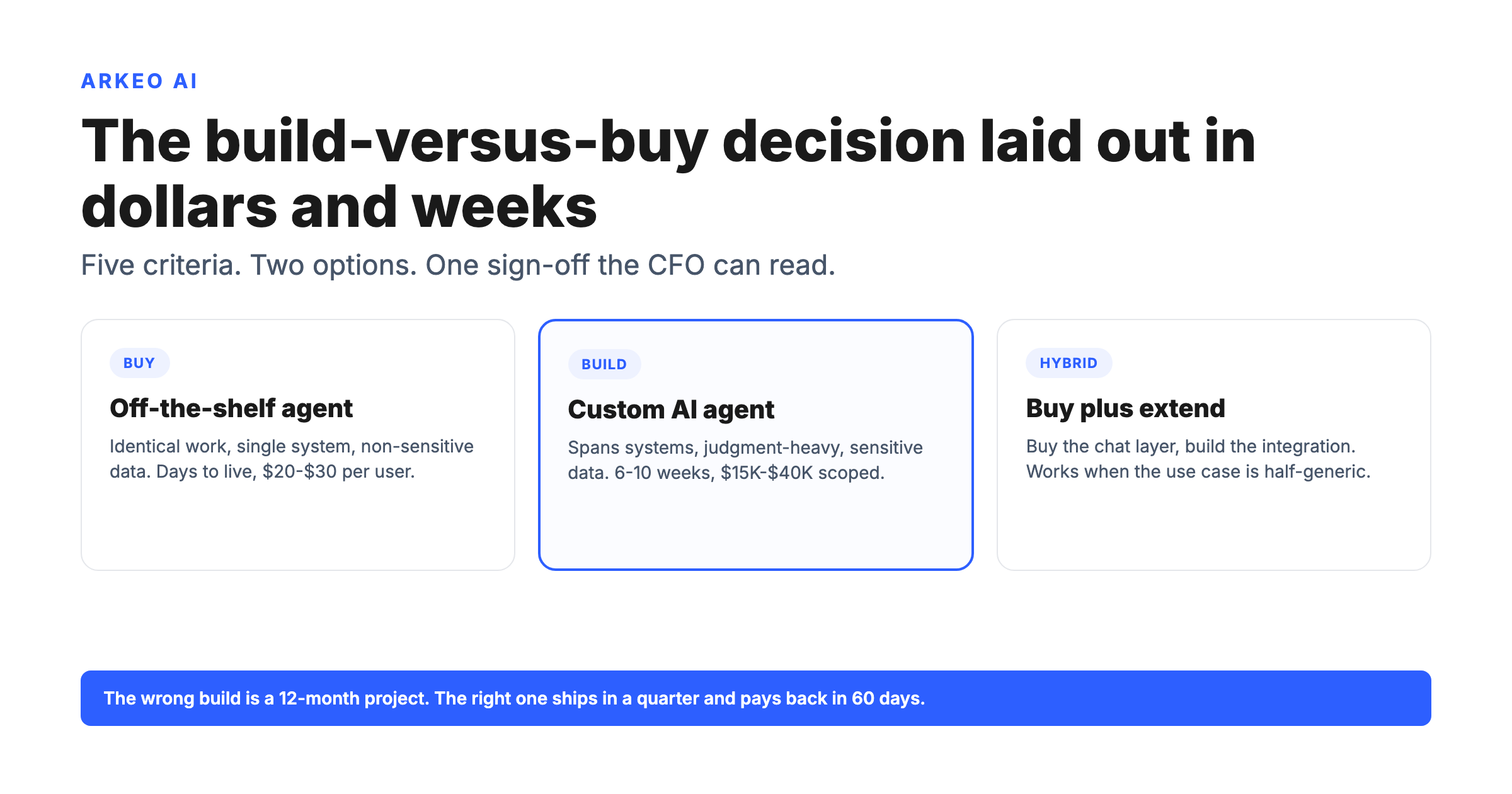
Forget the feature comparison tables. The decision comes down to three questions:
- How much AI are you using? Under 100 million tokens per month: cloud is cheaper and simpler. 100 million to 1 billion tokens: run the numbers, you may be approaching the crossover. Over 1 billion tokens: on-premise almost certainly wins on cost.
- How sensitive is your data? If your data includes client information, financial records, or anything regulated: on-premise removes an entire category of risk. No amount of cloud provider promises replaces physical control.
- Is AI a tool or infrastructure? If AI is a tool a few people use sometimes: cloud. If AI is becoming infrastructure that runs your operations — a private AI workforce handling document processing, reporting, compliance, and communications — on-premise.
The Simplest Test: You would not rent your phone system by the minute. Do not rent your AI workforce by the token.
The simplest test: how would you buy a workforce, not a tool
You would not rent your phone system by the minute. You would not staff your finance team via per-token billing. The same logic, applied to AI, gives you the answer faster than another vendor demo.
How much will you actually use?
Light or experimental? Cloud is fine. Steady operational use? The token bill becomes a recurring tax.
How sensitive is the data?
Public marketing copy? Cloud. Bid strategy, contracts, client PII, regulated work? Private, every time.
Tool or infrastructure?
Helping a few people draft emails? Tool. Running operations every day? Infrastructure, treat it like one.
The Hybrid Path
Most mid-market companies end up somewhere in between. They use cloud APIs for frontier capabilities (the latest reasoning models, specialised vision tasks) while running routine inference on-premise. This is not a compromise. It is the architecture that most closely matches how AI is actually used in operations: a few tasks need the best model available, and everything else needs a reliable, private, cost-effective workhorse. Companies across the industries we serve, from construction to oil and gas to professional services, are landing on this same hybrid pattern.
If you are leaning toward on-premise, our step-by-step deployment guide covers the hardware, software stack, and realistic timeline. For understanding why mid-market companies specifically are driving this shift, see why mid-market companies are moving to private AI. And if you want to understand what AI agents can do once they are running on your infrastructure, read about what AI agents actually do for business operations.
Ready to See the Numbers for Your Business?
Arkeo builds private AI systems for mid-market companies. No cloud dependencies, no data leaving your building, no per-token pricing. Start with a free 30-minute assessment.