Category
What AI Agents Can Actually Do for Business Operations
Last updated: April 2026
Gartner predicts that 40% of enterprise applications will include task-specific AI agents by the end of 2026, up from less than 5% in 2025. That is not a gradual shift. That is an explosion. An AI agent is software that can take actions on its own: reading documents, making decisions, triggering workflows, and completing multi-step tasks without a human clicking buttons at every stage. The difference between an AI agent and a chatbot is the difference between a colleague who does the work and a colleague who tells you what to do. When you deploy multiple agents working together across your operations, you have something more than automation: you have a private AI workforce.
⚡ Quick Answer
- What they are: AI agents are autonomous software systems that can read, decide, and act across your business tools without human intervention at every step.
- What they do: Document processing, report generation, data extraction, scheduling, client communications, compliance monitoring, and multi-step operational workflows.
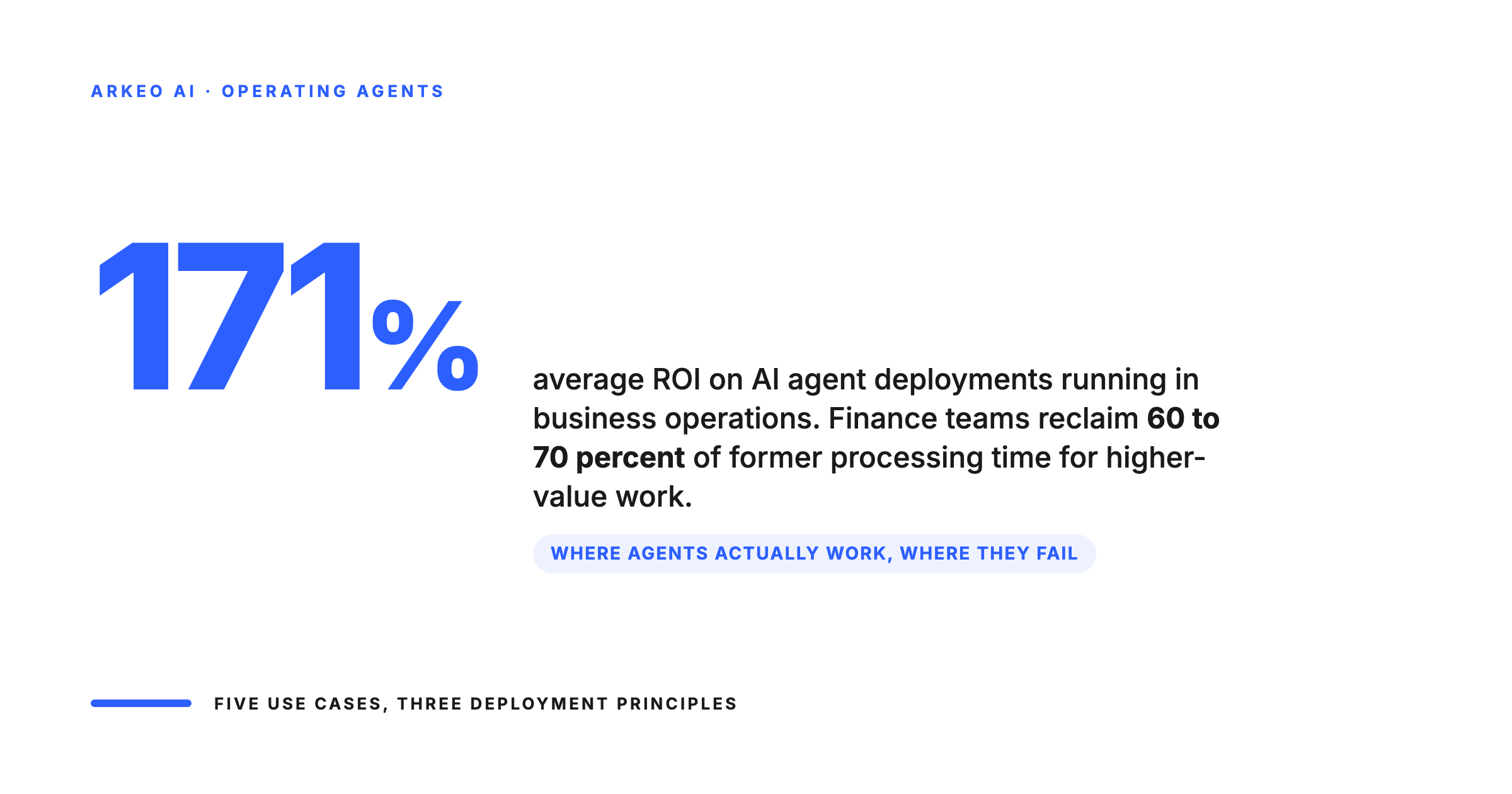
- ROI: Companies deploying AI agents report average ROI of 171%, with finance teams reallocating 60-70% of former processing time to higher-value work.
- The catch: 40% of agentic AI projects will be cancelled by end of 2027 (Gartner). The failures share one trait: they started with the technology instead of the problem.
What AI Agents Actually Are (and Are Not)
The term "AI agent" has been stretched to cover everything from simple chatbots to science fiction fantasies. For business operations, it means something specific and practical.
An AI agent takes an input (a document, a data source, a trigger event), makes decisions about what to do with it, and executes actions across your systems. It does not just suggest the next step. It takes the next step.
Examples that work today:
- A document arrives in your inbox. The agent reads it, extracts key data points, updates your project management system, flags items that need human review, and files the document. Total human involvement: reviewing the flagged items.
- A weekly report needs to be generated from three data sources. The agent pulls the data, generates the analysis, formats the report, and distributes it to the right people at 7am Monday. Total human involvement: reading the report.
- A client emails a question about a project. The agent reads the email, checks the project status in your systems, drafts a response with current information, and queues it for human review before sending. Total human involvement: reviewing and clicking send.
What AI agents are not: They are not artificial general intelligence. They do not "think." They follow patterns learned from training data and execute within boundaries you define. An agent that processes invoices does not suddenly start writing marketing copy. The boundaries are real.
A chatbot tells you what to do. An agent does it.
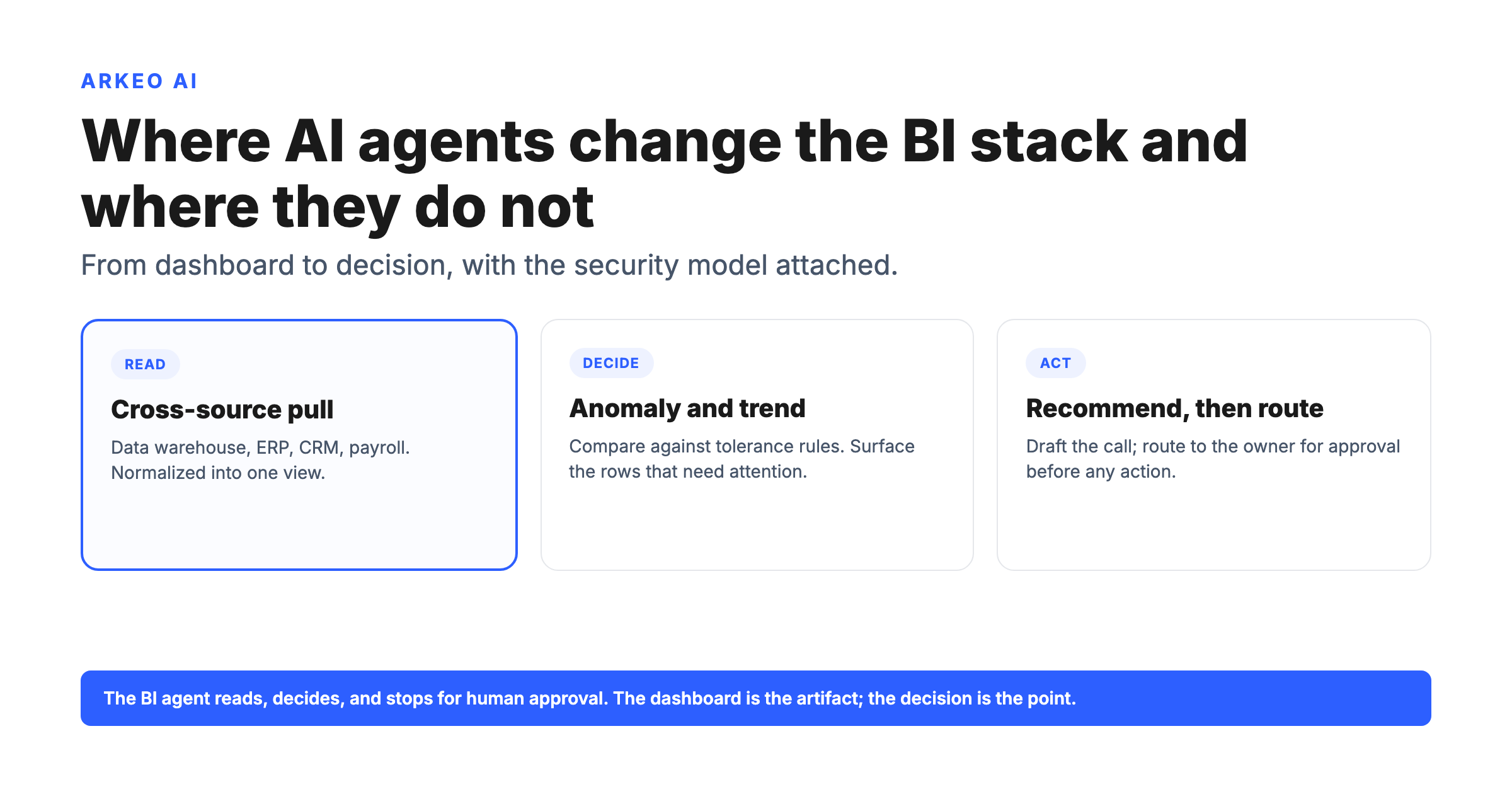
The vocabulary blurs in marketing copy, but the operating difference is concrete. One produces text. The other reads documents, decides, takes action, and reports back.
Tells you what to do
Reads, decides, acts
The Five Use Cases That Actually Work
Ignore the 50-use-case listicles. For mid-market business operations, five categories of AI agents deliver consistent, measurable ROI today.
1. Document Processing and Data Extraction
This is the single highest-ROI AI agent use case in business operations. Finance staff using data extraction agents reallocate 60-70% of their former processing time to higher-value analysis and strategic work.
The agent reads invoices, contracts, proposals, safety reports, compliance documents. It extracts structured data: dates, amounts, parties, key terms, action items. It enters that data into your systems. It flags exceptions for human review.
The Numbers: For a company processing hundreds of documents per week, this eliminates hours of manual data entry and reduces error rates from human-level (2-5%) to near-zero.
2. Report Generation and Analysis
Operational reporting eats time across every department. Weekly status reports, financial summaries, project dashboards, compliance reports. An AI agent pulls data from your existing systems, identifies trends and anomalies, generates formatted reports, and delivers them on schedule.
The shift is not just speed. It is consistency. The agent checks the same things every time, in the same order, with the same level of detail. No Friday afternoon shortcuts. No forgotten metrics.
Want to See AI Agents Working in Your Operations?
Book a free 30-minute AI Assessment. We will identify 2-3 high-impact agent use cases specific to your business, estimate the time savings, and outline a deployment plan. No obligation.
3. Client Communications
Drafting client updates, responding to routine questions, generating project status emails. An AI agent reads your project data, understands the context, and drafts communications in your company's voice. A human reviews before sending.
This is not about replacing client relationships. It is about ensuring every client gets timely, accurate updates instead of waiting for someone to find 30 minutes to write the email.
4. Scheduling and Resource Coordination
Complex scheduling across multiple teams, projects, and constraints is exactly the kind of problem AI agents handle well. The agent considers availability, project deadlines, skill requirements, travel time, and resource conflicts. It proposes schedules and flags conflicts that need human decision-making.
For construction, oil and gas, professional services, manufacturing, and operations-heavy businesses, this alone can reclaim hours per week from project coordinators.
5. Compliance Monitoring
Regulatory compliance requires checking the same things repeatedly across a large volume of documents and activities. This applies across every industry Arkeo serves: safety compliance in oil and gas, permit tracking in construction, privacy requirements in professional services, quality standards in manufacturing. AI agents monitor your operations for compliance gaps: missing documentation, expired certifications, approaching deadlines, process deviations. They flag issues before they become violations.
This is where private AI becomes critical. Compliance data is inherently sensitive. Running compliance agents on cloud infrastructure means your compliance gaps, and the data that reveals them, sit on someone else's servers.
Five operating workflows where agents reliably return cost in months, not years
These are the patterns that show up across the firms we have helped deploy. Not every agent project should be on this list. Every one of these is on this list because it has paid back in production.
Document processing — invoice, contract, RFI parsing. Highest volume, cleanest signal.
Report generation — weekly client updates, exec dashboards, compliance filings. Boring and load-bearing.
Client communications — drafting updates, replying to routine questions, routing escalations.
Why 40% of AI Agent Projects Will Fail
Gartner predicts that over 40% of agentic AI projects will be cancelled by the end of 2027. That is not pessimism. That is a pattern. The projects that fail share common traits.
They start with the technology, not the problem. "Let's implement AI agents" is not a strategy. "Our document processing takes 40 hours per week and has a 3% error rate" is a problem that an agent can solve. Start with the bottleneck. Define success as time saved, errors reduced, or revenue recovered. Then determine whether an agent is the right tool.
The #1 Failure Pattern: Trying to automate everything at once. The successful deployments start with one workflow, prove it works, measure the impact, then expand. The failed projects try five departments simultaneously and collapse under the complexity.
They ignore the data question. Where does the agent's data come from? Where does it go? Who can see it? If you are running agents on cloud infrastructure processing sensitive operational data, you have created a data governance problem you may not discover until it is too late. Companies that run agents on private infrastructure eliminate this entire category of risk.
How to Deploy AI Agents Without Losing Control
The deployment question is not whether to use AI agents. By end of 2026, 40% of enterprise applications will have them built in. The question is whether you control the agents, or someone else does.
Three principles for deploying AI agents that compound value instead of creating risk:
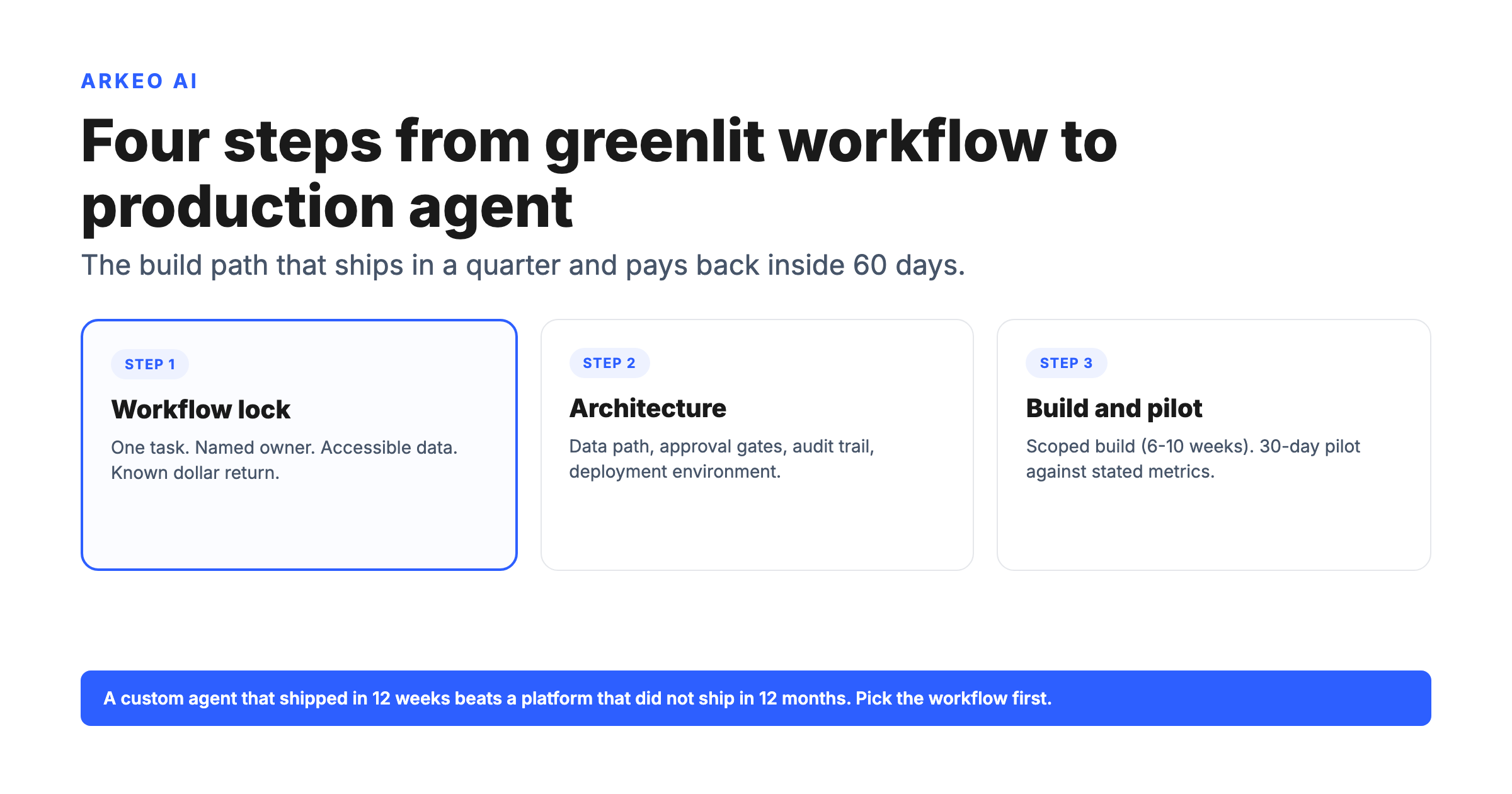
1. Start with one high-friction workflow. Pick the task that everyone complains about. The one that takes too long, has too many errors, and nobody wants to do. Deploy a single agent against that workflow. Measure the before and after. Use that proof point to justify expansion.
2. Keep data on your infrastructure. AI agents need access to your operational data to be useful. That data is too valuable and too sensitive to sit on someone else's servers. Run agents on private infrastructure where the data never leaves your network. The deployment tools (Ollama, vLLM, Docker) make this no harder than cloud deployment. For the full cost comparison, see our cloud vs on-premise AI analysis. When you are ready to start, our deployment guide covers the step-by-step process. And for the business case behind moving to private AI, read why mid-market companies are making the switch.
3. Human-in-the-loop by default. Start every agent with a human review step before final actions. The agent drafts the email; a human sends it. The agent proposes the schedule; a human approves it. The agent flags the compliance gap; a human decides the response. Over time, as trust builds, you remove the review step from low-risk actions. Never from high-risk ones.
Three deployment principles separate the 60 percent of agent projects that ship from the 40 percent that stall
Gartner forecasts 40 percent of agent projects will fail. The reasons are not technical. They are governance and scope. These three principles are the simplest checklist for staying on the right side of that number.
Start with one workflow
Pick the highest-volume, lowest-ambiguity workflow. Ship it. Measure it. Then add the second.
Keep data on your infrastructure
For regulated work or competitive intelligence, the agent runs on hardware you control. Non-negotiable.
Human in the loop by default
Agents handle volume. Humans handle exceptions. Confidence thresholds route the edge cases up, not through.
Ready to Deploy AI Agents That You Control?
Arkeo builds and manages private AI agent systems for mid-market companies. We deploy the agents, integrate them with your systems, and manage ongoing operations. Your data stays on your infrastructure. Your AI workforce works on your schedule. Start with a free assessment to identify your highest-impact use case.