Category
Why Mid-Market Companies Are Moving to Private AI
Last updated: April 2026
Sixty-four percent of mid-market companies have now deployed at least one AI workload. That number was 42% a year ago. Private AI means running artificial intelligence models on your own infrastructure instead of sending your data to a third-party cloud provider. The shift is not philosophical. It is happening because the economics changed, the risks became real, and the tools got simpler.
⚡ Quick Answer
- What is happening: Mid-market companies (50-5,000 employees) are moving AI workloads from cloud APIs to private, on-premise infrastructure at an accelerating rate.
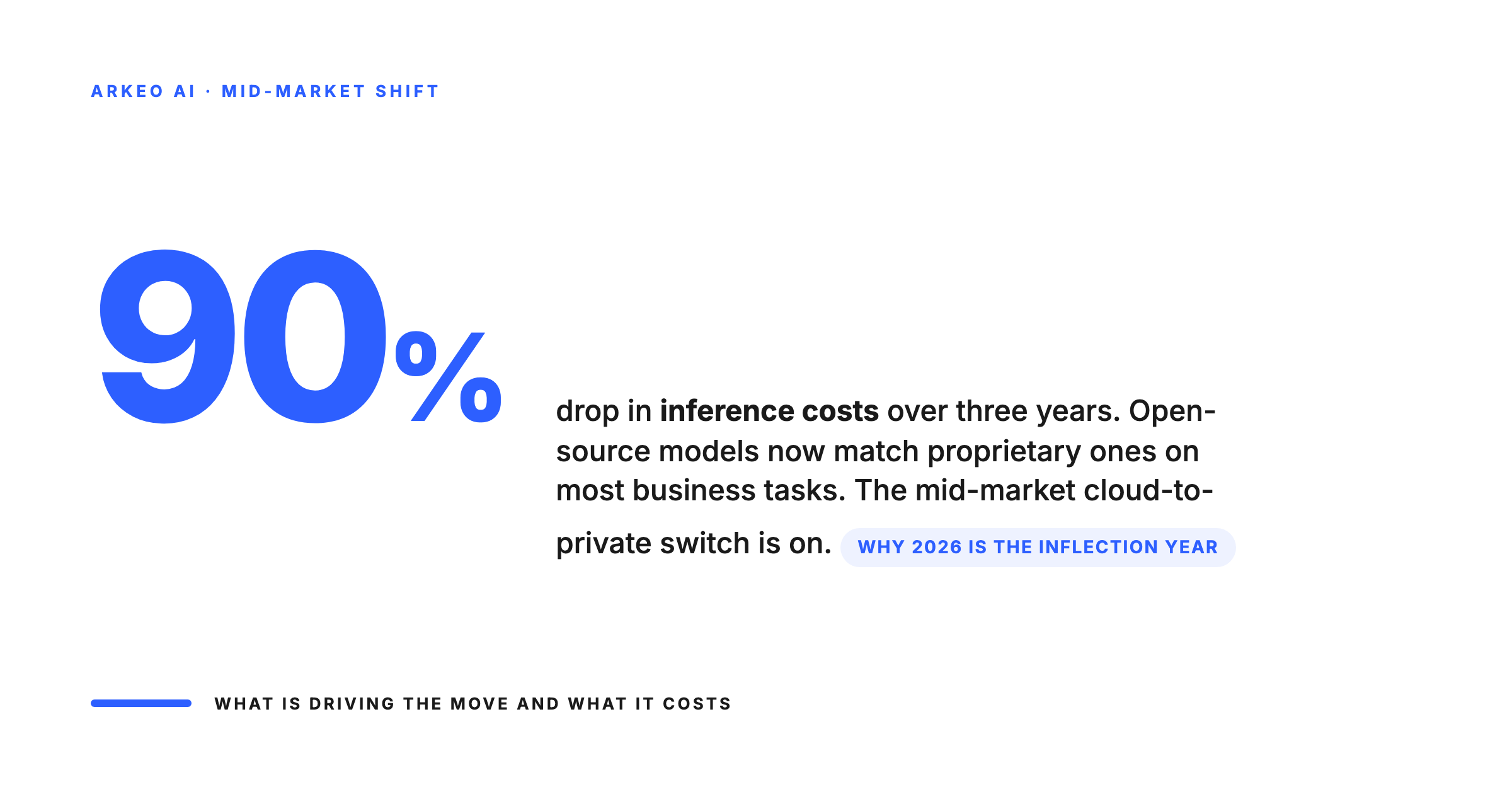
- Why now: Inference costs dropped 90% in three years, open-source models now match proprietary ones for most business tasks, and cloud API bills scale linearly with success.
- The trigger: Data privacy. 69% of organisations already suspect employees are feeding company data into unauthorised AI tools. Private AI eliminates this entire risk category.
- ROI: Companies using AI in operations report 5.8x average ROI within 14 months. Private deployment makes that ROI predictable instead of variable.
The Mid-Market AI Problem
Enterprise companies (5,000+ employees) have AI teams, dedicated budgets, and the negotiating power to get custom cloud contracts. Small businesses (under 50) use off-the-shelf tools and do not worry about infrastructure. The mid-market sits in the worst position: too much data to risk on free tools, too small to build a dedicated AI division, and too smart to ignore AI entirely.
Here is what that looks like in practice. A 200-person professional services firm starts using ChatGPT for proposal writing. It works. Adoption spreads. Within six months, dozens of employees are pasting client data, financial projections, and proprietary methodologies into cloud AI tools. Nobody approved this. Nobody tracked it. Nobody thought about where that data ends up.
Gartner found that 69% of organisations already suspect or have evidence that employees are using prohibited generative AI tools. Gartner further predicts that 40% of organisations will suffer security and compliance incidents from shadow AI by 2030. For mid-market companies without enterprise-grade governance, that is not a prediction. That is a timeline.
Why the Economics Changed
Two years ago, private AI was a luxury. The hardware was expensive, the models were inferior to cloud APIs, and you needed a team of ML engineers to keep it running. All three of those things have changed.
Inference Costs Collapsed
Inference costs have dropped 90% over three years. The GPU hardware that once cost enterprise budgets is now mid-market accessible. A cost-optimised inference cluster (8 NVIDIA L40S GPUs) runs approximately $79,000 in hardware. That is a capital expense, not a monthly bill. It sits on your balance sheet, not your operating expenses, and it generates value for 3-5 years.
Compare that to cloud API costs. At operational scale (1+ billion tokens per month), cloud APIs run $9,000 to $200,000 monthly. The hardware pays for itself in months, not years.
Open-Source Models Closed the Gap
In 2023, there was a genuine capability gap between GPT-4 and everything else. That gap no longer exists for most business use cases. Meta's Llama, Mistral, and DeepSeek models now perform comparably to proprietary APIs for document processing, summarisation, code generation, and operational tasks. Cost per token drops 10x to 100x when you run these models on your own hardware instead of paying API rates.
Most mid-market companies think they need GPT-4 or Claude for their AI use cases. They do not. Ninety percent of business AI is operational: summarising documents, drafting communications, processing data, generating reports. An open-source model running locally does this as well as a cloud API, at a fraction of the cost, with none of the data risk.
Why private AI suddenly works for firms that could not justify it eighteen months ago
None of these are dramatic on their own. Together they compress the entry point for a real on-premise deployment from a hyperscaler-only proposition to a mid-market budget line.
Inference costs dropped 90%
GPU efficiency, model distillation, and quantization all pulled the cost of running a model way down.
Open-weight models caught the frontier
Llama, Mistral, DeepSeek now match proprietary models on most business tasks. No vendor lock-in required.
One developer can deploy it
No data science team needed. One IT engineer with container experience stands up the stack in weeks.
Deployment Got Simple
The operational barrier collapsed alongside the cost barrier. Tools like Ollama, vLLM, and Docker-based deployment frameworks mean a single developer can stand up an inference server in an afternoon. You do not need an ML engineering team. You need one person who understands containers, and two days to set up the pipeline.
Want to See if Private AI Makes Sense for Your Business?
Book a free 30-minute AI Assessment. We will map your current AI usage, estimate your on-premise vs cloud costs, and build a 90-day deployment plan. No obligation.
The Three Reasons Mid-Market Companies Switch
1. Data Control
This is the reason that starts the conversation. A CEO reads about a data breach involving an AI provider. A compliance officer asks where the ChatGPT data goes. A client asks whether their information is being processed through third-party AI.
Private AI answers all three questions the same way: the data never leaves your building. There is nothing to breach, nothing to audit, nothing to explain to a client. When a model runs on your infrastructure, your data sovereignty is physical, not contractual.
The EU Data Act (effective September 2025) extends sovereignty requirements to industrial and non-personal data. Gartner forecasts AI governance spending will reach $492 million in 2026 and surpass $1 billion by 2028. Companies that deploy AI privately sidestep most of this governance overhead because the data never enters the regulatory grey zone of third-party processing.
2. Cost Predictability
Cloud AI pricing punishes success. The more value you extract, the more you pay. A team that doubles its AI usage doubles its bill. There is no volume discount that changes this fundamental equation.
Private AI flips the model. After the hardware investment, your cost per inference is fixed (electricity plus maintenance). Double your usage and your cost barely moves. This is not a small difference. Over a three-year period, on-premise infrastructure achieves up to 18x cost advantage per million tokens compared to cloud APIs.
For a mid-market company budgeting year-over-year, the difference between "our AI costs are $6,500 per month, predictable" and "our AI costs are somewhere between $8,000 and $45,000 depending on usage" is the difference between a line item and a liability.
3. Competitive Advantage
Here is the blunt truth: the companies that own their AI infrastructure own their AI workforce. They are not waiting for OpenAI to change pricing. They are not locked into a vendor's roadmap. They are not competing on the same tools as everyone else.
When you run your own models, you can fine-tune them on your data. A construction company's AI learns the language of RFPs, safety reports, and project schedules. An oil and gas operator's AI understands well data, turnaround schedules, and regulatory filings. A professional services firm's AI handles client frameworks and proposal templates. A manufacturing company's AI processes production data and supply chain documentation.
The Data Moat: Every month your private AI runs on your data, it gets harder for competitors to catch up. That specificity is the competitive moat that generic cloud AI cannot replicate.
Companies using AI in operations report 5.8x average ROI within 14 months (McKinsey Global AI Survey 2025). Private deployment makes that ROI predictable and sustainable instead of variable and vendor-dependent.
Three forces that turn a private deployment into a defensible move
No one moves to private AI for the novelty. The firms making the switch are answering specific pressures, and the math holds up under any procurement review.
Data control
Zero prompts leave the network. Every drawing, contract, and client record stays inside the firewall.
Cost predictability
6 to 18 month payback against per-token cloud bills. After that, capacity is fixed cost, not variable.
Competitive advantage
3.4x throughput lift on workflows fine-tuned to the firm. Generic cloud cannot match the win rate.
What Private AI Looks Like for a Mid-Market Company
Forget the data centre imagery. Private AI for a mid-market company is not rows of servers in a cold room. It looks like this:
- Hardware: 1-2 servers with GPU cards, sitting in your existing server room or a small colocation rack. Physical footprint: about the size of a filing cabinet.
- Software: Open-source models (Llama, Mistral, or similar) running on an inference framework (vLLM, Ollama). No licensing fees.
- Management: One IT person or developer manages the system, or your provider handles it entirely. Arkeo's managed operations model means monitoring, updates, optimisation, and security are handled for you. No IT hire required.
No IT Hire Required: The biggest barrier to private AI for mid-market companies isn't the hardware. It's the assumption that you need a dedicated AI team. With a managed operations model, you don't.
- Integration: API endpoints that your existing tools connect to. Same interface as cloud APIs, just pointing to your own server instead of someone else's.
We build exactly this at Arkeo. Our private AI deployments run on client infrastructure with zero cloud dependencies. The AI processes client data, generates outputs, and learns from company-specific patterns without any of that data crossing the network boundary. For a detailed cost comparison of cloud vs on-premise, see our cloud AI vs on-premise AI analysis. If you are ready to deploy, our step-by-step deployment guide covers the hardware, software, and timeline. And to understand what AI agents can do once running on your infrastructure, read about AI agents for business operations.
What a mid-market private AI deployment actually looks like under the hood
Less exotic than it sounds. The whole stack is four boring layers, all open source or boring enterprise infrastructure. The breakthrough is that any of them works at this scale today.
Hardware
Inference-class GPU rig. $11K to $335K depending on volume. Sized for steady operational use, not training.
Software
Open-source inference engine (Ollama, vLLM), open-weight model (Llama, Mistral, DeepSeek). $0 in licenses.
Management
Containers, monitoring, audit logs. The same Docker, Kubernetes, and observability stack you already run.
Integration
API calls into your existing systems. Same wire format as cloud APIs. Migrate workflows one at a time.
The Objections (and Why They Are Outdated)
"We do not have the expertise." You did not have cloud expertise in 2010 either. The tooling has matured to the point where deploying a private AI model is simpler than setting up a new email server. If your team can manage Docker containers, they can run inference.
"The upfront cost is too high." Compare the upfront cost to 24 months of cloud API bills at operational scale. The hardware pays for itself in 4-12 months depending on usage. After that, you are generating AI outputs for the cost of electricity.
"Cloud models are better." For frontier tasks (advanced reasoning, multimodal analysis, cutting-edge benchmarks), yes. For 90% of business AI (document processing, summarisation, drafting, data analysis), open-source models match cloud performance at 10-100x lower cost.
"What about model updates?" Open-source model releases happen quarterly. Updating a model on your infrastructure takes hours, not days. And unlike cloud APIs, the update happens on your schedule, not the vendor's.
Ready to Stop Renting Your AI?
Arkeo builds private AI systems for mid-market companies. We handle the hardware, the deployment, the integration. You keep the data, the control, and the cost savings. Start with a free assessment.