Category
Will AI Take Over Construction? Strategic Insights for 2026
Last updated: April 2026
Every few months, this question comes back. Usually after a headline about robots laying bricks or AI designing buildings. AI will not replace construction workers. Construction is too hands-on, too unpredictable, and too relationship-driven. What AI is replacing is the busywork: the estimating, scheduling, reporting, and compliance tracking that keeps your best people from doing their actual jobs.
For the full picture of what AI actually does in construction today, see our complete guide to AI in construction.
⚡ Quick Answer
- Will AI replace construction workers? No. AI handles administrative and analytical work, not physical construction.
- What AI is doing: Cutting estimating cycles by 30-50%, flagging schedule risks weeks early, monitoring job sites via computer vision, and automating compliance documentation.
- The real risk: Not that AI takes over construction, but that your competitors adopt it and you do not. 37% of firms already use AI (Deloitte). No more than 10% have scaled it strategically (McKinsey).
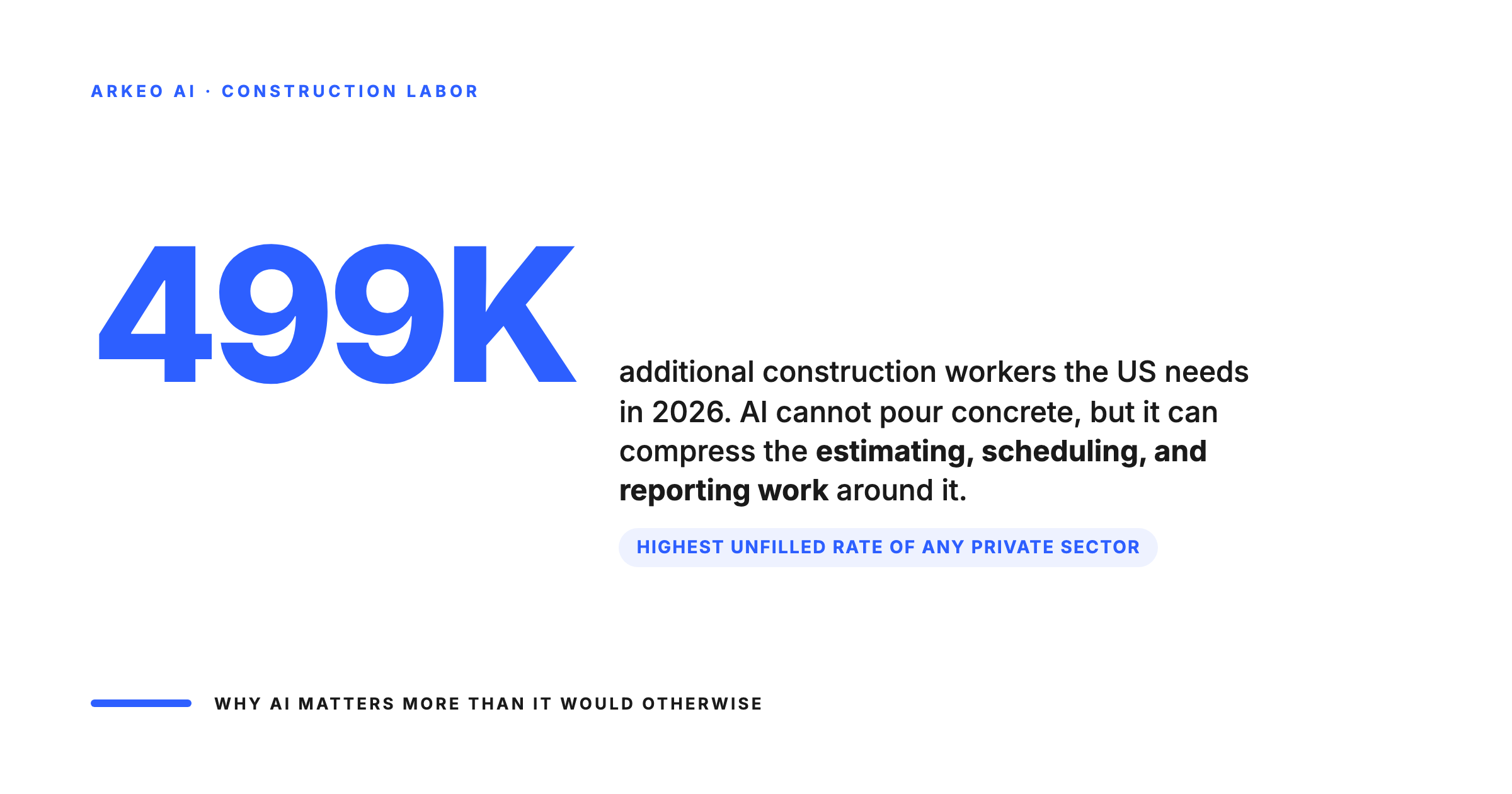
- The labour gap: The industry needs 499,000 additional workers in 2026. AI lets existing teams operate at a higher level.
What AI Is Actually Doing in Construction Right Now
Four workflows where AI is already running on construction job sites in 2026
Not robots laying bricks. Not autonomous excavators. The AI changing construction right now is replacing the administrative weight that used to keep your best people from doing their actual jobs.
Estimating
Computer vision reads drawings, pulls quantities, generates baseline costs.
Scheduling
Predictive models flag slippage and dependency risks before the critical path slips.
Safety Monitoring
Vision models detect PPE gaps, unsafe postures, and proximity violations in real time.
RFIs and Submittals
Language models draft, route, and answer RFIs from the spec book and historical projects.
Forget the futuristic demos. Here is what is happening on real job sites and in real offices in 2026:
Estimating teams are using AI to analyse historical bid data and produce more accurate cost models in a fraction of the time. Firms report cutting estimating cycles by 30 to 50% while improving win rates.
Project managers are getting early warnings about schedule risks weeks before they would show up in a traditional progress review. AI cross-references weather, supply chain data, labour availability, and your own project history to flag problems while there is still time to act.
Safety teams are using computer vision to monitor job sites through existing camera systems, catching PPE violations and hazardous conditions in real time. Bluebeam's 2025 report found 89% of early AI adopters reported measurable profitability gains, with safety monitoring among the highest-impact use cases.
Operations staff are automating documentation: RFI summaries, daily log compilation, compliance reports, and client updates. The work still gets done. It just does not require someone to do it manually.
Where Could AI Free Up Your Team's Time?
Book a free 30-minute AI Assessment. We will map your highest-impact automation opportunities and give you a realistic deployment plan. No obligation.
The Labour Shortage Makes AI More Important, Not Less
Construction is facing a workforce gap that is not closing. The industry needs 499,000 additional workers in 2026. Experienced superintendents are retiring. Skilled trades are harder to recruit.
AI does not solve the labour shortage. But it changes the math. When a project coordinator supported by AI can handle the administrative load that used to require two or three people, you stretch your existing team further without burning them out. When your estimating team turns around bids 40% faster, you pursue more work without hiring more estimators.
The Question You Should Actually Be Asking
Construction trails the rest of the economy on AI adoption by nearly two to one
When 37 percent of your industry is using AI but 72 percent of all industries are, the gap is not academic. It is the lead time competitors are accumulating on you while you wait for the right moment.
use AI in some part of operations today. Deloitte, 2026 construction survey.
report using AI in at least one business function. McKinsey, State of AI 2025.
The real risk is not that AI takes over construction. It is that your competitors adopt it and you do not.
McKinsey's State of AI report found that 72% of companies across industries have adopted AI in at least one function. In construction, 37% of firms are already using AI (Deloitte).
A competitor who bids faster and more accurately wins work you could have won. A competitor whose project managers get early warnings avoids the delays you are still absorbing. A competitor whose safety system catches hazards automatically has a better EMR than you do.
Why Where Your AI Runs Matters
Most AI tools in construction today are cloud-based. Your data flows to someone else's servers and gets processed alongside data from thousands of other companies.
Private AI runs on your infrastructure. Your data never leaves your building. The models learn exclusively from your projects. A cloud AI tool gives every subscriber the same generic capability. A private AI system compounds intelligence specifically for your business.
For firms handling government projects, operating under Canadian data residency requirements, or wanting to keep bid strategy confidential, private AI is becoming the standard.
Where to Start Without Overcommitting
Four practical steps to start with AI without overcommitting
The firms that get stuck in pilot mode skip steps one and two. The ones that scale into operations work this sequence end to end.
Pick the biggest time drain
Identify the one workflow eating the most senior hours. Estimating is usually the answer.
Audit data exposure
Map what data leaves your environment if you use cloud AI. Bids, drawings, contracts, financials.
Choose cloud or private
For regulated work or government projects, private AI is the default. For internal admin, cloud may be fine.
Run a 60 to 90 day pilot
Pick one workflow, measure baseline, deploy, measure again. If it does not save hours, kill it and pick another.
The firms getting the most value did not try to transform everything overnight. They picked one high-pain area, proved the ROI, and expanded.
Pick your biggest time drain. Estimating and scheduling are the most common starting points.
Understand your data exposure. If anyone on your team uses ChatGPT, cloud estimating tools, or AI-enhanced project management software, your project data is already flowing through third-party servers.
Get an assessment. A structured AI assessment maps your workflows, identifies the highest-impact opportunities, and gives you a roadmap with real numbers.
The whole process from assessment to a running private AI system takes about 90 days for a firm with 50 to 500 employees.
Ready to See Where AI Fits Your Operation?
Book a 30-minute AI Assessment. We will map your highest-impact opportunities, assess data exposure, and outline a phased plan. No obligation.