Category
AI in Construction Management: Scheduling, Delivery, and Project Control
Last updated: April 2026
Your PM finds out about the schedule slip during Thursday's coordination meeting. By then, the concrete crew has already been rescheduled, the electricians are double-booked next week, and the owner's rep is asking why the milestone is moving. AI in construction management uses machine learning and predictive analytics to monitor project schedules, forecast delays before they cascade, optimise resource allocation, and surface cost overruns weeks before they appear in monthly reports. It does not replace your project manager. It gives them visibility they have never had.
For a broader look at how AI is transforming the construction industry, see our complete guide to AI in construction.
⚡ Quick Answer
- Speed: AI-powered platforms improve project delivery times by up to 20% (Autodesk).
- The problem: Large construction projects typically run 20% over schedule and up to 80% over budget (McKinsey). AI makes scheduling dynamic, not static.
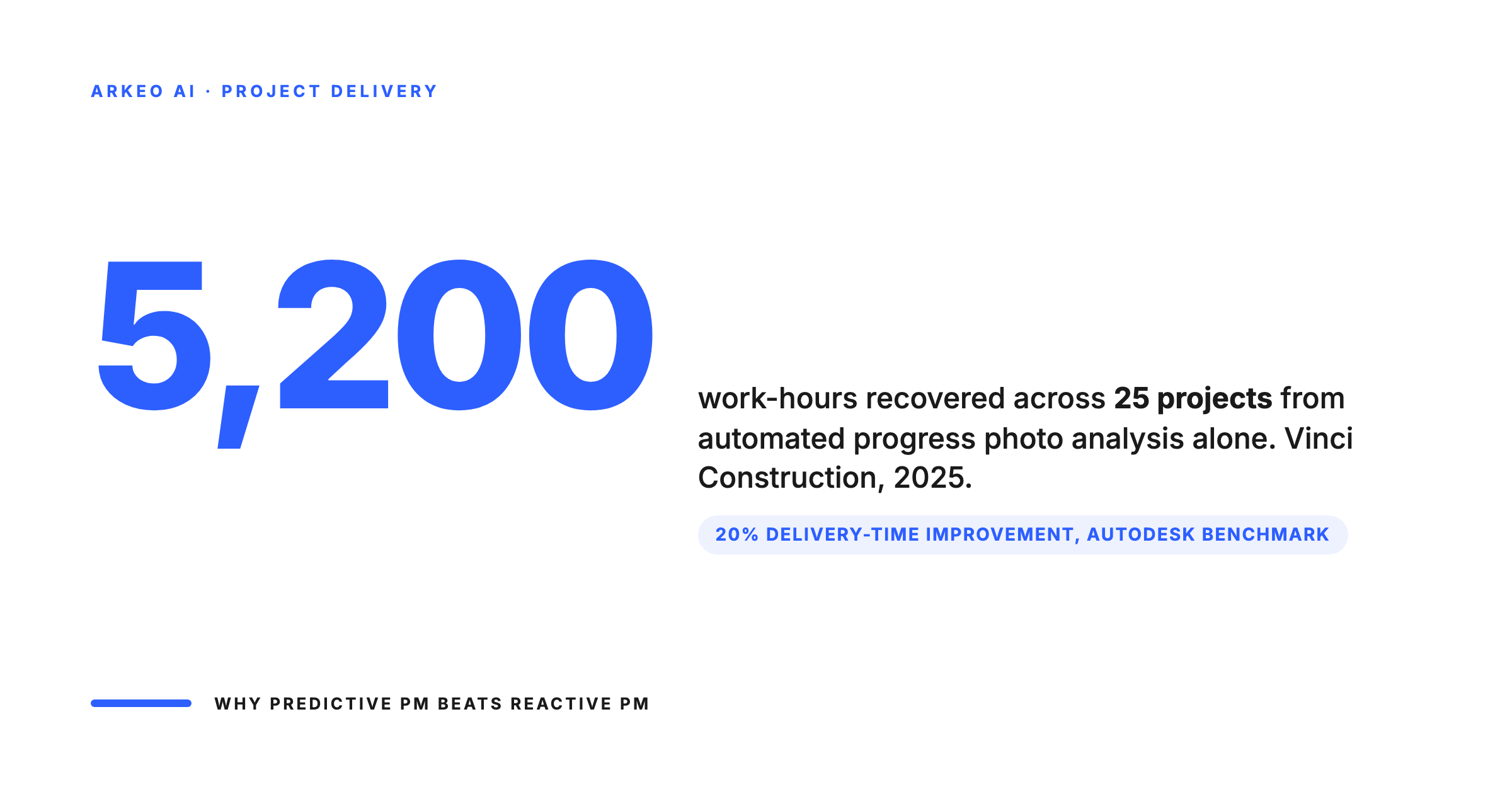
- Case study: Vinci Construction saved 5,200 work-hours across 25 projects through automated progress photo analysis alone.
- Best application: Predictive scheduling, resource allocation, progress monitoring, and cross-project portfolio intelligence.
- Next step: Book a free AI Assessment to find out where AI fits in your operation.
Why Traditional Construction Scheduling Fails
The construction industry has a scheduling problem that technology alone did not create and gantt charts alone will not solve. Large projects run 20% over schedule on average. Budget overruns reach 80% on complex projects. The pattern is consistent across project types and geographies.
The root cause is that traditional scheduling is static in a dynamic environment. A CPM schedule gets built at project kickoff, maybe updated weekly during coordination meetings, and adjusted reactively when delays are already cascading through the critical path. By the time the PM identifies a two-week material delay's impact on three downstream trades, the damage is compounding.
AI changes this by making scheduling continuous and predictive. Instead of updating the schedule once a week, the system continuously analyses progress data (site photos, daily reports, delivery logs, weather forecasts) and models the downstream impact of every change in real time. The PM does not discover the problem on Thursday. The system flags it on Monday, with alternative sequencing options already modelled.
How AI Is Used in Construction Project Management
AI touches construction PM across four primary workflows:
Predictive scheduling. AI analyses historical project data, current progress, weather forecasts, supply chain signals, and labour availability to predict where delays will occur before they happen. The system does not just flag "behind schedule." It models the downstream cascade: if the steel delivery slips by four days, here is what happens to framing, here is the impact on the mechanical rough-in, here is the cost.
Progress monitoring. Computer vision analyses site photos and drone footage to compare actual progress against the schedule baseline. Vinci Construction saved 5,200 work-hours across 25 projects by automating this single task. The AI compares what should be done against what it sees on site, flagging discrepancies that would otherwise require a superintendent to walk every floor with a set of drawings.
Resource allocation. For firms running multiple projects simultaneously, AI optimises crew and equipment deployment across the portfolio. Instead of each PM fighting for the same crane or the same framing crew, the system models utilisation across all projects and recommends optimal allocation based on schedule priority, travel time, and cost.
Cost intelligence. AI tracks actual costs against the estimate in real time, identifying trends before they become problems. If concrete costs are running 12% over estimate across three projects, the system flags it as a systemic issue, not just a project-level variance. That intelligence feeds back into the estimating process, making future bids more accurate.
The Real-World Results
Autodesk reports that AI-powered construction platforms improve delivery times by up to 20%. That number comes from firms that have integrated AI into their daily project management workflows, not firms running occasional experiments.
Bluebeam's 2025 survey found that early AI adopters in AEC reclaim 500 to 1,000 hours on critical tasks like scheduling, planning, and document analysis. That translates to roughly 2-4 full-time equivalent positions worth of capacity recovered through automation, not additional hiring.
The gains compound across project portfolios. A GC running 8-10 active projects simultaneously that reduces schedule overruns by even 10% across the board is recovering thousands of labour hours, avoiding liquidated damages, and improving client satisfaction metrics that directly affect future contract wins.
Here is the uncomfortable truth: most construction PMs spend 30-40% of their time on tasks that AI can automate. Weekly schedule updates, progress reporting, RFI tracking, document management. That is not a criticism of PMs. It is a failure of the tools the industry has given them. AI does not replace the PM's judgment, relationships, or problem-solving. It replaces the data gathering that eats their day before they can start the real work.
What Would Your PM Do With 15 Extra Hours Per Week?
Book a free 30-minute AI Assessment. We will map your current project management workflows, identify where AI saves the most time, and outline a deployment plan sized for your firm.
From a ten-day cascade to a two-day correction
A traditional PM finds out a delivery slipped during the morning standup, then spends a week chasing alternates. An AI-augmented PM sees the slip the night it happens and pulls the fix into the next-morning review.
to detect a delay cascade, model alternatives, and present a recovery plan to the superintendent.
to do the same loop. Same PM, same project, same trades — just less manual chasing of the same data.
AI in Construction Scheduling: From Reactive to Predictive
The specific application of AI to scheduling deserves a closer look because it represents the biggest paradigm shift in how construction projects are managed.
Traditional scheduling tools (Primavera, MS Project, Procore) are fundamentally databases. They store the plan. They do not predict what will happen to the plan when conditions change. AI scheduling tools are fundamentally different. They are prediction engines that happen to store the plan.
Consider a practical example. A multi-story commercial build has a critical path that runs through the structural steel erection. The AI system monitors three signals simultaneously: the fabricator's production tracking (is the steel on schedule?), weather forecasts for the delivery and erection window, and crane availability across the firm's portfolio. If the fabricator falls behind by two days, the system immediately models the cascade, identifies which crews need to be rescheduled, calculates the cost impact, and presents options to the PM before the morning standup.
That same analysis done manually requires the PM to call the fabricator, check the weather, review the schedule, model alternatives in Primavera, and present options to the superintendent. Two days of reactive work compressed into two hours of proactive review.
Reactive scheduling versus predictive scheduling
Most schedules are still static documents reviewed weekly. The shift to AI-driven scheduling is the shift from a document to a live model that flags risk before it becomes delay.
Static gantt, weekly review
Live model, continuous review
Getting Started with AI in Construction Management
The firms successfully deploying AI in construction PM share a pattern: they start with one high-value workflow, prove the ROI, and expand.
Start with progress monitoring. It requires the least change management (your team is already taking site photos), delivers visible results quickly (automated progress vs schedule comparison), and builds data that feeds more advanced AI applications later.
Add predictive scheduling after 2-3 projects. Once the system has enough project data to identify patterns, scheduling predictions become increasingly reliable. The first project through the system is a calibration exercise. By the third project, the predictions start reflecting your firm's actual performance patterns.
Consider data sovereignty. If your project data includes client specifications, proprietary processes, or competitive intelligence, evaluate private deployment options. A PM system that learns from your entire project history becomes a strategic asset. Make sure that asset stays on your infrastructure. For a cost comparison, see our cloud vs on-premise analysis.
Ready to Move From Reactive to Predictive?
Arkeo deploys AI systems for construction firms that need their project data to stay on their own infrastructure. Book a free assessment. We will review your PM workflow and show you where AI fits.