Category
AI in Manufacturing: An Operator's Guide

Last updated: May 2026
You already know AI belongs somewhere on the plant floor. The harder question is where it earns its keep without stalling in a pilot that never reaches production. That gap is the real bottleneck. In Arkeo's deployments the pattern is consistent: the first few weeks of a manufacturing AI project go to cleaning and wiring one MES, ERP, or historian feed and naming the human who owns it, not to the model. Deloitte's 2025 Smart Manufacturing and Operations Survey of 600 senior manufacturing executives at large U.S. manufacturers found that only 29% are running AI or machine learning at the facility or network level, while 23% are still stuck piloting it. For generative AI the divide is starker: 24% deployed at scale against 38% still piloting. Most manufacturers are not behind on ambition. They are behind on getting one use case all the way to the floor.
This guide is written for the operator making that call. Projects move when that one data path is clean and owned. They stall when the feed is dirty, the fields are half-maintained, or no one is accountable for the agent once the demo is over. If you want a faster route, you can book a free AI Assessment and walk out with a prioritized list of where AI fits your operation, but the rest of this page will give you the framework either way.
Quick Answer
• What it is: AI in manufacturing is the use of analytical and generative models to inspect quality, predict equipment failure, plan production, and run document and ERP workflows, attached to a specific bottleneck and data path.
• Where it pays: Quality control (vision), predictive maintenance, production planning, and ERP or document workflow agents, in that order of provable ROI for most plants.
• Cost: 30-day quick wins lean on low-cost, often per-seat off-the-shelf tools; a custom workflow agent is a scoped one-time build investment, not a subscription; and budget for ongoing model monitoring and retraining, because plant AI drifts and needs an owner.
• Why it matters: 92% of executives believe smart manufacturing will be the main driver of competitiveness within three years (Deloitte), but value only shows up when AI is tied to real production, not isolated pilots.
What Does AI in Manufacturing Actually Mean?
AI in manufacturing is the application of analytical and generative models to specific production problems: inspecting quality with computer vision, predicting equipment failure from sensor data, planning and scheduling production, and automating the document and ERP workflows that surround the floor. It is not one technology and it is not a robot. It is a set of capabilities you point at a bottleneck where you already have data and a clear owner.
The distinction that trips up most leaders is analytical versus generative. Analytical AI finds patterns in numbers and images: it spots a defect a tired inspector misses at hour seven, or it flags a bearing that is about to fail. Generative AI reads and writes language: it drafts a deviation report, answers an operator's question about a work instruction, or reconciles a supplier email against a purchase order. Both matter in a plant, but they solve different problems, and they mature at different speeds. The floor runs on analytical pattern recognition first, because vision and anomaly detection attach cleanly to a line you already instrument. Language agents are the layer on top, sitting over your MES and ERP data once the analytical foundation is in place.
Why It Is Broader Than Robotics
Most people picture an arm welding a chassis when they hear manufacturing AI. That is automation, and it predates the current wave by decades. The high-value AI use cases are quieter and rarely involve moving metal. They live in the data your MES, ERP, and sensors already produce. A vision model watching a line does not look like a robot. A scheduling agent rebalancing tomorrow's run does not either. Treating AI as a robotics question is the fastest way to overspend on the wrong thing and miss the use cases that actually move output.
Why Most Value Comes From Workflow-Linked Use Cases
Here is the false belief worth killing early: most manufacturers think AI is a technology you buy and switch on. They are wrong. AI in manufacturing is a workflow you redesign with a model inside it. The plants that get results do not get them from buying a product. They attach AI to a production use case and run it at scale, and that is the throughline across every durable deployment: value comes from AI inside a real workflow, never from a pilot sitting off to the side. The adoption data backs this up. Deloitte found far more large manufacturers piloting AI than running it at scale, and the broad base of firms is earlier still: the Federal Reserve's analysis of U.S. Census Bureau data put adoption at roughly 18% of all firms as of year-end 2025. When the model is tied to a process someone owns, with clean data feeding it, it compounds. When it is a science project, it gets unplugged the first quarter budgets tighten.
Where Does AI Create the Most Value in Manufacturing?
Four use-case families produce nearly all the provable ROI in a typical plant. They differ sharply in how fast they pay back, how clean your data needs to be, and how hard they are to roll out. The table below is the asset to bookmark, because choosing the wrong starting point is the most common and most expensive mistake in manufacturing AI.
| Use case | ROI horizon | Data requirements | Rollout difficulty |
|---|---|---|---|
| Quality control (vision) | Fast (weeks to months) | Labeled defect images from one line | Moderate; needs camera placement and lighting |
| Predictive maintenance | Medium (months) | Sensor history plus past failure records | Moderate to high; depends on sensor coverage |
| Production planning | Medium (months) | Clean MES and ERP order, capacity, and downtime data | High; integration and trust are the hard parts |
| Document and ERP workflows | Fast (weeks) | Existing documents, emails, and ERP records | Low to moderate; least disruptive entry point |
Quality Control
Computer-vision inspection is where most plants should look first, because the ROI is visible and the data already exists in the form of parts coming down a line. A mature vision model runs continuously and does not get tired at hour seven, and it catches defects that human inspectors miss after a full shift. The advantage is structural rather than heroic: a vision model attaches to a specific line and a specific data path, sees every part at the same standard, and never has a bad afternoon. That is why quality control tends to deliver the cleanest, fastest payback of the four families, and why it sits at the analytical end of the spectrum where the proven manufacturing results concentrate today. If quality escapes are costing you returns or scrap, this is usually the cleanest first win, and the specific accuracy and ROI math goes deeper in the guide to AI for manufacturing quality control.
The blunt truth: AI models on a plant floor break, drift, and need maintenance of their own. A vision model trained on last year's parts will quietly degrade when a supplier changes a material finish. Predictive-maintenance models need retraining as equipment ages. Anyone selling you a set-and-forget plant AI is selling you a future outage. The systems that last have an owner who watches them.
In practice, this is the cost most plants forget to budget for. Picture a line where a vision model has run clean for months, catching the defects it was trained on. Then a supplier quietly changes a material finish, the parts now reflect light a little differently, and the model starts passing flaws it used to flag. Nothing alarms; the demo still demos. The defect only surfaces downstream, and someone spends a week tracing it back to a drifted model that needed retraining on the new finish. That ongoing monitor-and-retrain cycle, not the initial build, is the real recurring cost of plant AI. It is also why an owner who watches the model beats any vendor promise of set-and-forget.
See where AI fits your operation
A free AI Assessment maps your bottlenecks and data paths to the highest-ROI manufacturing use case, so you start with a win instead of a science project.
Book Your Free AI Assessment →
Predictive Maintenance
Predictive maintenance reads sensor and equipment data to flag failures before they stop the line. The payoff is real but slower, because it requires sensor history and a record of past failures to learn from. The decision criterion is straightforward to apply even without exact numbers in hand: predictive maintenance pays when an unplanned stop on a given line costs more per hour than the all-in run rate of the sensors, the model, and the ongoing monitoring program it takes to watch that asset. If a stoppage on that machine is cheap to absorb, the ROI case does not close no matter how feasible the model is. This is also the use case where data readiness matters most: a machine with three years of vibration logs and clean failure records is a strong candidate, while one with no instrumentation is not, no matter how much it costs you when it breaks. The path from a single critical asset to a fleet-wide program is laid out in the predictive maintenance guide.
Production Planning
Planning and scheduling is the use case with the highest ceiling and the steepest difficulty. An AI planning agent rebalances a schedule against orders, capacity, material availability, and downtime far faster than a planner working a spreadsheet, and Deloitte's respondents reported smart-manufacturing gains of a 20% improvement in production output, 20% in employee productivity, and 15% in unlocked capacity. The criterion for whether the ROI case closes is interdependence, not plant size: planning AI pays when a single schedule change ripples across more work centers than a human planner can realistically re-optimize before the window to act has passed. A shop where one line runs largely independently rarely needs it; a plant where every reschedule cascades through shared machines, tooling, and material does. The catch is integration: a planning agent is only as good as the MES and ERP data it reads, and earning planners' trust takes time. Start here only after you have proven AI elsewhere. The mechanics are covered in the AI in production planning guide.
Document and ERP Workflows
The most underrated entry point is the paperwork around the floor. Generative agents read supplier emails, draft deviation and non-conformance reports, reconcile invoices against purchase orders, and answer operator questions about work instructions. It is the least disruptive use case because it touches systems of record rather than the line itself, and it pays back in weeks. For many plants this is the right first move precisely because nothing on the floor has to change while the team builds confidence in AI. This sits inside the broader category of industrial artificial intelligence, and it is often the smartest place to build the team's confidence before touching the line.
Four manufacturing AI workflows that pay back fastest
These four show up in every mid-market plant that has shipped real AI in production. Vision-driven QC, predictive maintenance, production planning, and ERP-side document agents. In that order, generally.
Quality control (vision)
Camera + model catches defects, missing components, surface flaws faster and more consistently than manual QC.
Predictive maintenance
Telemetry + inspection logs flag failure-risk patterns days or weeks ahead of unplanned downtime.
Production planning
Demand signals + capacity + supplier lead-times rolled into live planning. No more spreadsheet heroics.
ERP and document workflows
Invoice matching, BOM parsing, compliance reporting, COA review. Boring, load-bearing, fast payback.
What Do Manufacturers Get Wrong With AI?
The failure modes are predictable, and every one of them traces back to ignoring bottleneck, data path, or ownership. Four show up again and again.
Read those four modes together and a single root cause shows up underneath all of them: the AI was never bound to a production workflow that a named person owns. Hype projects skip the bottleneck, isolated pilots skip the path to the floor, unclear ownership skips the accountable human, and dirty data paths skip the clean feed the model depends on. The survey data shows how widely this plays out. Across large manufacturers Deloitte found 23% piloting AI or machine learning and 38% piloting generative AI, against only 29% and 24% running them at facility or network scale, and the same gap appears economy-wide: the Federal Reserve note reports roughly 18% of all firms had adopted AI by year-end 2025 even as 78% of the labor force already works at a firm that has. Deloitte also found 65% of executives rank operational risk as a first- or second-priority concern, yet the pilots that would reduce that risk stall for exactly these reasons.
The fix is the inverse of the failure: pick one bottleneck, clean and wire the single data path it depends on, and name one owner before any model is trained. That ordering is not just an Arkeo opinion. The U.S. government's own playbook for industrial AI, the NIST AI Risk Management Framework, treats data quality and validity as foundational to a trustworthy system, on the same footing as security and reliability. Fix the data path and assign the owner first, then add the model.
How Do You Choose the First Manufacturing AI Use Case?
The selection method that works is bottleneck-first, then filtered for feasibility. Do not start from the technology. Start from the constraint that is costing you the most output, quality, or margin right now. The decision flow below is the shape of it: name the bottleneck, check whether the data is ready, run it through an ROI and feasibility filter, and only then commit to a first use case.
Three filters that pick the first manufacturing AI use case for you
Most plants pick the use case that sounds most exciting. The pattern that ships starts with a bottleneck the plant manager can name without slides, screens it for data readiness, and ends with a feasible payback. The first use case picks itself once the filters run.
Bottleneck first
Pick the workflow your plant manager names without slides. The one already costing you money or time daily.
Data readiness
The data needed exists, is reachable by the model, and is clean enough to act on. No multi-month data project before the pilot.
ROI and feasibility
A concrete number to move, a feasible build path, a payback inside two quarters. Otherwise the next workflow goes first.
Step one is bottleneck-first selection. Name the single process where a delay, defect, or manual workaround hurts most. That is your candidate. If quality escapes drive returns, look at vision. If unplanned downtime kills your numbers, look at maintenance. If planners spend their days firefighting, look at scheduling.
Step two is the ROI and feasibility filter. A candidate has to clear three gates before it becomes your first project: data readiness (do you have clean, accessible data for it today), safety constraints (does the use case touch anything that affects worker safety or regulated output, which raises the bar on human oversight and approval logic in line with the NIST AI Risk Management Framework), and integration complexity (how many systems must the AI read and write across). A high-value use case that fails the data-readiness gate is not your first project; it is your third, after you fix the data. This buyer-side decision process is the focus of the guide for manufacturing companies evaluating AI.
What Does a Practical Adoption Path Look Like?
The plants that succeed do not boil the ocean. They sequence. The Arkeo approach moves through three horizons, each earning the right to the next, and the roadmap below shows the shape of it.
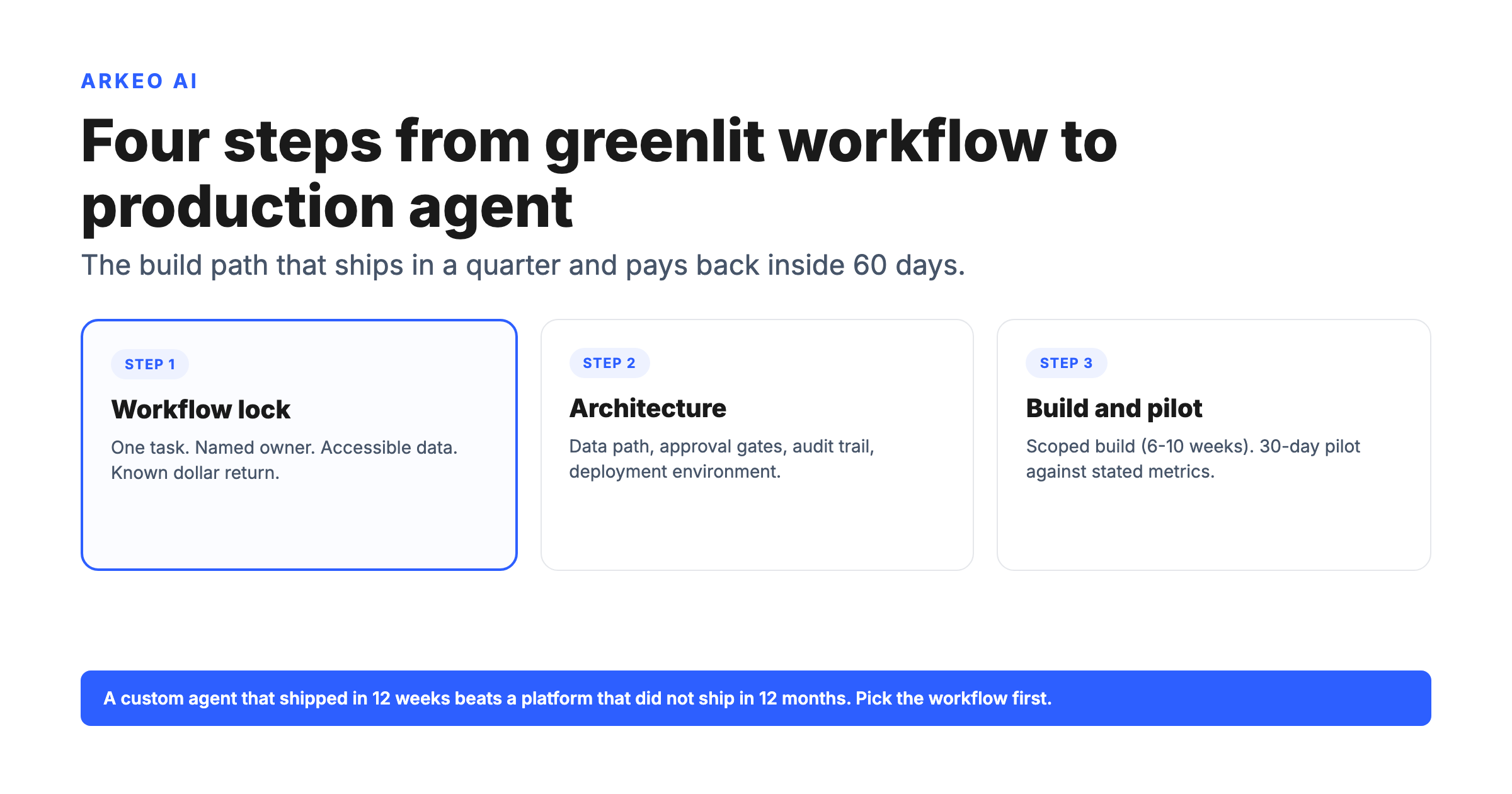
Three milestones in a practical manufacturing AI rollout
No big-bang transformations. Each milestone ships a real capability into the plant before the next one starts. Trust earned in the first 30 days is what funds the architecture work later.
30-day off-the-shelf wins
Use existing products on a known bottleneck. ERP-side reporting, document workflows, vision QC where the tool already fits.
90-day custom workflow agents
Custom agent on one cross-system workflow. Quality, predictive maintenance, or planning, with named owner and baseline.
12-month private architecture
Private AI on plant infrastructure. Proprietary process and machine data stays in the plant. Compounding intelligence.
30-day wins. Off-the-shelf tools and well-built prompts applied to the document and ERP workflows around the floor. These lean on low-cost, often per-seat software you can turn on this month. No floor change, fast payback, and a team that now believes AI is real because it saved them hours this month.
90-day build path. The top one to three custom workflow agents tied to the bottleneck you named: a vision model on the worst quality line, a maintenance model on the most expensive asset, a planning agent reading your MES. Be honest with yourself about the shape of this spend: a custom agent is a scoped, one-time build investment rather than a monthly subscription, and every model you deploy carries an ongoing monitoring and retraining cost because, as the drift example above shows, plant AI degrades and has to be watched. This is where AI stops being a tool and becomes part of the operation.
12-month architecture decisions. The move from scattered agents toward a controlled, private AI operating system. For plants handling sensitive IP or operating under regulatory constraints, this is where the on-premise question becomes central: where does the data live, who can see it, and can the AI run inside your firewall. Arkeo deploys on-premise and private AI for exactly these environments, and it is a deliberate architecture choice, not a default. We use what we sell, which is why the 12-month view is grounded in running these systems rather than theorizing about them.
Arkeo AI was founded in 2023 on 25 years of business operating experience and three years of deploying AI agents in production. That is the lens behind this guide: the Arkeo Operating System exists because scattered pilots do not survive contact with a real plant, and an owned, sequenced architecture does.
Map your manufacturing AI roadmap
A free AI Assessment identifies your 30-day wins, the first custom workflow agents worth building, and the right deployment model for your plant.
Book Your Free AI Assessment →