Category
AI for Manufacturing Quality Control, Done Right
Last updated: May 2026
You want to know exactly where AI improves quality control on your floor and what has to be true before it works. The honest answer is that the win almost never comes from the vision model alone. In Arkeo's deployments the pattern is consistent: the camera and the model are the easy part, and the first weeks go to the workflow around them, deciding what happens when a part is flagged, who reviews it, where the record lands, and how a borderline case escalates. A model that flags a defect but routes nowhere is a science project. A model wired into review, non-conformance, and traceability is a quality system. That difference, not raw model accuracy, is what separates the pilots that reach the floor from the ones that quietly get unplugged.
This guide is written for the operator making that call. Arkeo AI was founded in 2023 on 25 years of business operating experience and three years of deploying AI agents in production, and the lens behind this page is hard-won: quality control AI earns its keep as a governed workflow, never as a box that silently scraps parts. If you want a faster route to a decision, you can book a free AI Assessment and walk out knowing whether quality control is the right first AI workflow for your plant, but the framework below will serve you either way. For the broader map of where AI fits across the floor, the operator's guide to AI in manufacturing sets the context this article drills into.
Quick Answer
• What it is: AI for quality control is computer vision and classification that supports a governed inspection workflow, with documented review, routing, traceability, and clear escalation, never an unchecked black box that auto-scraps parts.
• Where it helps: Inspection support, defect classification, documented review and non-conformance routing, traceability and genealogy, and drafting root-cause reviews for a human to approve.
• Cost and timeline: A scoped, one-time build for the model and workflow integration, plus an ongoing monitoring and retraining budget, because plant conditions change and the model drifts. A pilot scoped to one line and one defect type typically runs in weeks, not months, and most of that time is data and review setup, not the model.
• Why it matters: A human inspector's accuracy degrades across a shift; a vision model runs the same check continuously at the same standard, so the value is consistency inside a workflow that a person still owns.
Where Does AI Help in Quality Control?
AI helps quality control when it supports a governed workflow, including inspection support, defect classification, documented review and routing, and traceability, with human review and clear escalation, not as an unchecked black box. Read that twice, because the second half is where most plants go wrong. The temptation is to buy a camera that promises to pass or fail parts on its own. The plants that get durable results do the opposite: they treat the model as one step inside an inspection process a person still owns.
There are five places AI earns its keep in quality, and only the first is the part everyone pictures.
Inspection support. A vision model watches the line and flags candidate defects for a person to confirm. This is the heart of it, and the structural advantage is real but unglamorous. A human inspector at hour seven of a shift is fighting fatigue and monotony, and accuracy degrades; a vision model runs the same check on every part at the same standard, all shift, without a bad afternoon. State that as the operational reality it is, not as a percentage someone made up on a vendor slide.
Defect classification. Beyond pass or fail, a model can sort flaws into categories, a scratch versus a dent versus a contamination mark, so the data flowing into your quality system is structured from the start instead of hand-typed later.
Documented review and routing. When a part is flagged, the system records it, presents it to an operator, and routes a confirmed defect into your non-conformance process. This is the workflow spine, and it is what makes the output auditable rather than anecdotal.
Traceability and genealogy. Every flag, every operator decision, and every disposition gets logged against the lot, the part, and the time. When a customer reports an escape three weeks later, you can trace it instead of guessing. For plants under audit or regulatory oversight, this record is the point, and it is one reason quality records and non-conformance logs often belong on infrastructure you control rather than a vendor cloud.
Root-cause review. A model can draft a first-pass root-cause summary from the defect pattern and the genealogy, but a human reads it, corrects it, and signs it. The AI accelerates the analyst; it does not replace the judgment.
Notice that four of the five are workflow, not vision. That is the whole thesis of this article: quality control AI is a process you redesign with a model inside it, not a product you switch on. 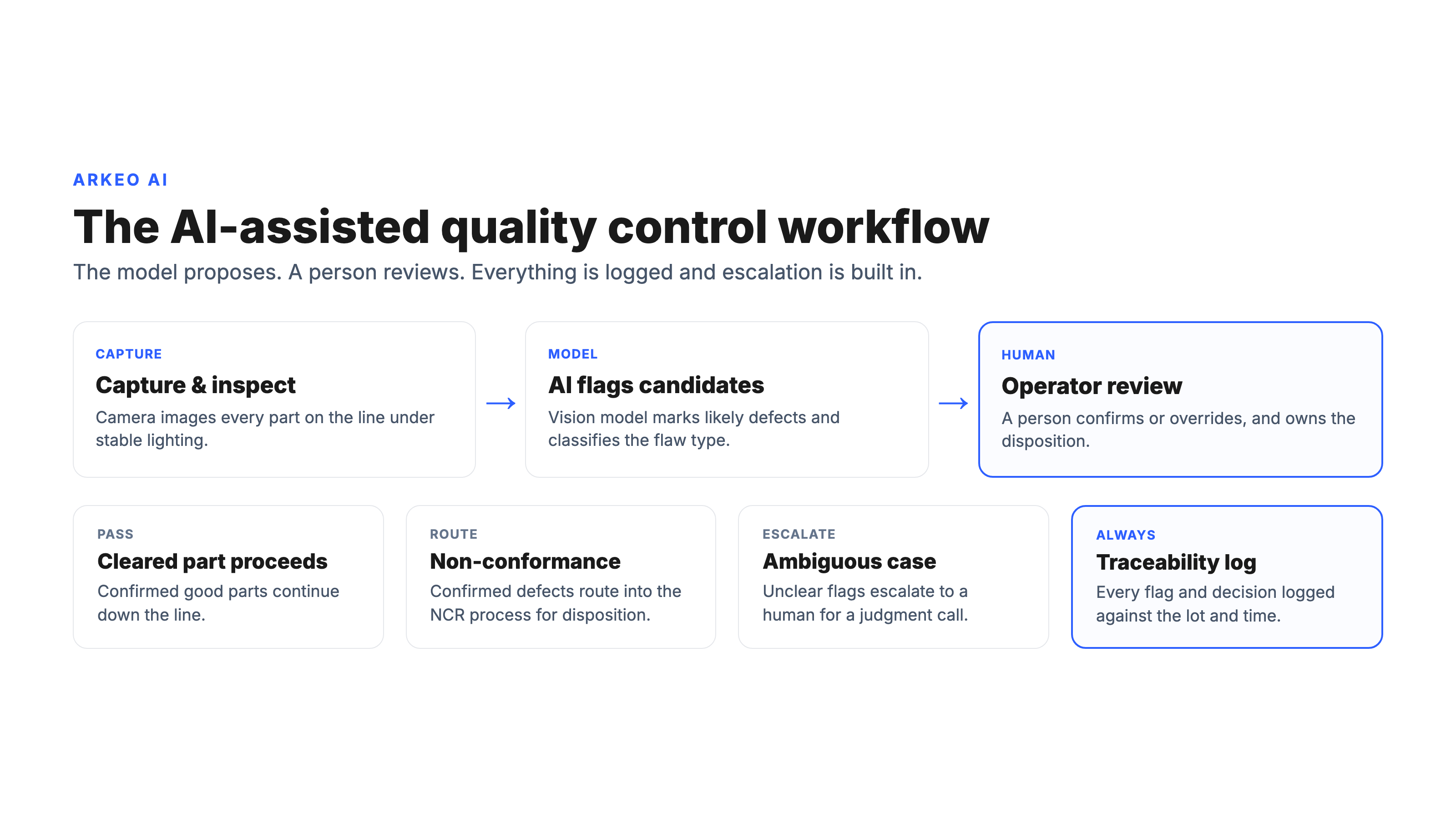
The diagram above is the shape of a working deployment. Capture and inspect, the model flags candidate defects, an operator reviews, and the part either passes or routes into non-conformance, with every step written to a traceability log and a clear escalation path when a case is ambiguous. Pull the operator out of that loop and you do not have a faster quality system; you have an unaccountable one.
What Conditions Make Quality Control AI Viable?
The model is rarely the constraint. Four conditions decide whether a quality AI project works, and a costly use case that fails any one of them is not your first project no matter how compelling the demo looked.
Image quality. Vision is only as good as what the camera sees. Inconsistent lighting, vibration, glare off a finish, or poor fixturing will defeat a strong model. Plants that succeed fix the physical capture conditions before they tune anything in software. If you cannot photograph the defect consistently, you cannot detect it consistently.
Training-data quality and labels. A defect model learns from labeled examples, and the labels carry the plant's definition of a defect. If two inspectors disagree on what counts as a reject, the labels encode that disagreement and the model inherits it. Clean, agreed, representative labels, including enough examples of the rare defects that actually matter, are the real raw material. This is also why a plant that has already been capturing inspection images is a far stronger candidate than one starting from zero.
Operator review. The workflow needs a human checkpoint by design, not as a fallback. The U.S. government's framework for trustworthy AI, the NIST AI Risk Management Framework, organizes the work around four functions, Govern, Map, Measure, and Manage, and treats human reviewability and accountability as core characteristics of a system you can trust. In a quality context that means an operator confirms or overrides flags, owns the disposition, and is the named accountable party, while the model proposes.
Feedback loops. Every operator correction is training signal. A viable deployment captures those corrections and uses them to retrain, which is how the model keeps pace with new parts, new suppliers, and changing conditions. NIST's Measure and Manage functions are exactly this: measure performance against a known ground truth, then manage drift continuously rather than assuming the model stays accurate forever.
Here is the false belief worth killing now: most leaders think buying a more accurate model is the path to better quality AI. They are wrong. The accuracy of the model on launch day matters far less than whether the four conditions above hold and whether a person owns the loop. A brilliant model on a glare-blind camera, fed contradictory labels, with no review checkpoint and no retraining plan, will fail. A solid model inside a clean, governed workflow will compound.
What Can Go Wrong With Quality Control AI?
The failure modes are predictable, and every one of them is a workflow or governance failure rather than a modeling failure. Three show up again and again.
See whether quality control is your right first workflow
A free AI Assessment maps your inspection bottleneck, data, and review process to a governed quality workflow, so you start with a system that holds up instead of a pilot that stalls.
Book Your Free AI Assessment →
Here is the blunt truth a vendor will not put in the brochure: plant AI models break, drift, and need maintenance of their own. A vision model trained on last year's parts will quietly degrade the day a supplier changes a finish, and the failure is silent, which is the dangerous part. Picture a line where the model has run clean for months. A supplier swaps a coating, the parts now reflect light a little differently, and the model starts passing flaws it used to flag. The demo still demos. The defect surfaces three weeks later at a customer, and someone spends a week tracing it back to a drifted model that needed retraining. That ongoing monitor-and-retrain cycle, not the initial build, is the real recurring cost, and it is exactly why NIST puts continuous Measure and Manage at the center of a trustworthy system. An owner who watches the model beats any vendor promise of set-and-forget.
How Do You Test Quality Control AI Safely?
You test it as a governed pilot, not a leap of faith, and the discipline maps directly onto the NIST functions: define success, measure against ground truth, and manage the rollout with a human in the loop the whole way. The sequence that works has four moves.
Pilot on one line and one defect type. Resist the urge to inspect everything at once. Pick the single line and the single defect family where escapes cost the most, and scope the pilot to that. A narrow pilot is the only kind that produces a clean read on whether the workflow holds.
Run in shadow mode first. Before the model is allowed to influence any disposition, run it alongside your existing inspection and compare its flags to the human ground truth. Shadow mode is how you Measure performance honestly without putting a single shipped part at risk, and it tells you about false positives and missed defects before they cost anything.
Define success criteria up front. Decide before launch what good looks like, in terms your quality team agrees on, and tie it to operational outcomes such as escapes caught, operator time recovered, and the false-positive load operators will tolerate. Criteria set after the fact get bent to make the project look successful. This is your Map and Measure work, done before money is committed.
Keep review checkpoints and a retraining plan. The pilot is not done when the model is accurate; it is done when the operator review loop, the escalation path, and the retraining cadence are all running. That Manage function is what carries the system past launch day. The same governed-action thinking applies anywhere AI takes or proposes an operational step, which is the throughline of AI industrial automation more broadly.
That sequence is also how you can size the effort before you commit. In Arkeo's deployment pattern, a quality control pilot scoped to one line and one defect type typically runs in weeks, not months: a focused data audit, then labeling and ground-truth agreement, then a shadow-mode run against human inspection, then a success-criteria review against the numbers your quality team set up front. The reason it stays in weeks rather than stretching to months is that the model is the small part. The bulk of the time goes to data and review setup, getting clean, agreed labels and a working operator loop, not to training the model itself. So when you scope your own pilot, weight the calendar toward data readiness and integration, not the algorithm, and treat a plant that already captures clean inspection images as the candidate that moves fastest. If your data is messy or your defect definition is contested, expect the front of that timeline to stretch, which is itself a useful signal about whether quality control is your right first project.
Before any of that, run your candidate through the readiness check below. It is the most citation-worthy asset on this page, because skipping it is the most common and expensive mistake in quality AI.
If your candidate clears every line above, quality control is a strong first AI workflow. If it fails one, that line is the work to do before you build, and naming it now saves a stalled pilot later. For a concrete picture of vision-based defect detection in a finished deployment, the manufacturing AI examples walk through what one looks like end to end.
When Should Quality Control Be Your First AI Use Case?
Quality control is one of the cleanest first moves in manufacturing AI, but only when the readiness check holds and the math closes. The selection criterion is simple to state: the cost of escaped defects plus the inspector time the workflow recovers has to exceed the cost to build the workflow and monitor it over time. If a defect is cheap to absorb downstream, or if you would still need full manual inspection alongside the model, the ROI case does not close, however feasible the model is.
The adoption data says this is a live decision, not a someday one, and it also tells you where most of the field gets stuck. Deloitte's 2025 Smart Manufacturing and Operations Survey found that 29% of large U.S. manufacturers are running AI or machine learning at the facility or network level, yet 23% are still piloting AI or machine learning and 38% are piloting generative AI, with respondents reporting gains of a 20% improvement in production output, 20% in productivity, and 15% in unlocked capacity. Read those numbers together and the gap is the lesson: a large share of manufacturers are stuck in pilots rather than running AI at scale, which is exactly the trap a quality program falls into when the model works in a demo but the workflow, the review loop, and the retraining plan were never built. That gap is the case for disciplined pilot design. The plants that cross from piloting to production are the ones that scoped a governed workflow up front, not the ones that chased a more accurate model. Across the broader economy the Federal Reserve's analysis of U.S. Census Bureau data put adoption at roughly 18% of all firms by year-end 2025, with over 20% planning to adopt in the first half of 2026. Production AI is real and in use, and most of the field is still piloting, which is precisely why a disciplined, governed pilot is the advantage.
Quality control sits at the analytical end of the floor, alongside the sensor-driven anomaly detection behind predictive maintenance in manufacturing. Both attach cleanly to a line and a data path, both reward a governed workflow, and both fail the same way when no one owns the model after launch. If quality escapes are what hurt most today, start here. If unplanned downtime is the bigger bleed, the maintenance use case may be the better first project. The right answer comes from your bottleneck, not from the technology.
That is the through-line behind the Arkeo Operating System and the reason it exists: scattered, ungoverned pilots do not survive contact with a real plant, while an owned, governed workflow does. Arkeo deploys on-premise and private AI for environments where quality records, lot genealogy, and non-conformance data need to stay inside your firewall for audit and traceability, and the firm uses what it sells rather than theorizing about it.
Map your first quality control AI workflow
A free AI Assessment evaluates whether quality control is the right first AI workflow for your plant and what data, review, and process work has to come first.
Book Your Free AI Assessment →