Category
AI Industrial Automation: The Judgment Layer

Last updated: May 2026
You already run automation. Your PLCs hold tolerances, your MES schedules work orders, and your ERP moves the paperwork. So the honest question is not whether to automate. It is whether AI actually adds value beyond the rules-based automation you already run, or whether it is another dashboard nobody trusts on the floor. That is the right question to ask before spending a dollar, and the answer is specific: AI earns its place only on the work your deterministic systems cannot do well, and only when it is governed.
The pattern that holds up across real industrial deployments is simple. AI proposes, prioritizes, and flags. People or governed deterministic systems approve and act. Arkeo AI builds on 25 years of operating experience and three years spent deploying production agents inside real workflows, and that line has never moved. The plant floor is unforgiving, so the first design decision is always which decisions a model is allowed to make alone, and the answer for anything safety-critical or high-frequency is none. If you want a structured read on where your own workflows fall, the free AI Assessment maps them before any build starts.
This guide is the companion to the broader AI in manufacturing hub. It is not the systems definition piece; that is covered separately. This one is about automation layers and how to deploy the AI layer without handing it the keys to a process that can hurt someone or scrap a batch.
Quick Answer
• What it is: A layer of AI judgment added on top of deterministic automation. It proposes, prioritizes, and flags, while people or governed control systems approve and act.
• Where it pays: Exceptions, prediction, classification, and cross-system coordination. Not safety-critical control.
• What it requires: Approvals, escalation, observability, and rollback, per the NIST AI Risk Management Framework.
• The ROI test: The AI layer pays when the cost of the exceptions and delays it removes exceeds the build plus monitoring cost.
What Is AI Industrial Automation?
AI industrial automation is a layer of AI judgment added on top of deterministic automation. It proposes, prioritizes, and flags, while people or governed control systems approve and act. It does not replace your PLC or rules engine for critical, high-risk, deterministic actions. It sits above them and handles the things fixed logic was never good at: ambiguous inputs, prediction, classification, and routing the exceptions that today land on a person's desk.
That framing matters because the alternative gets sold constantly. The hype version is the autonomous factory where AI runs the line end to end. That is not how responsible deployments work, and it is not how Arkeo deploys. A model that is wrong but confident is a liability anywhere a wrong action is unacceptable, so the deterministic systems keep the actions that must always behave the same way, and AI gets the judgment work that benefits from pattern recognition.
The adoption data backs the caution. Per the Federal Reserve FEDS note (April 2026), roughly 18 percent of firms had adopted AI by year-end 2025, while 78 percent of the labor force already worked at AI-adopting firms and over 20 percent of firms planned to adopt in the first half of 2026. Adoption is real and accelerating, but it is far from universal, which means most operators are still deciding where the line sits. This guide is about drawing it deliberately.
How Is AI Different From Traditional Industrial Automation?
Traditional automation is deterministic. Given the same input, a PLC or rules engine produces the same output every time. That is exactly what you want for safety interlocks, high-frequency control loops, and any action that must be auditable and predictable. It is fast, it is provable, and it does not hallucinate.
The limit shows up the moment the input is ambiguous. Rules struggle with messy sensor data, novel defect patterns, demand signals that do not fit a template, and the long tail of exceptions that humans currently absorb. That is the gap the AI layer fills. Below is the working model of the three layers and where each one belongs.
| Layer | What it does best | Who acts | When to use it |
|---|---|---|---|
| Rules-based automation (PLC, rules engine) | Fixed, deterministic, auditable control | The system acts directly | Safety-critical, high-frequency, must-behave-identically actions |
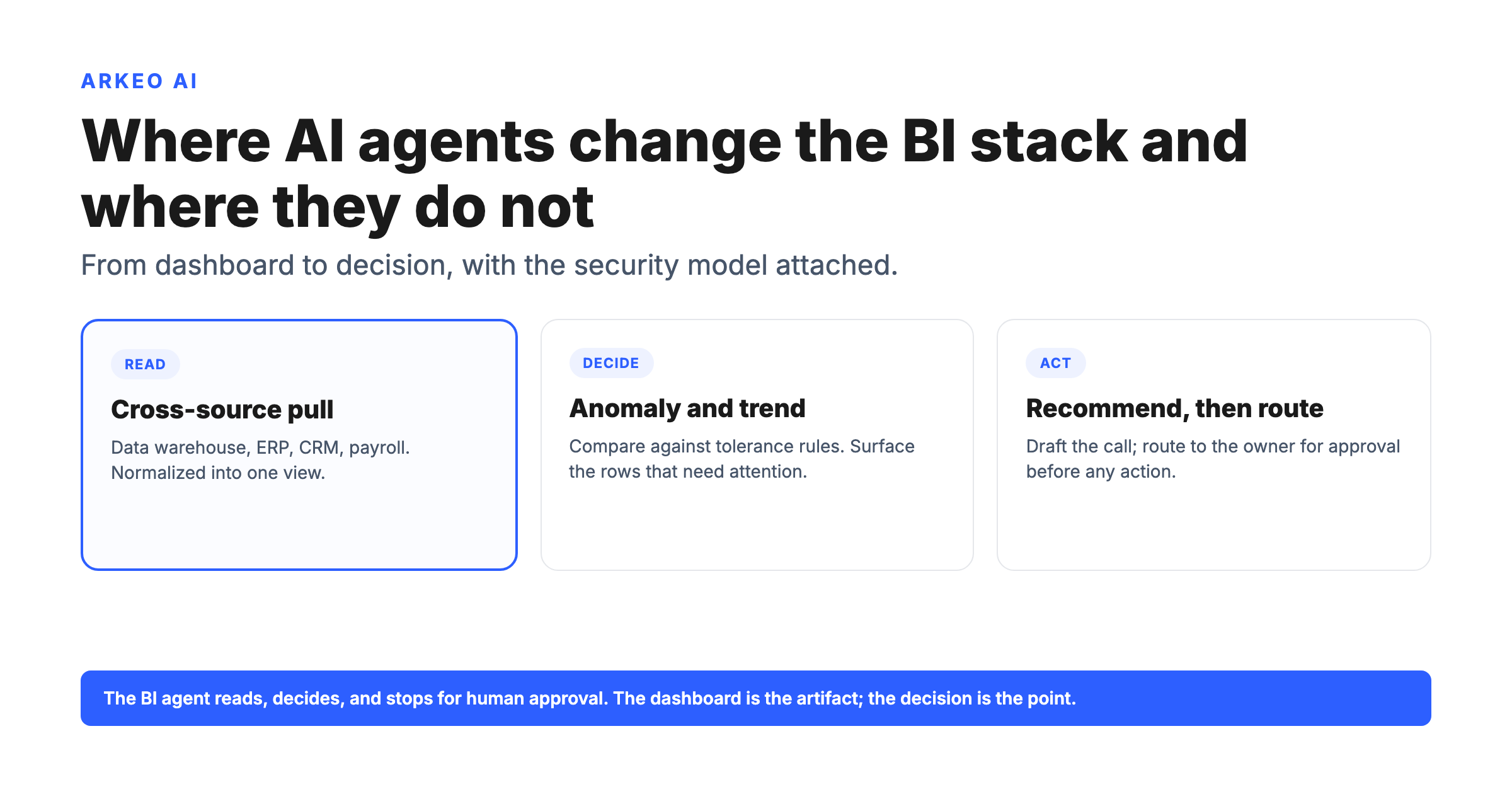
| AI-assisted decisioning | Classification, prediction, exception triage | AI recommends, a person approves | Ambiguous inputs where a recommendation saves time but the call still needs a human |
| Agentic workflow orchestration | Coordinating multi-step work across MES, ERP, and tickets | AI proposes the sequence, gated by approval checkpoints | Cross-system coordination that today eats coordinator hours, with humans still in the loop |
Notice the right-hand column does the real work. The decision is never "AI or automation." It is "which layer fits this specific decision," and most plants need all three running side by side. That is harder than buying one tool, which is exactly why the mapping comes before the build.
Know which workflows belong to which layer before you build
The free AI Assessment maps your workflows into rules-based, AI-assisted, and agentic candidates so you invest where the judgment layer earns its monitoring cost.
Book Your Free AI Assessment →
Where Does AI Add Value to Industrial Automation?
AI earns its keep in four places, and they all map to numbers an operations leader already tracks: throughput, downtime, quality, and coordination.
Exception routing. Most lines run fine until something does not fit the rules. AI can read the context of an exception and route it to the right person or queue instead of letting it sit. That removes delay, which is the most expensive thing on a constrained line.
Prediction. AI can flag a developing problem before a threshold trips, which is the basis of AI predictive maintenance in manufacturing. The model proposes that an asset is trending toward failure; a planner approves the work order. The deterministic maintenance system still executes it.
Classification. Vision and signal models sort, grade, and tag faster than manual review, then surface the borderline cases for human sign-off rather than auto-rejecting good product.
Workflow orchestration. Cross-system coordination across MES and ERP is where coordinator hours disappear. An agent can assemble the steps and draft the actions, but the consequential moves stay gated.
The leaders seeing returns are real. The Deloitte 2025 Smart Manufacturing and Operations Survey found 29 percent of manufacturers using AI and machine learning at facility or network scale and 24 percent using generative AI at scale, with another 23 percent piloting AI and machine learning and 38 percent piloting generative AI. The same survey reported gains of around 20 percent in production output, 20 percent in productivity, and 15 percent in unlocked capacity, and 92 percent called smart manufacturing the main competitiveness driver within three years. The signal is not that everyone is done. It is that most are still piloting, which is exactly the moment governed rollout separates the wins from the abandoned dashboards.
Where Is Rules-Based Automation Still Better?
Here is the blunt truth a vendor will not put in a brochure: most of your plant should stay deterministic, and adding AI to the wrong place makes things worse, not better. Rules-based automation is still the right answer for critical control logic, safety interlocks, and any high-risk deterministic action where a wrong-but-confident output is unacceptable.
The common false belief is that more AI is always more modern, so it must be better. It is not. A model that occasionally produces a plausible wrong answer is fine when a human reviews the suggestion. It is dangerous when it directly trips a relay. The job of the design is to keep AI on the proposing side of the line for anything consequential, which is also the position the NIST AI Risk Management Framework pushes you toward through its trustworthy-AI characteristics: systems must be safe and accountable, and a person or governed system stays responsible for the action.
How Do You Deploy AI Into Industrial Workflows Safely?
Safe deployment is not a slogan. It is four mechanisms, and they map directly to the NIST framework's Govern, Map, Measure, and Manage functions. Skip them and the AI layer becomes the shadow system nobody can audit when it goes wrong.
Here is the kind of failure that teaches operators why those four mechanisms exist, framed as a pattern that shows up on real lines rather than any one shop. Picture a batch-scheduling workflow where the AI-assisted layer sequences the day's runs and routes the exceptions a coordinator used to handle by hand. For weeks it looks like a clear win: throughput is up, the queue is shorter, and the recommendations are good enough that approvers start clicking through them quickly. Then a low-volume product with an unusual changeover requirement comes through. The model has barely seen that case, so it confidently slots the run into a window that the line cannot actually accommodate, and because the recommendation looked like every other one, it sails past a human who has stopped reading closely. The mistake is caught a shift later when a supervisor notices the changeover does not fit, and the run is rescheduled by hand. Nothing was harmed, but the near miss is the lesson. The AI was wrong but confident on an edge case it was never trained to recognize, approvals had quietly decayed into rubber-stamping, and nobody could see at a glance why the model made the call. That single workflow is the argument for all four mechanisms at once: escalation should have flagged the out-of-distribution case instead of presenting it as routine, observability should have surfaced the reasoning, and rollback should have made the correction a one-click revert rather than a manual scramble.
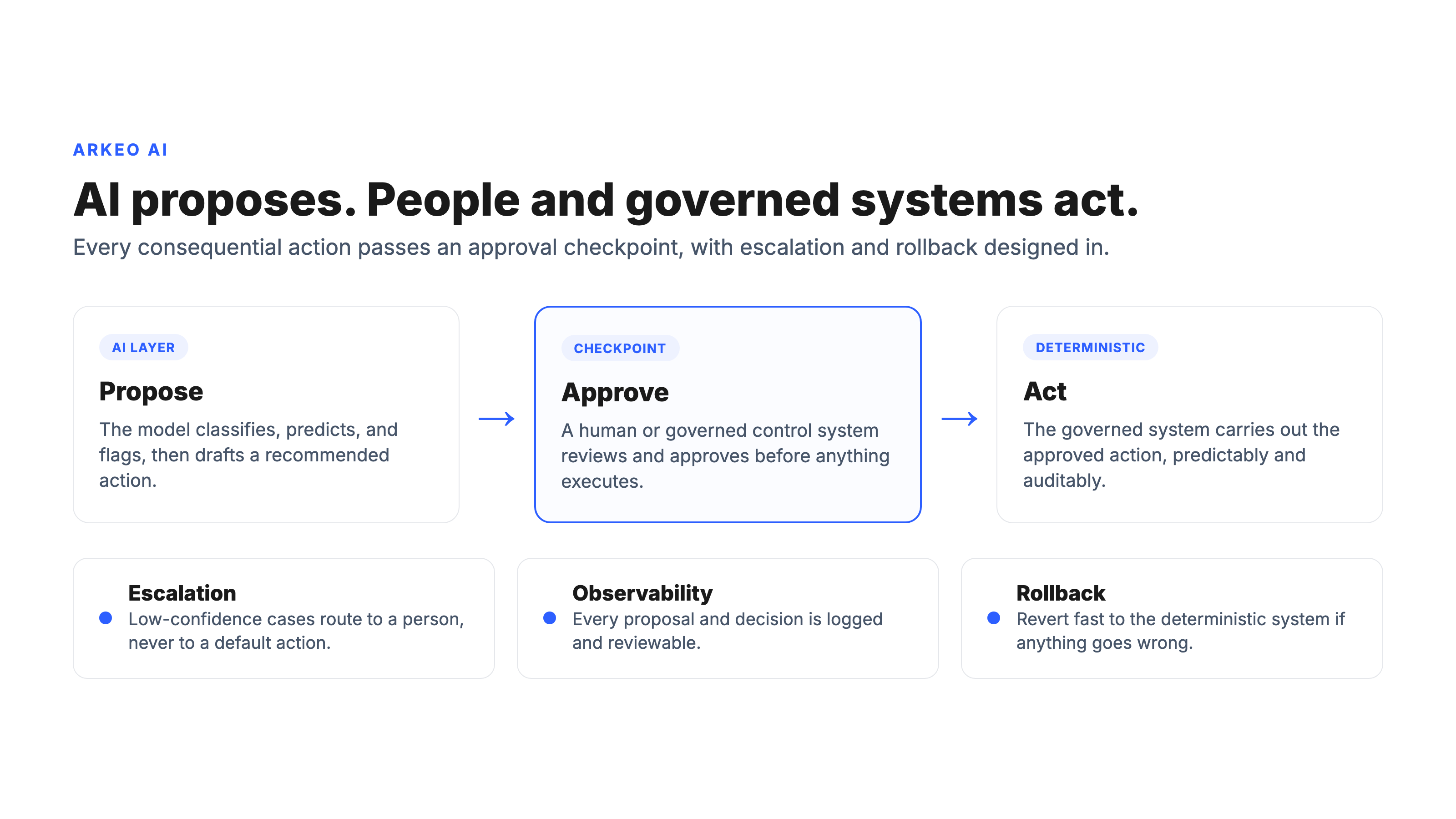
Approvals. Keep a human in the loop for any consequential action. AI drafts the work order, the maintenance call, the rescheduling move; a person with authority approves before it executes. This is the NIST accountability characteristic in practice.
Escalation. Define what happens when the model is uncertain or out of distribution. Low-confidence cases route to a human, not to a default action. The escalation path is designed before launch, not improvised after the first bad call.
Observability. You must be able to see what the model did and why. Every proposal, the inputs behind it, and the human decision are logged. This is the Measure function: continuous monitoring, not set-and-forget.
Rollback. When something goes sideways, you revert fast. The deterministic system is the fallback, so pulling the AI layer out of a workflow never stops the plant. This is the Manage function: managed risk with a known recovery path.
These four mechanisms are not a checklist Arkeo hands a client and walks away from. They are wired into the Arkeo Operating System, the platform the agents run inside, so approvals, escalation paths, decision logs, and rollback are part of how a workflow is deployed rather than something bolted on afterward. Arkeo runs its own operations on that same system, which is the short version of why the discipline holds: the team uses what it sells, so the gaps that only show up under real load get found internally before they reach your floor. The workflows ship the same way they are built, often on-premise or in a private deployment so the data and the audit trail stay inside your environment rather than a third-party cloud. The discipline is the same in either case: the model never holds an action it cannot be held accountable for. For the systems-level view of what this layer is made of, the companion piece on industrial artificial intelligence covers the architecture.
What Should You Evaluate Before Investing?
Before any build, four things decide whether the AI layer is worth it. Get honest answers to these and the go/no-go decision makes itself.
Data quality. AI judgment is only as good as the signals feeding it. If your sensor data, work-order history, or quality records are sparse or inconsistent, fix that first. A model trained on bad data confidently produces bad recommendations.
System access. The layer needs governed read and write access to MES, ERP, and the relevant control systems, with the write side gated by approvals. If integration is locked down or undocumented, the integration cost is the real project, not the model.
Ownership. Someone has to own the workflow: who approves, who monitors, who pulls the rollback. AI without an accountable owner is the most common reason pilots stall. The owner is a person, not the model.
ROI. The criterion is concrete. The AI layer pays when the cost of the exceptions and delays it removes exceeds the build plus ongoing monitoring cost. Monitoring is not free; observability and human review are recurring costs, so a workflow that only saves a few minutes a week rarely clears the bar. Target the workflows where exceptions are frequent and expensive.
If those four questions feel hard to answer for your own operation, that is the point of starting with an assessment rather than a build. The free AI Assessment exists to produce those answers and to sort your workflows into simple automation, AI-assisted decisioning, and custom agents before anyone writes code. The paid Consult is the logical next step once you have decided what to build, but the mapping comes first and it is free.
Map your workflows before you build
The free AI Assessment shows which industrial workflows need simple automation, AI-assisted decisioning, or governed custom agents, with the approvals and rollback designed in.
Book Your Free AI Assessment →