Category
AI in Production Planning: A Practical Guide

Last updated: May 2026
Your weekly production plan survives until roughly Tuesday morning. Then a rush order lands, a machine goes down, a supplier ships short, and a planner spends the rest of the day rebuilding a schedule by hand while the floor waits. That is the real problem AI is being sold against, and the honest question is whether AI can materially improve planning or whether the actual bottleneck is messy data and loose process discipline. The answer, after three years of deploying agents inside operating businesses, is that it can be both, and the order matters. The pattern that keeps repeating is simple: the planning model is rarely the hard part. The trustworthy inputs and the clear constraints feeding it are.
Arkeo AI was founded in 2023 on 25 years of operating experience, and the same lesson surfaces on every engagement. AI helps planning most where a single change ripples across more work centers and constraints than a human can re-optimize before the action window closes. It helps least where the underlying data is stale or the rules that govern the plan live only in a veteran planner's head. Before committing budget, it is worth pressure-testing which of those two situations you are actually in. That is exactly what the free AI Assessment is built to do, and it is the same operator-first question that runs through this broader guide on AI in manufacturing. Arkeo runs the Arkeo Operating System (AOS) and deploys the same agents it sells inside its own business, so this read is lived, not theoretical.
Quick Answer
• What it is: Decision support for planners. AI runs scenarios, flags exceptions, proposes priorities, and coordinates across ERP, MES, inventory, and quality systems while the planner keeps ownership and approves the plan.
• What it is not: Autonomous scheduling. It is only as good as the inputs and constraints you give it.
• When it pays: when schedule changes ripple across more work centers than a planner can re-optimize in time, the system data is trustworthy, and a planner owns and can override the result.
• Why it matters: Deloitte's 2025 survey ties smart-manufacturing initiatives to 20% higher production output and 15% unlocked capacity, and better planning is how that capacity gets unlocked.
What Does AI in Production Planning Actually Mean?
AI in production planning is decision support. It runs scenarios, flags exceptions, proposes priorities, and coordinates across your ERP, MES, inventory, and quality systems, while planners keep ownership and approve the plan. It is only as good as its inputs, and it is not autonomous scheduling. That distinction is the whole point of this article. The pitch you usually hear is that an algorithm will take over the schedule and run the plant on its own. The reality that earns its keep is quieter: AI sits next to the planner, does the heavy combinatorial work a human cannot do fast enough by hand, and hands back options for a person to weigh and approve.
This is different from a fixed weekly plan that is printed and then defended until it breaks. It is also different from a rules-only scheduler that follows hard-coded logic and cannot reason about a situation it was never explicitly told about. AI planning support sits between those, learning and computing across many signals at once, but it still answers to the planner who owns the outcome.
Where Does AI Actually Help Planners?
Strip out the hype and the genuine value lands in four places, all of them decision support rather than autonomy.
Scenario analysis. When demand shifts or a constraint changes, a planner wants to know the consequences of three or four responses before committing to one. AI can run those what-if scenarios across the whole order book in seconds and show the trade-offs: this option protects the on-time delivery on your biggest account but pushes overtime up, that option keeps labor flat but slips two smaller jobs. The planner still chooses. The AI just makes choosing an informed act instead of a guess.
Exception detection. Most planning pain is not the steady state, it is the exceptions: a plan that quietly violates a tooling constraint, an order sequenced before its material arrives, a changeover that breaks a quality hold. AI is good at scanning a proposed plan against the rules and surfacing the handful of lines that will bite you, so the planner spends attention where it matters instead of re-checking everything by hand.
Prioritization. When a rush order or a machine-down event forces a reshuffle, the question is which jobs move and in what order. AI can propose a priority sequence that respects due dates, setup efficiencies, and capacity, then explain why. The planner accepts, edits, or overrules it.
Cross-system coordination. A good plan needs orders and bills of material from the ERP, live machine status from the MES, real inventory positions, and current quality holds, all in one view. Most of that data is scattered across systems that do not talk to each other cleanly, so planners reconcile it manually. Pulling those feeds into one coordinated picture is some of the most concrete value AI planning delivers, and it is why so much of the work is integration, not algorithms.
Picture a planner whose largest customer pushes a rush order in at 9 a.m. on a day a critical CNC cell is already down for an unplanned repair. That single event ripples across a dozen work centers: every downstream sequence shifts, three other jobs are now at risk of slipping their dates, and the inventory for the rush job has not been verified. A human planner cannot fully re-optimize that web before the morning production meeting. AI can lay out two or three viable re-sequences in minutes, each with its trade-offs visible, so the planner walks into the meeting with options instead of a half-finished spreadsheet. That is the shape of the win. The planner still owns the call.
What Can AI Not Solve in Planning By Itself?
Here is the blunt truth a planning vendor will not lead with: a brilliant optimizer fed bad inputs produces a confident, beautifully formatted, completely wrong plan. The model does not know the data is stale. It will schedule against an inventory feed that says you have 400 units on hand when the real number is 90 because a receipt was never posted, and it will do it with total confidence. Three failure modes account for most of the disappointment.
Bad or late data. If the inventory feed lags reality, if the MES status is hours behind the floor, if BOMs are out of date, the plan inherits every error and amplifies it. Garbage in, confident garbage out. This is the single most common reason planning AI underwhelms, and it has nothing to do with the algorithm.
Missing constraints. Veteran planners carry rules in their heads that were never written down: this customer will not accept a partial shipment, that machine cannot run two specific jobs back to back, this operator is the only one certified for a particular setup. If those constraints are not captured, the AI will cheerfully propose plans that violate them, and the floor will quietly ignore the schedule. Surfacing that tribal knowledge is real work, and it is work no model does for you.
Weak ownership. If no planner truly owns the plan and the authority to override it, an AI suggestion becomes one more input that nobody acts on decisively. Decision support only works when there is a decision-maker.
Find out if your data is ready before you buy a planning tool
The free AI Assessment maps your ERP, MES, and inventory inputs against the planning problems most likely to pay off, so you fix what is actually blocking you instead of buying an optimizer your data cannot feed.
Book Your Free AI Assessment →
The NIST AI Risk Management Framework is useful language for this. It separates standing a system up from actually governing it over time, across the Govern, Map, Measure, and Manage functions. For planning, that means the control layer around the AI matters as much as the AI: knowing what data feeds it, what assumptions it made, and who can step in. A planning model with no visibility into its assumptions is a black box you cannot trust, and the framework is explicit that transparency and human oversight are how you keep an AI system accountable.
How Do You Use AI in Planning Safely?
Safe use comes down to keeping the planner in command and the AI in a support role. Three controls make that real, and they map directly onto the manage-it-over-time discipline the NIST framework describes.
Human review on every plan that matters. AI proposes, the planner disposes. The output is a recommended plan with its reasoning attached, not a schedule that auto-commits to the floor. For routine, low-stakes adjustments you can let more of it flow through; for anything that touches a major customer, a capacity constraint, or a quality hold, a person signs off.
Override logic the planner trusts. The planner has to be able to overrule the AI cleanly, and the system has to learn from the override rather than fight it. If the AI keeps proposing a sequence the planner keeps rejecting, that is a missing constraint surfacing, and capturing it makes the next plan better.
Visibility into assumptions. Every proposed plan should show its work: which data it used, how fresh that data was, which constraints it applied, and what it traded off. No black-box schedules. When a planner can see the assumptions, they can catch the stale inventory feed before it becomes a wrong plan, and they build the trust that makes them actually use the tool.
This is also where the honest case for keeping AI close to your own systems and data lands. Arkeo deploys planning support on-premise and inside the firewall where the operating data lives, which keeps sensitive order, capacity, and customer data under your control and keeps the assumptions auditable. The technology is genuinely capable now, but AI agents still drift and occasionally surface confident nonsense, so the human review and override steps are not bureaucratic overhead. They are the reason the system stays trustworthy enough to use.
What Systems Need to Connect for AI Planning to Work?
A planning AI is only as good as the picture it can see, and that picture is assembled from four sources. The integration work to connect them is usually the larger half of any planning project, and it is the half that gets underestimated.
It needs the ERP for the demand side: open orders, due dates, bills of material, and routings. It needs the MES for the live floor reality: which machines are running, what is down, what is behind, and actual cycle progress. It needs inventory for what is genuinely on hand, allocated, and inbound, because a plan built on a phantom stock position is worse than no plan. And it needs quality inputs: holds, nonconformances, and rework that take capacity off the table or block a shipment. The diagram below shows how those four feeds flow into the AI engine and back out through a planner before anything reaches the floor.
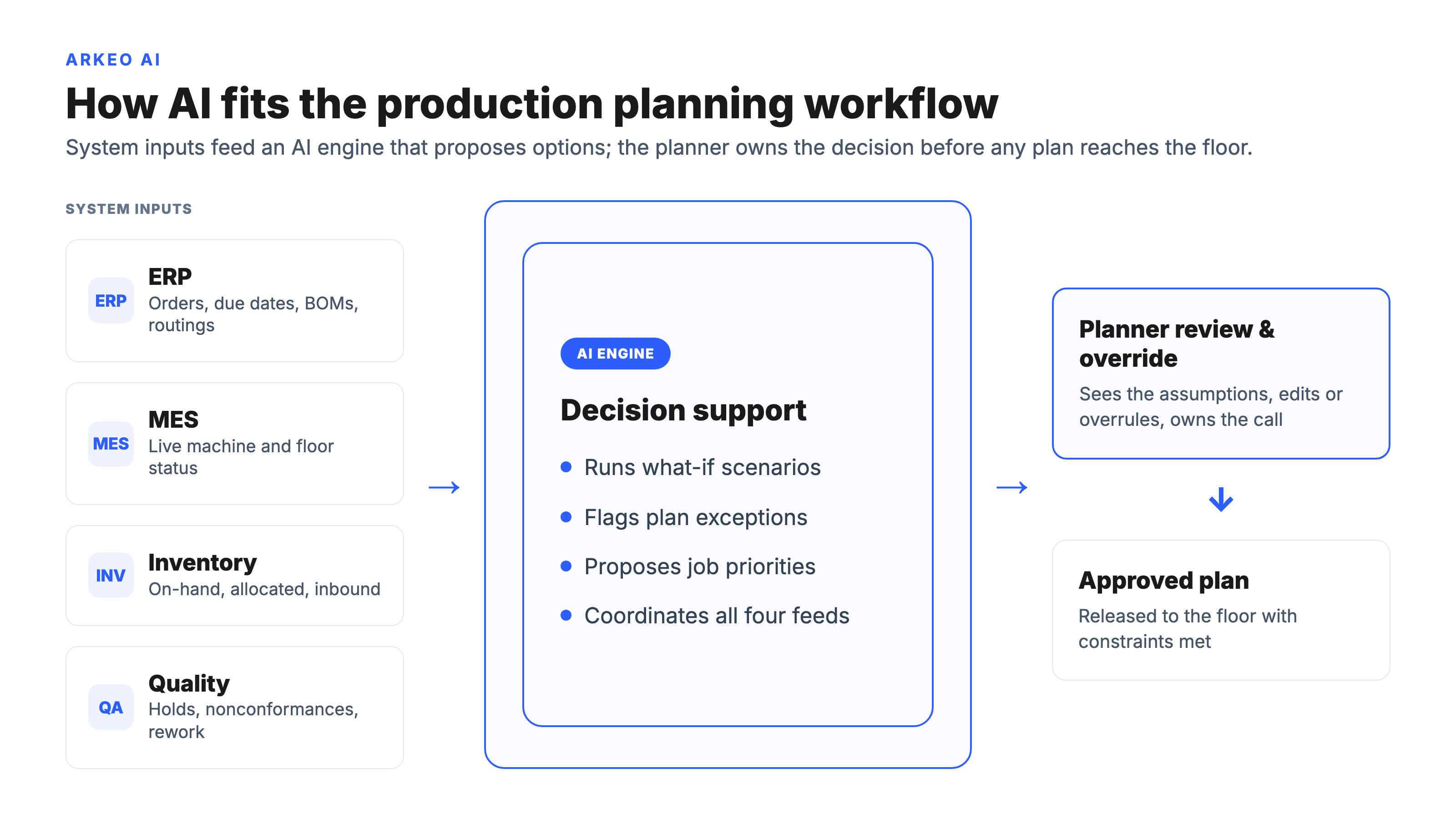
The order of difficulty is the opposite of what most people expect. The optimizer is largely a solved problem you can buy. Getting clean, current, trustworthy data out of four systems that were never designed to talk to each other is the project. If your ERP and MES already exchange data reliably and your inventory accuracy is high, you are most of the way there. If they do not, that integration and data-trust work is the real first phase, with or without AI.
When Is Production Planning a Good First AI Use Case?
Planning is not automatically your best starting point, and the decision turns on three concrete criteria rather than any vendor's promise.
The first is the complexity criterion. Planning AI pays when a schedule change ripples across more work centers and constraints than a human planner can re-optimize before the action window closes. If your plant runs a handful of work centers and a planner can rebuild the schedule in an hour, the payback is thin. If a single rush order or breakdown cascades across dozens of interdependent steps and the window to respond is short, AI earns its place.
The second is the data criterion. Your ERP, MES, and inventory inputs have to be reasonably trustworthy. Not perfect, but trustworthy enough that a planner is not constantly correcting the source data. If the inputs are messy, fixing them is your real first project, and it is a project that pays off even if you never deploy a planning model.
The third is the ownership criterion. There has to be a planner who owns the plan and has the authority to override the AI. Decision support with no decision-maker is shelfware.
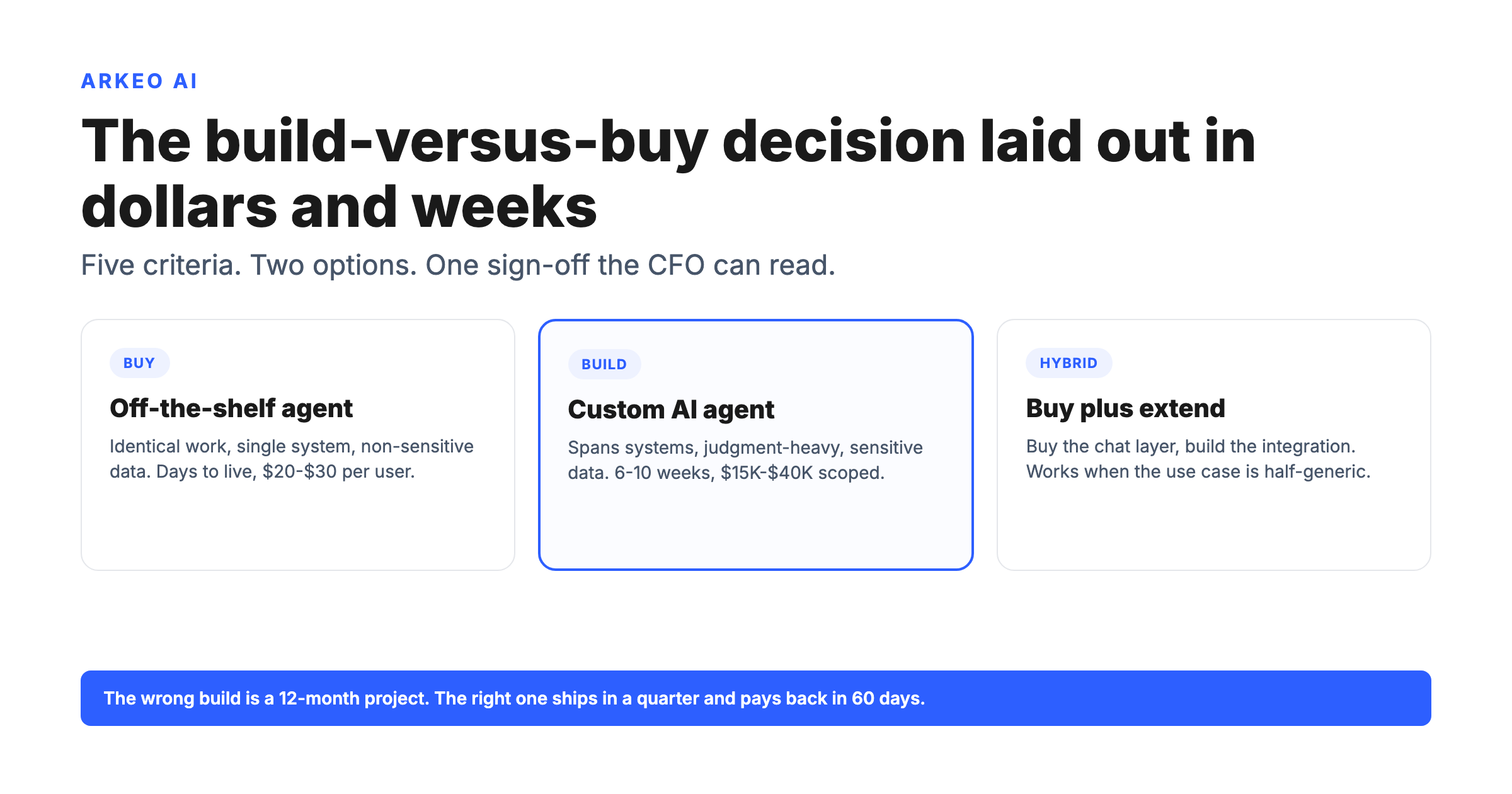
If all three are true, planning is a strong first use case. If your data is the weak link, you may get a faster, cleaner first win from a use case with a tighter, more contained data loop. AI for manufacturing quality control often qualifies, because a camera generates labeled examples quickly and the act-on-it response is immediate. If your pain is more about machines breaking than schedules churning, AI predictive maintenance in manufacturing may sequence ahead of planning, though it carries its own heavy data-history requirement. And if your interest is in letting AI take governed action across systems rather than just advise, AI industrial automation covers where approval gates belong. The checklist below makes the planning-readiness call concrete before you spend a dollar.
Arkeo's sequencing is deliberately conservative, and the wider data supports starting where you are ready. Deloitte's 2025 Smart Manufacturing and Operations Survey ties smart-manufacturing initiatives to roughly 20% higher production output and 15% unlocked capacity, and unlocking capacity is precisely what better planning and coordination deliver. The Federal Reserve, in research published in April 2026, found that around 18% of U.S. firms had adopted AI by the end of 2025, with over 20% more planning to adopt in the first half of 2026. Adoption is accelerating, which makes it more important, not less, to choose a first use case your data and process discipline can actually carry. The free AI Assessment exists to make that call for your operation, and the paid Consult is the logical next step once you have decided what to build first.
Start planning AI where it can win
The free AI Assessment evaluates whether planning, scheduling, or another workflow is your best first move using your real systems and data, so your first project ships and pays back.
Book Your Free AI Assessment →