Category
AI for Manufacturing Companies: A Buyer's Guide

Last updated: May 2026
You are not trying to decide whether AI matters to manufacturing. You already believe it does. The decision in front of you is narrower and more expensive to get wrong: is AI worth funding in your plant right now, and how do you avoid writing a check for a project that demos well and never reaches the floor. That is the real risk, and it is common. In Arkeo's manufacturing engagements the first few weeks almost never go to the model. They go to wiring and cleaning one MES, ERP, or quality data feed and naming the single person who will own the workflow once the pilot ends. A buyer who funds the model before that data path and that owner exist is funding the most likely version of the false start. If you want that homework done for you before you commit a budget, you can book a free AI Assessment and get a manufacturing-specific read on where AI fits and where it does not. The rest of this page gives you the decision criteria either way, and it fits inside the broader picture in the guide to AI in manufacturing.
Quick Answer
• What this is: A buyer-side decision guide for funding AI in a manufacturing company, not a tools comparison and not a pitch that every plant needs AI today.
• When to fund it now: Only when you can name a costly, repeatable bottleneck, point to a usable data path, and assign a human owner for the workflow. If you cannot, the first investment is the assessment that finds those, not a model.
• Cost shape: Per-seat off-the-shelf tools for the first 30-day wins, a scoped one-time build for custom workflow agents, and an ongoing monitoring and retraining line item, because plant AI drifts and needs an owner.
• Why it matters now: Large manufacturers are moving first while most of the field is earlier, so being early is an advantage that is still available rather than a reason to wait.
Should Manufacturing Companies Invest in AI Now?
A manufacturing company should fund AI now only if it can name a specific bottleneck, point to a usable data path into that bottleneck, and assign a human owner for the workflow. If it cannot do all three, the first and cheapest investment is the assessment that finds them, not a model. That is the buyer's test, and it is deliberately unsentimental. AI is worth funding when it is attached to a problem that already costs you money and to data you can already reach. It is not worth funding as a mandate to "have AI" with no target.
The market timing question has a clear answer. The field is moving, and it is moving unevenly in a way that favors decisive buyers. Deloitte's 2025 Smart Manufacturing and Operations Survey of 600 senior manufacturing executives at large U.S. manufacturers found that 92% believe smart manufacturing will be the main driver of competitiveness within three years, and 78% are already putting 20% or more of their improvement budget into it. That is the competitive backdrop. The adoption picture is the more useful signal for timing: the Federal Reserve's FEDS note on monitoring AI adoption, drawing on U.S. Census Bureau and Atlanta Fed data, found that roughly 18% of all firms had adopted AI as of year-end 2025 even though 78% of the labor force already works at a firm that has. Large employers are moving first; the broad base of smaller manufacturers is earlier. Being early is an edge that is still on the table, not a reason to hesitate.
Here is the false belief worth killing before you spend anything. Most leaders think the AI investment decision is a technology decision, a question of which model or which vendor. They are wrong. For a manufacturing buyer it is an operations decision: which bottleneck, whose data, who owns it. Get that right and the model choice is almost an afterthought. Get it wrong and the best model on the market will still stall in a pilot.
What Does a Good-Fit Buyer Look Like?
The buyers who get value from AI share a profile, and it has nothing to do with size or sophistication. It has to do with whether the conditions for a clean first win are present. Run your own situation against the signals below before you fund anything.
Notice what is missing from the good-fit column: company size, revenue, and how advanced your existing systems are. A 200-person plant with one painful, well-instrumented bottleneck and a willing owner is a far better buyer than a billion-dollar manufacturer that wants AI everywhere and owns it nowhere. The fit is about conditions, not scale.
What Do Poor-Fit Situations Look Like?
The poor-fit column is not a verdict that AI is wrong for you. It is a list of things to fix before you fund a build. The most expensive mistake a buyer makes is treating a poor-fit situation as a reason to push harder rather than a reason to do the preparation first. Each poor-fit signal maps to a specific, addressable gap: no target workflow means you have not run a bottleneck analysis yet; dirty data means the data path needs wiring before any model; no owner means the org question has not been answered. None of those are solved by buying a model sooner. They are solved by sequencing.
This is the blunt truth most vendors will not put in a deck: the majority of manufacturing AI today is stuck in pilots, not running in production. Deloitte found that across large U.S. manufacturers, 23% are piloting AI or machine learning against 29% running it at facility or network scale, and for generative AI the gap is wider, with 38% piloting against 24% deployed at that scale. Those stalled pilots are exactly the expensive false starts you are trying to avoid, and almost all of them trace back to a poor-fit condition that nobody fixed before the check was written. The honest move when you see your own situation in the right-hand column is to slow the spend, not accelerate it.
Find out if AI is worth funding in your plant
A free AI Assessment runs your operation against these good-fit and poor-fit signals and tells you which bottleneck, data path, and owner are ready, before you commit a budget.
Book Your Free AI Assessment →
Where Do Manufacturing Companies See the First Value?
When the conditions are right, first value tends to show up in four places. The point of naming them is not to rank tools; it is to give you candidate bottlenecks to test against your good-fit signals. Each one only pays when it is attached to a single owned workflow with a clean feed.
Quality. Computer-vision inspection is the most common clean first win because the data already exists as parts moving down a line, and the payback is visible. If quality escapes drive returns or scrap, this is usually the cheapest place to prove value. The buyer-side math and rollout detail live in the guide to AI for manufacturing quality control.
Planning. An AI scheduling agent rebalances a run against orders, capacity, material, and downtime faster than a planner working a spreadsheet. The ROI case closes when a single schedule change ripples across more work centers than a human can re-optimize in the window to act; a shop where one line runs independently rarely needs it. The mechanics are in the AI in production planning guide.
Maintenance. Predictive maintenance reads sensor and failure history to flag a stoppage before it happens. It pays when an unplanned stop on a given asset costs more per hour than the all-in run rate of the sensors, the model, and the monitoring program that watches it; on a machine that is cheap to absorb when it stops, the case does not close. The path from one critical asset to a fleet program is in the predictive maintenance guide.
Documents and coordination. The most underrated entry point is the paperwork around the floor: generative agents that draft deviation reports, reconcile invoices against purchase orders, and answer operator questions about work instructions. It is the least disruptive option because it touches systems of record rather than the line, and it pays back in weeks. For many buyers this is the right first move precisely because nothing on the floor has to change while the team builds confidence.
How Do You Avoid Wasted AI Spend?
Wasted manufacturing AI spend is rarely a model problem. It is a buyer-process problem, and it shows up in three predictable ways. Knowing them turns your due diligence into a checklist instead of a hope.
Readiness issues. The single most common cause of wasted spend is funding a build before the data path is clean and the bottleneck is named. A model is only as good as the data it reads, and a half-maintained ERP field or a drifting sensor starves it before any algorithm choice matters. Readiness is not a vague feeling; it is a checkable state, and the checklist below is the one to run before you sign anything. This is also where governance belongs in the conversation. The U.S. government's NIST AI Risk Management Framework treats data quality and human oversight as foundational to a trustworthy system, on the same footing as security and reliability, which is exactly the readiness bar a buyer should hold a build to.
Bad pilots. The second pattern is the isolated proof of concept that was never designed to reach the floor, so it never does. A pilot that lives off to the side, disconnected from a real production target, is the textbook stall point in the Deloitte data above. The defense is simple: refuse to fund a pilot that does not have a named path to production and an owner attached on day one.
Unclear ownership. The third is the accountability gap. A project that falls between IT and operations dies the quarter budgets tighten, because no one is responsible for keeping the agent alive once the demo is over. Naming the owner before the model is trained is not a nicety; it is the difference between a system that compounds and one that gets unplugged.
What Does a Low-Regret Rollout Look Like?
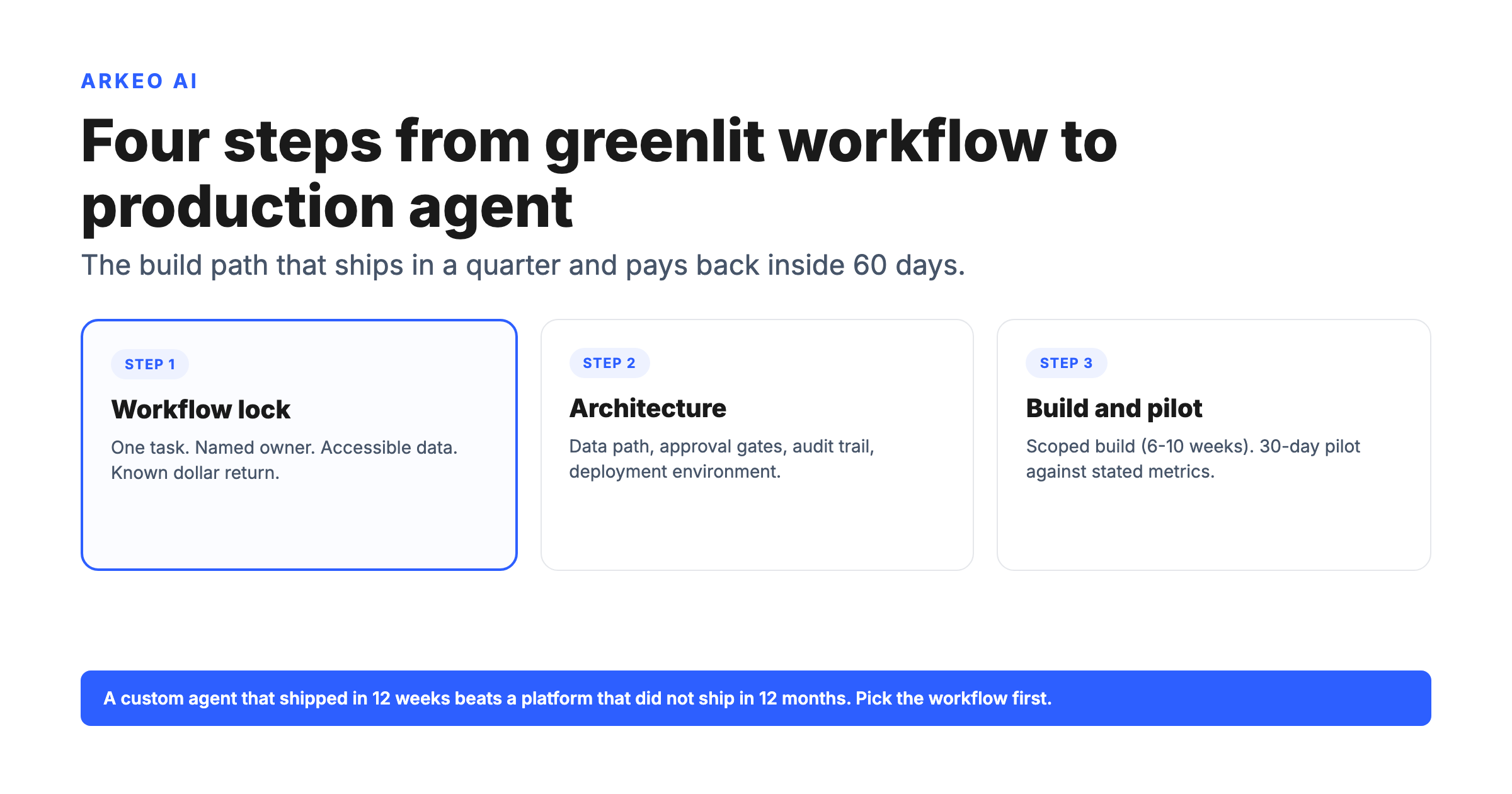
A low-regret rollout is sequenced so that each stage earns the right to the next and nothing commits you to a large bet before a small one has paid off. It maps directly to the Arkeo methodology and to what the free assessment produces: 30-day wins, a 90-day build path, and a 12-month architecture view. The timeline below is the shape of it.
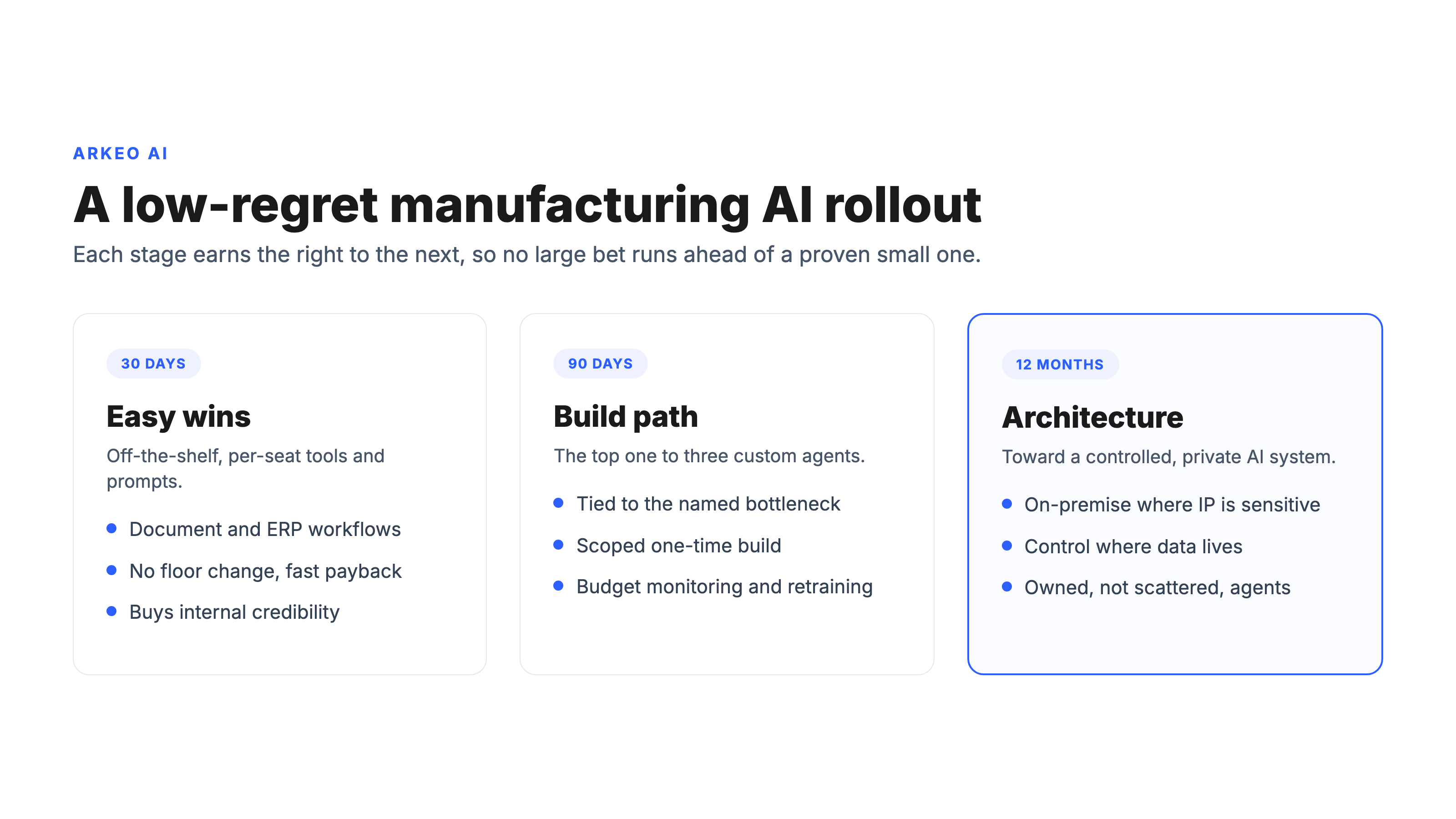
30-day wins. Start with low-cost, often per-seat off-the-shelf tools and well-built prompts pointed at the document and ERP workflows around the floor. No floor change, fast payback, and a team that now believes AI is real because it saved them hours this month. This is the stage that buys you internal credibility for everything after it.
90-day build path. The top one to three custom workflow agents tied to the bottleneck you named: a vision model on the worst quality line, a maintenance model on the costliest asset, a planning agent reading your MES. Be honest about the spend shape here. A custom agent is a scoped, one-time build investment rather than a monthly subscription, and every model you deploy carries an ongoing monitoring and retraining cost. Picture a vision model that runs clean for months, then a supplier quietly changes a material finish and the model starts passing flaws it used to catch. Nothing alarms; the demo still demos. The defect surfaces downstream, and the fix is retraining on the new finish. That monitor-and-retrain cycle, not the initial build, is the recurring cost a buyer should plan for.
12-month architecture. The move from scattered agents toward a controlled, private AI operating system. For plants handling sensitive IP or operating under regulatory constraints, this is where the on-premise question becomes central: where the data lives, who can see it, and whether the AI runs inside your firewall. Arkeo deploys on-premise and private AI for exactly these environments, and it is a deliberate architecture choice made at this horizon, not a default for every plant. Arkeo AI was founded in 2023 on 25 years of business operating experience and three years of deploying AI agents in production, and the Arkeo Operating System exists because scattered pilots do not survive contact with a real plant while an owned, sequenced architecture does. We use what we sell, which is why this rollout is grounded in running these systems rather than theorizing about them.
What Should You Do Next?
The next step is not to pick a tool. It is to confirm which of your bottlenecks clears the good-fit signals and the readiness checklist, so your first dollar buys a win instead of a science project. That is precisely what the assessment is for: it prioritizes the candidate bottlenecks, checks the data paths, names the likely owner, and shapes the 30-day, 90-day, and 12-month plan for your specific plant. The free AI Assessment is the lead magnet; if you later want a deeper, paid diagnostic, the Consult is the separate engagement that follows, but the planning session itself costs you nothing and is the right first move for a buyer who wants to avoid a false start.
Get a manufacturing-specific AI roadmap
A free AI Assessment prioritizes your bottlenecks, checks your data paths, and shapes a 30-day, 90-day, and 12-month plan so you fund the right first workflow.
Book Your Free AI Assessment →