Category
Phased AI Implementation Strategy: Crawl, Walk, Run
Last updated: June 4, 2026
By David Brennan · Arkeo AI · Building and Deploying Custom AI agents since 2023
If you are the operator who has watched a big-bang AI rollout fail (your own, or someone else's), you have likely already decided the next one will be phased. The question that decides whether a phased AI implementation strategy actually works is not which three phase labels you pick. It is what evidence you require before you advance, and what published signal forces you to stop. Without explicit gate criteria and explicit halt conditions, phasing is the same big-bang rollout in slower clothing, and the agent gets promoted on momentum instead of evidence. In this guide, you'll get the three-phase Crawl-Walk-Run model with the gate criteria that move each one forward, the four halt conditions that stop the advance early, and the drift signal that retires more agents than launches do.
The honest production number for phase-gating: roughly 30 percent of Crawl pilots should not advance to Walk, and the most common reason a deployed agent has to be re-validated is a vendor model update that quietly changes outputs against a stable input set (the drift halt). A free AI Assessment defines the Crawl phase so you know what done looks like before you start.
If you want the calendar plan, see the 90-day AI implementation plan. If you want the named obstacles, see AI implementation challenges. This post is the gate discipline.
Quick Answer
• What it is: A phased AI implementation strategy in three phases (Crawl, Walk, Run) with explicit gate criteria for advancing each and four halt conditions for not advancing.
• The gates: Accuracy and documented failure modes at Crawl to Walk; production override rate and safety incidents at Walk to Run; bounded autonomy and adoption at Run.
• The honest part: Around 30 percent of pilots should not advance from Crawl to Walk. Halting is success.
• Why it matters: Without gates, phasing is the same big-bang rollout in slower clothing.
Why does phase-gating matter, and what does skipping it cost?
A phased AI implementation strategy is the discipline of moving an AI agent through three production-readiness phases (Crawl, Walk, Run) with explicit gate criteria that must be met before each advance, plus explicit halt conditions that stop the advance early. The phases without the gates are theater. The gates are the entire point.
The Deloitte State of Generative AI Wave 4 study of 2,773 C-suite respondents found more than two-thirds expect 30 percent or fewer of their generative AI experiments to scale within three to six months. BCG's Where's the Value in AI? report from October 2024 found 74 percent of companies struggle to capture value from AI. The Stanford HAI 2025 AI Index reports 78 percent of organizations used AI in 2024, up from 55 percent. Adoption is high. Translation to production is not. Phase-gating closes that gap because it forces teams to advance on evidence or stop on evidence, not on momentum.
What do Crawl, Walk, and Run actually mean?
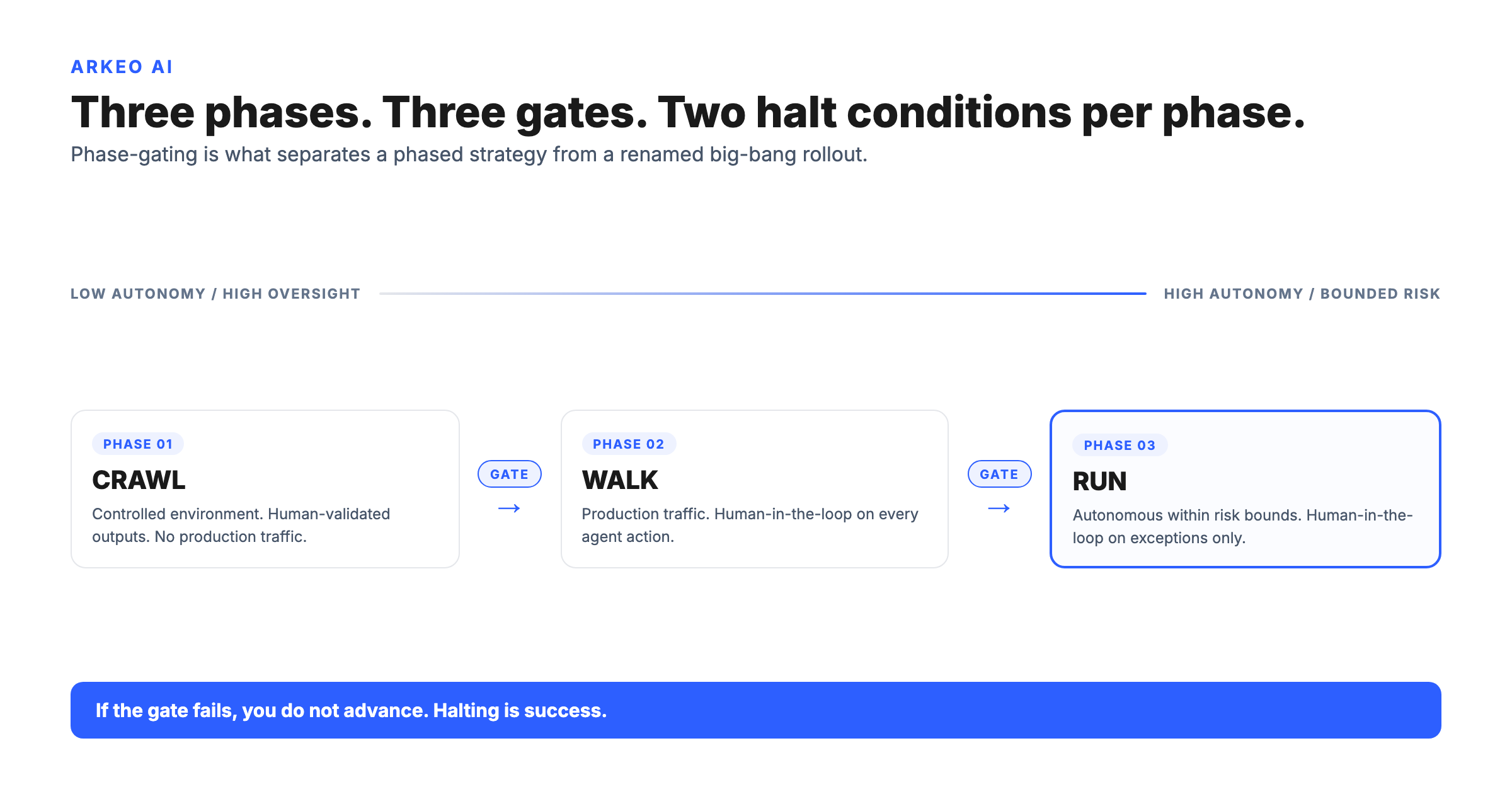
Crawl runs a single workflow in a controlled environment with human-validated outputs and no production traffic. Walk puts the agent on production traffic with a human-in-the-loop checkpoint on every action. Run is autonomous execution inside a defined risk envelope, with HITL on exceptions only. Arkeo deploys this under the Assess, Deploy, Manage model on a private, on-premise AI workforce where data never leaves the building, and we use what we sell.
THE THREE PHASES
Crawl, Walk, Run with the gate between each
Three phases. Three gates. The gate, not the phase label, is what matters.
PHASE 01
CRAWL
Controlled environment, human-validated outputs, no production traffic. The agent sees real data but its outputs do not touch customers, regulators, or downstream systems.
GATE TO ADVANCE
Does the agent hit the pre-published accuracy bar on a held-out sample, with a documented failure-mode list?
HUMAN ROLE
Reviews every output. The reviewer is the audit log.
PHASE 02
WALK
Production traffic with a human-in-the-loop checkpoint on every agent action. The agent is doing real work. A human approves before the action commits.
GATE TO ADVANCE
Is the human override rate below the published threshold over a defined production window, with no security or compliance incidents?
HUMAN ROLE
Approves every action. Override rate is the signal.
PHASE 03
RUN
Autonomous execution within defined risk bounds. Human-in-the-loop on exceptions only. The agent commits actions on its own inside the bounded envelope and escalates anything outside it.
GATE TO ADVANCE
Is autonomy held inside the risk envelope, with escalations resolved at the published service level and adoption rising not falling?
HUMAN ROLE
Owns exceptions and the envelope itself.
If the gate fails, you do not advance. Halting is success.
What does the Crawl to Walk gate actually require?
The Walk phase is where the PwC AI Agent Survey of 300 senior US executives finds 66 percent of agent adopters reporting productivity gains, with 79 percent of US businesses adopting agents. Production traffic surfaces patterns no controlled-environment dataset contains, and the failure modes the team did not log in Crawl. Which is exactly why the gate matters.
Picture a 320-person mid-market lender running an agent that drafts initial loan-decline letters. In Crawl, the agent hits 94 percent accuracy on a 600-letter historical sample and the team is ready to ship. The gate to Walk is not just that number. It is the documented failure-mode list, the regulatory review of those failure modes, the human-override workflow in production, and the signed rollback plan. Skipping any of the four is how a 94 percent agent causes a fair-lending review six months later. The Crawl-to-Walk gate is the most important gate in the strategy because it is the moment the agent first sees production consequences.
The operator test: Write out your Crawl-to-Walk gate criteria right now. Does it include the accuracy bar, the failure-mode list, the regulatory review, the override workflow, and the rollback plan? If any of the five is missing, the gate exists on paper but not in practice.
A free 60-minute AI Assessment names your first Crawl workflow, the published accuracy bar, the gate to Walk, and the halt conditions, in writing, before any deployment work begins.
Book Your Free AI Assessment →How is the Run phase bounded?
The Run envelope is the set of decisions the agent commits on its own (transaction value below a threshold, customer segment within a list, action class within a published catalog). Anything outside escalates. The gate from Walk to Run is whether the override rate has stayed below threshold over a defined window, with no security or compliance incidents. Adoption matters too: if humans are working around the agent in Walk, do not promote it. In Arkeo's build experience, a scoped single-workflow agent runs roughly $15,000 to $40,000 and 6 to 10 weeks to production (8 to 12 weeks for a private or enterprise deployment), and the first quick win typically lands in 30 to 90 days. That quick win is almost always a Walk milestone, not a Run one. Run is the destination, not the proof.
What are the halt conditions, and why is halting success?
The halt conditions are the published reasons you stop advancing. They are not failure modes, they are the system working. Without them, phasing collapses into a one-way ratchet where momentum carries the agent past every red flag because nobody wants to be the executive who killed the demo.
FOUR HALT CONDITIONS
When to NOT advance (and why halting is success)
Published before the phase starts. Checked on a defined cadence inside the phase.
HALT 01
Quality regression
Accuracy drops below the published baseline over a defined production window. The agent got worse on real traffic than it was on the held-out sample. Do not advance until the regression is explained and closed.
HALT 02
Security signal
A data-leak indicator, an access-control failure, or a shadow-AI workaround appears. The IBM Cost of a Data Breach 2025 report attaches a $670,000 premium to shadow-AI incidents. Halt is cheaper.
HALT 03
User abandonment
Humans stop using the agent or build workarounds. The override rate looks fine but volume drops. The team is voting with its feet. Autonomy on top of an unloved agent is not autonomy, it is an incident waiting to happen.
HALT 04
Drift
A vendor model update changes outputs against a stable input set. The agent now behaves differently than the version that earned the gate. Hold the phase, re-run the baseline, then decide.
Around 30 percent of pilots should NOT advance from Crawl to Walk. That is the system working.
Picture a 450-person specialty manufacturer running an agent that triages inbound supplier-quality complaints. In Walk, the override rate is 4 percent and the agent is on track for Run. In month four, a vendor model update lands. The override rate moves to 11 percent on the same input categories. Drift halt triggers. The team holds Walk, re-runs the Crawl baseline against the new model version, finds two failure modes that did not exist a month ago, and updates the gate. The team did not lose. The system worked.
The operator test: Look at any agent you have deployed in the last 12 months. When did you last run a structured output-consistency check against a fixed input set? If the answer is more than 30 days, you have not checked for drift. You have assumed it.
Where do mid-market teams break the gate discipline?
The most common failure is treating the gate as a target to hit on the published date rather than evidence to gather. The fix is publishing the halt conditions at the start of the phase, on the same page as the gate criteria, with the same executive signature. For the calendar view, see the 90-day AI implementation plan. For obstacles inside each phase, see AI implementation challenges. For quarterly cadence, see AI implementation roadmap sequencing. The pillar lives in enterprise AI strategy.
A free 60-minute AI Assessment defines your first Crawl workflow, the gate to advance, and the halt conditions to stop early, in writing, before any deployment dollars are committed.
Book Your Free AI Assessment →