Category
What a Generative AI Governance Framework Must Cover
Last updated: May 2026
Your team is already running generative AI. A rep drafts proposals in a public chatbot, an analyst pastes a customer contract in to summarize it, a manager wires a copilot into a live workflow. You wrote an AI governance policy last year, and it covered model risk, bias, and fairness. None of it tells anyone what they may type into a prompt, who checks the output before a customer sees it, or where that data goes after they hit enter. Arkeo AI has spent three years deploying generative and agentic systems inside real operations, and that gap is the most common one we find: solid AI governance on paper, zero generative-specific control where the work actually happens.
Quick Answer
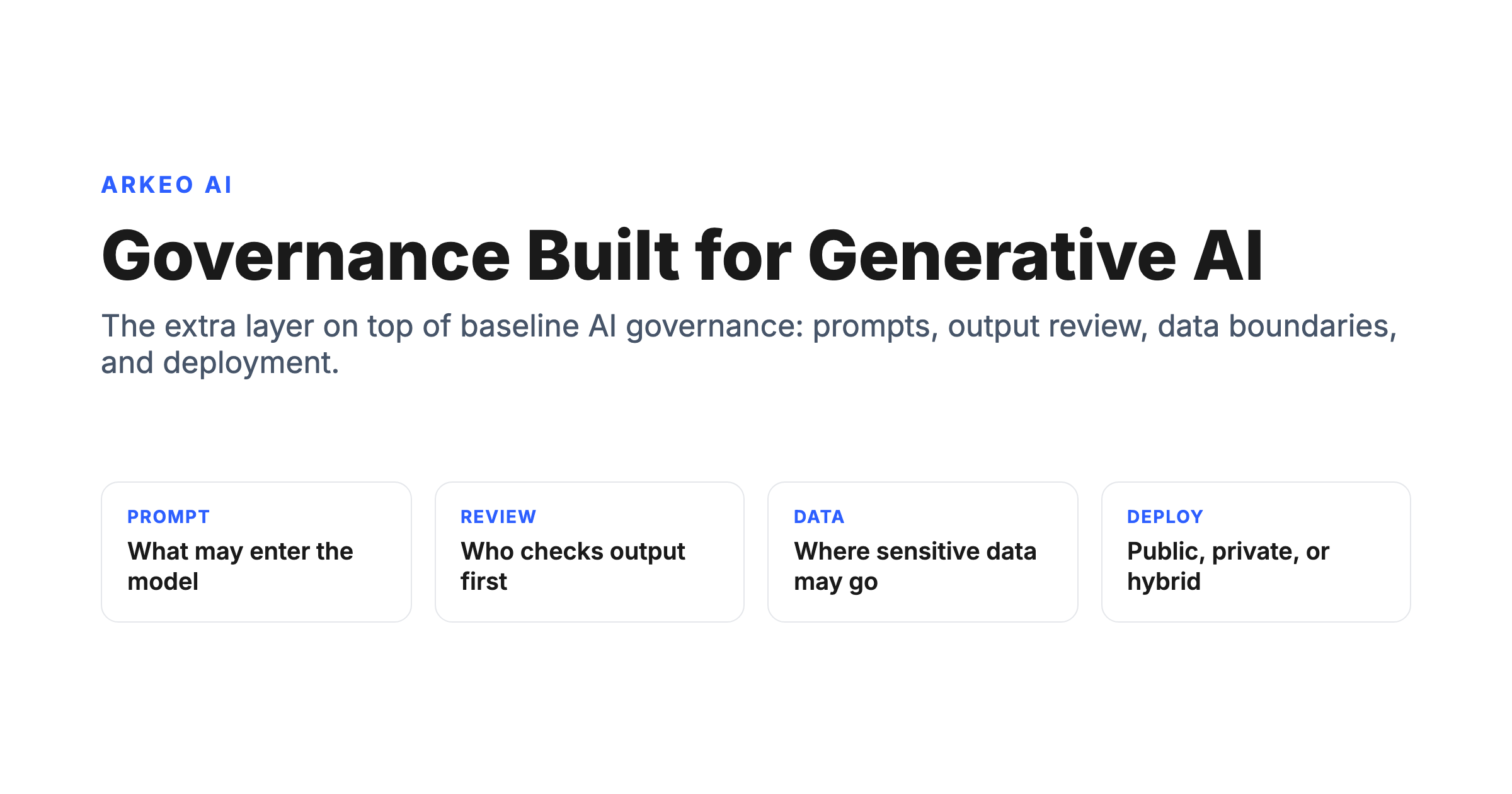
• What it is: A second governance layer on top of baseline AI governance that controls prompt usage, output review, data boundaries, and where the model runs.
• Why generic governance is not enough: Generative AI adds risks (hallucination, data leakage through prompts, IP exposure) that bias-and-fairness governance was never built to catch.
• What matters most: Access rules, usage rules, review rules, and a deployment choice (public, private, or hybrid) that decides how heavy the burden is.
This guide lays out the controls that framework actually needs, not another ethics statement. The rest of this page covers why generative AI needs its own layer, the specific controls to put in place, where teams get it wrong, and how the deployment model changes everything.
Why Does Generative AI Need Its Own Governance Framework?
A generative AI governance framework is the extra layer of controls, on top of baseline AI governance, that governs how people prompt generative systems, how outputs are reviewed before they are acted on, what data may flow into a model, and where the model runs. Baseline AI governance handles model risk, bias, and fairness. It does not handle a system that writes new content on demand, can be fed sensitive data through an open text box, and produces confident answers that are sometimes simply wrong.
Here is the belief that gets organizations in trouble: that a generic AI governance program already covers generative AI. It does not. The technology is different enough that the people setting the standards say so directly. In a 2024 study of 2,600 security and privacy professionals, Cisco found that 92 percent of respondents said generative AI is a fundamentally different technology requiring new data and risk management techniques. In the same study, 27 percent of organizations had banned generative AI tools at least temporarily over privacy and security risk, while 48 percent admitted entering non-public company information into those tools anyway.
The policy bodies have already moved. NIST published its AI Risk Management Framework Generative AI Profile (NIST AI 600-1) in July 2024, a companion to the broader AI RMF created specifically because generative systems carry risks that AI governance generally was not designed to address. The profile identifies 12 risks unique to or amplified by generative AI, including confabulation (hallucination), data privacy, information security, and information integrity, and proposes more than 200 actions deployers can take to manage them. The OECD updated its AI Principles in May 2024 for the same reason, adding provisions on privacy, intellectual property, safety, and information integrity that it judged necessary specifically because of generative and general-purpose AI. When the standards bodies write a separate profile, the signal is clear: the generic layer is not enough.
What Controls Matter Most for Generative AI?
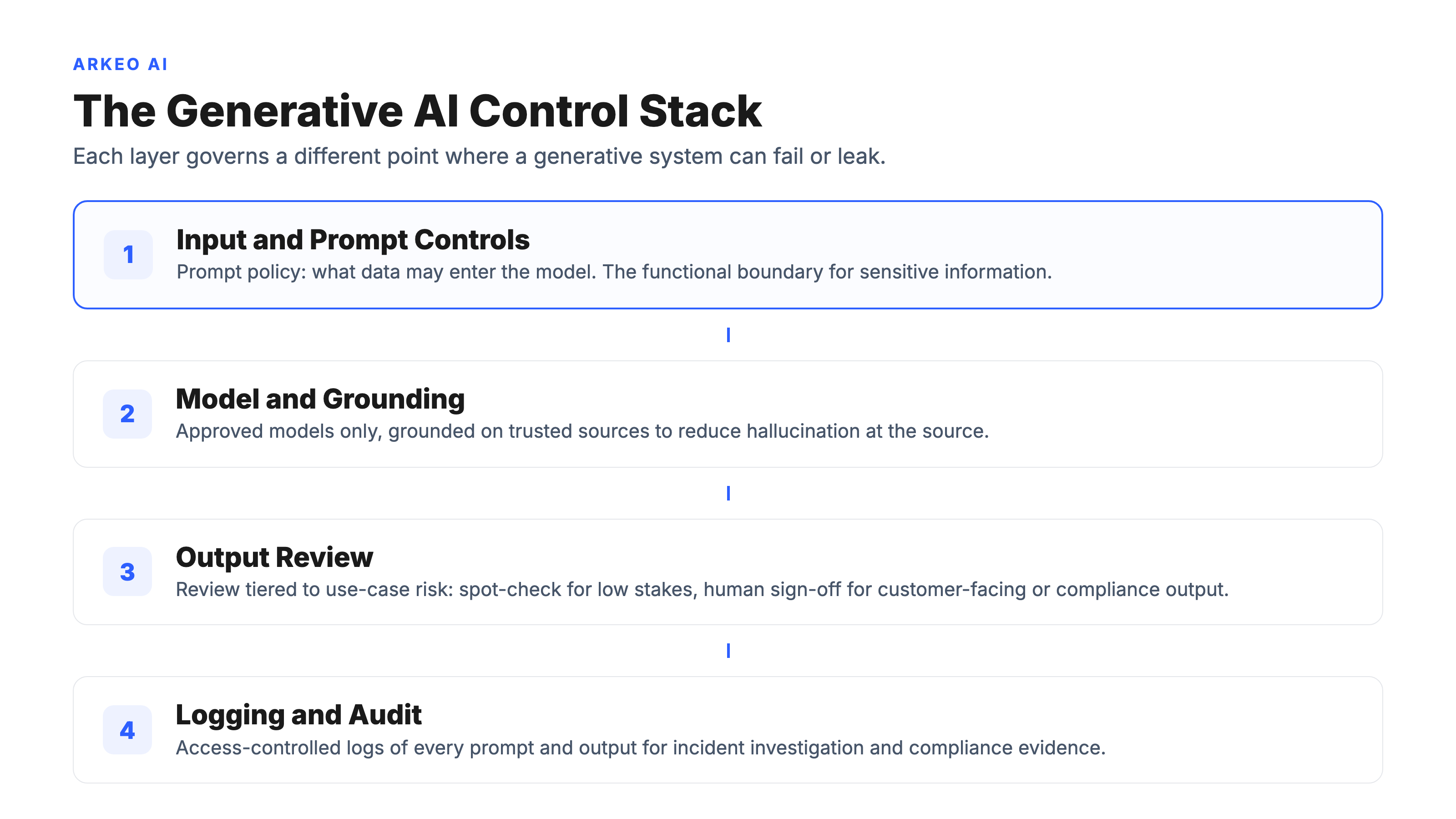
A generative AI governance framework is built from four control families: access rules (who can use which models), usage rules (what people may prompt), review rules (who checks output before it is used), and deployment choices (where the model runs). The table below maps each generative-specific risk to the control that contains it. This is the part most policies skip, because it is the part that touches the actual workflow.
| Generative AI risk | The control that contains it |
|---|---|
| Hallucination (confabulation) | Tiered output review: spot-check for low-stakes use, mandatory human sign-off before any customer-facing or compliance output is acted on. Implementation: any output touching contract or regulated language gets a named reviewer sign-off before send, logged to the incident trail. |
| IP and copyright exposure | Usage rules on what source material may be fed in, plus a copyright policy for generated content. The EU AI Act now makes a written copyright policy a legal obligation for general-purpose model providers. Implementation: legal owns the copyright policy and reviews it quarterly; any output reused in a paid deliverable is checked for source provenance before it ships. |
| Data leakage through prompts | A written prompt policy that names what categories of data may never be entered (no customer PII, no unreleased product data), plus a deployment choice that keeps sensitive data off public models entirely. Implementation: define Category A data as PII, proprietary, and regulated information; it never enters a public prompt, and the rule is posted inside the tool where people work, not buried in a wiki. |
| Prompt and output logging | Access-controlled logs of inputs and outputs for audit, incident investigation, and compliance evidence. Logging is a governance asset, not a privacy liability. Implementation: prompts and outputs are retained for a defined window (commonly 12 months), readable only by security and the workflow owner, never by the prompting user's manager for performance review. |
| Misuse and policy violations | Real-time guardrails and in-the-loop evaluators that screen prompts and outputs as they happen, not just after the fact. Implementation: a blocked-prompt event routes to the security owner the same day, and repeated violations trigger a workflow review rather than a quiet log entry no one reads. |
That last row matters more than it looks. IBM, in its guidance on governing data exposure in generative AI, identifies prompt injection, data leakage, jailbreaks, and hallucinations as four real-time risk categories that cannot be managed by offline or post-hoc review alone. They need policy enforcement and guardrails that run while the prompt is being processed. The blunt truth a vendor brochure leaves out: generative AI models hallucinate, and they do it confidently. NIST documents that confabulations are widespread in current large language models and that users are misled precisely because false outputs arrive wrapped in plausible-sounding logic and citations. No control eliminates that. Output review is what catches it before someone acts on a fabricated answer. Once the controls are laid out this way, the real work is matching each one to a live workflow, which is exactly what a free AI Assessment does with a team that has run this specific rollout pattern inside operations like yours.
See where generative AI fits your operation
A free AI Assessment maps your live and planned generative AI use to the prompt, review, data, and deployment controls that actually fit your business, before the gaps cost you.
Book Your Free AI Assessment →
Where Do Teams Get Generative AI Governance Wrong?
Most generative AI governance does not fail on paper. It fails in a handful of specific gaps, and each one maps directly to a missing control. The pattern below shows where generative-AI governance most often breaks in practice.
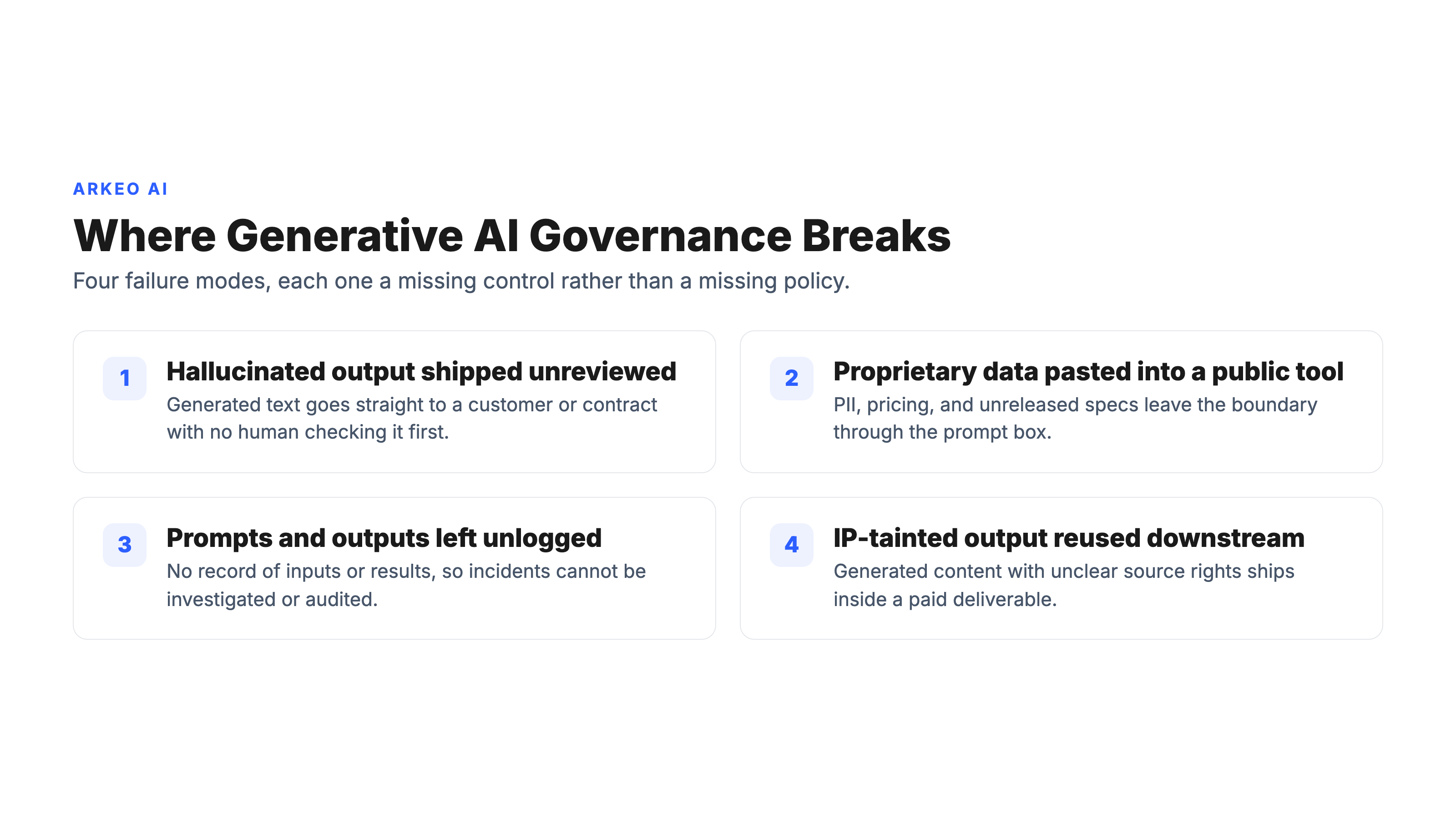
No output review. The model is treated as a finished-work machine instead of a draft machine. Generated text goes straight to a customer, a contract, or a compliance document with no human checking it. In any field with professional liability (legal, healthcare, financial advice, safety documentation), acting on AI output without human review can void professional standards of care no matter how accurate the model is on average. Unclear prompt policy. Nobody has written down what may go into a prompt, so employees decide individually, in the moment, under deadline pressure. A prompt policy is the equivalent of data classification for generative AI: define what categories of information may be entered, and you have a functional data boundary even on a public model. Skip it, and you have implicitly no boundary at all. Bad data boundaries. Sensitive data lands in a public tool because the deployment choice was never matched to the data-sensitivity requirement.
That gap is not closing on its own. The Cisco 2025 Data Privacy Benchmark Study found that 64 percent of organizations worry about inadvertently sharing sensitive information through generative AI tools, yet nearly half still admit feeding personal employee or non-public company data into them. Awareness is high and behavior has not caught up, which is the definition of a control gap rather than a knowledge gap.
Consider a mid-market firm, purely as an illustration, that rolled generative AI out from the bottom up. A sales team found a public chatbot useful for drafting proposals and started pasting full customer contracts in, names and pricing attached, months before any prompt policy existed. The drafts were good. The proposals went out faster. Nothing visibly broke, and that is exactly the trap. The sensitive data had already left the building through the prompt box before anyone in leadership knew the workflow existed. The absence of an incident is not evidence of control. It usually means no one is looking. A prompt policy and a deployment decision would have caught it on day one.
How Does the Deployment Model Change Generative AI Governance?
This is the choice that decides how heavy your governance burden is, and most frameworks treat it as an afterthought. The deployment model determines how much control you have over the single biggest generative AI risk: data leaving your boundary through a prompt.
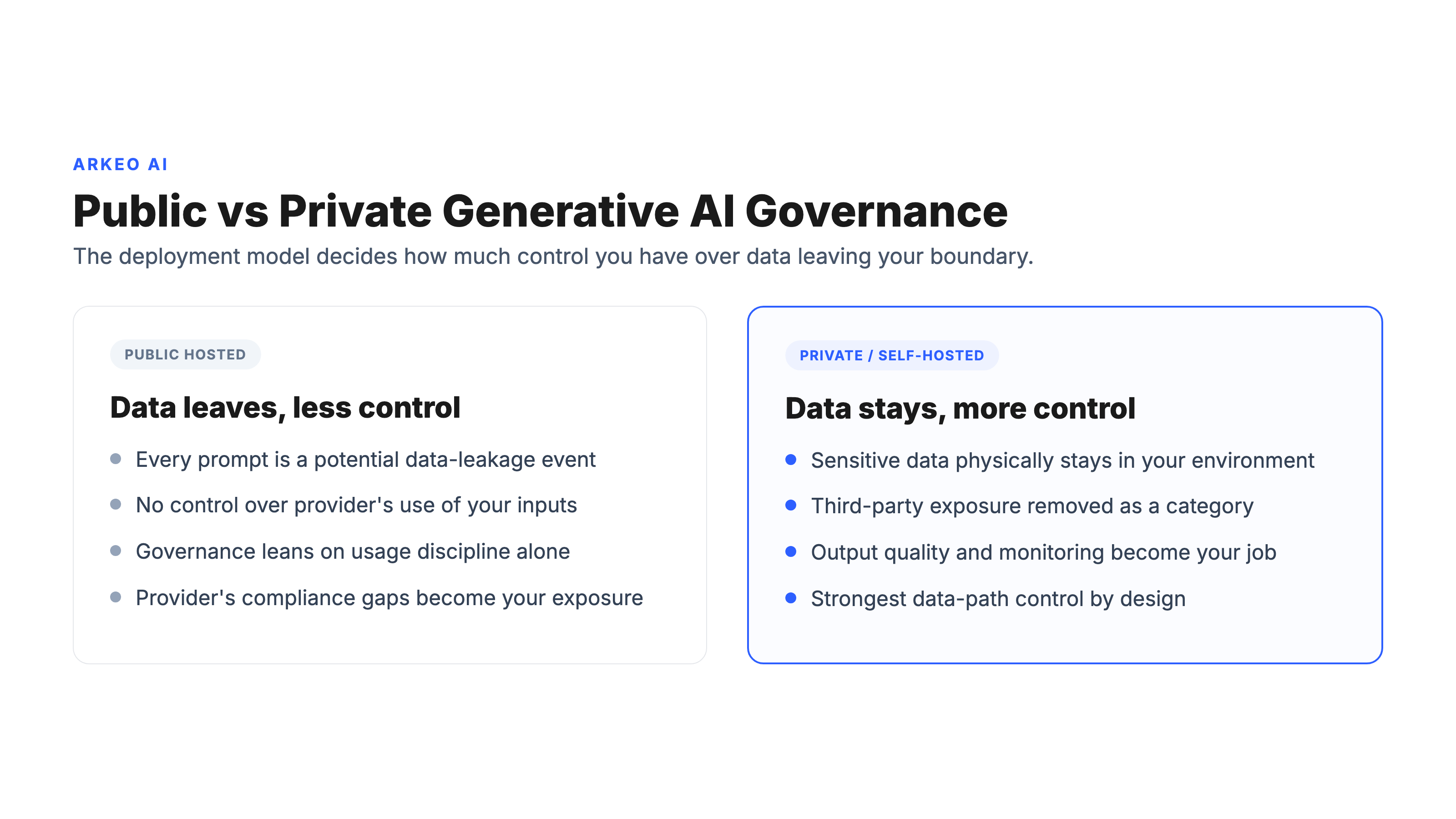
With public hosted generative AI (a chatbot or copilot reached through a public API), every prompt is a potential data-leakage event and you have no control over how the provider uses what flows in. Your governance has to lean almost entirely on usage discipline: prompt policies, training, and the hope that people follow them under deadline pressure. With private or on-premise generative AI, the data physically stays inside your environment, which eliminates third-party exposure as a category. The trade is that responsibility for output quality and monitoring shifts entirely to you, because there is no provider backstop. Hybrid architectures are common in practice and the hardest to govern, because you have to run both regimes at once and route each workload to the right one.
This is also where regulation bites. The EU AI Act made general-purpose AI obligations applicable on 2 August 2025: providers placing GPAI models on the EU market must meet transparency and copyright obligations, including publishing a summary of training data content, and models above a defined compute threshold are presumed to carry systemic risk and face enhanced duties. From that date, the rules also require providers to maintain copyright policies and report serious incidents to the AI Office. If you integrate a third-party model into your workflows, your governance has to account for whether that provider meets these obligations, because their gap can become your exposure. The legislative pressure is broad: Stanford HAI's 2025 AI Index found that U.S. state-level AI laws more than doubled in a single year, from 49 in 2023 to 131 in 2024, and flagged a widening gap between AI deployment and the governance needed to manage it. The structured way to close that gap is to anchor your controls to a recognized standard, which the breakdown of the NIST AI governance framework covers in detail.
For a fuller comparison of how each deployment model maps to data control and cost, see the deep dive on private AI. The governance principle behind it is simple and worth stating plainly: the strongest data-path control is the one where the sensitive data physically cannot reach a public model in the first place.
How Do You Roll Out Generative AI Governance Without Blocking Adoption?
The mistake is trying to govern everything before anyone is allowed to ship. You produce a long policy nobody reads, and people route around it to the public tools you were trying to control, which is how shadow AI starts. The approach that works is risk-tiered: match the weight of the controls to the stakes of the use case, not to the capability of the tool.
Sort your generative AI uses into tiers. Low-stakes uses (internal ideation, first-draft summarization) need a light touch: a prompt policy and spot-check review. High-stakes uses (customer-facing responses, compliance documents, contract language) get the full set: mandatory human sign-off, logging, and a deployment choice that keeps sensitive data off public models. The error in most rollouts is applying one review standard across every use case, which either smothers the low-stakes work or under-governs the high-stakes work. Pick one high-visibility workflow, build the full loop around it (access rule, prompt policy, review tier, deployment choice, logging), prove it works, then reuse the pattern and tighten controls as the tier climbs.
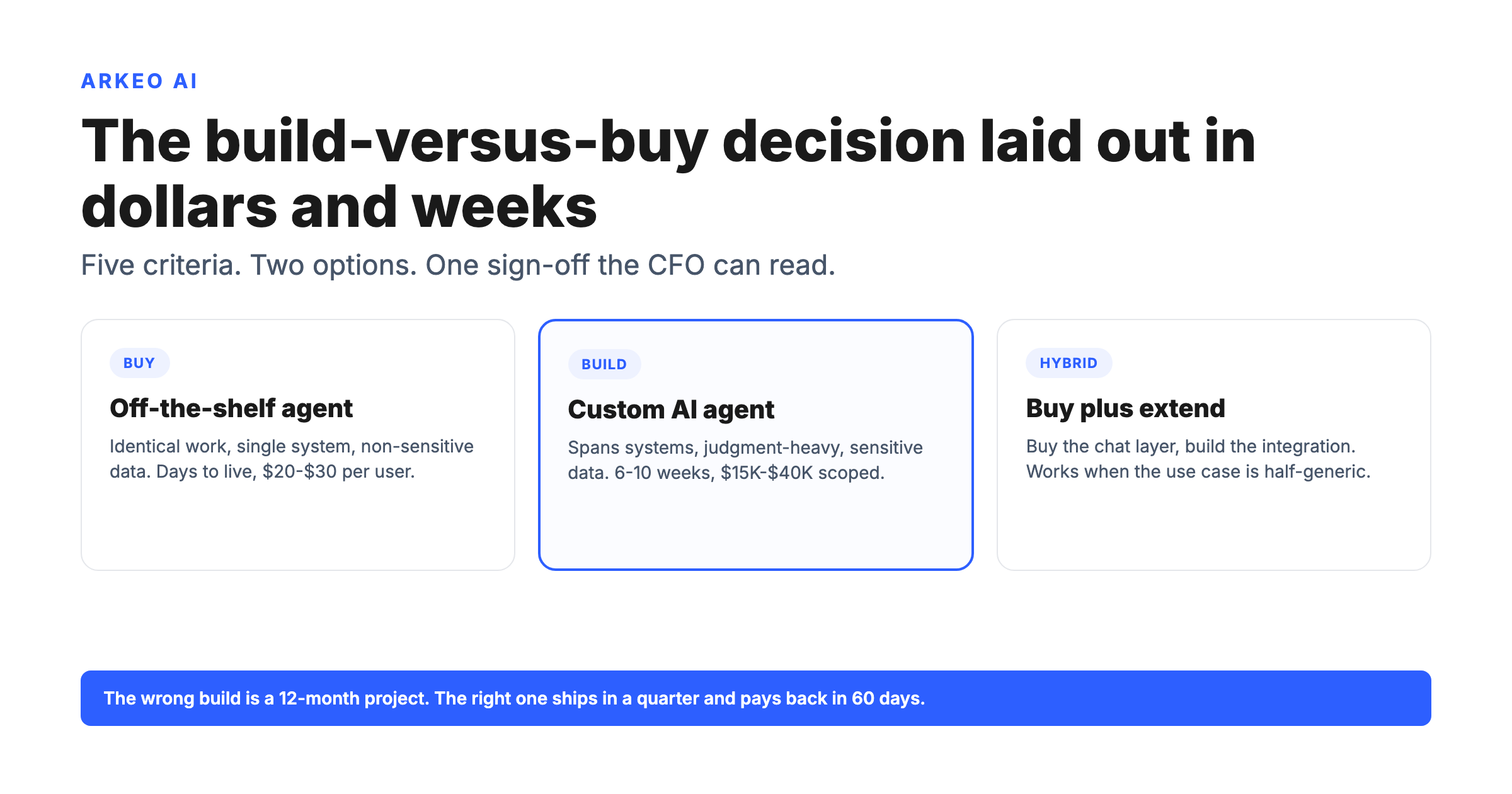
That mirrors how Arkeo approaches every engagement: map the current state and its bottlenecks, capture easy wins in the first 30 to 90 days, identify the top custom agent opportunities, then move toward a longer-term private AI architecture, with governance built into each step rather than parked at the end. In practice the first governed workflow is typically live within three to four weeks, which is short enough to prove the pattern before scaling it. When those custom agents start acting on their own, the controls change again, which is the subject of the agentic AI governance framework. It also reflects a position worth being direct about. Arkeo AI was founded in 2023, brings 25 years of business operating experience, and runs its own operations on the systems it deploys for clients, often on-premise or in private deployments where the data never leaves your control. We use what we sell, which is why the deployment choice sits at the center of how we design generative AI governance rather than at the edge. For the broader program these controls plug into, the pillar on the AI governance framework covers the baseline layer this one extends.
Build governance around your real generative AI workflows
A free AI Assessment turns this framework into a plan: your prompt rules, your review tiers, and the right deployment for each workflow, without blocking the adoption you want.
Book Your Free AI Assessment →