Category
What is Private AI? How to Deploy a Secure AI Workforce
Last updated: May 2026
Cloud AI tools like ChatGPT are fast, but they carry a hidden tax: every prompt and document your employees upload becomes training data for public models. If you are feeding a public AI your operational data, you are actively leaking your competitive advantage. Every strategy document, financial projection, and proprietary workflow sent to a public endpoint strengthens the foundational model your competitors will eventually use.
Most operators know this, which is why they block AI access entirely, only to watch employees find unauthorized workarounds. The reality is that blocking AI is a losing strategy. Shadow AI creeps into every department. Employees will use unauthorized web applications on their personal devices to rewrite emails or parse spreadsheets. The only way to secure your data without sacrificing productivity is to build an environment you explicitly control from the ground up.
Private AI is the architectural shift from renting public tools to deploying an artificial intelligence environment inside controlled and approved infrastructure. It allows you to build an AI workforce that operates exclusively on your terms, secured by your own access policies, and completely disconnected from public training feedback loops.
- What is Private AI? Private AI is an artificial intelligence environment deployed inside controlled and approved infrastructure, such as on-premise servers, private cloud, or a dedicated hosted environment.
- The Shift: Instead of treating AI as a cloud software tool, businesses deploy it as a Private AI Workforce using a three-step model.
- 1. Assess: Evaluate data silos, governance policies, and infrastructure readiness.
- 2. Deploy: Install secure, local AI agents tailored to specific business workflows.
- 3. Manage: Monitor, tune, and update agents continuously to prevent operational drift.
The Difference Between Public AI and Private AI
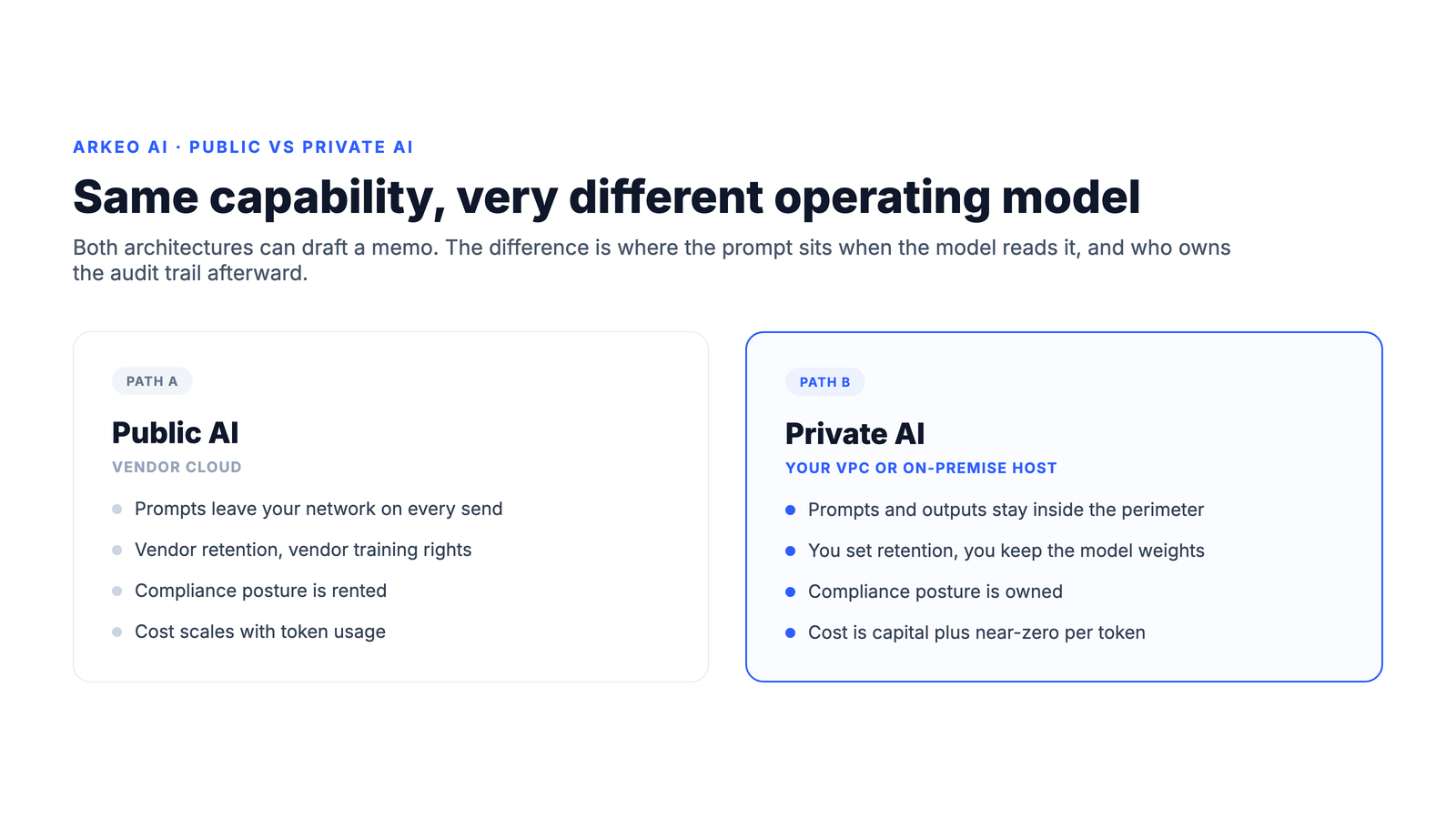
IBM defines Private AI as an architectural approach that balances privacy with performance. The distinction is simple but critical for business operators evaluating risk.
Public AI operates on a per-token utility model. You send data to their servers. They process it and send it back. You do not own the model, you do not control the data flow, and the provider often reserves the right to use your inputs for future training. You are a tenant in a massive apartment building. You have a lock on your door, but the landlord holds a master key and routinely inspects the plumbing.
Private AI means the model lives where your data lives. Whether it is deployed on bare-metal servers in your office or a dedicated, isolated cloud instance, the data never crosses into a public tenant. Your intellectual property remains entirely within your control. Your models learn from your data to improve your workflows, and that operational truth never leaves the building.
Bare-Metal vs Private Cloud Architecture
When businesses decide to build a Private AI Workforce, the first major technical hurdle is choosing the physical or virtual location of the infrastructure. The decision typically comes down to bare-metal on-premise deployments versus private cloud architectures. Each carries distinct operational realities regarding latency, data sovereignty, and control.
A bare-metal deployment involves installing physical hardware directly inside your corporate data center or office environment. This is the ultimate expression of data sovereignty. Because the servers sit on your physical network, you have absolute control over the physical and logical access layers. Data never leaves your building. Latency is virtually eliminated because the data does not have to travel over the public internet to reach a processing node. For industries dealing with restricted intellectual property or strict national security clearances, bare-metal is often the only compliant option. However, bare-metal requires significant capital expenditure and a dedicated facility capable of handling massive power and cooling demands.
Conversely, a private cloud architecture leverages dedicated, isolated instances hosted by providers like AWS, Azure, or specialized GPU hosting services. Unlike public cloud SaaS offerings, a private cloud AI deployment means the infrastructure is logically separated from other tenants. You get a dedicated virtual private cloud, encrypted tunnels, and isolated storage blocks. The primary advantage here is operational flexibility. You can scale computational resources up or down without racking new servers. Data sovereignty is maintained through strict contractual and architectural boundaries, ensuring that the cloud provider has no access to the data layer. While network latency is marginally higher than bare-metal, private cloud architectures offer robust redundancy and disaster recovery capabilities that are difficult to replicate on-premise without massive budgets.
Ultimately, the choice dictates your operational control. Bare-metal means you own the stack down to the silicon, but you are responsible for hardware maintenance. Private cloud offloads hardware management while preserving the vital isolation your data requires. We have deployed agent systems in both environments since 2023, and the correct choice always stems from a company's specific compliance constraints and capital allocation strategy.
Hardware Requirements for On-Premise AI
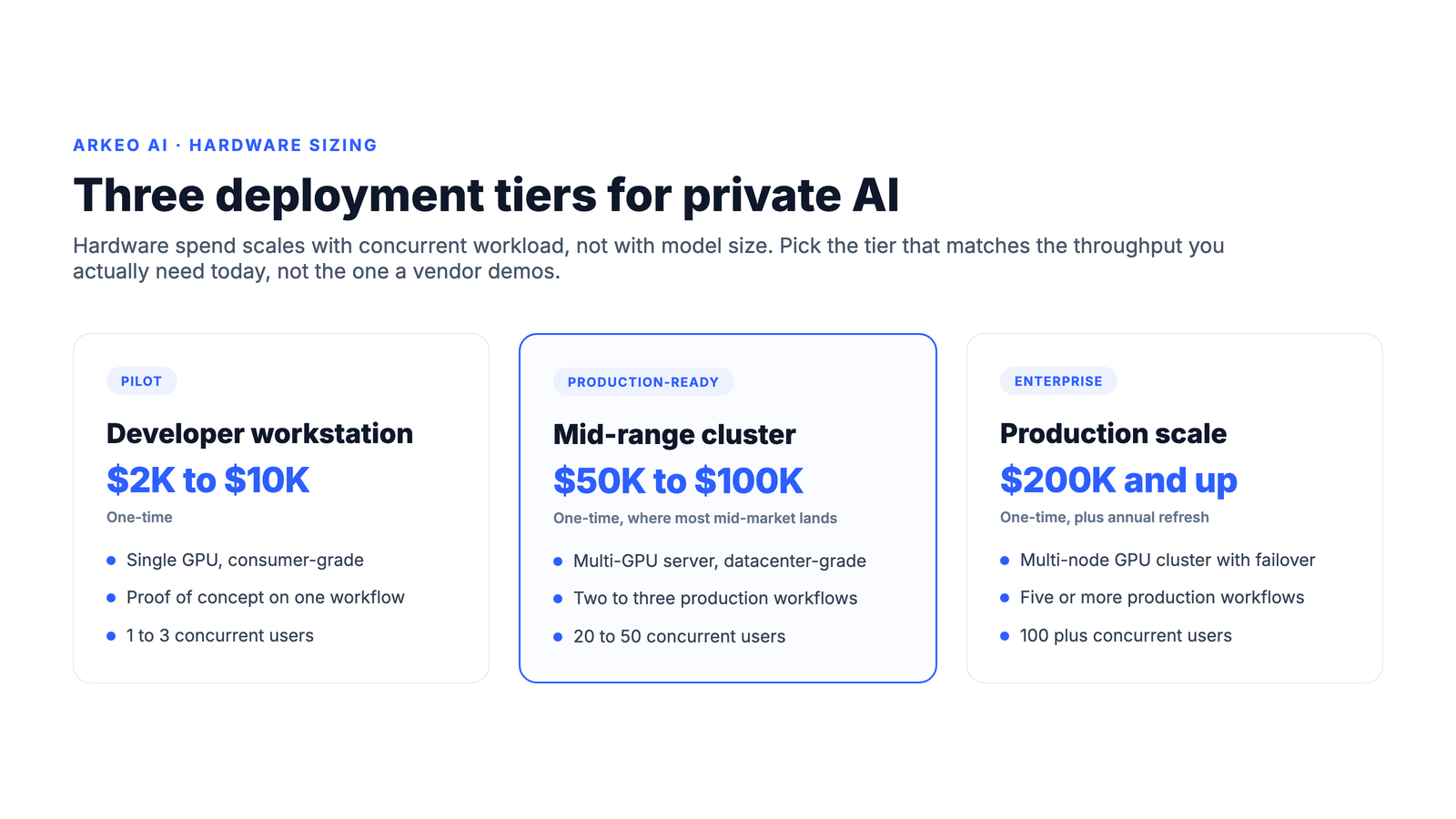
If you choose to host your AI workforce on your own infrastructure, you must understand the hardware realities. Running an enterprise-grade agent system is not like hosting a traditional web application. AI workloads are intensely demanding and require specialized configurations.
The core of any AI deployment is the GPU. You cannot run robust agent workflows on consumer-grade graphics cards. While consumer cards are fine for hobbyists, production environments require enterprise GPUs like NVIDIA H100s or A100s. These units are designed for continuous, maximum-load operation and feature error-correcting memory. Consumer hardware will bottleneck under simultaneous multi-agent requests, leading to failed processes and system timeouts.
VRAM (Video Random Access Memory) is another critical constraint for local Large Language Models (LLMs). The size of the model dictates the minimum required VRAM. If a model cannot fit entirely into VRAM, the system is forced to offload processing to the system CPU and RAM. This causes performance to plummet from processing dozens of tokens per second to barely rendering one token a second. Deploying a highly capable 70-billion parameter model requires significant clustered VRAM, meaning multiple high-end enterprise GPUs linked together over high-bandwidth interconnects.
Storage is equally vital, specifically for vector databases. Agent systems rely on Retrieval-Augmented Generation (RAG) to fetch relevant proprietary data before acting. This requires blazing-fast storage. Traditional hard drives or even standard SSDs are insufficient. You need NVMe storage drives capable of extreme Input/Output Operations Per Second (IOPS). When an agent needs to scan millions of embedded vectors to answer an operational query, the storage drive must serve that data instantly to prevent the GPU from sitting idle.
Finally, networking constraints are often overlooked. Pushing massive datasets into training loops or serving heavy models across a corporate network requires high-throughput infrastructure. Standard gigabit ethernet will throttle your deployment. Enterprise AI environments typically demand 10GbE or faster internal networking to ensure data moves from storage arrays to compute nodes without creating artificial bottlenecks.
Why You Need a Private AI Workforce
Many executives still view AI as software: a tool you buy a license for and hand to your team. This is a mistake. Software executes deterministic code. AI agents execute probabilistic workflows. You do not install agents. You onboard them. They require oversight, governance, and management.
According to IBM's 2025 Cost of a Data Breach Report, the global average cost of a breach is $4.4M. Despite this risk, IBM found that 63% of organizations lack AI governance policies, and an alarming 97% of organizations reporting an AI-related security incident lacked proper AI access controls.
You cannot secure public AI tools retroactively. You must deploy a Private AI Workforce where security and access controls are foundational, not an afterthought.
Stop Guessing About Your Data Infrastructure
Our custom assessment maps your data silos and identifies exactly what you need to deploy a Private AI Workforce securely.
Book Your AI AssessmentWhere do you stand?
The numbers below are general. Yours will be specific.
In a 60-minute AI Assessment Arkeo will model your real workload, your real concurrency, and your real growth, then produce a private versus cloud cost comparison sized for your operation.
Cost Analysis: Cloud vs On-Premise 3-Year TCO
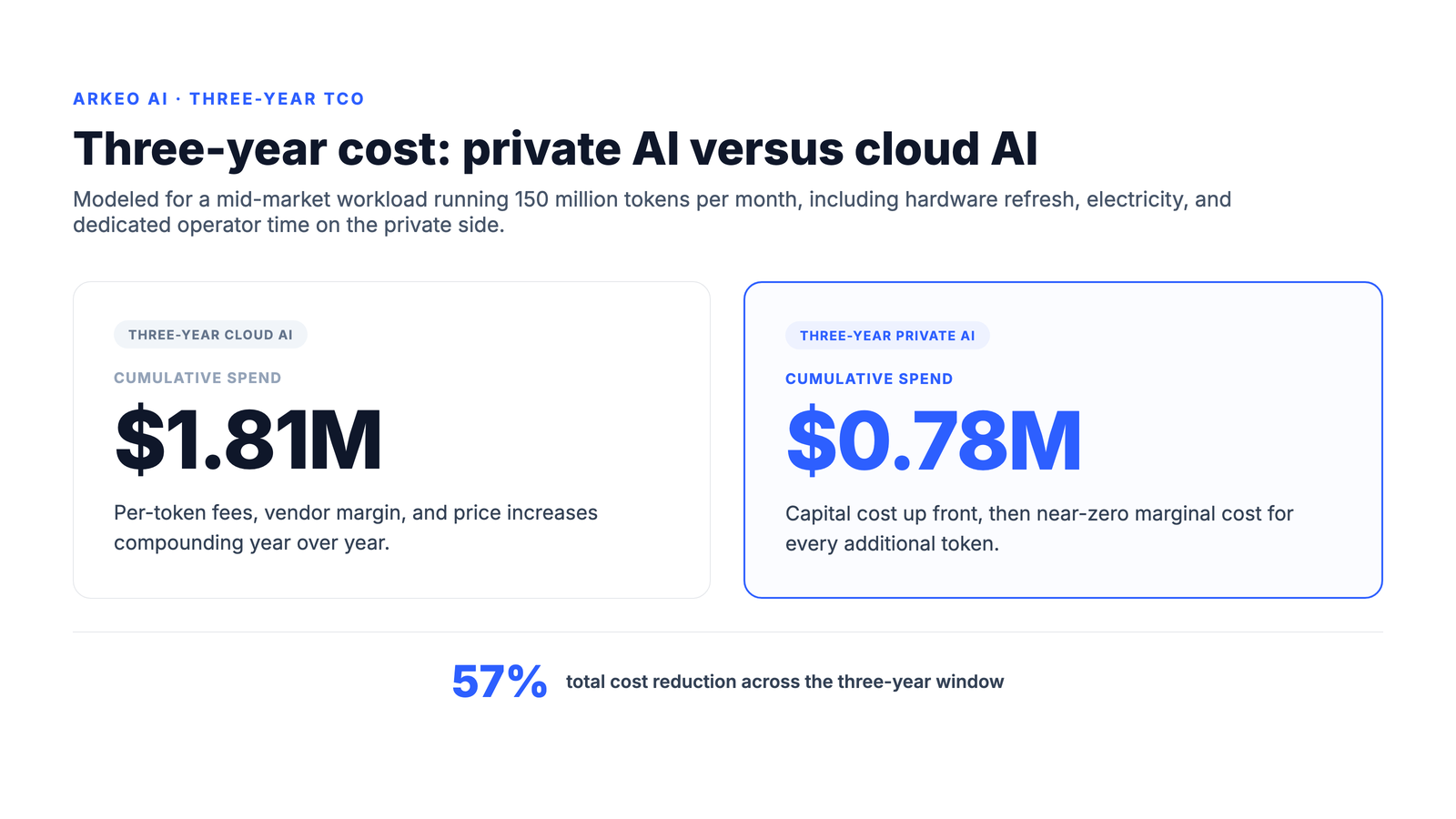
The financial modeling of an AI workforce is often where mid-market operators stumble. Evaluating the Total Cost of Ownership (TCO) over a three-year period reveals stark differences between renting public cloud APIs and deploying private infrastructure.
Public cloud AI models operate on a consumption basis. You pay for what you use, calculated in tokens. Initially, this appears cost-effective. A pilot program with five employees using an API might cost a few hundred dollars a month. However, token fees scale linearly and unpredictably. When you shift from simple chat interfaces to autonomous agent systems that process thousands of documents, execute background loops, and run continuous data retrieval, your token consumption explodes. A successful public cloud AI deployment actively penalizes you for scale. We have seen operators face unexpected monthly bills exceeding $20,000 simply because their agents began efficiently parsing historical records.
On-premise or dedicated private cloud models shift this financial dynamic entirely. Deploying your own hardware requires significant upfront Capital Expenditure (CapEx). You must purchase the servers, the GPUs, and the high-speed networking equipment. The initial outlay can easily reach six figures for a robust deployment. However, once the hardware is racked and powered, the marginal cost of processing an additional document drops essentially to zero. You own the compute. Whether your agent parses one document or one million documents, your baseline hardware cost remains fixed.
Over a three-year timeline, the lines inevitably cross. The cumulative Operational Expenditure (OpEx) of public token fees overtakes the initial CapEx and ongoing power/cooling costs of a private deployment. Furthermore, hardware can be depreciated according to standard accounting practices, providing tax advantages that variable cloud subscriptions cannot match.
Beyond the raw math, predictable costs allow for better business planning. When your compute cost is fixed, you are incentivized to find more ways for your AI workforce to operate. When every operation carries a variable token fee, you naturally restrict your agents to control costs. A Private AI Workforce aligns financial predictability with operational growth.
The 3-Step Deployment Model: Assess, Deploy, Manage
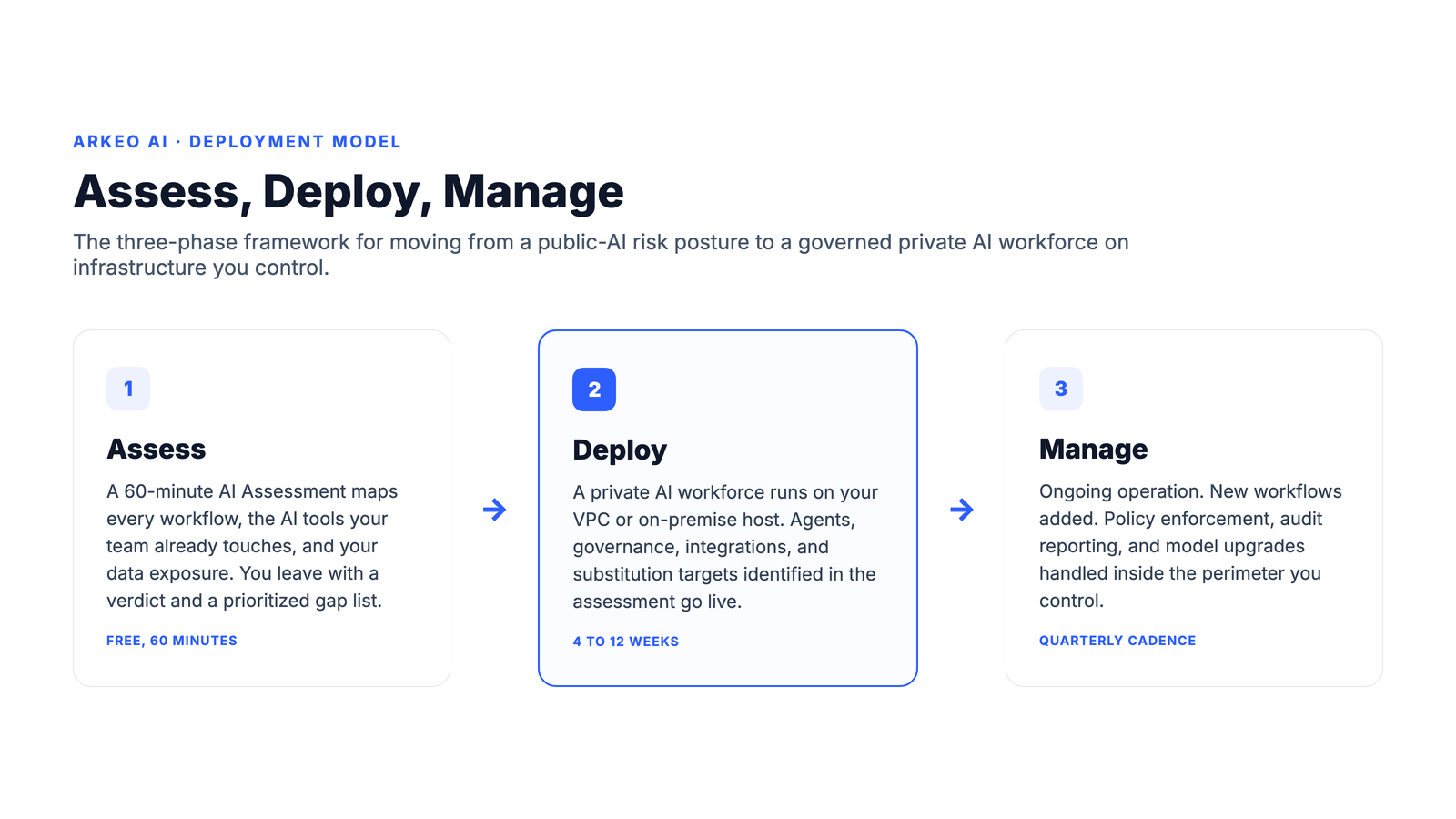
Deploying a Private AI Workforce is not an IT project. It is an operational transformation. Throwing technology at bad processes only scales inefficiency. A successful integration follows a strict, sequential three-phase model: Assess, Deploy, and Manage.
Phase 1: The AI Readiness Assessment
You cannot drop an AI agent into a mess of undocumented processes and siloed data. The AI Readiness Assessment maps your current data infrastructure, evaluates your security posture, and identifies high-ROI workflows. It cleans the house before the workforce arrives.
The first critical step in this phase is data mapping. AI agents require clean, accessible, and structured data to function accurately. If your operational data is scattered across legacy SQL databases, unstructured Excel files on local desktops, and fragmented SharePoint folders, an agent will fail. The assessment identifies exactly where the operational truth lives and dictates the pipelines required to unify it into a secure vector database.
We then evaluate operational workflows. Not every task is suitable for an AI agent. We look for high-volume, low-variance processes that currently trap your best employees in administrative gridlock. By identifying specific bottlenecks, we build a targeted deployment roadmap that guarantees immediate, measurable ROI rather than vague technological promises.
Finally, the assessment establishes the security baseline. We define the access controls, map the compliance requirements, and document the data sovereignty constraints. This ensures that before a single model is loaded, the entire architectural plan meets the rigorous standards required by the executive team.
Phase 2: Deploying Local AI Agents
Phase two moves from theory to production. We configure the controlled infrastructure and deploy the specific agents required for your operations. Unlike generic public chatbots, these agents are integrated directly with your proprietary data stores, secured behind robust access controls.
The core of the deployment is the agent orchestration layer. This is the central nervous system of your AI workforce. It dictates how different agents communicate, hand off tasks, and access the vector database. Instead of a single massive model trying to do everything, we deploy specialized agents focused on discrete tasks. One agent might handle document parsing, while another strictly handles data validation. The orchestration layer coordinates this team.
During deployment, we connect the agents to your internal data pipelines. This is where Retrieval-Augmented Generation (RAG) is implemented. Agents are tethered to your operational reality, meaning they cannot hallucinate facts based on public internet training data. If an agent does not find the answer in your secure database, it explicitly flags the gap rather than inventing a response.
Before moving to full production, the deployment undergoes aggressive red-teaming. We actively try to break the agents, bypass their access controls, and force them into error states. This rigorous testing phase ensures that the system is stable, secure, and ready to handle the chaotic reality of daily business operations.
Phase 3: Managing and Monitoring Your AI Workforce
Most AI deployments fail after month three because organizations treat the launch as the finish line. AI agents drift. Workflows change. Managing a Private AI Workforce means ongoing tuning, monitoring for hallucinations, and adapting to new operational requirements. This is where Arkeo's managed service ensures long-term ROI.
Continuous monitoring is non-negotiable. Agents are probabilistic systems. Over time, as underlying data schemas shift or operational procedures evolve, an agent's accuracy can slowly degrade. This is known as operational drift. Our management phase includes strict telemetry and logging to detect performance anomalies before they impact the business. We monitor token generation speeds, retrieval accuracy, and task completion rates.
When an agent begins to drift, it requires immediate tuning. This does not mean retraining the foundational model, which is expensive and unnecessary. Instead, it involves adjusting the prompt architecture, refining the retrieval algorithms, or updating the embedded data context. Our team handles these subtle calibrations to maintain peak performance without burdening your internal staff.
Finally, the management phase scales the workforce. As your business grows and your team becomes comfortable working alongside AI, new workflows will inevitably emerge. We continuously map new processes and deploy additional specialized agents, expanding the capabilities of your private infrastructure securely and predictably.
Vertical Use Cases for Private AI
A Private AI Workforce adapts to specific industry constraints. Generic tools fail when confronted with highly specialized vertical data formats. Agent systems thrive on specificity.
Construction AI Agents
In the construction sector, project margins are won or lost in the administrative details. Construction firms generate massive volumes of unstructured data: daily field logs, highly technical Requests for Information (RFIs), change orders, and complex architectural drawings. A Private AI Workforce can parse a 500-page RFI PDF entirely offline. It cross-references the contractor questions against the project specifications and historical bidding data securely.
Imagine an autonomous agent system monitoring incoming project communications. When a structural anomaly is flagged in a daily report, the agent instantly retrieves the specific engineering schematics, compares the field notes against the approved designs, and drafts an alert to the project manager. All of this happens within a secure, dedicated environment, ensuring that critical project bids and proprietary methodologies are never exposed to public models.
Oil and Gas Operational Agents
The oil and gas industry operates under intense regulatory scrutiny and remote field conditions. Connectivity is often sporadic, and data security is a matter of corporate survival. Private AI deployments can operate entirely on edge servers located directly at the wellpad or regional facility. These agents automate field compliance and equipment logs in completely isolated environments.
A specialized agent can ingest continuous SCADA data alongside handwritten operator logs. It detects microscopic anomalies in pressure readings that predate a failure, cross-referencing these signals against decades of proprietary maintenance records. The system then automatically generates the required regulatory compliance reports, significantly reducing the administrative burden on field engineers while ensuring strict data sovereignty over critical infrastructure operations.
Manufacturing Floor Automation
Manufacturers struggle with data fragmentation. The ERP system, the supply chain logistics database, and the programmable logic controllers on the factory floor rarely communicate seamlessly. A Private AI Workforce bridges these legacy systems securely. By deploying agents on local servers, manufacturers can parse highly sensitive supply chain data and production quotas without exposing their vendor pricing or IP.
An agent can monitor incoming supplier manifests, verify the parts against current floor inventory, and dynamically adjust production schedules based on predicted material shortages. Because the model operates on local infrastructure, it can interface directly with legacy, on-premise inventory systems that are intentionally air-gapped from the broader internet for security reasons.
Professional Services and Legal AI
Law firms, accounting practices, and specialized consultancies trade exclusively on confidentiality. Using public AI tools to review client documents is a blatant violation of ethical obligations. Private AI allows professional services to deploy agent systems while maintaining strict ethical walls and client privilege.
An agent system can execute massive document reviews during the discovery phase of litigation. It can ingest thousands of contracts, emails, and financial statements, tagging relevant entities and summarizing risk clauses. Because the infrastructure is entirely isolated, the firm can guarantee to its clients that no data was processed by external third parties. The workforce handles the exhausting brute-force analysis, freeing senior partners to focus on high-value strategy.
Ready to Build Your AI Workforce?
We build, deploy, and manage Private AI agents on your infrastructure.
Book Your AI AssessmentReady to own your AI?
Stop renting your compliance posture. Start owning it.
Arkeo's 60-minute AI Assessment maps your current AI surface, scores your exposure, and produces a 12-month deployment plan tailored to your operation.