Category
The NIST AI Governance Framework, In Practice
Last updated: May 2026
You have heard the four letters in every vendor pitch and procurement questionnaire: align with NIST and your AI governance is handled. So you read the framework, nod along, and then sit down to write an actual policy. Who approves a new agent before it touches customer data? What triggers a review? Who can shut a model off when it misbehaves? The framework does not say. That gap is exactly where most teams stall.
Arkeo has spent three years deploying AI agents inside real businesses, on private and on-premise infrastructure, on top of 25 years of running and operating companies, and the same pattern shows up every time: the framework is a strong reference, but it is not the operating model. This guide explains what the NIST AI governance framework actually gives you, what it deliberately leaves open, and how to translate it into decisions your team can act on. If you would rather start by mapping it to your own workflows, you can book a free AI Assessment and work the translation through with someone who builds this for a living.
Quick Answer
• What it is: The NIST AI Risk Management Framework (AI RMF 1.0, formally NIST AI 100-1) is a voluntary, non-regulatory framework for managing AI risk, built around four functions: Govern, Map, Measure, and Manage.
• Cost: Free to download and use; NIST is a non-regulatory federal agency, so adopting it is voluntary.
• Why it matters: It gives you a shared language and a disciplined review structure, but it does not define who owns a decision, what triggers a review, or how your specific workflows get approved. That part is yours to build.
What Is the NIST AI Governance Framework?
The NIST AI governance framework is the AI Risk Management Framework (AI RMF 1.0), a voluntary, non-regulatory set of guidelines for identifying and managing the risks of AI systems. NIST released it on January 26, 2023, under the formal designation NIST AI 100-1. It is not a law and not a certification you pass. NIST itself describes the framework as "voluntary, rights-preserving, non-sector specific, and use-case agnostic," designed to flex to organizations of any size in any industry.
That word voluntary is the part most buyers skim past. The National Institute of Standards and Technology is a non-regulatory federal agency inside the U.S. Department of Commerce, founded in 1901. Its job is to advance measurement science and standards, not to enforce them. NIST cannot fine you. It writes guidance that other agencies, regulators, and companies choose to adopt. So when a contract says "NIST-aligned," the authority comes from the contract, not from NIST.
Why Do So Many Teams Reference NIST?
Because it earned its credibility the slow way. The AI RMF was built through an open, consensus-driven process: a formal Request for Information, three public workshops, two public-comment drafts, and input from more than 240 organizations across industry, academia, civil society, and government, with roughly 400 sets of formal comments. The result is a framework that lawyers, engineers, and regulators can all point to without arguing about whose definitions win.
It also travels well. NIST has published official crosswalk documents mapping the AI RMF to other standards, including ISO/IEC 42001 and the EU AI Act. That lets you use the framework as a common backbone and layer jurisdiction-specific requirements on top, instead of maintaining four overlapping governance programs that contradict each other.
What Does the NIST Framework Actually Give You?
Three things, mostly: a shared risk vocabulary, a review structure, and the Playbook of suggested actions.
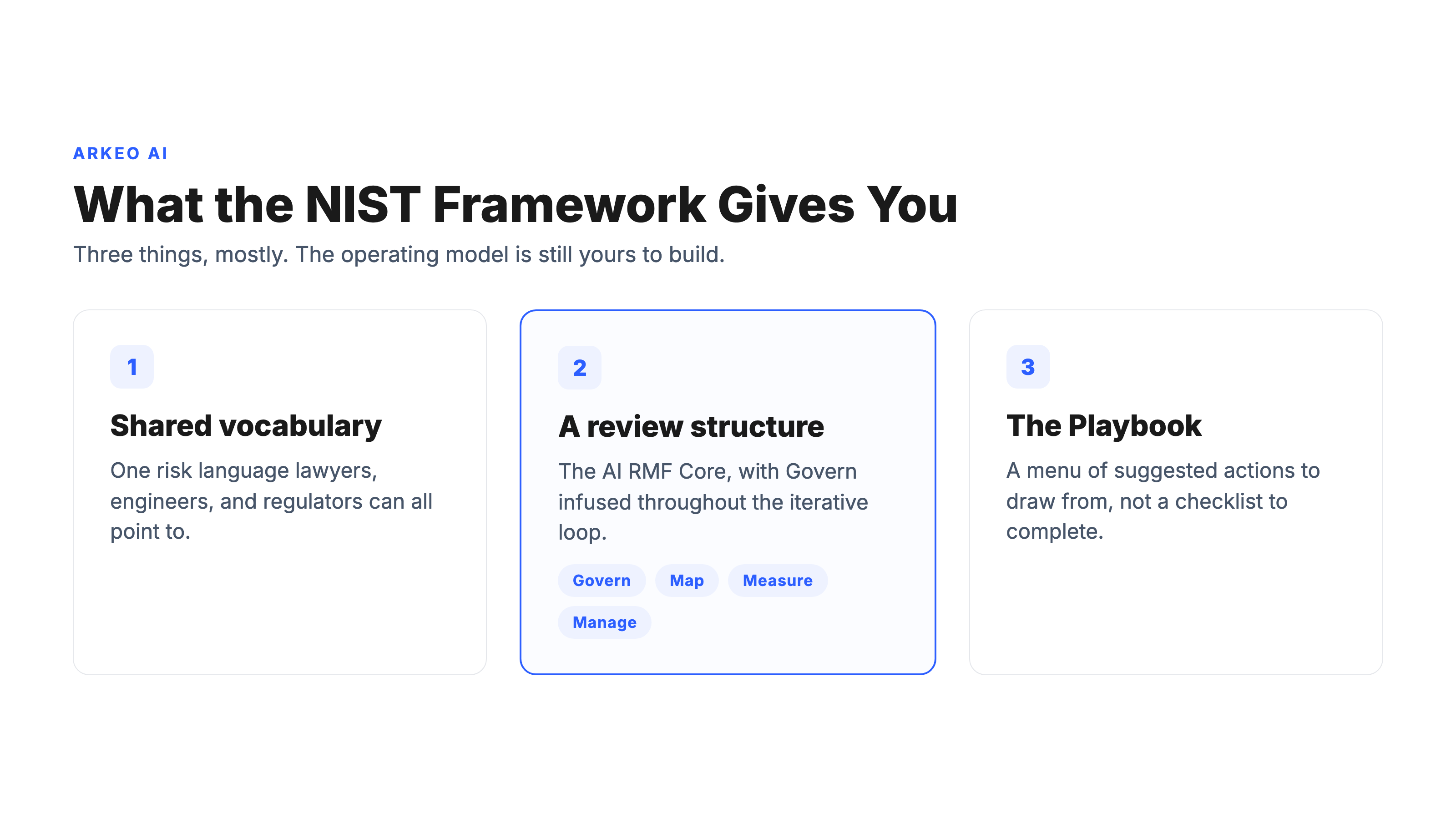
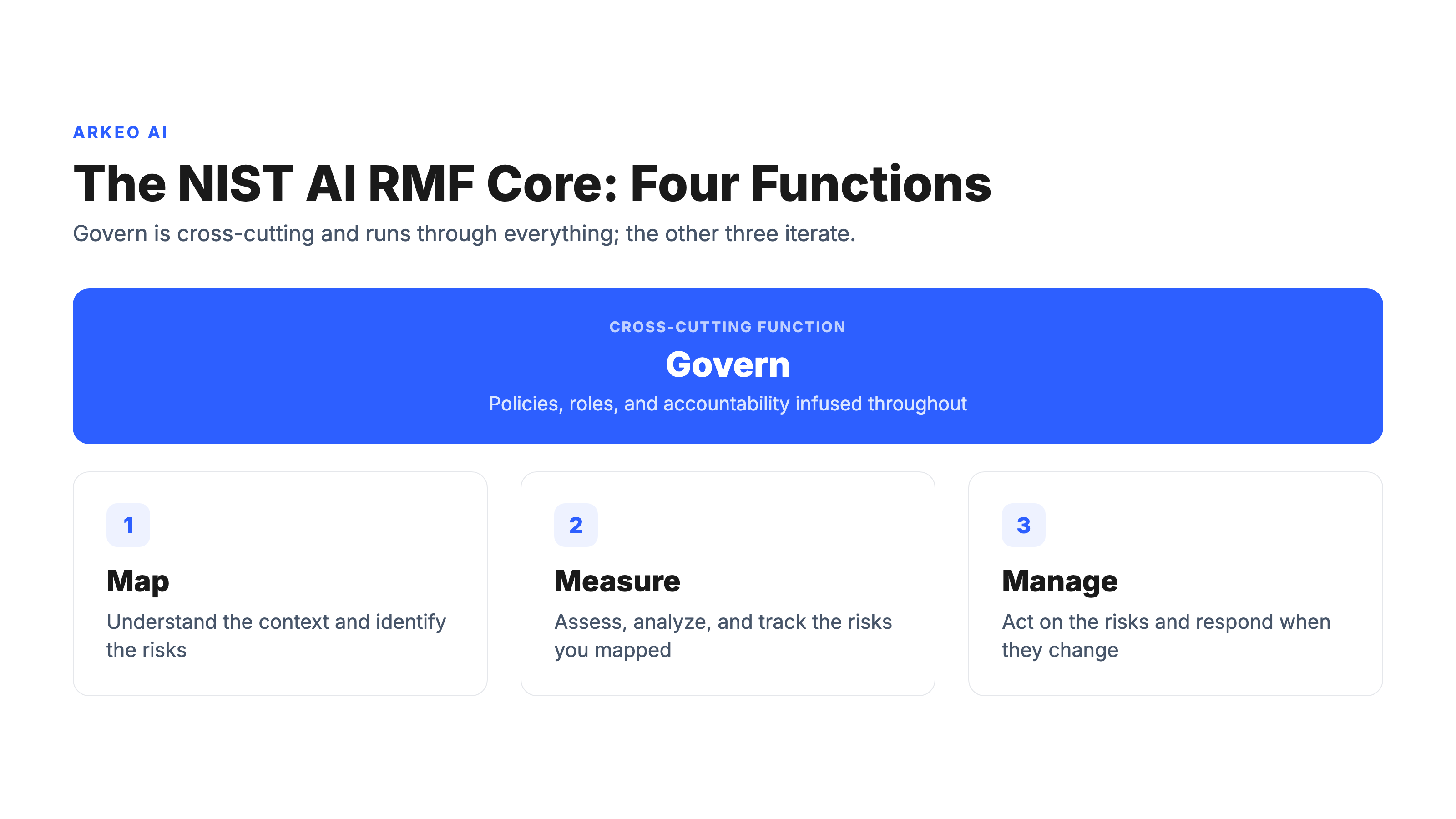
The structural backbone is the AI RMF Core, made up of four functions: Govern, Map, Measure, and Manage. Govern is the cross-cutting function. NIST is explicit that it is meant to be infused throughout the other three, not run once and filed away. After Govern, most users start with Map (understand the context and risks), then move into Measure (assess and track them) and Manage (act on them) on an iterative loop.
The framework also gives you a working definition of what "good" looks like. NIST names seven characteristics of trustworthy AI systems: valid and reliable; safe; secure and resilient; accountable and transparent; explainable and interpretable; privacy enhanced; and fair with harmful biases managed. That vocabulary is genuinely useful. It turns a vague worry like "is this model safe?" into a checklist you can hold a vendor to.
And there is the AI RMF Playbook, a companion resource that suggests concrete actions aligned to each subcategory of the four functions. The Playbook is deliberately not a checklist. It is a menu of suggested actions you draw from, updated periodically. You adopt as many or as few as fit your use case.
What Does NIST Not Give You?
Here is the blunt truth a vendor pitch leaves out: adopting NIST does not make you compliant, and it does not make you done. There is no NIST certificate. The framework is the starting line, not the finish.
Most teams believe that if they map their AI program to the four functions, governance is handled. They are wrong. NIST tells you that AI systems should be "accountable and transparent." It does not tell you who in your company is accountable, what transparency means for your specific product, or what happens at 2 a.m. when an agent starts returning garbage to a customer. The framework names the goal; you still have to build the machine that reaches it.
Look at the gap concretely. NIST gives you the categories. Your internal governance still has to fill in the operating detail.
| What NIST covers | What your internal governance still has to define |
|---|---|
| Risk language and a shared vocabulary (Map, Measure, Govern, Manage) | Which workflows are in scope, in what order, and who decides |
| A goal that AI be "accountable and transparent" | The named owner, the escalation path, and the review cadence |
| A menu of suggested actions (the Playbook) | Which suggestions address real risk in your environment, and your approval thresholds |
| Seven characteristics of trustworthy AI | What "safe enough to ship" means for your data, your customers, and your rollback criteria |
The gap NIST leaves is where the work starts
The free AI Assessment maps the four functions against your actual workflows and shows where your governance is solid and where it has gaps NIST cannot fill for you.
Book Your Free AI Assessment →
That right-hand column is the work. It is where governance actually starts, not ends. Skipping the Govern function and jumping straight to measurement is the most common failure pattern: teams end up with dashboards full of metrics and no one whose job it is to act on them.
How Do You Apply NIST in a Real Business?
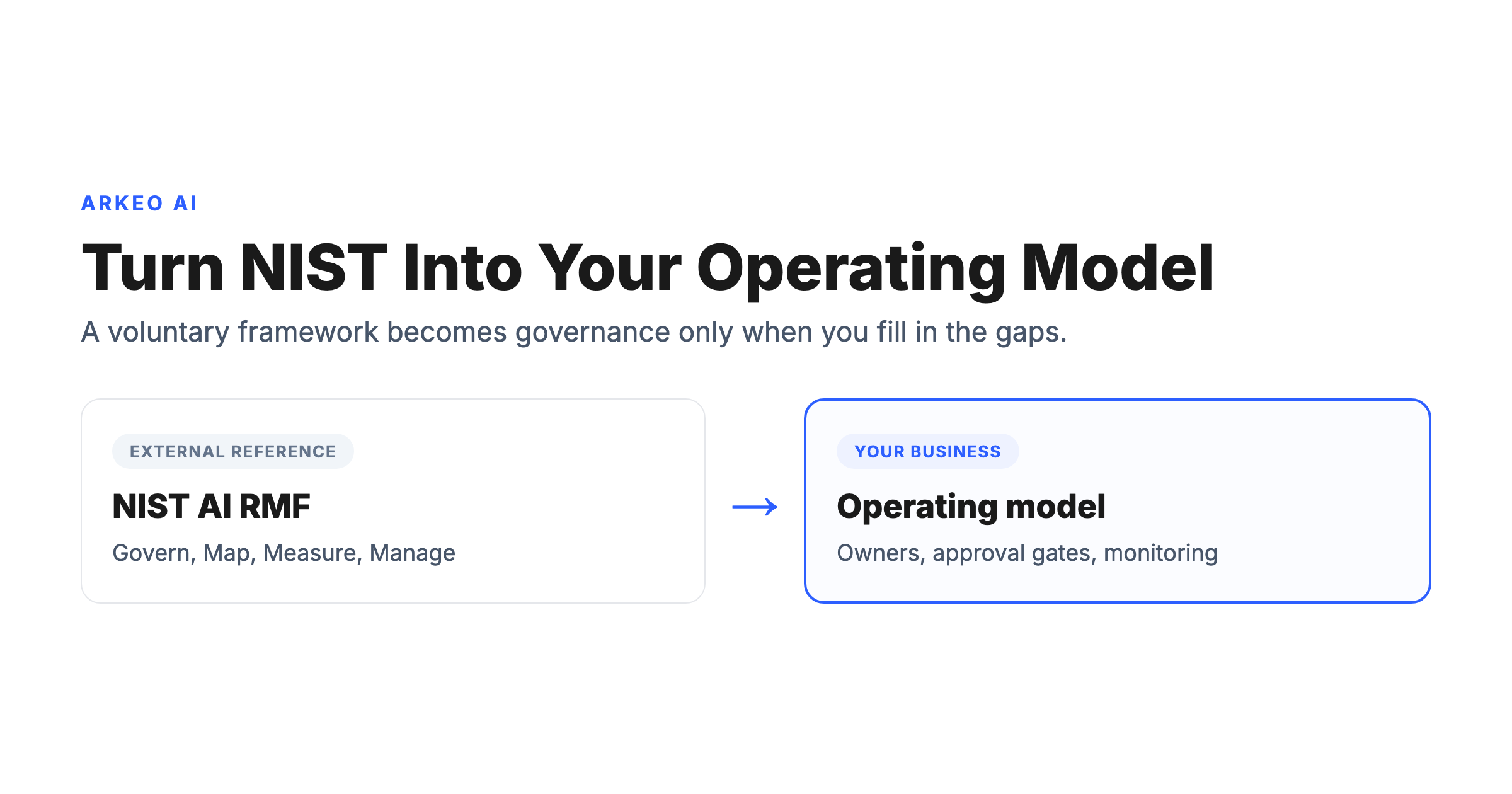
Treat the external framework as input and produce an internal operating model as output. NIST gives you the language and the structure; you convert it into policy, process, and deployment decisions that match how your company actually runs.
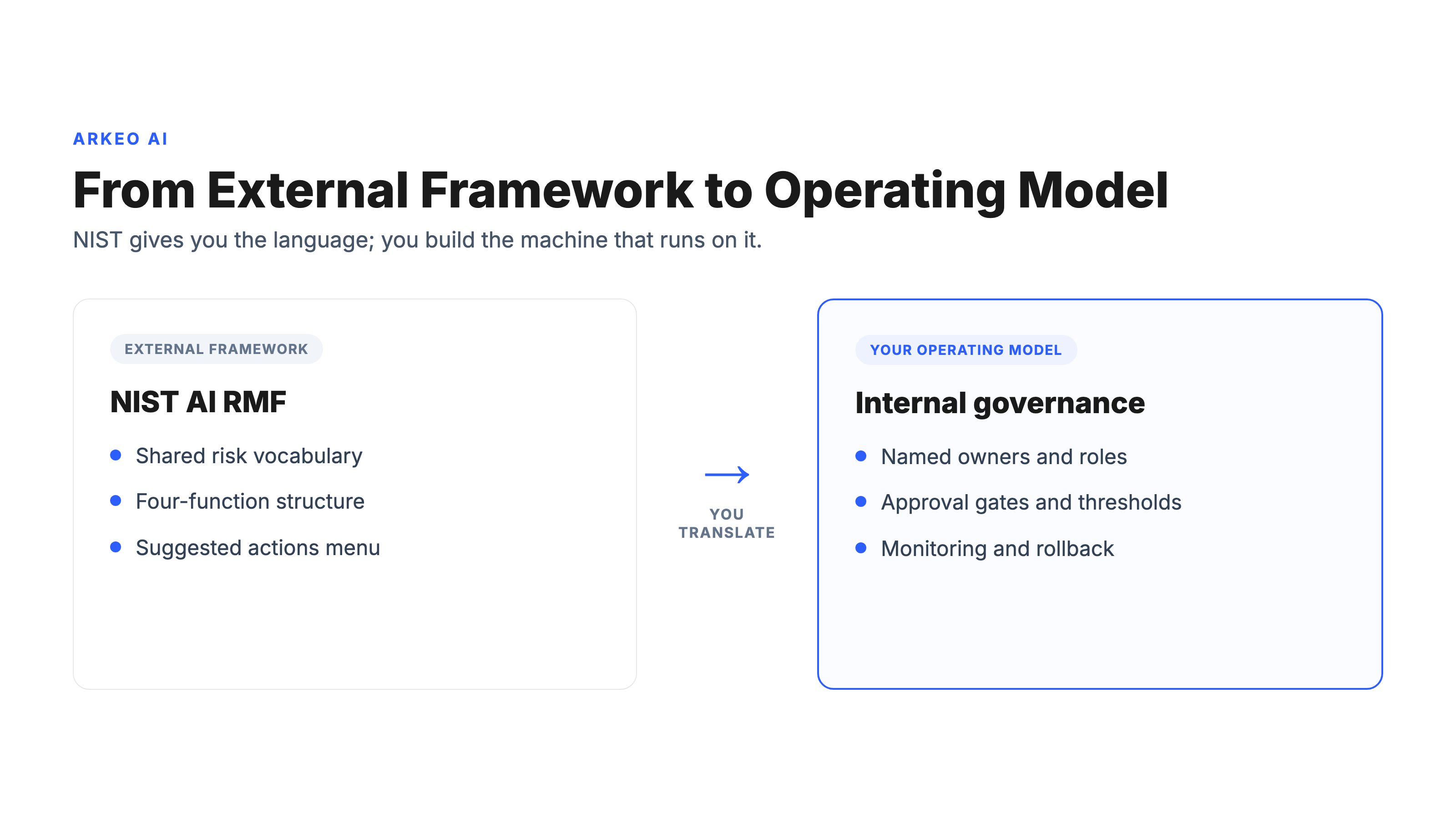
Across three years of deployments, the same gap shows up in the same place. A common pattern: a small operations team, often three or four people, wants an agent to draft customer responses. NIST's Map function tells them to understand the context and the risks. Useful. But the framework will not tell them that the agent must never auto-send anything that touches a refund without a human approving it, that the named review owner is the support manager rather than "IT," that the rollback trigger Arkeo sets is a 5 percent jump in customer complaints week over week, or that the logs live on the company's own servers and not a vendor's cloud. Those are governance decisions. NIST frames them; the team has to make them, and almost no one has made them before the agent is already drafting replies.
This is the lens Arkeo brings to the work, and 25 years of operating businesses is why the lens lands where it does: governance gaps are almost never framework gaps, they are operational ownership gaps, the same kind that sink a process long before any AI is involved. The Arkeo Operating System (AOS) starts by mapping your current state and bottlenecks, then sequences easy wins, custom workflow agents, and a long-term private AI architecture, with ownership and approval gates defined for each. We use what we sell: every agent we deploy for a client runs through the same governance gates we run our own on. The framework informs that work; it does not replace it.
When Do You Need to Go Beyond NIST AI RMF 1.0?
The moment you deploy generative or agentic AI. AI RMF 1.0 was written for AI systems broadly. Generative models behave differently, so NIST released a dedicated companion on July 26, 2024: NIST AI 600-1, the Generative Artificial Intelligence Profile. It was developed under Executive Order 14110 and applies the same four-function structure to generative AI, identifying 12 categories of generative AI risk and more than 200 suggested developer actions.
The 600-1 risk list reads like a roster of the failures teams actually hit: a lowered barrier to cybersecurity attacks, the production of mis- and disinformation, and what NIST formally calls "confabulation", the technical term for the output everyone else calls hallucination. The Profile concentrates its suggested actions on four areas that map cleanly to real governance: governance, content provenance, pre-deployment testing, and incident disclosure.
If you are deploying an LLM or an agent today, treat NIST AI 600-1 as a required supplement to 100-1, not an optional add-on. Voluntary, again, describes NIST's authority, not your market reality: as the EU AI Act, sector regulators, and enterprise procurement increasingly reference AI RMF alignment, ignoring the framework can put you out of step with the contracts you are trying to win. To structure all of this into a single program, start from a clear AI governance framework and, if you need a head start on the documents, a practical AI governance framework template.
Turn NIST into an operating model before you build
The free AI Assessment translates NIST's four functions and generative AI risks into the specific approvals, owners, and monitoring your workflows need, before you commit budget to a build.
Book Your Free AI Assessment →