Category
AI Governance Framework Template You Can Run
Last updated: May 2026
AI is deploying across your business faster than anyone is reviewing it, and the governance conversation keeps getting deferred because no one knows where to start. New tools get bought, agents get wired into workflows, and the question of who is accountable keeps sliding to next quarter. What you actually want is a starting structure: the sections to fill in, the owners to name, the controls to put in place, without building it from a blank page while that adoption races ahead. Arkeo AI has spent three years deploying agents inside live operations, and the same gap shows up every time. The teams that govern AI well are not the ones with the longest policy document. They are the ones who started from a template that names the decisions, assigns them, and gets used at the point a system goes live.
Quick Answer
• What it is: A reusable structural skeleton, not a finished policy, that names the AI decisions you must make and assigns an owner to each.
• Core sections: Scope, ownership, risk tiers, review and approval, deployment rules, monitoring, and incident escalation.
• Why it matters: A template only governs if it is wired into procurement and deployment as a gate, not parked in a folder as an after-the-fact audit.
This guide walks the sections a working template should contain, how to run a lean version or a mature one, and where most templates fall apart. If you would rather map these sections to your own AI use cases and deployment realities with people who build these systems for a living, you can book a free AI Assessment and work through it directly. The structure below is enough to start on your own.
What Is an AI Governance Framework Template For?
An AI governance framework template is a reusable structural skeleton, not a finished policy, that names the decisions an organization must make about AI and assigns ownership over each one. A finished policy tells you the rules. The template comes first: it lays out the sections, the roles, and the gates so you are not inventing governance structure from scratch under pressure. Its real value is forcing those decisions before a deployment incident makes them urgent.
Here is the belief worth challenging. Most teams treat a governance template as paperwork: a document to produce, file, and forget so a compliance box gets ticked. That misreads what it is for. A template is an operating tool. It only earns its place if it changes what happens at a real decision point, when someone is about to buy an AI tool, wire an agent into a workflow, or push a model into production. A template that never reaches those moments governs nothing.
You do not have to invent the structure either. The NIST AI Risk Management Framework, published January 2023, organizes AI risk around four core functions: Govern, Map, Measure, and Manage. Govern is the cross-cutting function that supplies the policies, structures, and accountability the others depend on, and NIST is explicit that organizations may apply the functions in any order based on their resources and capabilities. That cross-cutting Govern function maps almost directly onto the sections a practical template needs: who owns what, how risk is classified, what gets reviewed, and how incidents are handled.
Why Do Teams Need Structure Before Scaling AI?
Because the alternative is governing nothing while adoption races ahead. Stanford HAI's 2025 AI Index reports that the number of recorded AI-related incidents reached 233 in 2024, a 56.4 percent jump over the prior year. The same chapter found the share of businesses with no responsible AI policy fell from 24 percent to 11 percent and AI-specific governance roles grew 17 percent in 2025, so the rest of the market is putting structure in place. It also named the obstacles slowing the holdouts: knowledge gaps at 59 percent, budget constraints at 48 percent, and regulatory uncertainty at 41 percent. A template attacks the first one directly, because it removes the blank-page problem that makes governance feel like a project you are not staffed for.
Now the blunt part. AI systems do not fail politely. They produce confident wrong answers, take actions you did not intend, and drift quietly as the data around them shifts. No template prevents any of that. What a template does is decide, in advance and on paper, who is accountable when it happens, what triggers a review, and who gets notified. The structure does not stop the incident. It stops the incident from being discovered three months late in a customer complaint, with no name attached to the system that caused it.
What Sections Should an AI Governance Framework Template Include?
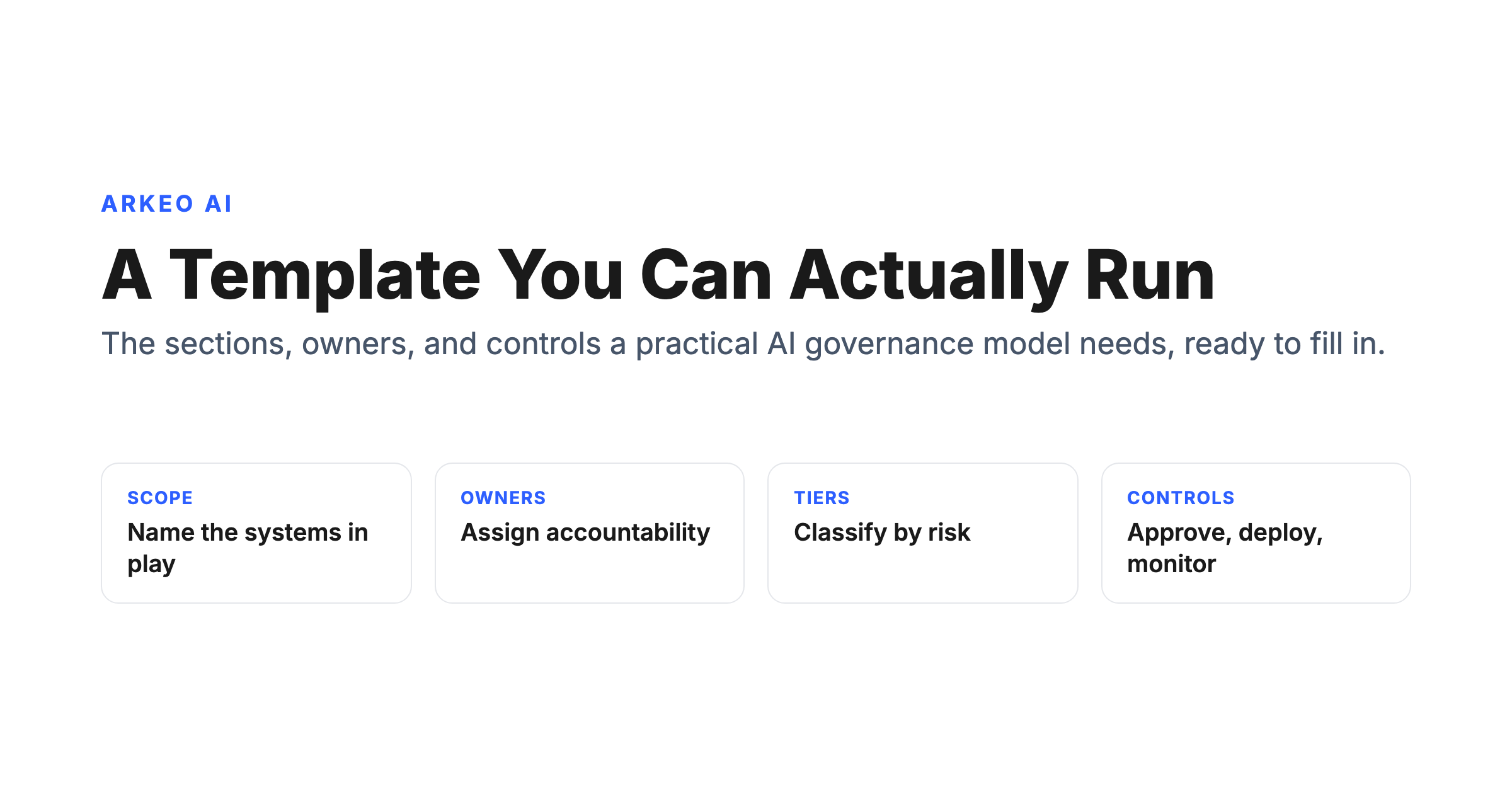
A working template is built from a small set of sections that interlock. The list below is the practical core, drawn from the NIST AI RMF Govern function and the way mature programs actually run. The NIST AI RMF Playbook breaks the Govern function into categories covering organizational policies and AI inventories by risk level, documented roles and responsibilities with C-suite accountability, impact assessments, stakeholder recourse, and third-party risk, while stating plainly that it is "neither a checklist nor set of steps to be followed in its entirety." You borrow what fits.
| Template section | What it must answer |
|---|---|
| Scope | Which AI systems and tools are in scope, including the unsanctioned ones already in use. |
| Ownership and roles | Who is accountable for each system, who approves deployment, who reviews independently, and who runs technical controls. |
| Risk tiers | High, medium, and low criteria that decide which use cases get full review, light review, or none. |
| Review and approval | The sign-off required before a system goes live, and the record of who decided what. |
| Deployment rules | Where each system may run, public cloud, private, or on-premise, matched to the sensitivity of its data. A workable heuristic: if PII or proprietary data is in the inference path, default to private or on-premise deployment; low-sensitivity task automation may run on managed cloud. |
| Monitoring | The cadence and metrics for catching drift, degradation, and misuse while it is still cheap to fix. |
| Incident escalation | What triggers a review, who is notified, and how a problem reaches a decision-maker fast. |
Risk tiering is the section that does the most work, so build it first. It is the decision that determines which AI use cases receive full review, lightweight review, or no review at all. Without it, every AI project gets the same scrutiny regardless of impact, which produces either over-governance of low-stakes tools or under-governance of high-stakes ones. The clearest public model for the tiers is the EU AI Act, which sorts systems into four levels: unacceptable risk (prohibited outright), high risk (which requires risk mitigation, data governance, logging, documentation, and human oversight), transparency risk (disclosure obligations), and minimal risk (no specific rules). IBM's governance guidance frames the same move operationally: establish "a defensible assessment process" and "consistently categorize each use case into the appropriate risk tier." Your template does not need four named tiers from a regulation; it needs criteria your own people can apply consistently.
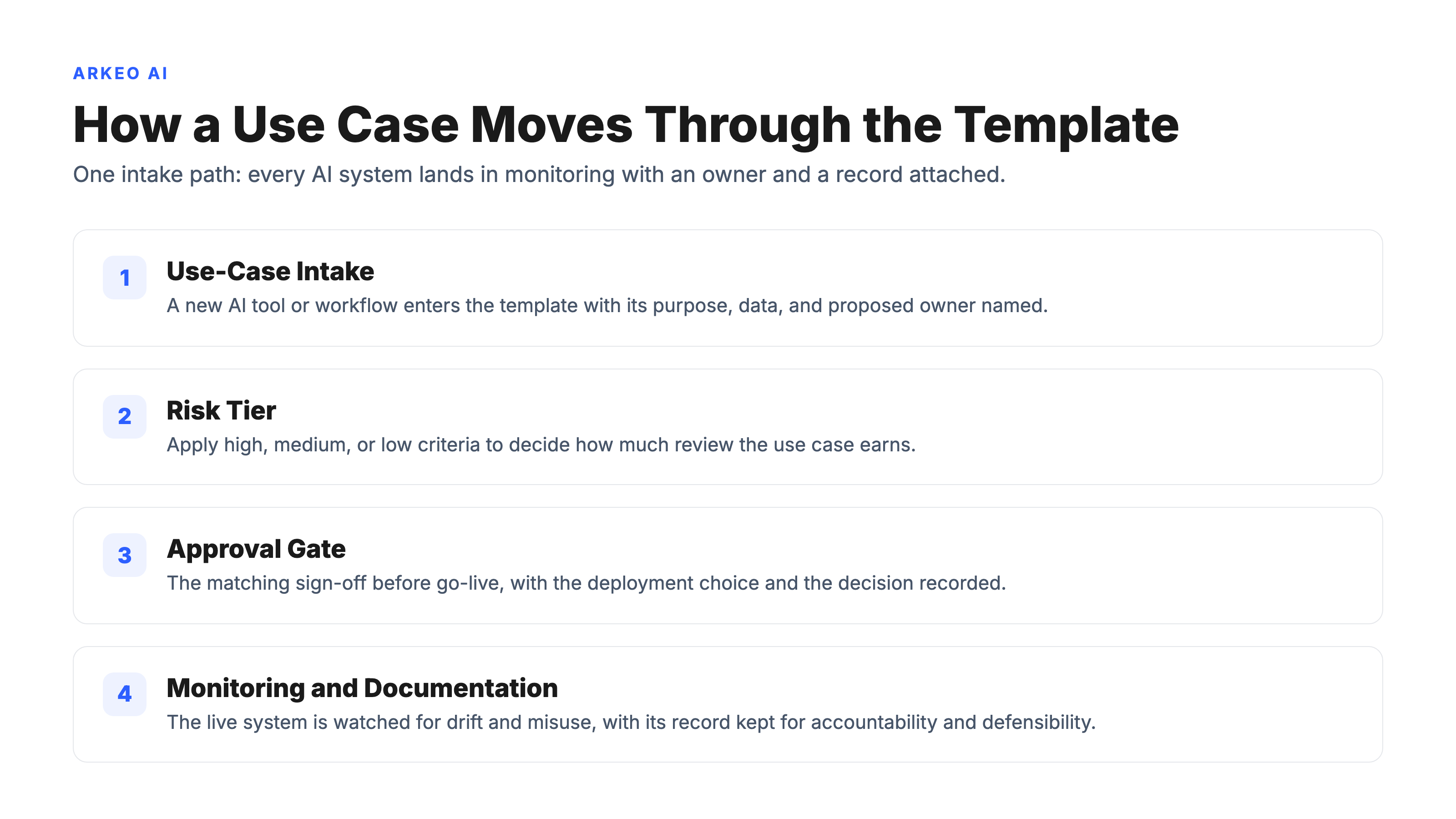
The flow above is what the template encodes: a use case enters, gets a risk tier, passes through the matching approval gate, and lands in monitoring with its documentation attached. On roles, keep the RACI honest. At minimum a template should name four: the AI system owner accountable for ongoing risk, the business sponsor with decision authority for deployment, the risk or compliance function as independent reviewer, and IT or data engineering responsible for technical controls and monitoring. Smaller organizations may collapse these into two or three people, but the role separation should still be written down, because that is what keeps the person who builds a system from being the only person who signs off on it.
How Do You Adapt the Template by Company Stage?
The same skeleton scales up or down, and the framework authors expect that. NIST designed the AI RMF to be "voluntary, rights-preserving, non-sector specific, and use-case agnostic, providing flexibility to organizations of all sizes and in all sectors," and at its release NIST stated the framework can help organizations "in any sector and any size" jump-start or enhance their risk management. So a small company is not bending the rules by running a lighter version; it is using the framework as intended.
A lean template, appropriate for a company under roughly 200 people or early in AI adoption, needs five working sections and no more: scope, ownership, risk classification, a deployment checklist of what must be true before go-live, and incident escalation. That is enough to make every live system traceable to a named owner and a recorded decision. A mature template, the kind a regulated or large enterprise needs, adds the formality: third-party and supply-chain risk, impact assessments, external stakeholder recourse, and a certifiable management-system backbone. ISO/IEC 42001, the first AI management system standard, supplies that backbone through a Plan-Do-Check-Act structure, and its companion ISO/IEC 23894 adds a dedicated AI risk-management process layer on top. The OECD, whose AI definition the EU, US, and UN all use in their own frameworks, anchors the accountability and transparency principles those mature sections map to.
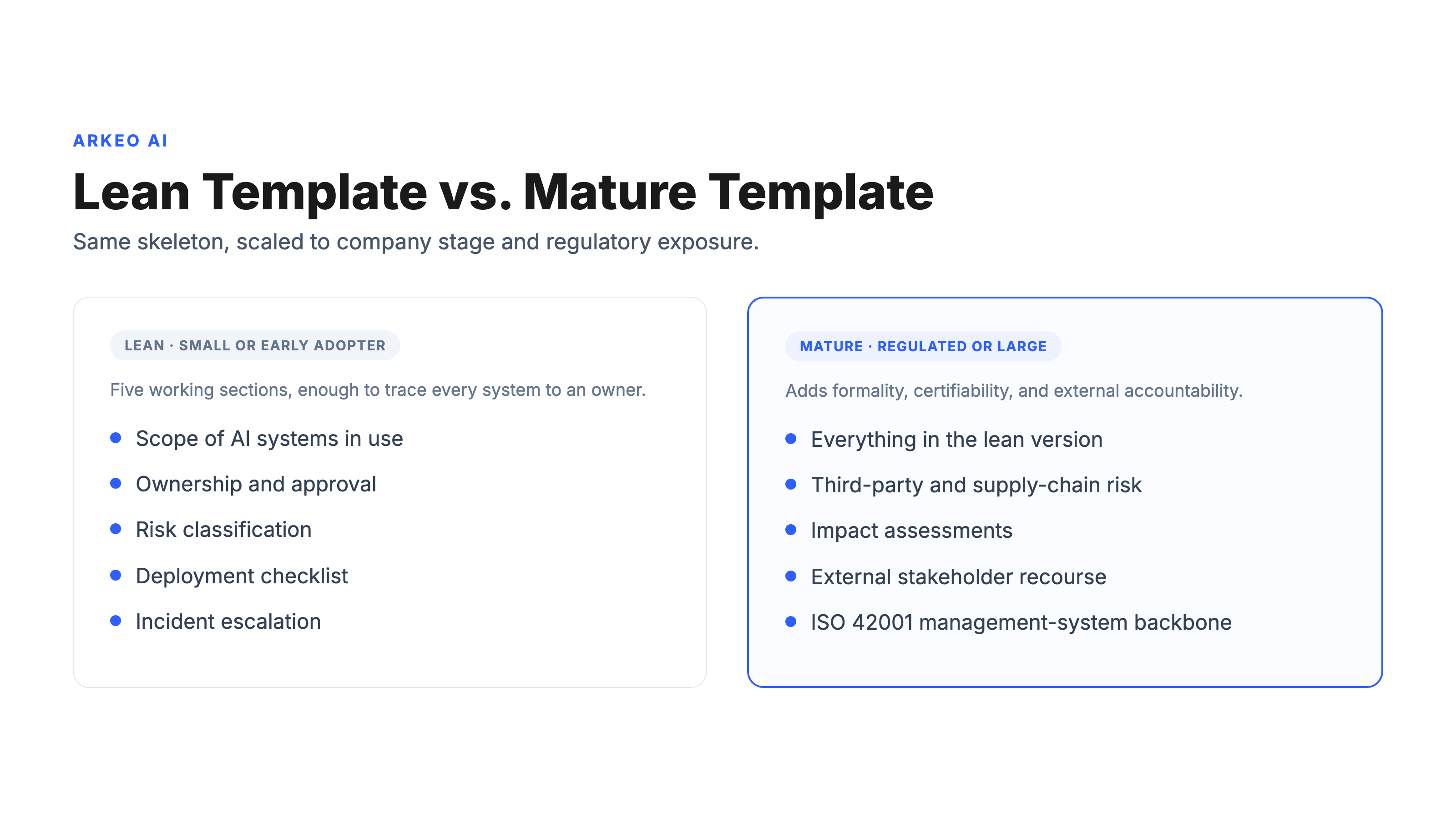
The trap is reaching for the mature version too early. A five-person working group does not need supply-chain risk clauses before it has named who owns its first AI tool. Start lean, prove the loop works on real systems, then add formality as the AI portfolio and the regulatory exposure grow.
Turn a template into your governance model
Sorting which sections you need now versus later is the hard part. A free AI Assessment maps these sections to your real AI use cases and the right deployment for each, so the template becomes a model you can actually run.
Book Your Free AI Assessment →
What Are the Most Common AI Governance Template Mistakes?
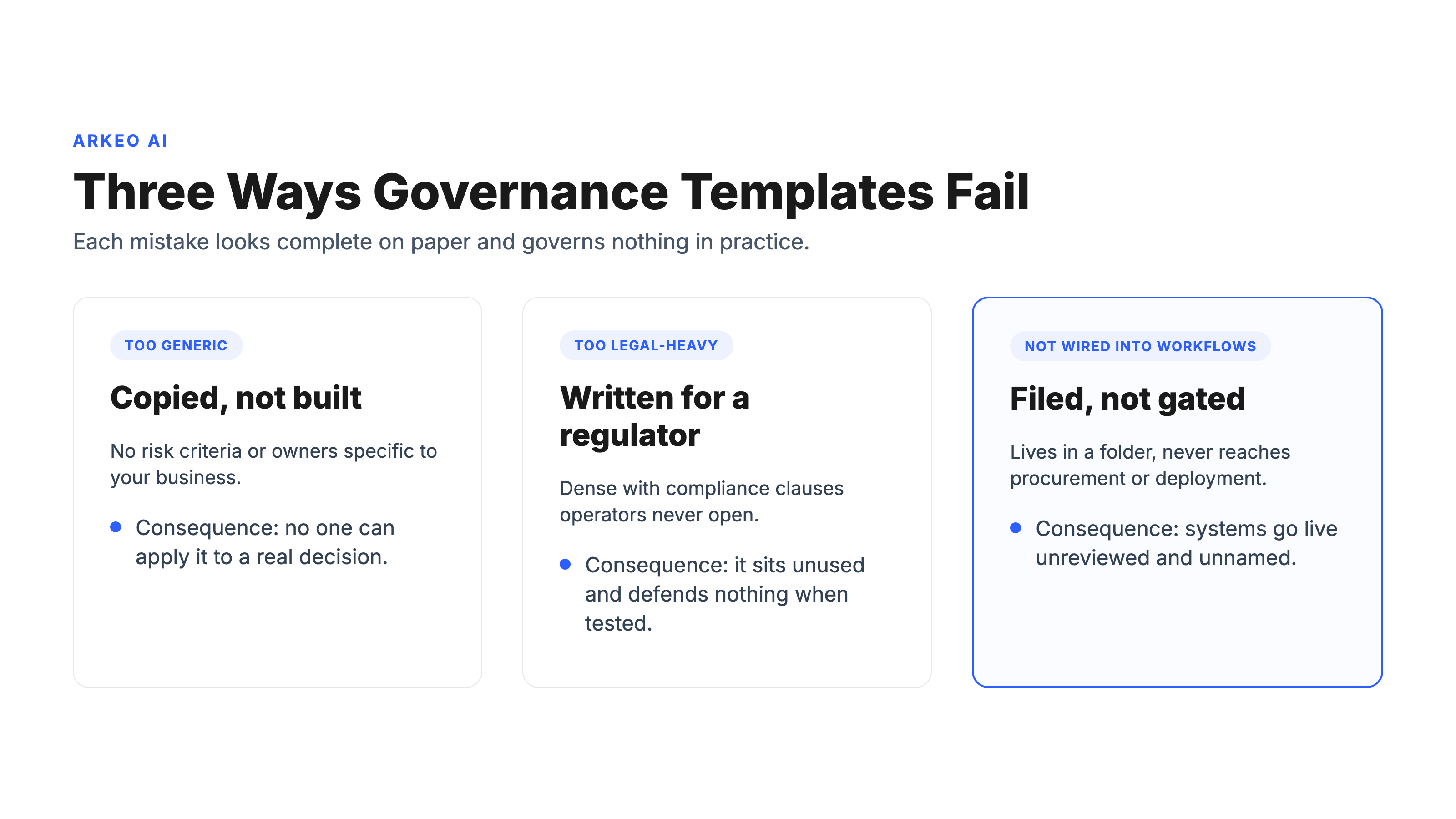
Three failure modes account for most useless templates, and each is avoidable.
Too generic. A template copied wholesale, with no risk criteria or owners specific to your business, reads fine and governs nothing, because no one can apply it to an actual decision. Too legal-heavy. A template written as a compliance artifact, dense with clauses meant to satisfy a regulator, gets handed to operators who will never open it. Documentation in a template serves two real purposes, internal accountability for who decided what and external defensibility if an incident occurs, and a legal-heavy document usually answers neither when tested. Not tied to workflows. This is the big one. The most common template failure is a document that sits in a SharePoint folder but is never consulted at the moment of an AI purchase or a deployment approval. A template only governs if it is embedded in procurement, project intake, or the deployment pipeline as a gate, not a retrospective audit.
Picture a mid-market operations team, purely as an illustration, that wrote a solid governance template during a quarterly planning week. It named risk tiers and owners and looked complete. But it lived as a slide in a shared drive, and nobody wired it into how new tools got bought or how agents got deployed. Six months later a department had stood up three AI workflows, none reviewed, because the template was a reference document instead of a required step. Nothing had broken yet, and that is the dangerous part: the absence of an incident was not evidence of control, only evidence that no one was looking. A template that lived inside the intake process would have caught all three on day one.
What Do You Do After the Template Exists?
You operationalize it, and then you test it. A template is not done when it is written; it is done when a real use case has passed through it and the gate held. The move that works is to run one live use case end to end: classify it, assign the owner, walk it through the approval, record the deployment decision, and stand up the monitoring. If any section is too vague to apply to a real system, you found a gap before an incident did. Then reuse the loop for the next use case and tighten controls as the risk tier climbs.
That mirrors how Arkeo approaches every engagement. Map the current state and its bottlenecks, capture easy wins in the first 30 to 90 days, identify the top custom agent opportunities, then move toward a longer-term private AI architecture, with governance built into each step rather than parked at the end. Arkeo AI was founded in 2023, brings 25 years of business operating experience, and runs its own operations on the Arkeo Operating System (AOS) it deploys for clients. We use what we sell, often on-premise or in private deployments where the data never leaves your control, and that shapes how we design the deployment-rules section: the strongest data-path control is the one where sensitive data physically cannot reach a public model.
For the full picture of what sits behind these sections, the AI governance framework guide covers the operating model, the regulatory references, and where frameworks break down. And once your template is filled in, a worked AI governance framework example shows the sections populated with real entries so you can see what a completed version looks like in practice.
Move fast without governing nothing
Regulations are still shifting and adoption will not wait for them. A free AI Assessment gets a working governance loop standing in 30 to 90 days, so structure keeps pace with deployment instead of trailing it by months.
Book Your Free AI Assessment →