Category
A Practical AI Governance Framework Example
Last updated: May 2026
You have read the definition of AI governance. You know it means owners, risk tiers, approvals, and monitoring. What you still cannot picture is what it looks like inside a company running several AI tools at once: who sits on the committee, who signs off on what, and what happens when a higher-risk use case shows up. Arkeo AI has spent three years deploying agents inside live operations, and the gap between the concept and a working structure is where most governance efforts stall. This page closes that gap with one worked example you can hold in your head, then adapt to your own business.
Quick Answer
• What it is: A concrete, illustrative governance structure for a mid-market company, showing roles, risk tiers, ownership, and an escalation path.
• What it shows: An executive sponsor, a governance committee, named model owners per use case, and a documented flow for higher-risk AI.
• Why it matters: A worked example turns governance from an abstract policy into something you can copy the shape of and fill in for your own workflows.
Use the example as a starting shape, not a template to clone line for line. If you would rather map this structure to your own use cases and deployment plan with a team that builds these systems for a living, you can book a free AI Assessment and work through it directly. The rest of this page walks the example end to end, then shows you what to keep, what to cut, and what not to copy at all.
What Should a Practical Governance Example Actually Show?
A useful AI governance framework example shows four things in motion: who owns each AI system, how systems are sorted by risk, how a new use case gets reviewed and approved, and how decisions about where the AI runs get made. Anything less is a policy excerpt, not an operating model. A definition tells you governance exists; an example shows you how a decision travels from “someone wants to use this tool” to “it is live, owned, and monitored.”
The structure does not have to be invented from scratch. The NIST AI Risk Management Framework Core organizes governance around four functions, with Govern designated as a cross-cutting function, and its accountability guidance expects defined roles spanning boards, senior management, audit functions, and the teams that design, test, and procure AI. That is the backbone any example borrows from. The job here is to make it tangible.
What Does a Sample Governance Framework Look Like?
Picture a 300-person specialty manufacturer running three AI use cases at once. The first is an internal tool that drafts and summarizes meeting notes. The second is a customer-service assistant that suggests replies for human agents to send. The third is a proposal-pricing model that recommends quote figures to the sales team. Three use cases, three very different levels of risk, one company that needs a single structure to govern all of them. This company is hypothetical, used purely to make the structure concrete.
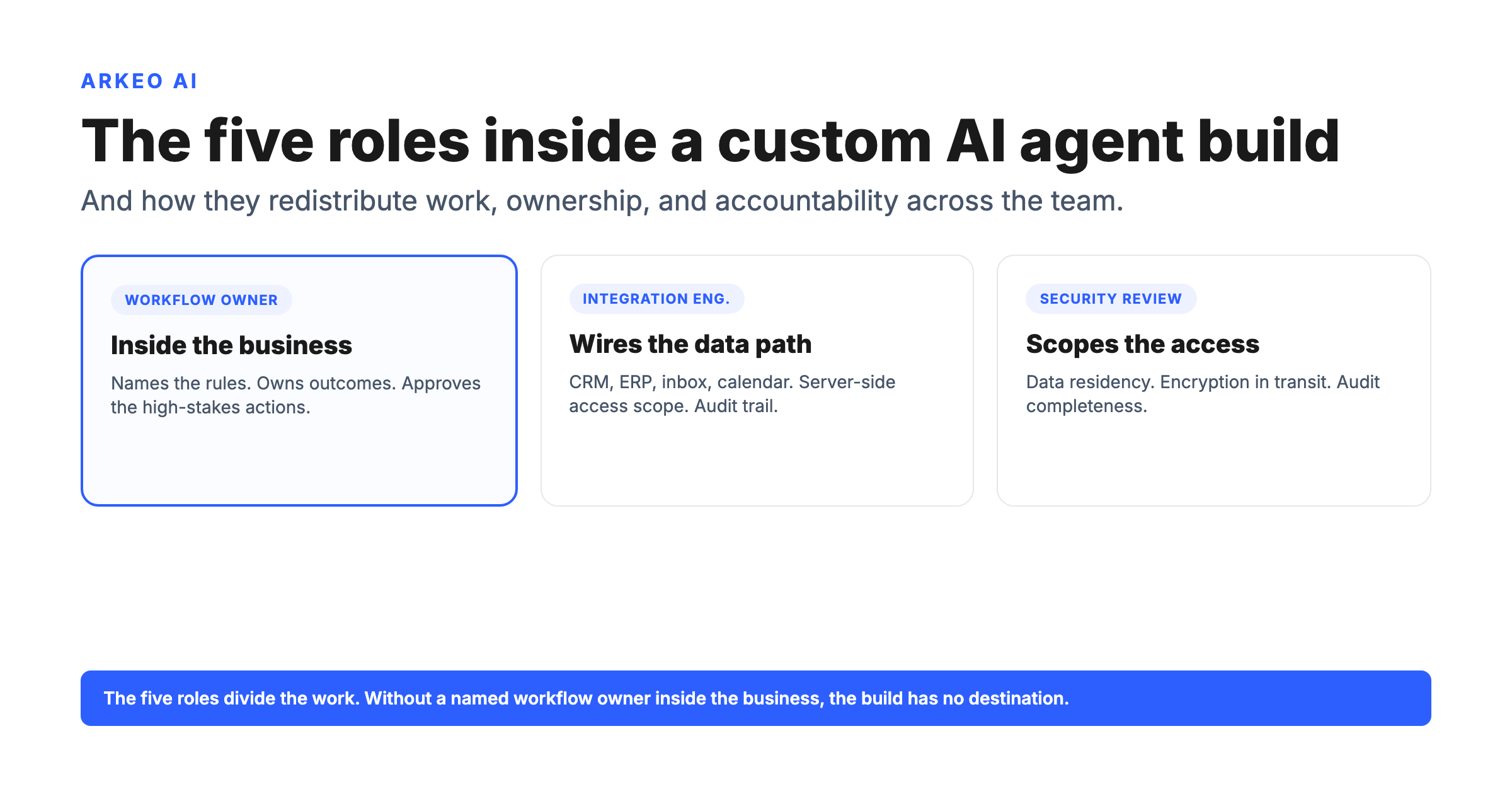
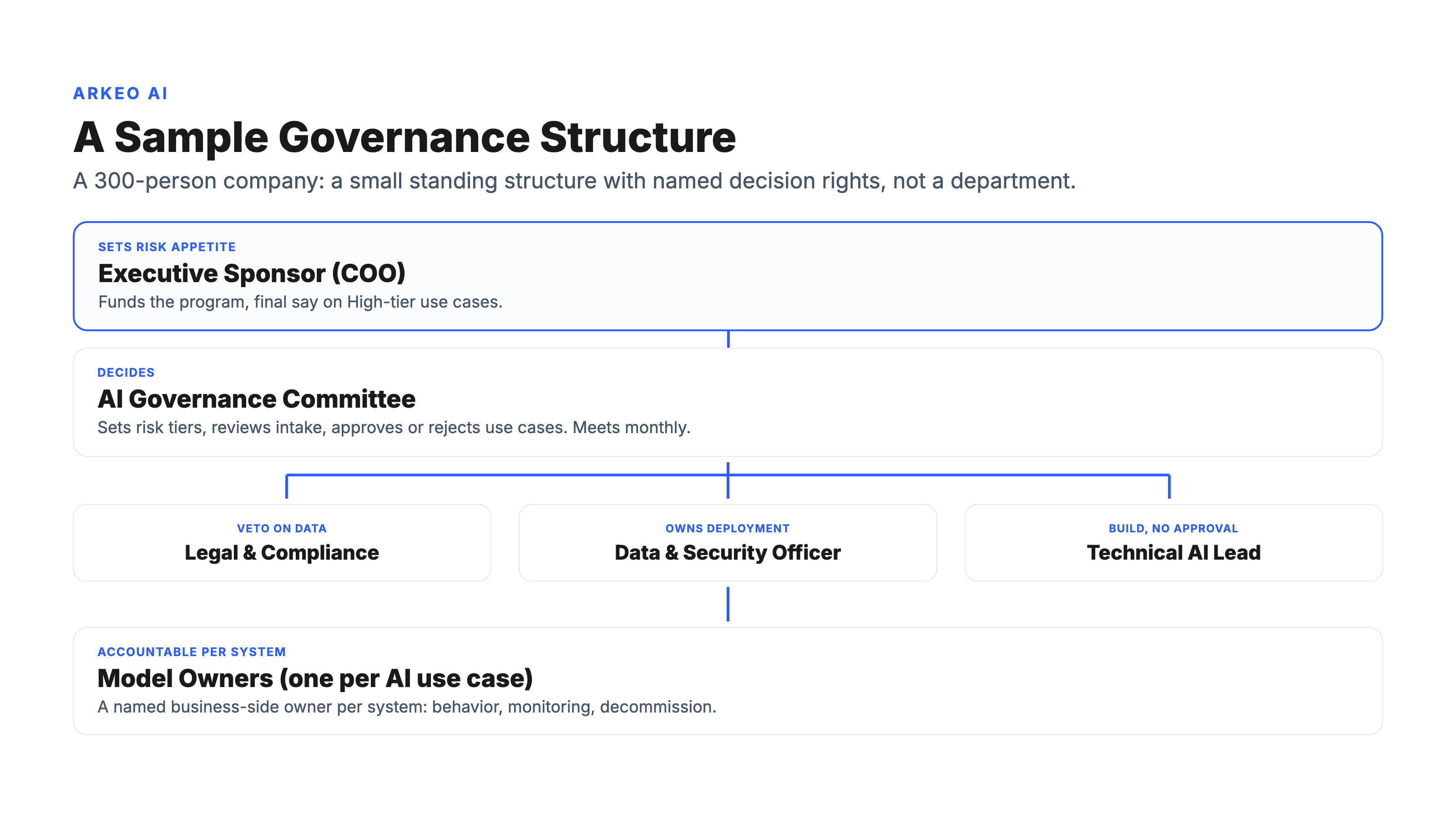
Start with the people. A practical governance body for a company this size does not need a department. It needs a small standing group with clear decision rights, mirroring the role separation NIST calls for. The table below is the sample governance structure, the most reusable asset on this page.
| Role | Responsibility | Decision rights |
|---|---|---|
| Executive sponsor (COO) | Owns the risk appetite, funds the program, holds final accountability. | Final say on High-tier use cases and budget. |
| AI governance committee | Sets risk tiers, reviews intake forms, approves or rejects use cases. Meets monthly. | Approves Medium-tier; recommends on High-tier. |
| Legal and compliance lead | Reviews data handling, contractual exposure, and any applicable obligations. | Veto on data and compliance grounds. |
| Data and security officer | Owns data-path rules and the deployment decision (public, private, on-premise). | Approves where each system may run. |
| Model owners (per use case) | A named business-side owner per system, accountable for behavior and monitoring. | Initiate intake; can pause or decommission their system. |
| Technical AI lead | Builds and maintains systems; produces model cards and bias checks. | Advisory; no approval authority (separation of duties). |
Notice what that last row does. The person who builds the system does not get to approve it, which keeps development separate from oversight. That separation is not Arkeo opinion; the NIST AI RMF Govern guidance explicitly calls for separating development from testing functions and for conflict-of-interest prevention. The structure stays small, but the accountability lines are real.
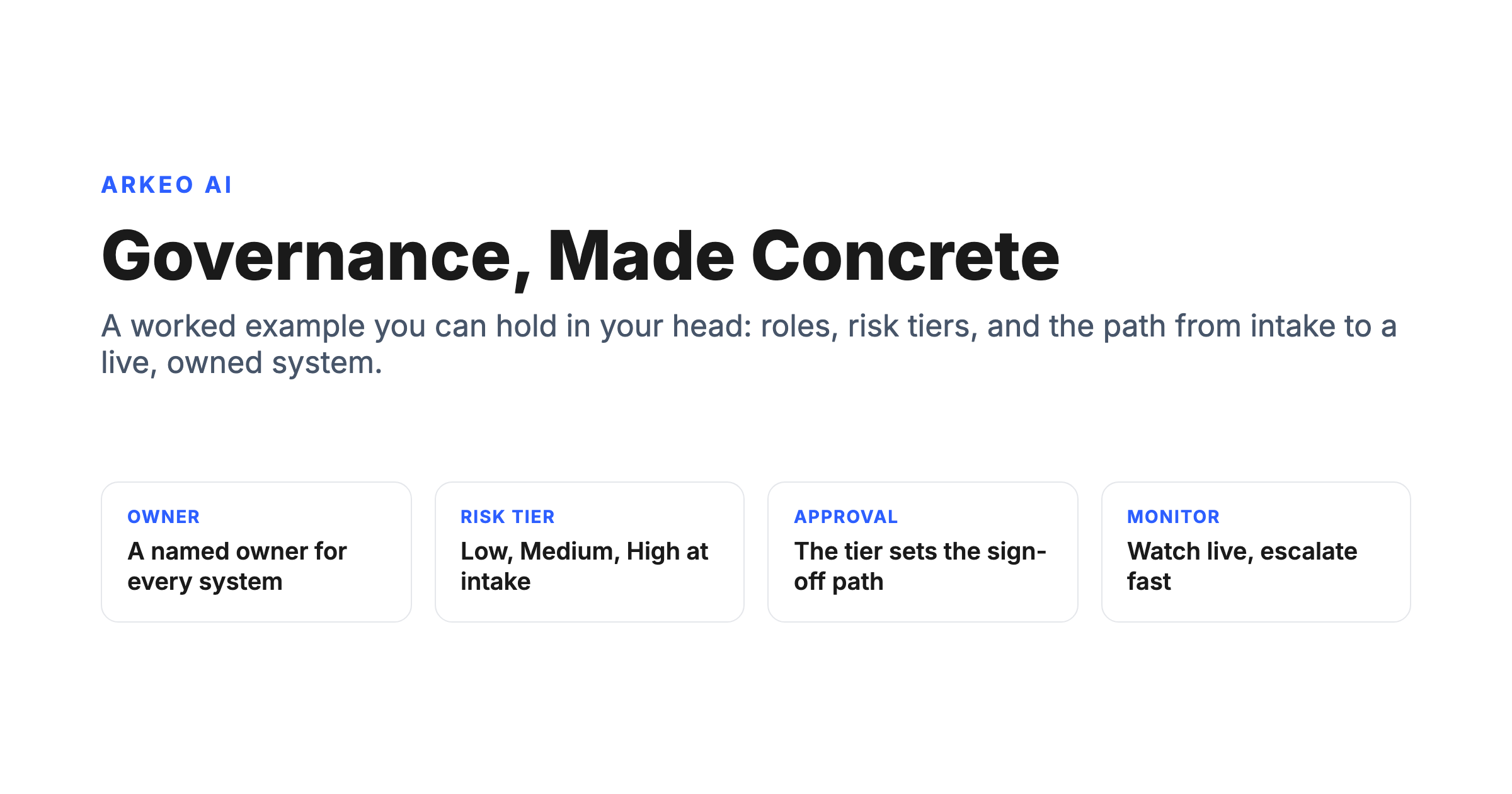
Now the rules that sit on top of those people. The example company runs three core rules. First, every AI use case has a named model owner before it goes live, never “the team” or “IT.” Second, every use case carries a risk tier, set at intake. Third, the tier decides the path: Low-tier systems get IT sign-off and go; Medium-tier needs the business owner plus legal; High-tier needs committee review and a documented risk assessment before deployment. Mapping the three sample use cases against those rules, the meeting-notes tool lands Low, the customer-service assistant lands Medium because it touches customers, and the proposal-pricing model lands High because its output drives revenue decisions and could embed pricing bias.
Here is the belief that wrecks most first attempts: that a governance example is something you adopt wholesale, like installing software. It is not. Most teams think the goal is to find the “right” framework and copy it. The teams that succeed treat an example as a shape to argue with, keeping the parts that fit their workflows and discarding the parts that do not. An example that survives contact with your business is one you have edited, not one you have pasted.
See where this structure fits your operation
A free AI Assessment maps a governance structure like this one to your real use cases, owners, and deployment choices, before the gaps cost you.
Book Your Free AI Assessment →
How Does the Example Handle a Higher-Risk Use Case?
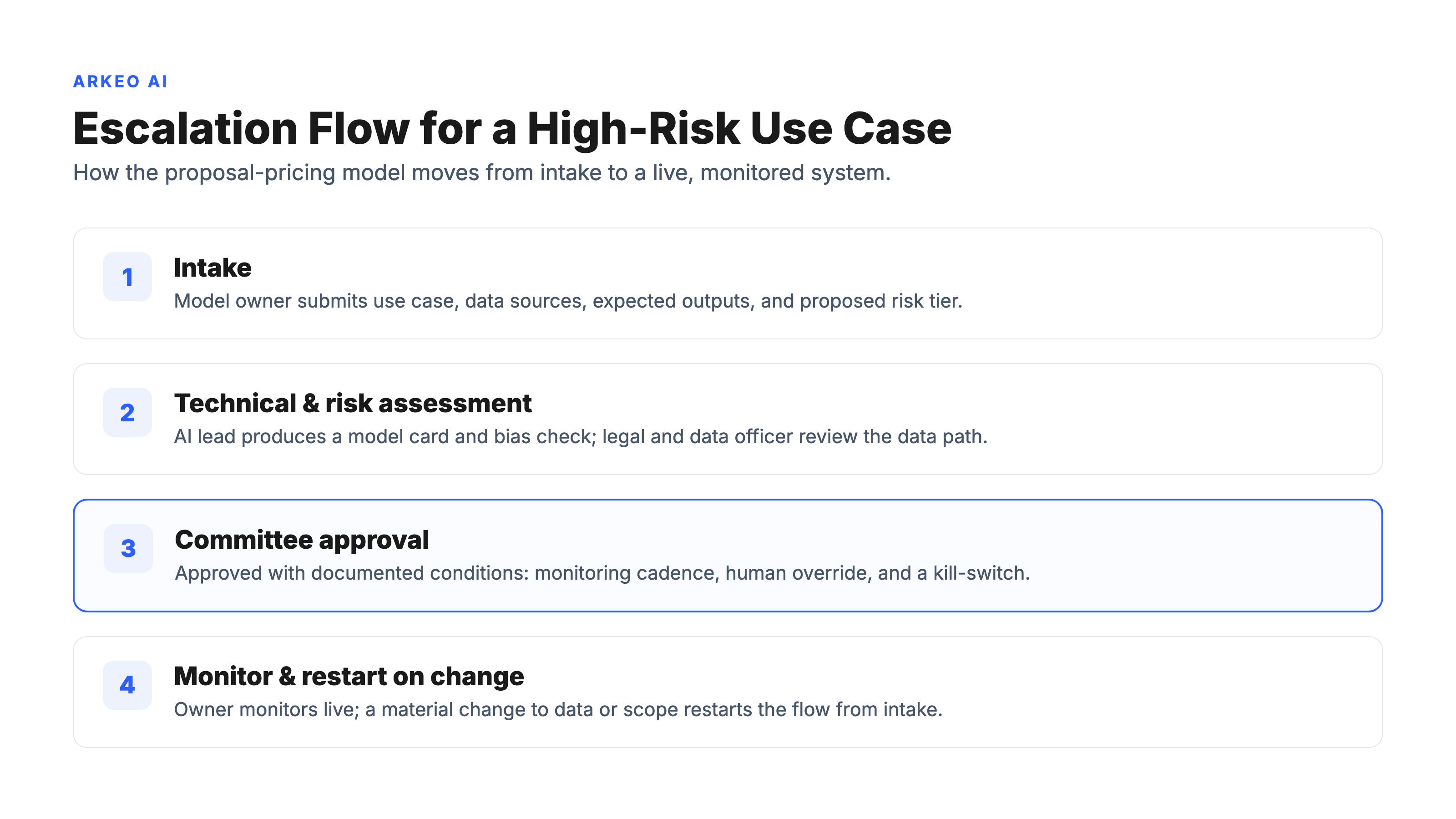
The proposal-pricing model is the interesting one, because Low-tier systems barely test a framework. A High-tier use case is where the structure either holds or falls apart. In the example, a High-tier system follows a documented escalation flow rather than a quiet launch.
It starts when the model owner submits a use-case intake form capturing the intended use, data sources and sensitivity, expected outputs, proposed risk tier, and the owner’s name. The technical AI lead then runs an assessment, producing a model card and a basic bias check on the pricing recommendations, while legal and the data officer review the data path and any contractual exposure. Only then does the committee approve, with documented conditions: a monitoring cadence, a human override on every quote the model touches, and a kill-switch the model owner can pull if the recommendations drift. If the system later changes materially, say it starts pulling a new data source, the escalation restarts from intake.
This is not bureaucracy for its own sake. For any company operating in or selling into the EU, a documented, continuous risk management process is a legal requirement for high-risk AI under EU AI Act Article 9, and technical documentation must be prepared before the system goes live under EU AI Act Article 11. Even outside EU jurisdiction, the principle holds: scale your control to the potential harm. The OECD AI Principles make the same point from the accountability angle, holding the organizations that deploy AI responsible for its proper functioning. The escalation flow is simply how a small company operationalizes that without standing up a compliance department.
Now the blunt part. The escalation flow will not prevent the pricing model from being wrong. AI systems produce confident, wrong outputs and drift as the data around them shifts; that is normal, not an exception. What the flow does is make sure the wrong output is caught by a human override, traced to a named owner, and contained, instead of surfacing three months later in a margin report nobody could explain. Governance does not make AI safe. It makes failure visible and owned.
How Do You Adapt the Example to Your Own Company?
The structure above fits the example company. Yours is different, so adapt it along three axes.
By company size. A 50-person firm does not need a six-role committee. Collapse it: the owner-operator is the sponsor, one ops lead chairs an informal review, and model owners are whoever requested the tool. A 1,000-person company goes the other way, with a standing committee, a dedicated data officer, and an internal audit function. The roles stay the same; the number of heads behind them scales with you. ISO/IEC 42001, the first international AI management system standard, frames this as top management assigning and communicating responsibilities, which works at any size as long as the responsibilities are named.
By AI use case. The example ran three use cases. If your AI is all internal and low-stakes, you may only ever need the Low and Medium paths, and the heavy High-tier escalation can stay on the shelf until a risky use case appears. If you deploy autonomous agents that take actions on their own, you need tighter controls than this example shows, tiered by the blast radius of what the agent can do.
By deployment model. Where the AI runs is a governance decision, not just an IT one. The data and security officer in the example owns it because the strongest data-path control is physical: if sensitive data cannot reach a public model, no policy is needed to stop it from leaking there. This is why Arkeo AI, founded in 2023 and built on 25 years of business operating experience, runs much of its own work on-premise and in private deployments using the Arkeo Operating System (AOS) it deploys for clients. We use what we sell, and for High-tier use cases on sensitive data, private deployment often does more for governance than any approval form.
What Should You Not Copy Blindly?
Two failure modes show up when teams lift an example without editing it. The first is over-formality. A 60-person company that adopts a 12-page policy and a weekly committee will smother the very adoption it is trying to enable, and the policy will be ignored within a quarter. Match the weight of the governance to the size of the risk, not to how official it looks. The second is missing workflow fit. An example built for the manufacturer above will not map cleanly onto a services firm or a healthcare provider, because the use cases, the data sensitivity, and the obligations differ. Copy the shape, the roles, the tiers, the intake-to-approval flow, and then rebuild the specifics around the workflows you actually run.
For the underlying components behind this example and how they fit together, the AI governance framework guide covers the full operating model. And when you are ready to put this on paper for your own company, a working AI governance framework template gives you the sections and owners to fill in, which pairs naturally with the worked example here: the example shows you the shape, the template gives you the blanks.
What Should You Do Next?
The move from example to operating model is smaller than it looks. Pick one real use case, ideally a visible one, and run it through the structure on this page: assign a named owner, set its tier, document the approval, decide where it runs, and set a monitoring cadence. Prove the loop on one system, then reuse it for the next and tighten controls as the tier climbs. In Arkeo’s typical approach, a first governance model covering the initial 8 to 10 use cases, run by a small working group across two or three sessions, can stand up in a few weeks, then expand by risk tier as deployment scales. Governance built this way speeds adoption up, because an approved pattern never has to be re-argued.
Turn the example into your operating model
A free AI Assessment takes a structure like this and adapts it to your use cases, the right deployment for each, and a rollout that moves fast without leaving gaps.
Book Your Free AI Assessment →