Category
What an AI Governance Framework Should Include
Last updated: May 2026
Your teams are already using AI. Not in a controlled pilot, but in the gaps: a sales rep pasting a contract into a chatbot, an analyst running a model nobody approved, a manager wiring an agent into a live workflow over a weekend. The capability is spreading faster than anyone can answer a basic question: who is accountable when one of those systems gets it wrong? Arkeo AI has spent three years deploying agents inside real operations, and the same pattern shows up every time. The companies that move fast and stay safe are not the ones with the longest policy. They are the ones with a governance framework that makes the right call the easy call.
Quick Answer
• What it is: The operating model that governs how a business selects, deploys, reviews, monitors, and escalates AI systems in practice.
• What it includes: Ownership, risk tiers, approvals, data rules, deployment controls, monitoring, and escalation paths.
• Why it matters: Most organizations adopt AI faster than they govern it, and that gap is where breaches, rework, and stalled rollouts come from.
This guide lays out a framework you can actually run, not an ethics manifesto. If you would rather map your own governance needs to specific use cases and a deployment plan, you can book a free AI Assessment and work through it with a team that builds these systems for a living. The rest of this page explains what the framework contains, where it breaks, and how to stand one up without freezing the very adoption you are trying to manage.
What Is an AI Governance Framework?
An AI governance framework is the operating model that governs how a business selects, deploys, reviews, monitors, and escalates its AI systems in practice. It is not the policy PDF that sits in a shared drive. The policy is the rulebook; the framework is the machine that applies the rules to real decisions: which use case gets approved, who signs off, what data the system may touch, where it runs, and what happens the moment it behaves in a way no one expected.
Think of it the way you already think about financial controls. You do not have a single document called Money Policy. You have owners, approval thresholds, segregation of duties, monitoring, and an audit trail, all wired into how work gets done. AI governance is the same idea applied to a faster, less predictable kind of system. The point is to make AI decisions repeatable and accountable instead of improvised.
Here is the belief that sinks most programs: governance is an ethics checklist that slows AI down. It is not. A real framework is what lets you say yes faster, because the moment a use case is classified, owned, and bounded, you no longer have to relitigate the same risk questions every time someone wants to ship. Done right, governance is an accelerator with brakes attached, not a brake pedal you keep your foot on.
Why Does AI Governance Matter Beyond Compliance?
The headline reason is not the regulator. It is that AI is now everywhere in the business and almost nowhere under control. Stanford HAI's 2025 AI Index reports that the share of organizations using AI jumped to 78 percent in 2024, up from 55 percent the year before, with generative AI use in at least one business function more than doubling year over year. Adoption is no longer the question. Whether anyone is governing it is.
The Cisco 2024 AI Readiness Index surveyed nearly 8,000 senior leaders and found that only 13 percent of companies are fully ready to capture AI's potential, actually down from 14 percent the year before. On governance specifically, just 31 percent reported having highly comprehensive AI policies and protocols, and more than half pointed to a shortage of talent with expertise in AI governance, law, and ethics as a key obstacle. Read that together: most organizations are deploying a technology they admit they cannot yet govern.
The cost of that gap is now measurable. The IBM Cost of a Data Breach 2025 report found that 13 percent of organizations reported breaches of their AI models or applications, and 97 percent of those lacked proper AI access controls. The same report found that 63 percent of breached organizations had no AI governance policy or were still developing one. One in five reported breaches tied to shadow AI, the unsanctioned tools employees use without IT oversight, and those incidents added as much as $670,000 to the average breach cost. Read those numbers together and the pattern is plain: when nobody owns the decision about what an AI system can access, the access controls never get built, and the breach surface widens.
Now the blunt part. AI agents break, and they break in ways traditional software does not. They will confidently produce a wrong answer, take an action you did not intend, or quietly drift as the data around them changes. No framework prevents that entirely. What a framework does is make sure the breakage is caught, owned, and contained instead of discovered three months later in a customer complaint or an audit finding.
What Should an AI Governance Framework Include?
A practical framework is built from a small number of components that work together. Skip any one of them and the others lose their grip. These are the seven that matter, and the honest reason each one earns its place.
| Component | Why it matters |
|---|---|
| Ownership and accountability | A named person owns each AI system. With no owner, no one watches it, fixes it, or answers for it when it fails. |
| Risk tiering | Classifying systems by potential harm lets you put heavy review where it counts and light-touch approval everywhere else. |
| Approval and review | A defined sign-off before deployment stops shadow systems from going live and gives you a record of who decided what. |
| Data governance rules | Spelling out what data a system may access, and how it is handled, is what keeps sensitive records out of a public model. |
| Deployment controls | Choosing public cloud, private, or on-premise per system matches data sensitivity to where the AI actually runs. |
| Monitoring and review | Live performance review catches drift, degradation, and misuse while it is still cheap to fix. |
| Exception and escalation | Clear triggers and a path upward mean an edge case reaches a decision-maker fast instead of being quietly ignored. |
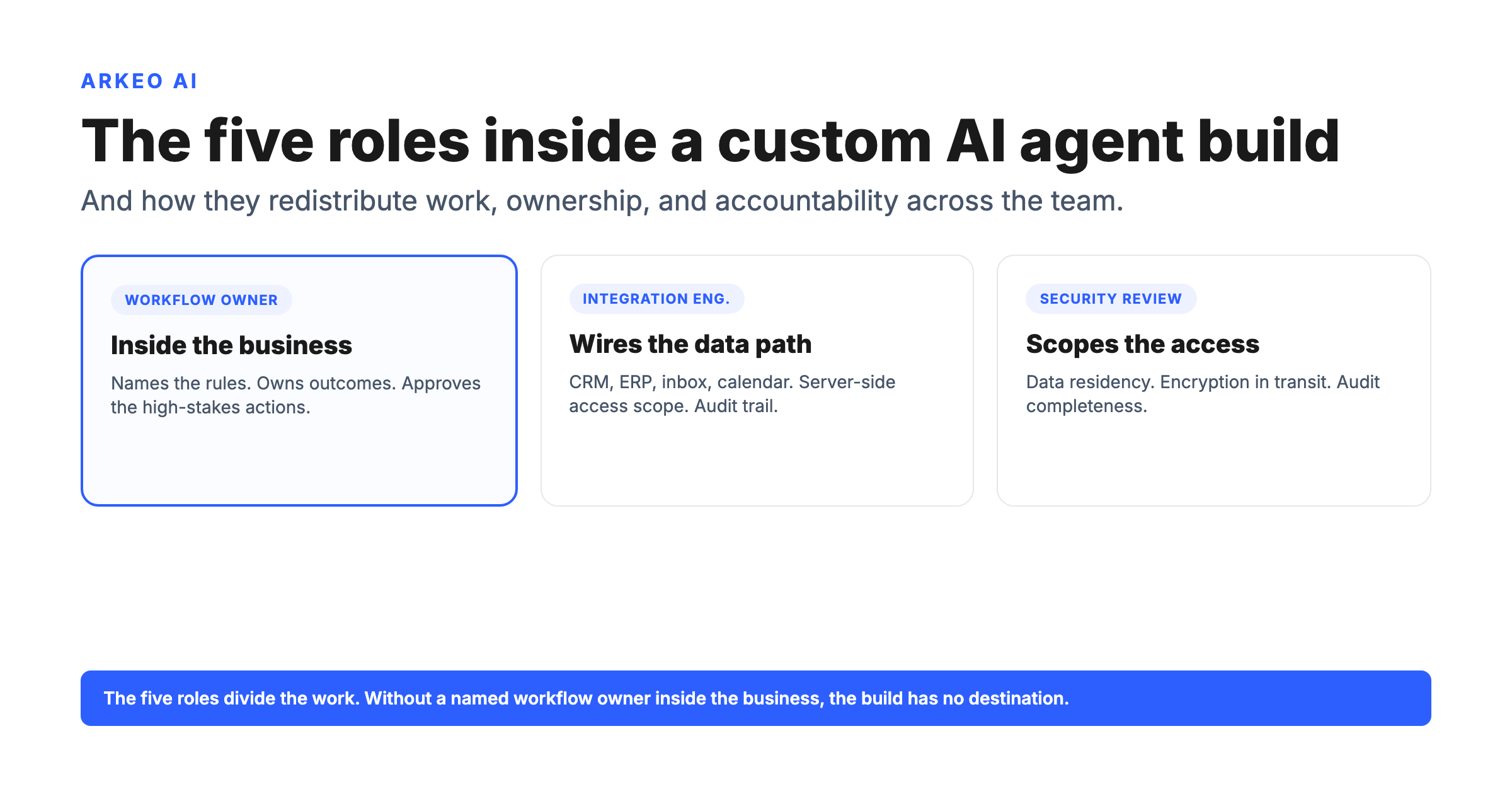
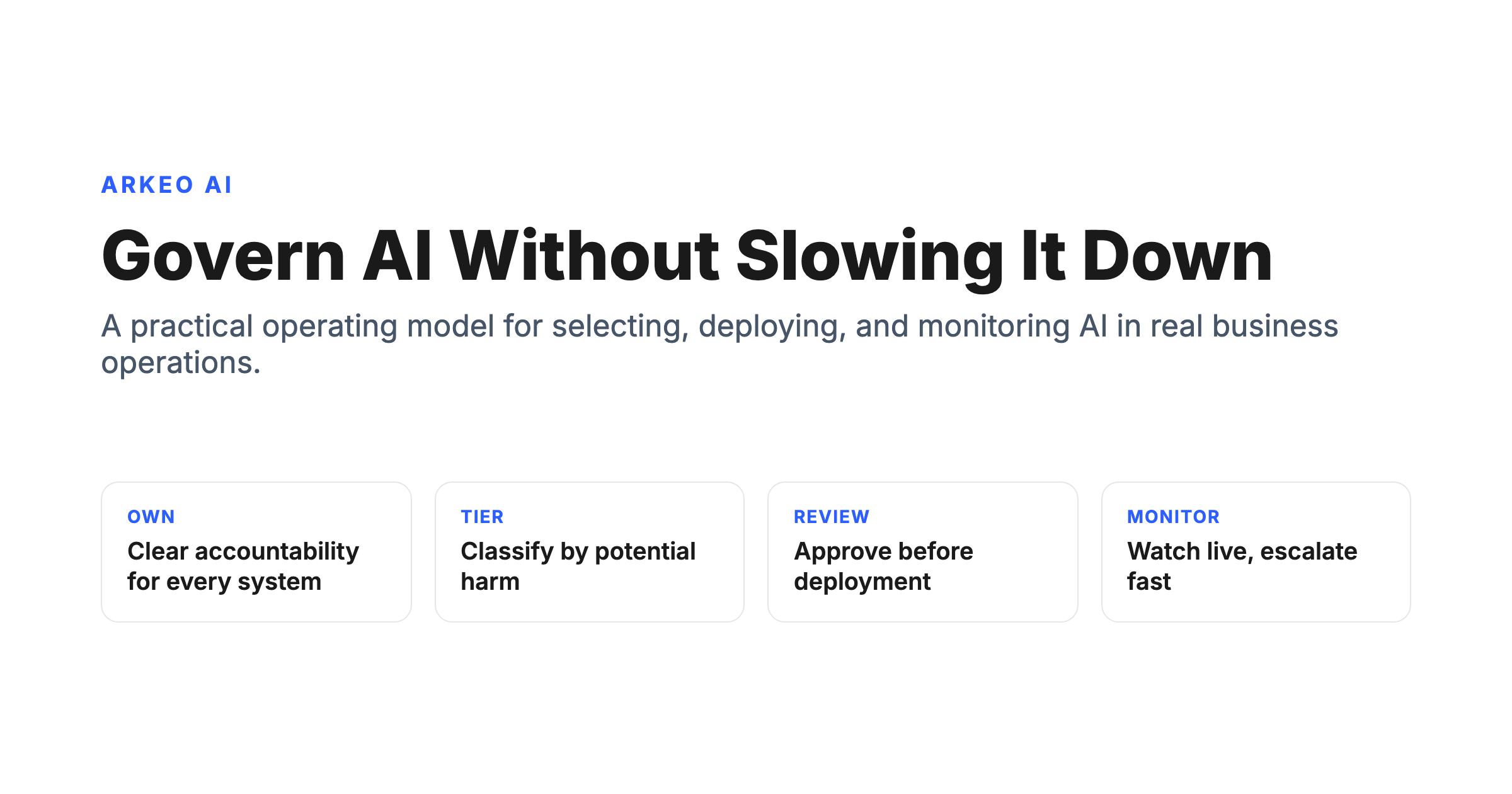
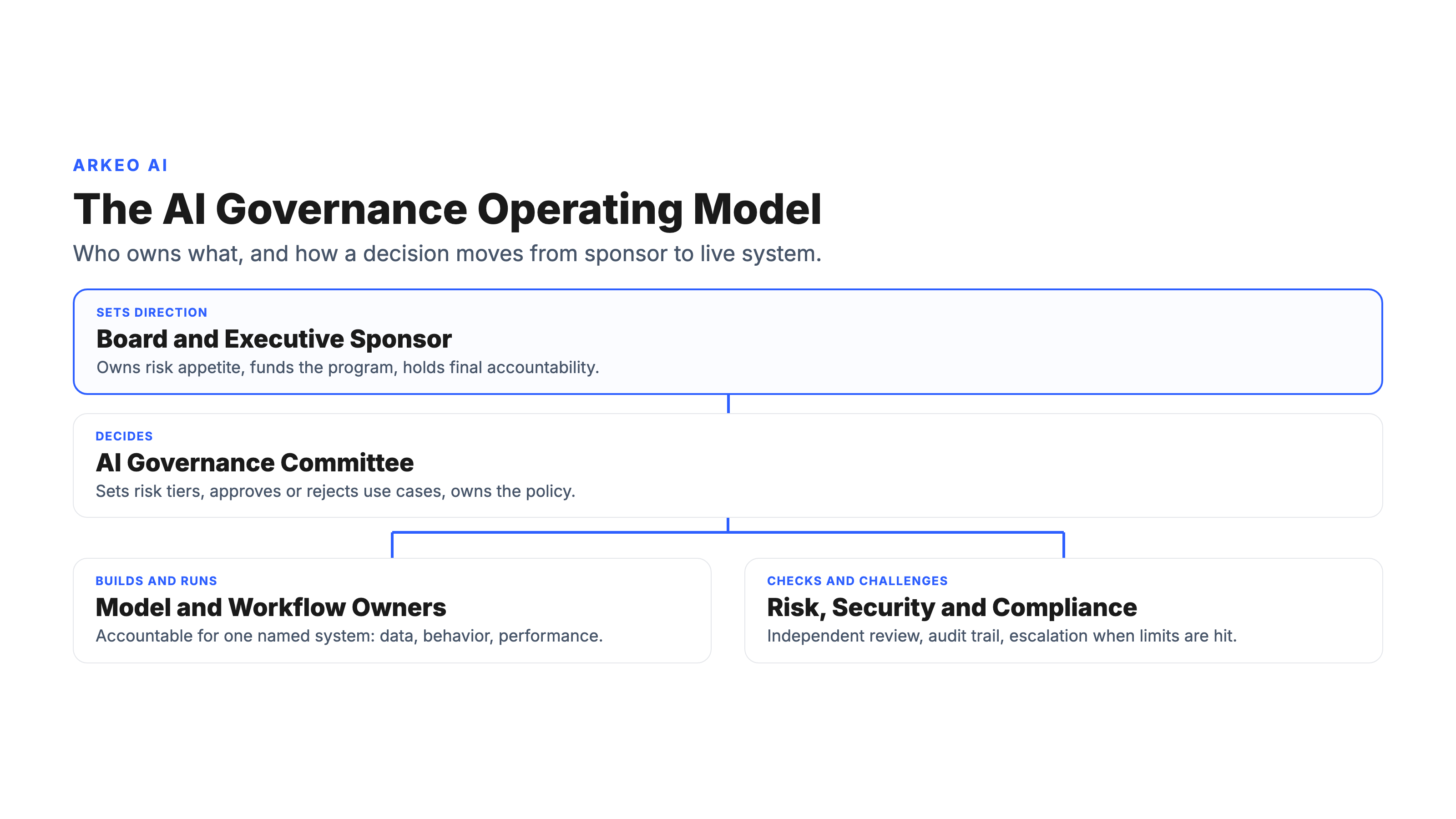
Those components only work if someone is wired to each one. That is the governance operating model: a board or executive sponsor that owns the risk appetite and the funding, an AI governance committee that sets the risk tiers and approves or rejects use cases, model and workflow owners accountable for individual systems, and an independent risk and compliance function that reviews, audits, and challenges. The flow runs in one direction, and every live system traces back to a named owner.
How Do NIST, the EU AI Act, and ISO 42001 Fit In?
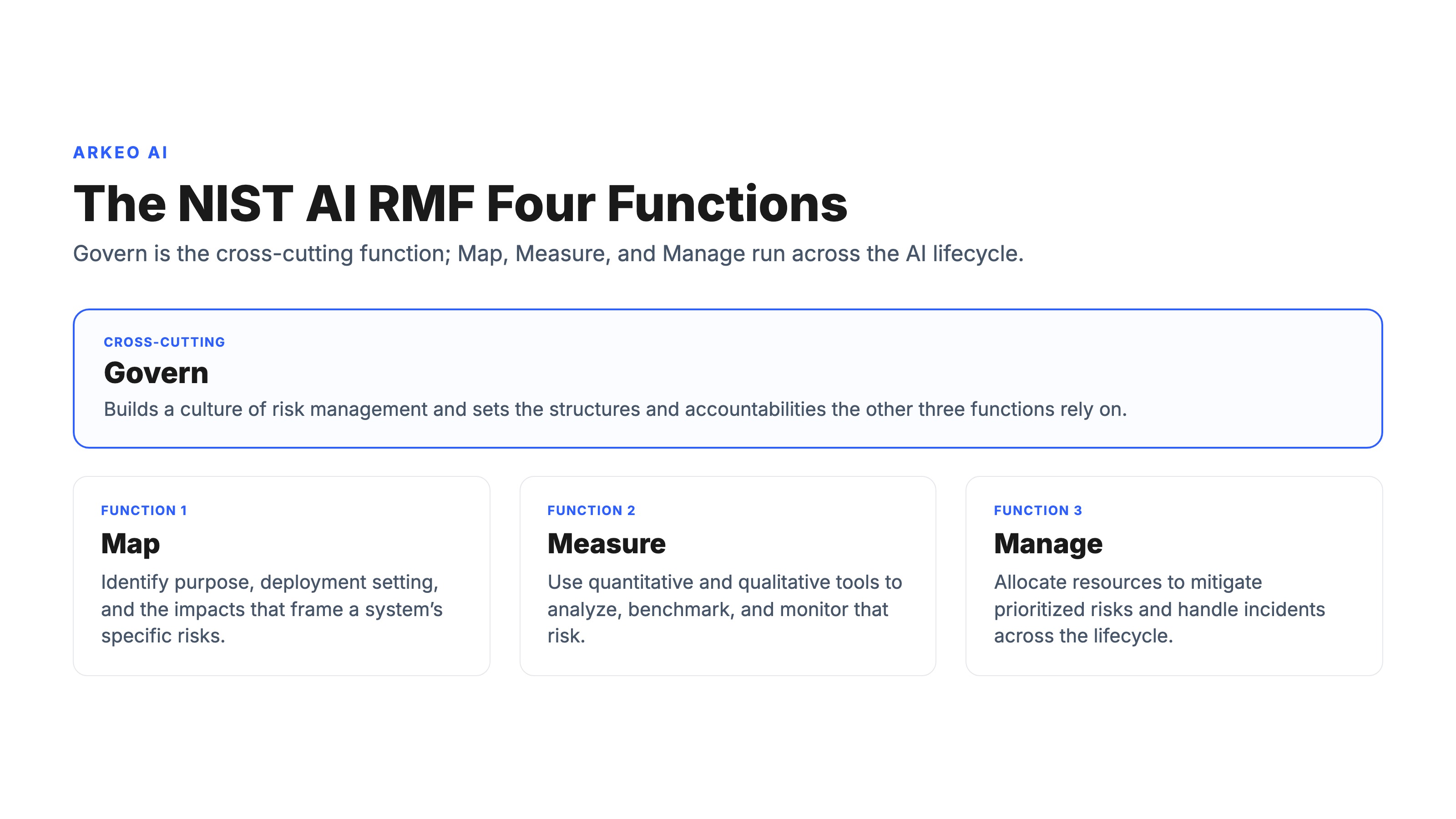
You do not have to invent governance vocabulary from scratch. Several primary frameworks give you shared structure, and the most widely used in U.S. business is the NIST AI Risk Management Framework, published in January 2023. It is voluntary, non-sector-specific, and built around four core functions. Govern is the cross-cutting function that cultivates a culture of risk management and sets the structures and accountabilities the others depend on, while Map frames each system's specific risks, Measure analyzes and benchmarks them, and Manage allocates resources to mitigate and handle incidents across the lifecycle.
If you operate in or sell into Europe, the framework becomes law. The EU AI Act entered into force on 1 August 2024 and sorts systems into four risk tiers: unacceptable risk (banned outright, such as social scoring), high risk (strict obligations including risk assessment, quality data, logging, documentation, and human oversight), transparency risk (disclosure for chatbots and AI-generated content), and minimal risk (no specific rules, which covers most current systems). Prohibited practices applied from February 2025 and full general-purpose AI rules from August 2025, with high-risk rules for critical sectors arriving in December 2027. It is the world's first comprehensive AI law, and the principle behind it travels even if you are not subject to EU jurisdiction: scale your level of control to the level of potential harm.
One more reference point rounds it out. ISO/IEC 42001, published in 2023, is the world's first AI management system standard, built on a Plan-Do-Check-Act cycle and certifiable by independent bodies. None of these is plug-and-play. Each is a shared map you still have to translate into your own approvals, owners, and controls for the workflows you actually run.
See where AI fits your operation
A free AI Assessment maps your live and planned AI use to the governance, deployment, and rollout choices that actually fit your business, before the gaps cost you.
Book Your Free AI Assessment →
Where Do AI Governance Frameworks Break Down?
Most frameworks do not fail on paper. They fail in the gaps between the boxes. Four failure modes show up again and again, and each one is avoidable.
Unclear ownership. A system goes live, the project team disbands, and no one is accountable for it anymore. When it drifts, there is no name on the hook, so nothing happens until something breaks publicly. Tool sprawl. AI gets adopted ad hoc across departments with no central visibility, which is exactly the shadow AI that IBM ties to higher breach costs. No review path. A model is approved once and never re-evaluated, even as the data and the business around it change. Deployment mismatch. Sensitive data ends up in a public tool because the deployment choice never matched the data-sensitivity requirement. The fix for all four is the same: an owner, a tier, a review cadence, and a deployment decision recorded for every system.
Picture a mid-market firm, purely as an illustration, that adopted AI from the bottom up. A sales team found a public chatbot useful for drafting and started pasting customer contracts and pricing into it to turn proposals around faster, months before any policy existed. To sanity-check the terms, someone fed in a full contract with the client names still attached. The launch had quietly skipped an approval step, because the approval step was owned by no one. Nothing went wrong, and that is the dangerous part. The work got done, the shortcut became the norm, and the sensitive data had already left the building before anyone in leadership knew the workflow existed. The absence of an incident is not evidence of control; it is usually evidence that no one is looking. A governance model with an owner, a data rule, and an approval gate would have caught it on day one.
How Does Governance Change for Generative and Agentic AI?
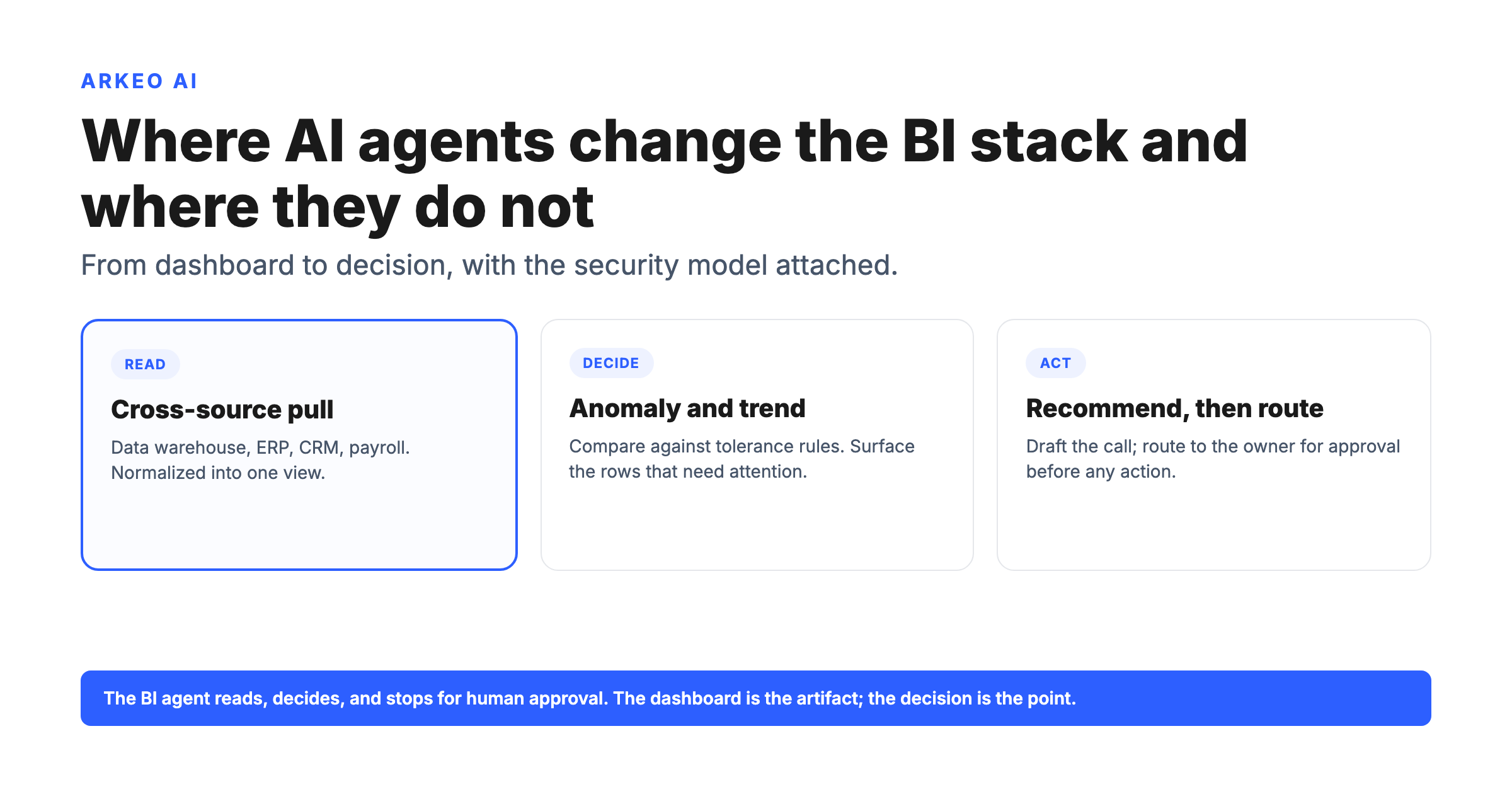
Traditional software does what it is told. Agentic AI decides how to do it, and that difference is what older governance models were never built for. An agent can take multi-step actions on its own, call other tools, and chain decisions together without a human in each loop. That autonomy raises three demands at once: higher-frequency review because behavior changes between runs, tighter data-path controls because the agent can reach data the original use case never named, and explicit escalation triggers so the system stops and asks before it crosses a defined limit.
The practical move is to tier agents by the blast radius of their actions. An agent that drafts internal summaries sits in a low tier. An agent that can move money, change records, or send external communications sits in a high tier with hard guardrails, mandatory logging, and a human approval gate on its riskiest actions. The deeper the agentic governance question runs, the more it pays to design the controls into the system from day one rather than bolting them on after launch.
How Do You Build Governance Without Stalling AI Adoption?
The mistake is trying to govern everything before you ship anything. You will produce a 150-page policy that no one reads and that stalls the adoption you set out to enable. The approach that works is the opposite: start narrow and earn the right to scale.
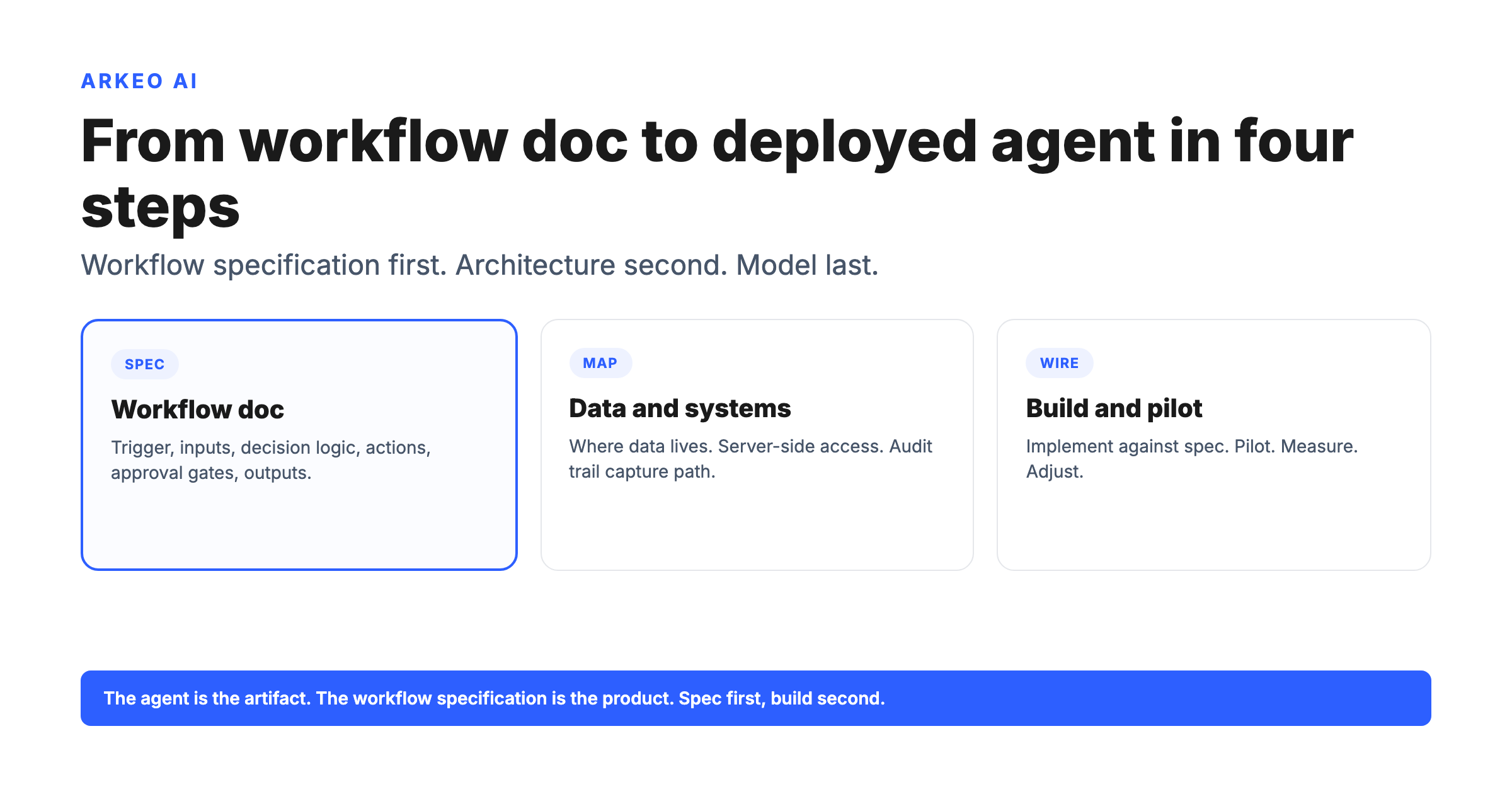
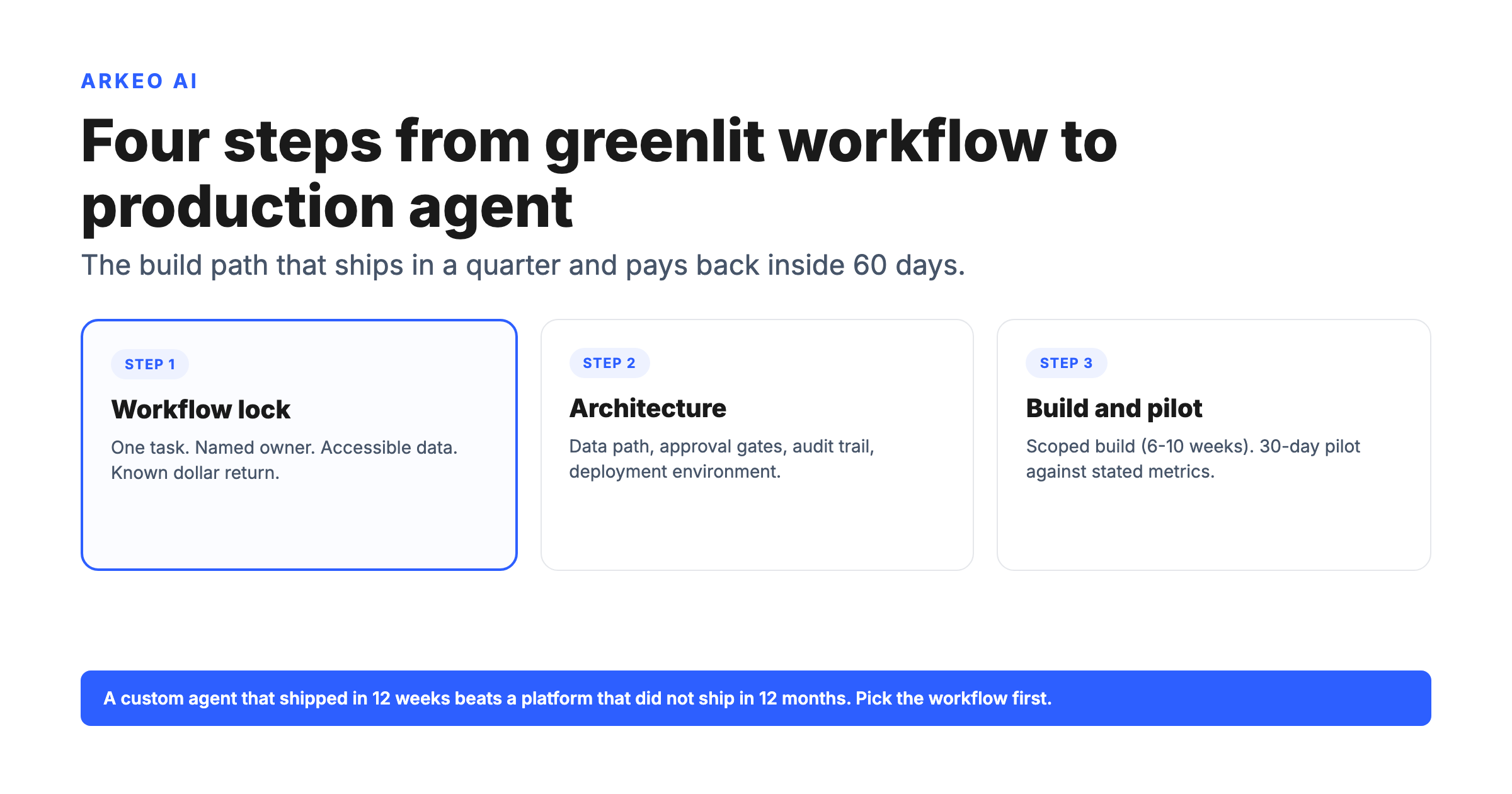
Pick one high-visibility use case. Build the full loop around just that one system: a named owner, a risk tier, a documented approval, clear data rules, a deployment choice, and a monitoring cadence. Prove the loop works on something real, then reuse it for the next use case and the next, tightening controls as the risk tier climbs. In Arkeo's typical approach, a first governance model covering the initial 8 to 10 AI use cases, run by a small cross-functional working group across two or three working sessions, can stand up in a few weeks, then expand by risk tier as deployment scales. That mirrors how Arkeo approaches every engagement: map the current state and its bottlenecks, capture easy wins in the first 30 to 90 days, identify the top custom agent opportunities, then move toward a longer-term private AI architecture. Governance is built into each step, not parked at the end.
When you are ready to put this on paper, a starting structure helps. A working AI governance framework template gives you the sections and owners to fill in, and if your roadmap leans on autonomous systems, a closer look at agentic AI governance covers the extra controls those systems need.
One more Arkeo position worth stating plainly, because it shapes how we design governance: Arkeo AI was founded in 2023, brings 25 years of business operating experience, and runs its own operations on the Arkeo Operating System (AOS) we deploy for clients. We use what we sell, often on-premise or in private deployments where the data never leaves your control. That matters for governance because the strongest data-path control is the one where the sensitive data physically cannot reach a public model in the first place.
Build governance around real use cases
A free AI Assessment turns this framework into a plan: your use cases, the right deployment for each, and a rollout that moves fast without leaving gaps.
Book Your Free AI Assessment →