Category
Building an Agentic AI Governance Framework
Last updated: May 2026
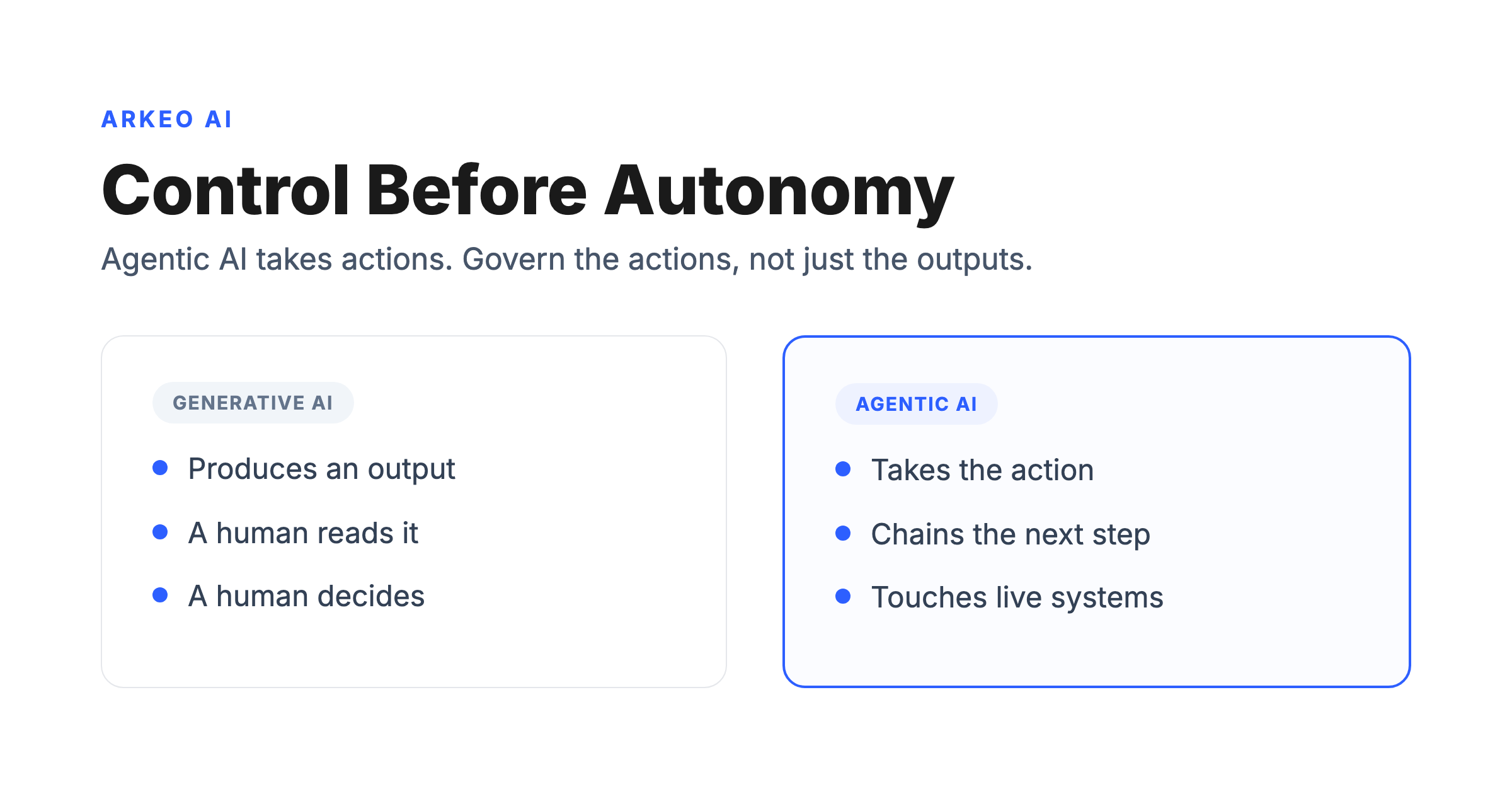
You are about to let software take actions on your behalf. Not draft an email for you to send, but send it. Not suggest an invoice, but post it. Not flag a record, but update it. That is the line between the generative AI tools your team already uses and the agentic systems showing up in every vendor pitch this year. Arkeo has spent three years deploying AI agents into mid-market operations, and the pattern is blunt: the governance that worked for a chatbot does not survive contact with a system that acts. Before you scope an agent project, you need a framework built for actions, not answers. The fastest way to find out what yours requires is a free AI Assessment that pressure-tests your readiness and the controls a rollout would need.
Quick Answer
• What it is: An agentic AI governance framework is the set of rules, permissions, and human checkpoints that control what an AI agent is allowed to do, not just what it is allowed to say.
• Why it is different: Agents take multi-step actions across live systems, so governance must cover action boundaries, approvals, rollback, monitoring, and escalation, not output review alone.
• Cost: The framework itself is policy and architecture work; the real cost is deploying without one. Start with a free readiness check before you scope anything.
• Why it matters: An over-permissioned agent with no escalation path does not produce a bad sentence. It performs a bad action, at machine speed, across every record it can reach.
Why does agentic AI change governance?
An agentic AI governance framework is the documented set of permissions, approval gates, monitoring, rollback, and escalation rules that control the actions an AI agent can take across your business systems. That definition matters because the governance most companies already have was written for a different kind of risk. A generative tool produces an output and a human decides what to do with it. An agent removes the human from the middle. It writes to a database, calls an API, sends a message, or modifies a file directly. Governance that only reviews outputs is governance for a problem you no longer have.
The regulators have already named the variable. The EU AI Act’s Article 14 requires that human oversight measures for high-risk systems be “commensurate with the risks, level of autonomy and context of use” (EU AI Act, Article 14). Autonomy is the dial. The more an agent acts on its own, the heavier the oversight the law expects. The 2024 update to the OECD AI Principles says the same thing in policy terms, requiring that AI actors keep a “capacity for human agency and oversight” to address misuse and use outside intended purpose (OECD). Neither standard exempts a system from oversight because it is autonomous. Autonomy is exactly why the oversight has to get stronger.
Most leaders assume agentic AI is just their existing AI tools with a longer leash. That belief is wrong, and it is the expensive kind of wrong. The difference is not capability, it is consequence. A chatbot that hallucinates wastes a few minutes of someone’s time. An agent that misreads an instruction can chain ten actions before anyone notices, and each action is real.
What does an agentic governance framework have to add?
Standard AI governance gives you a starting point. NIST’s Generative AI Profile (NIST AI 600-1), published in July 2024 as a companion to the AI Risk Management Framework, already directs organizations to define risk levels based on application scope, data sources, and expected behavior (NIST). Keep that. Then add the five things a framework for actions cannot live without.
Permissions scoped to the task. An agent with access to everything so it can do anything is not governed, it is merely supervised. Sound governance defines minimum-necessary permissions per task and per workflow step, enforced at runtime rather than set once at deployment.
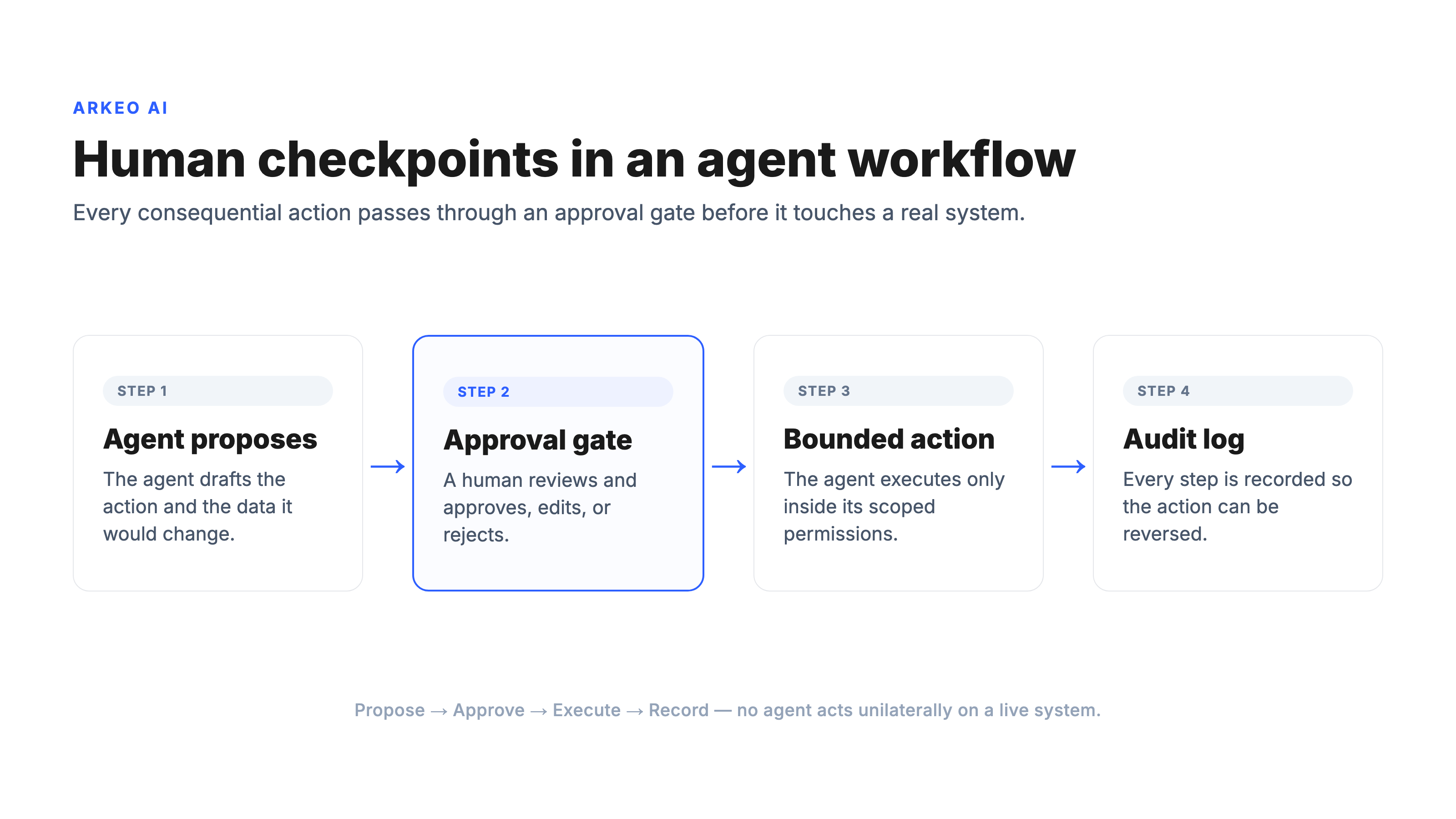
Approvals matched to stakes. Anthropic’s framework for trustworthy agents treats keeping humans in control as a core principle and names the central tension directly: balancing agent autonomy against human oversight before high-stakes decisions (Anthropic). You decide which actions require a human to approve before they happen and which an agent may take while a human watches.
Rollback as a rule, not a feature. When an agent completes a chain of actions and one step was wrong, you need to know what happened, in what order, and how to reverse it. Immutable audit logs and reversible operations are prerequisites for deployment, not nice-to-haves you bolt on later.
Monitoring that watches behavior. The market is now building dedicated tooling for exactly this. In June 2025, IBM introduced what it called the industry’s first software to bring AI security and AI governance teams together, adding behavioral analytics to detect privilege escalations or compromised agent behavior in real time, plus a human-in-the-loop authorization model that requires cryptographically verified approval when stakes are high (IBM). The signal for you is that this is now its own discipline, not a clause in your old AI policy.
Escalation paths designed in advance. Agents in multi-step workflows will hit edge cases and ambiguous inputs. Without a pre-defined path, who gets notified, what the agent does while it waits, what triggers an automatic stop, the agent either stalls or acts outside its sanctioned authority.
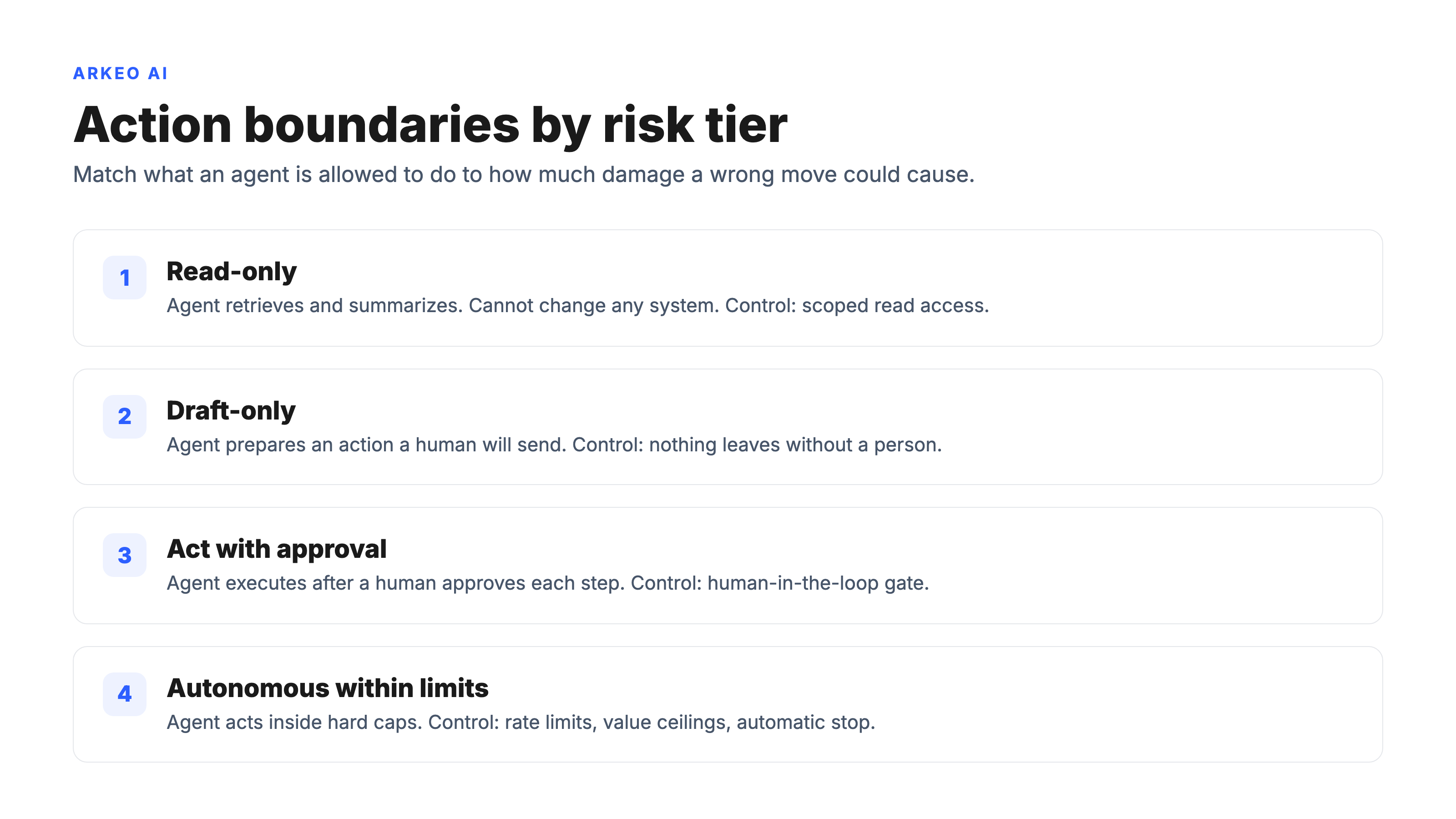
The cleanest way to make these decisions concrete is to write them down as a table your operators and your auditors can both read. Here is the shape of one.
| Action boundary | Approval required | Escalation type |
|---|---|---|
| Read-only retrieval | None; logged automatically | Alert on access outside scope |
| Draft a customer message | Human reviews before send | Hold in queue until reviewed |
| Update a CRM or ERP record | Human-in-the-loop per change | Notify owner; auto-stop on conflict |
| Issue a payment or refund | Cryptographic human approval | Hard stop above a value ceiling |
| Spawn or direct a sub-agent | Pre-approved task templates only | Block inherited privilege escalation |
That table is not paperwork. It is the difference between an agent that helps and an agent whose mistakes you cannot trace. Once you can see the blast radius of each action laid out, the question stops being whether to govern and becomes how much control each workflow needs before it goes live.
See where AI agents fit your operation
The free AI Assessment maps your highest-value workflows and tells you which ones are ready for bounded agent rollout and which still need controls in place.
Book Your Free AI Assessment →
Where does agentic governance break down?
Here is the part a vendor brochure leaves out: agents take actions, and agents break. Regularly. The failures are not exotic. They are the same three gaps, over and over.
Over-permissioned agents. IBM’s agentic security guidance warns that sub-agents optimized for smaller, targeted tasks are “likely candidates for risks like privilege escalation or over-permissioning,” and that high-impact use cases need strict validation protocols alongside monitoring and threat detection (IBM). An agent granted broad access to ship faster is a breach waiting for a trigger.
No escalation path. When an agent hits something it was not built to handle and there is nowhere to escalate, it does the worst possible thing: it guesses. A guess that becomes an action is how a single ambiguous input turns into a chain of wrong updates.
Poor observability. IBM’s analysis of agentic ethics makes the accountability shift explicit. When oversight moves from “human in the loop” to “human on the loop,” the person who signed off on the agent becomes the accountable party, and human oversight remains essential, in some cases as a legal requirement (IBM). If you cannot reconstruct what an agent did and why, you cannot answer for it. Accountability without observability is just exposure.
None of this is theoretical. Stanford HAI’s 2025 AI Index found that the share of businesses with no responsible AI policy fell from 24% to 11%, yet fewer than 10% of organizations report having robust governance frameworks for AI deployment (Stanford HAI). Most governance is a document, not a control. For static text tools that gap is uncomfortable. For agents that act, it is the failure mode itself.
How do you pilot agentic AI safely?
The companies whose agent projects survive are the ones that built control before scale. Gartner has forecast that 40% of enterprise applications will feature task-specific AI agents by the end of 2026, up from less than 5% in 2025, and separately warned that more than 40% of agentic AI projects will be canceled by the end of 2027 over escalating costs, unclear value, or inadequate risk controls. The pilots that make it through are narrow, gated, and bounded from day one.
A safe pilot has three properties. Its scope is narrow: one workflow, one team, one clearly defined job, not a platform-wide rollout. Its checkpoints are clear: a human approves every consequential action until the agent has earned a longer leash through a track record you can audit. And its actions are bounded: the agent operates inside hard limits, rate caps, value ceilings, and an automatic stop, so the worst case is contained by design rather than by hope.
This is how Arkeo deploys, and it is how Arkeo runs its own business. The Arkeo Operating System (AOS) is the agent layer the company uses internally before recommending anything to a client, on the principle that we use what we sell. The same discipline applies when those agents run on-premise or in a private AI environment, where the data never leaves your control and the audit trail lives on your infrastructure rather than someone else’s cloud. Governance and deployment are not separate decisions. The architecture you choose determines how much of this framework you can actually enforce.
Picture an operations lead piloting an agent that reconciles supplier invoices against purchase orders. Tier it read-only for the first two weeks: it flags mismatches, a person resolves them. Then move it to draft-only: it proposes the correction, a human posts it. Only after a clean audit log over dozens of cycles does it earn act-with-approval on low-value items, with a hard stop above a set dollar amount. That is a bounded rollout. The agent never gets a permission it has not proven it can be trusted with.
That progression is the operational layer on top of a broader policy. If you have not yet set the organization-wide rules an agent program inherits, start with the AI governance framework that defines them, then layer the action-boundary controls above onto each workflow. And because where an agent runs decides how tightly you can govern it, the choice between cloud and a private AI deployment is part of the governance decision, not a separate IT project.
When should you not deploy agentic AI yet?
Sometimes the right governance decision is to wait. Deloitte’s agentic AI research found that only one in five companies has a mature model for governing autonomous agents, while 42% are still developing their agentic strategy roadmap and 35% have no formal strategy at all (Deloitte). If you cannot answer who is accountable when an agent acts, you are in that majority, and the honest move is to fix the readiness gap before you grant a single permission.
The warning signs are concrete. You cannot produce an audit trail for the systems an agent would touch. You have no owner who can be paged when an action goes wrong. Your permissions are coarse, all-or-nothing, with no way to scope access per task. Or your data is scattered across systems no one fully maps. Any one of these means the framework has nowhere to attach. Deploy anyway and you are not running a pilot, you are running an uncontrolled experiment on live operations.
Find out if you are ready for agents
The free AI Assessment shows you exactly which controls, permissions, and escalation paths your business needs before any agent takes a real action.
Book Your Free AI Assessment →