Category
AI in Construction: 4 Market Trends That Matter in 2026
Last updated: April 2026
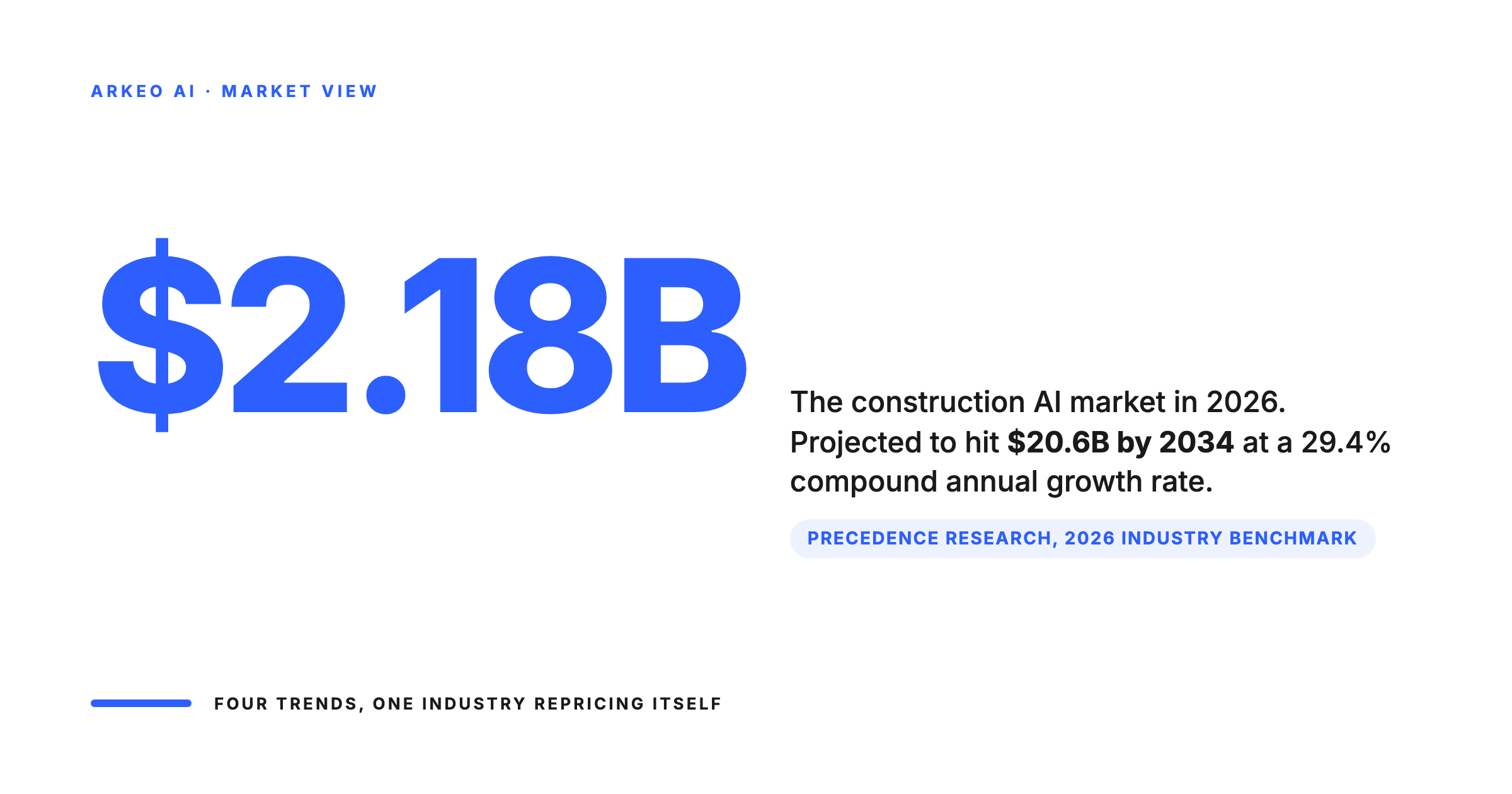
The AI in construction market is worth $2.18 billion in 2026 and growing at 29.4% annually. But the headline number disguises what actually matters for firms making deployment decisions today: where is the money going, what is working, and which trends will separate the firms that gain an edge from the ones that buy software nobody uses. The AI construction market in 2026 is defined by four trends: the shift from pilot projects to production deployments, computer vision moving from surveillance to operational intelligence, the rise of private AI infrastructure, and the emergence of AI-powered construction finance.
For the full picture of how AI is being used across the industry today, see our complete guide to AI in construction.
⚡ Quick Answer
- Market size: $2.18B in 2026, projected $20.6B by 2034 (Precedence Research). 29.4% CAGR.
- Adoption: 38% of contractors report measurable AI impact in 2026, up from 17% in 2025 (ServiceTitan).
- Key shift: From pilot experiments to production workflows. The 10% that scaled AI into core operations (McKinsey) are pulling away from the rest.
- Watch: Private AI infrastructure, agentic AI for multi-step construction workflows, and AI-powered construction finance are the three trends with the most near-term business impact.
- Next step: Book a free AI Assessment to find out where AI fits in your operation.
Trend 1: From Pilot to Production
The AI hype cycle in construction peaked around 2024. In 2026, the conversation has shifted from "what can AI do?" to "what is AI actually doing in production?"
ServiceTitan's 2026 report documented the inflection: contractor AI adoption doubled from 17% to 38% in a single year. But the critical detail is that 24% of firms now use AI for cost estimation and 22% for bid management. These are not experiments. These are production workflows where the output directly affects revenue.
The gap between early adopters and the rest is widening. Bluebeam's research found that 89% of early AI adopters report measurable profitability gains, and 94% plan to increase usage. Meanwhile, 45% of firms have no AI at all. The industry is splitting into two groups: firms where AI is becoming standard operating procedure and firms where it is still a conversation topic.
For mid-market contractors (50-500 employees), the window to gain a competitive advantage through AI adoption is narrowing. Once AI-powered estimating and scheduling become table stakes, the advantage shifts from "having AI" to "having better AI" and "having your own AI infrastructure."
Contractor production AI more than doubled in twelve months
The 2025 read was that AI in construction was mostly a pilot story. The 2026 read is that production estimating and bid workflows have crossed into the mainstream.
of contractors reported AI in production workflows. Most of the rest were running stalled pilots.
deploy AI in production. Estimating, scheduling, safety, document processing — daily workflows, not experiments.
Trend 2: Computer Vision Beyond Surveillance
Computer vision was the first AI technology to gain traction on construction sites, primarily for safety monitoring (PPE detection, hazard identification). In 2026, the applications have expanded well beyond surveillance.
Vinci Construction is using AI to analyse progress photos across 25 projects, saving 5,200 work-hours by automating schedule-vs-actual comparisons. Bechtel deploys AI across its 18,000-person craft workforce for PPE compliance. Fyld's video analysis platform reported 82% year-over-year growth, with customers including Kiewit.
The emerging applications are more strategic. AI analyses drone survey data to calculate earthwork volumes, tracks equipment utilisation across sites, monitors concrete curing conditions, and even reads architectural drawings for automated takeoffs. The common thread: computer vision is moving from "watch for problems" to "generate operational intelligence."
For firms evaluating AI investments, computer vision has the clearest ROI path because it works with data you are already collecting (photos, videos, drone footage). The incremental cost is the AI analysis layer, not new data capture infrastructure.
Trend 3: The Rise of Private AI Infrastructure
This is the trend with the largest near-term business impact for mid-market construction firms, and it is the one getting the least mainstream attention.
As AI moves from occasional experiments to daily production workflows, two problems become acute. First, per-use cloud costs scale linearly with usage. A firm processing 100 drawing sets per month through cloud AI estimating tools is paying thousands in API fees that a private deployment would eliminate. Second, data exposure risk compounds with volume. Every drawing, every bid, every schedule that flows through a cloud AI tool is data you do not control.
Gartner found that 69% of organisations suspect employees use prohibited AI tools with company data. For construction firms handling bid data, client specifications, and competitive pricing, this is not just an IT policy problem. It is a business risk that grows with every project.
Private AI deployment addresses both problems. Hardware investment of $79,000-335,000 breaks even against cloud in as little as 4 months and eliminates data exposure. The AI learns from your projects, your market, and your pricing patterns, and that intelligence stays yours permanently.
The construction firms that build proprietary AI infrastructure in 2026-2027 will have a compounding advantage by 2028: AI systems trained on hundreds of their own projects, producing estimates and predictions that no cloud tool can match because the cloud tool does not have access to their data.
Want to Understand How Private AI Applies to Your Firm?
Book a free 30-minute AI Assessment. We will evaluate your current AI usage, estimate the cost savings of private deployment, and map a practical timeline.
Private AI compounds. Cloud tools do not.
A cloud AI tool gives every subscriber the same generic capability. A private system trained on your projects gets better with every job. Year three is where the gap stops being matchable.
Foundation
First workflow deployed, baseline measured, system learns from real bids and real projects.
Patterns
Estimating, scheduling, and safety models now recognize your specific risks, suppliers, and cost basis.
Competitive moat
No cloud tool can match your win rate or risk model because no cloud tool has access to your data.
Trend 4: AI-Powered Construction Finance
Cash flow prediction and financial intelligence are the sleeper AI applications in construction. The industry has historically managed cash flow reactively: monthly reconciliations, quarterly reviews, and the sinking feeling when receivables slip and payables do not.
AI changes this by forecasting cash flow position based on schedule progress, invoicing patterns, historical payment behaviour, and contract milestones. The system predicts where cash crunches will occur weeks in advance, giving the finance team time to negotiate payment terms, draw on credit facilities, or accelerate invoicing before the squeeze hits.
For multi-project firms, AI aggregates financial intelligence across the portfolio: which project types are most profitable, where margin erosion patterns exist, which clients pay late, and how seasonal cycles affect cash position. This is the kind of intelligence that has historically lived in the CFO's intuition. AI makes it systematic and data-driven.
What These Trends Mean for Your Firm
The construction firms that will lead their markets in 2028-2030 are making three decisions right now:
They are moving from experiment to standard operating procedure. If AI is still a "project" in your firm, it is time to make it a workflow. Pick the highest-value application (estimating is the most common starting point) and commit to production deployment.
They are building proprietary AI infrastructure. The firms running AI on their own hardware are building a compounding intelligence advantage that cloud-only competitors cannot match. The investment window is now, while early-mover advantage still exists.
They are treating AI as a strategic capability, not a technology purchase. 72% of CEOs now own the AI decision (BCG 2026). The firms where AI delivers results have senior leadership driving the initiative with clear business outcomes, not IT running experiments with unclear mandates.
Where Does Your Firm Stand?
Arkeo works with mid-market construction firms to deploy AI that stays on their infrastructure and compounds with every project. Book a free assessment to find out where you are, where you should be, and how to close the gap.