Category
Custom AI Agents for Business: The Definitive Guide
Last updated: June 2026
If you run a $10M to $200M company and your team is already pasting confidential data into a public chatbot to clear backlog, the question on your desk is no longer whether to do something about agentic AI, it is which agent to build first and how to keep the data inside the building while you build it. Buy the wrong tool and you fund a 12-month integration that delivers a slide deck, a pilot, and a board meeting that asks why headcount went up. Build the right one and the first workflow returns capacity inside a quarter without adding a seat. This guide is the definitive operator view of custom AI agents for business: what an agent actually is, where it earns its keep across five core lanes, the four reasons agent projects die before they reach production, and the build-versus-buy call laid out in dollars and weeks. It is the hub for the rest of the cluster, so the deep dives on building, securing, and scaling agents sit one click away.
Adoption is no longer the question. The Stanford HAI 2025 AI Index found that 78% of organizations used AI in 2024, up from 55% the year before (Stanford HAI, 2025), and PwC's 2025 AI Agent Survey of 308 US executives reported that 79% have already adopted AI agents and 88% plan to increase agent budgets in the next 12 months (PwC, 2025). Arkeo writes this from inside that wave: founded in 2023 by an operator with 25 years running real businesses, and three years deploying custom AI agents on its own operations before recommending one to a client. We use what we sell, and we run it on private, on-premise infrastructure so client data never leaves the building.
Quick Answer
• What it is: A custom AI agent reads your data, decides what to do, takes action across your systems, and stops for human approval where it carries risk.
• Not a chatbot: Chatbots answer. Agents execute. Agents work across CRM, ERP, and inbox without a person copying and pasting between them.
• Cost: A scoped single-workflow custom agent costs about $15,000 to $40,000 to build (8 to 12 weeks if private or on-premise). Off-the-shelf copilots run about $20 to $30 per user per month.
• Where to start: One high-volume workflow with a named owner, accessible data, clear approval rules, and a known dollar return. Map it before you build it.
• Next step: The free AI Assessment turns the framework in this guide into a concrete first-build plan for your business.
What Is a Custom AI Agent for Business?
A custom AI agent is software that reads information from your systems, decides what to do with it, takes action, and pauses for human approval at the points that carry risk. Stated in operator terms rather than model terms: it pulls a record from your CRM, reads the inbound email, checks the account history, drafts the qualified response, updates the record, and stops short of anything that requires a human signature. It handles variable input, makes a decision inside guardrails, and works across more than one system. That last part separates an agent from the tools you already pay for.
The shorthand most operators carry into the conversation is that AI agents are smarter chatbots. They are not. A chatbot answers a question and waits for the next one. A rules-based automation follows a fixed script and breaks the moment an input arrives in a format it does not expect. A custom AI agent is the only one of the three that handles a message it has never seen before, decides what the situation calls for, and acts across the systems where the work actually lives.
Chatbot or custom AI agent?
A single user asks a question, reads a written answer, and decides what to do next. Public copilots and FAQ deflectors live here. Live in days. Cost: roughly $20 to $30 per user per month.
The workflow spans multiple systems, requires judgment on variable input, and earns back a build budget. Cost: about $15,000 to $40,000 to build (8 to 12 weeks if private). Returns capacity, not just suggestions.
The reason this distinction matters operationally: a chatbot cannot close your follow-up gap, and a rules-based automation breaks every time an email arrives in a format it did not expect. The agent is the layer that copes with the mess of real business, which is also why it carries real risk and needs the checkpoints designed in from day one.
Where Do AI Agents Actually Help a Business?
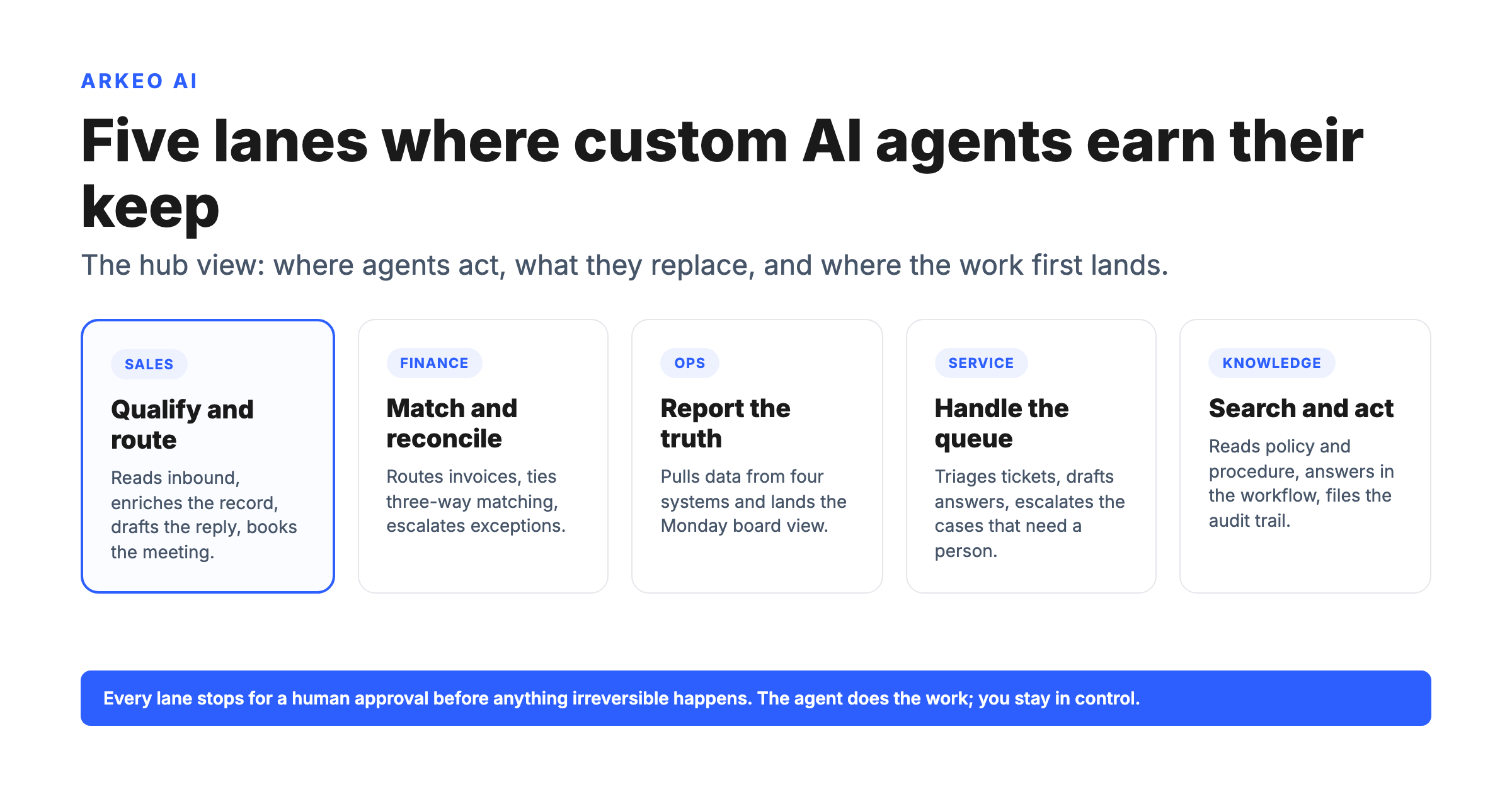
Agents earn their keep in workflows that are high-volume, judgment-light at the routine level, and currently eating hours from people who should be doing higher-value work. Five lanes map directly to how mid-market operations actually run. The hero diagram above lays out the five; the cards below put a one-line value prop under each so you can spot the highest-ROI lane for your operation.
THE FIVE LANES
Where custom AI agents earn their keep
Each lane is a workflow where the agent reads, decides, acts, and stops for human approval.
01
Sales and qualification
An agent watches inbound leads, enriches each one against the CRM and public data, scores it against your qualification rules, drafts the first reply, and books the meeting or routes it to a rep.
02
Email and admin triage
A shared inbox is a swamp of requests, scheduling, and noise. The agent classifies each message, drafts responses to the routine ones, files the rest, and surfaces what needs a human.
03
Finance workflows
Invoice intake, three-way matching, expense flagging, and reconciliation prep are structured enough for an agent to handle the first pass and route exceptions to a controller.
04
Operations reporting
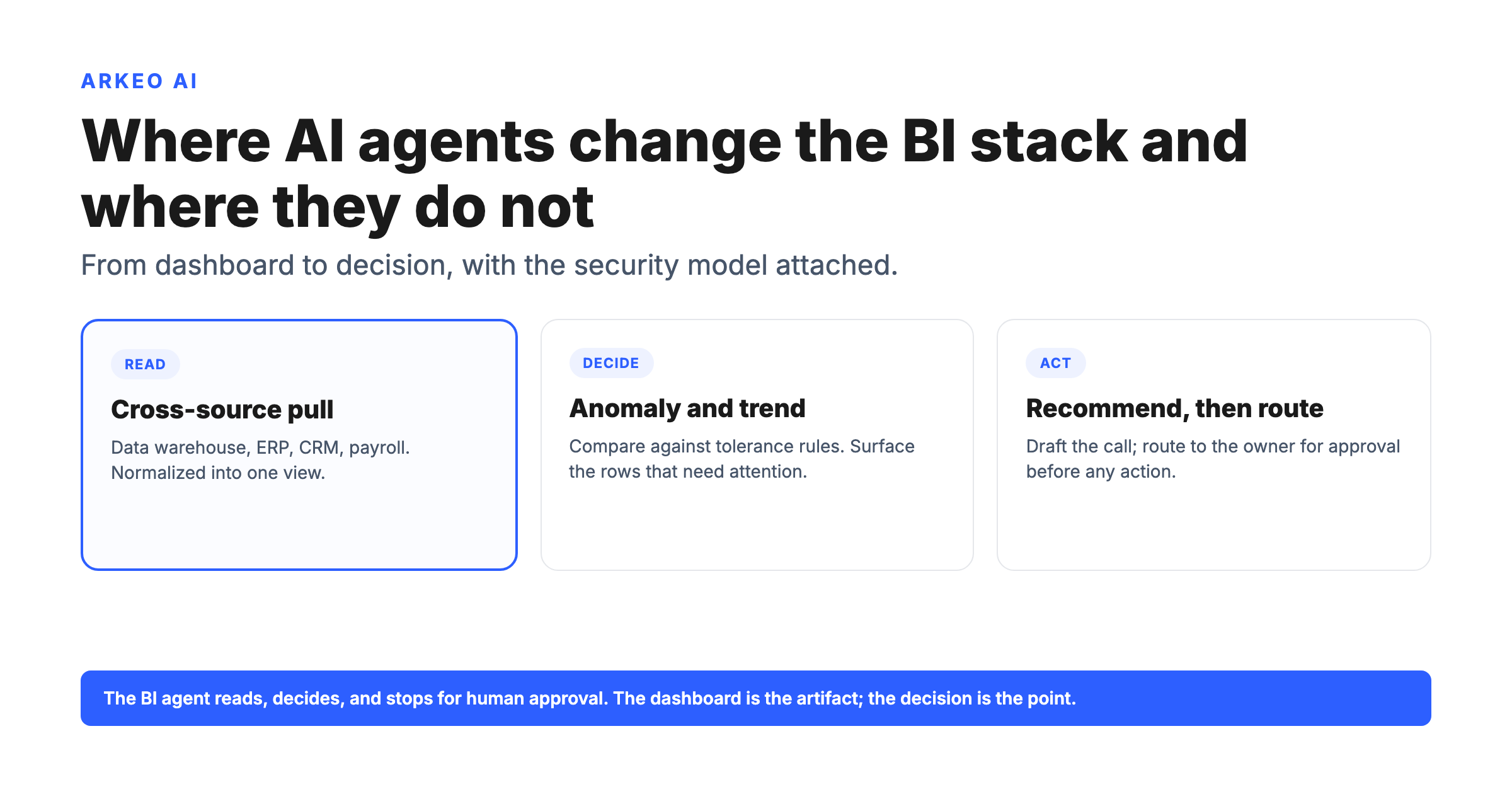
Instead of a person stitching numbers from four systems into a Monday deck, the agent pulls the data, builds the report, and flags the anomalies for review.
05
Knowledge work and policy lookup
Procedures, SOPs, contracts, and audit evidence get read, answered against, and filed by the agent. Compliance and onboarding stop being a person hunt for the right PDF.
Pick the lane with the largest dollar bleed, the cleanest data, and a named owner. That is the first agent. The rest follow.
of organizations have deployed AI agents at scale; only 14% in production at all. The gap is not the technology, it is operational readiness.
That two-percent figure is the line every mid-market operator should stare at. The technology is not the constraint. The constraint is whether the workflow has an owner, the systems talk, the approval logic exists, and someone can state the dollar return in plain English. Posts in this cluster on choosing the best AI agents for business and deploying autonomous AI agents for business drill into each lane and the decision criteria behind it.
Architect your first agent on your workflows, not someone else'sThe free AI Assessment maps your data, systems, and workflows, then names the first agent worth building and the dollar return behind it.
Book Your Free AI Assessment →
Why Do Most AI Agent Projects Stall Before Production?
Here is the part the vendor brochure leaves out: AI agents break, regularly, and almost none of the breakage is the model's fault. It is the surrounding business that was not ready. The pattern is consistent enough that the same four causes show up across mid-market deployments, and every one of them is fixable before a line of code is written.
FAILURE MODES
Four reasons mid-market agent projects stall
Each is a decision made up front, not a discovery made nine months in.
01
No workflow owner
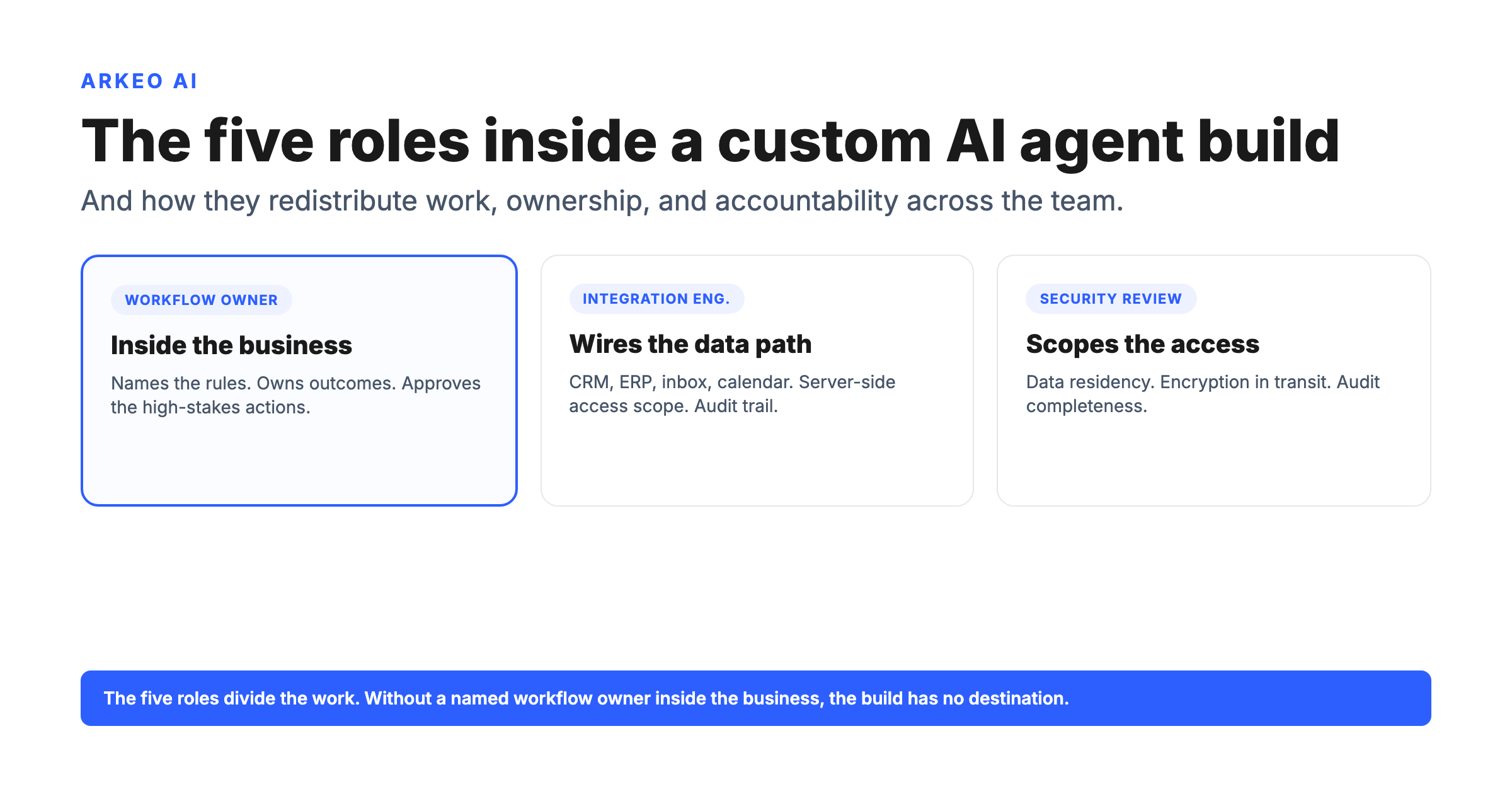
Pilots demoed by IT and orphaned at handoff. Nobody owns the process the agent is supposed to automate, so nobody can tell the agent what good looks like, and it drifts.
02
No system access
An agent that cannot read the CRM or write to the ERP is a chatbot with extra steps. Integration work is where the value is and where the security questions live.
03
No approval logic
Skip the checkpoints and the agent takes confident, wrong actions at speed. That is the failure mode that destroyed trust in two-thirds of the pilots tracked by Deloitte.
04
No ROI model
If nobody can state which hours the agent gives back or which revenue it protects, the pilot quietly dies. ROI clarity is the difference between renewal and replacement.
A custom agent project that names its owner, its data path, its approval gates, and its ROI before kickoff lands in production. The rest cycle into the next budget.
The model is the easy part. The hard part is whether the business was ready to run an agent.
Capgemini's research is blunt about what happens when the four ingredients are missing. Trust in fully autonomous agents fell from 43% to 27% in a single year, because companies rushed deployment and got burned on actions taken without checkpoints (Capgemini, 2025). The Deloitte 2025 TMT Predictions match the pattern: two-thirds of large enterprises piloting agentic AI reported the pilots produced limited measurable value, with rollout pace constrained by integration and governance rather than model capability (Deloitte, 2025).
How Do You Decide Whether to Build or Buy an AI Agent?
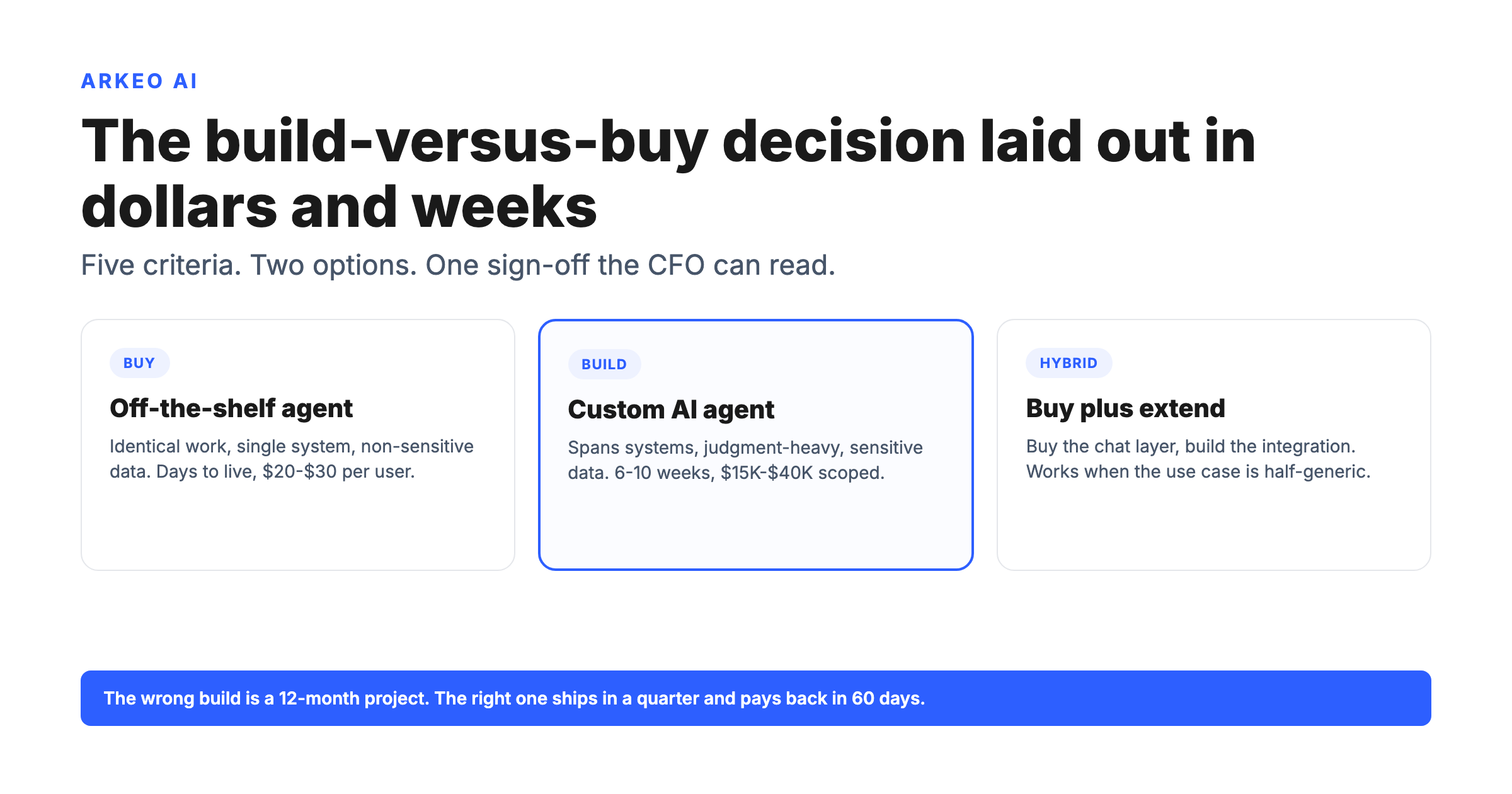
The build-versus-buy call gets answered honestly with two questions: does the workflow live inside a single system, and does the data ever need to leave the building? Off-the-shelf copilots cover the cases where the workflow is identical every time and lives inside one suite. Custom agents are warranted when the work spans systems, demands judgment on variable input, and touches data you cannot send to a public cloud.
In Arkeo's builds, the cost of a scoped single-workflow custom agent runs about $15,000 to $40,000 depending on integration complexity. Production timeline is 6 to 10 weeks in standard cloud and 8 to 12 weeks when the deployment is private or on-premise. Off-the-shelf copilots run about $20 to $30 per user per month and go live in days. The first quick win in either direction typically lands inside 30 to 90 days.
A high-volume workflow with a named owner, accessible data via API or warehouse, clear approval rules, and a known dollar return. Build a scoped custom agent this quarter. Posts on building custom AI agents walk the implementation.
The work is writing, summarization, or single-system productivity. Start with an off-the-shelf copilot. Move to a custom build when the workflow grows beyond one system or the data is sensitive.
Data lives in spreadsheets and people's heads, systems do not talk to each other, or leadership wants agents everywhere without one workflow to start. Get a readiness map first; the build will be wasted otherwise.
For larger organizations and regulated industries, the integration, access-control, and governance demands push the conversation toward enterprise AI agents that fit existing security and audit requirements rather than work around them. Arkeo's posture there is plain: the agent stack runs on private or on-premise infrastructure so customer records, financials, and proprietary processes never leave your control. That is the difference between an agent the security team approves and a pilot that gets killed at review.
What Does an Operator-Grade Agent Rollout Actually Look Like?
The mistake is trying to boil the ocean. The discipline is sequencing. The path below works because it pays for itself before the expensive part begins, and it borrows from how mid-market operations are actually run, not how AI labs publish slide decks.
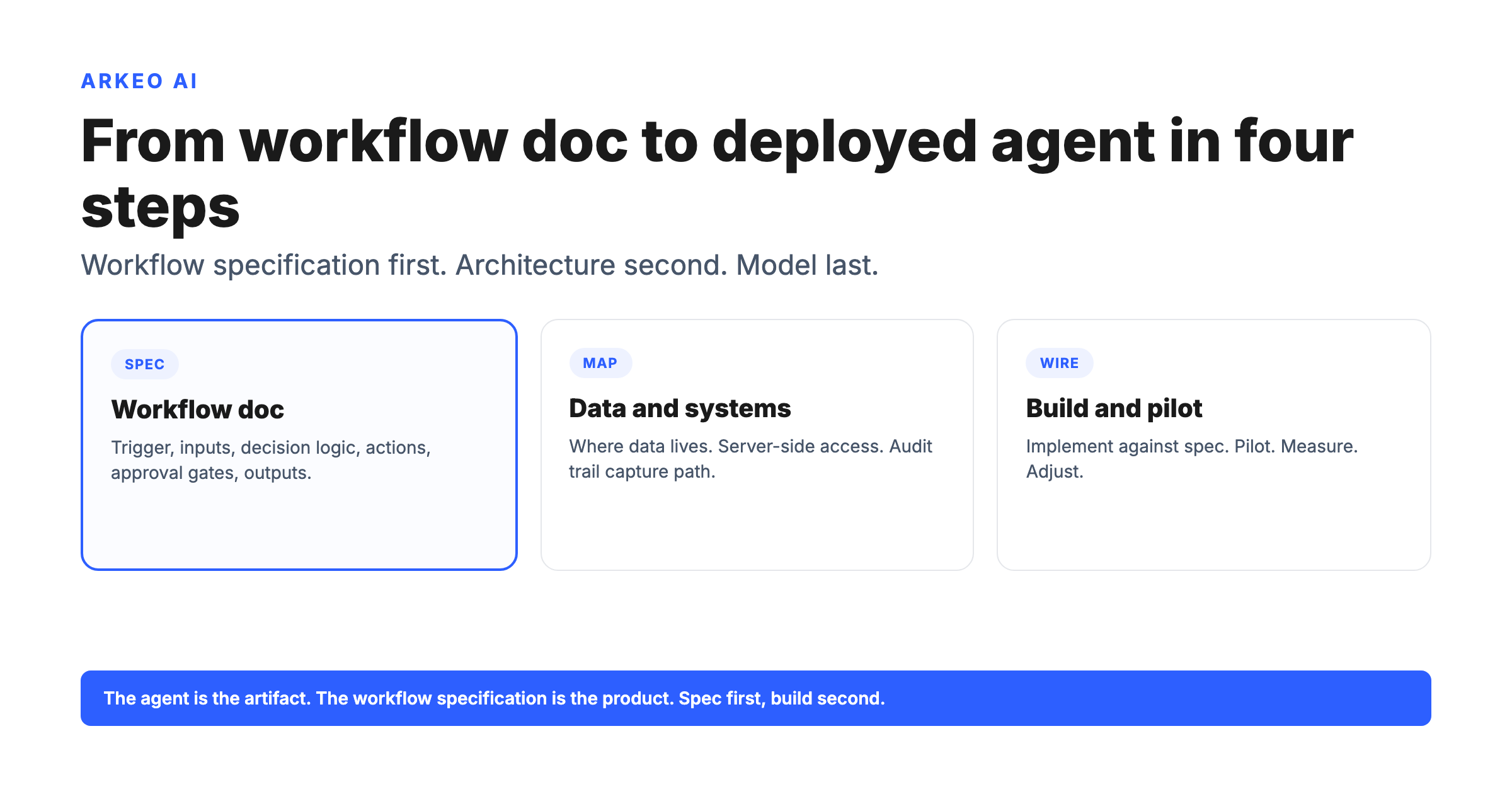
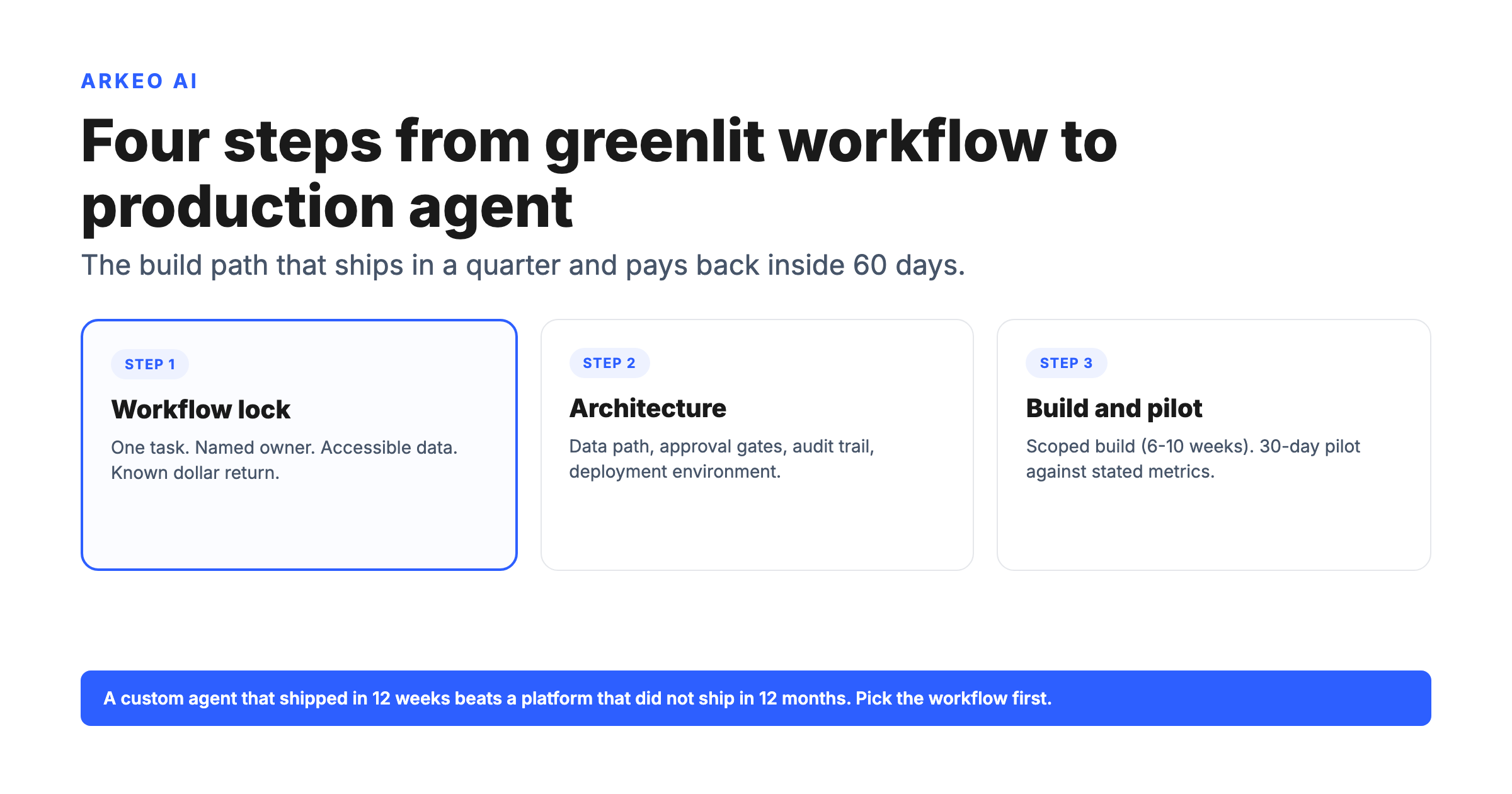
Current State. Map the bottlenecks and the data. Where do hours go, what systems hold the truth, where does work pile up waiting on a person, where does sensitive data sit. 30-to-90-Day Easy Wins. Turn on prompts and off-the-shelf tools that need no custom build. These land in 30 to 90 days and start returning hours immediately, which is what funds the rest. Mid-Term Agent Opportunities. Pick the top three workflows where the ROI is provable, build them with named owners and approval gates, and measure the hours returned. The first custom agent is typically in production within 60 to 90 days of a green-lit workflow. Long-Term Architecture. Move toward a private AI operating system: a coordinated set of agents working inside your own environment, on your stack, with your data, over a 12-month horizon.
Not sure which sub-topic to start with? The free AI Assessment looks at the five lanes against your workflows and names the right entry point.
That last stage is where the Arkeo posture matters. The same agent stack runs Arkeo's own operations before it is ever recommended to a client. We use what we sell, and we run it on private infrastructure so the data never leaves the building. For companies in regulated industries or handling sensitive IP, that private deployment model is the difference between an agent you can trust with the real data and one you can only demo with fake data. The deep dive lives in the post on custom AI agents for business operations.
How Big Is the Upside If You Get the First Agent Right?
The honest summary: AI agents are real, the value is real, and the gap between using AI and getting value from it is also real. Capgemini estimates that by 2028, agentic AI could generate up to $450 billion in economic value across surveyed markets (Capgemini, 2025). PwC found 88% of executives plan to increase AI budgets in the next 12 months because of agentic AI. Deloitte projects 25% of enterprises using generative AI will deploy agents in 2025, rising to 50% by 2027. The budget is coming. The question is whether it lands on a planned sequence of agents with owners and ROI, or on another pilot that demos well and dies.
Boston Consulting Group has reported in prose-only research that the productivity gap between top adopters and the rest is widening fastest in workflows where the agent owns the integration layer rather than the chat layer. The pattern matches what mid-market operators report on the ground: the wins land in companies that picked one workflow, named an owner, locked the data path, and shipped the first agent in under a quarter. The companies still exploring at the 12-month mark are almost always stuck on workflow ownership and data access, not on the model.
Name your first agent before the next budget cycleThe free AI Assessment turns this guide into a concrete first-build plan: the workflow, the data path, the approval logic, and the ROI behind each candidate.
Book Your Free AI Assessment →