Category
The Ultimate Guide to Building Custom AI Agents
Last updated: June 2026
If you run a $10M to $200M company and your team is moving from off-the-shelf copilots to a first custom AI agent build, the question is no longer whether to build, it is how to ship the first one inside a quarter without funding a 12-month custom-software project. Treat the build like an enterprise platform deployment and you spend $100,000 over a year on a system that demos well and never reaches production. Treat it like a scoped product engagement and the first agent ships in 6 to 10 weeks and pays back inside 60 days. This guide is the operator view of building custom AI agents: the four-step build path, the architecture decisions that decide whether the agent reaches production, the ownership map for who builds and who deploys, and the rollout that does not collapse on integration.
Arkeo has been deploying custom AI agents on its own operations since 2023, on 25 years of running mid-market businesses, and on a private, on-premise stack so client data never leaves the building. Stated as fact: we use what we sell. The Stanford HAI 2025 AI Index reported 78% of organizations used AI in 2024, up from 55% the year before (Stanford HAI, 2025).
Quick Answer
• What it is: Building a custom AI agent means commissioning software for one specific workflow: it reads your data, decides what to do, takes action across your systems, and stops for human approval.
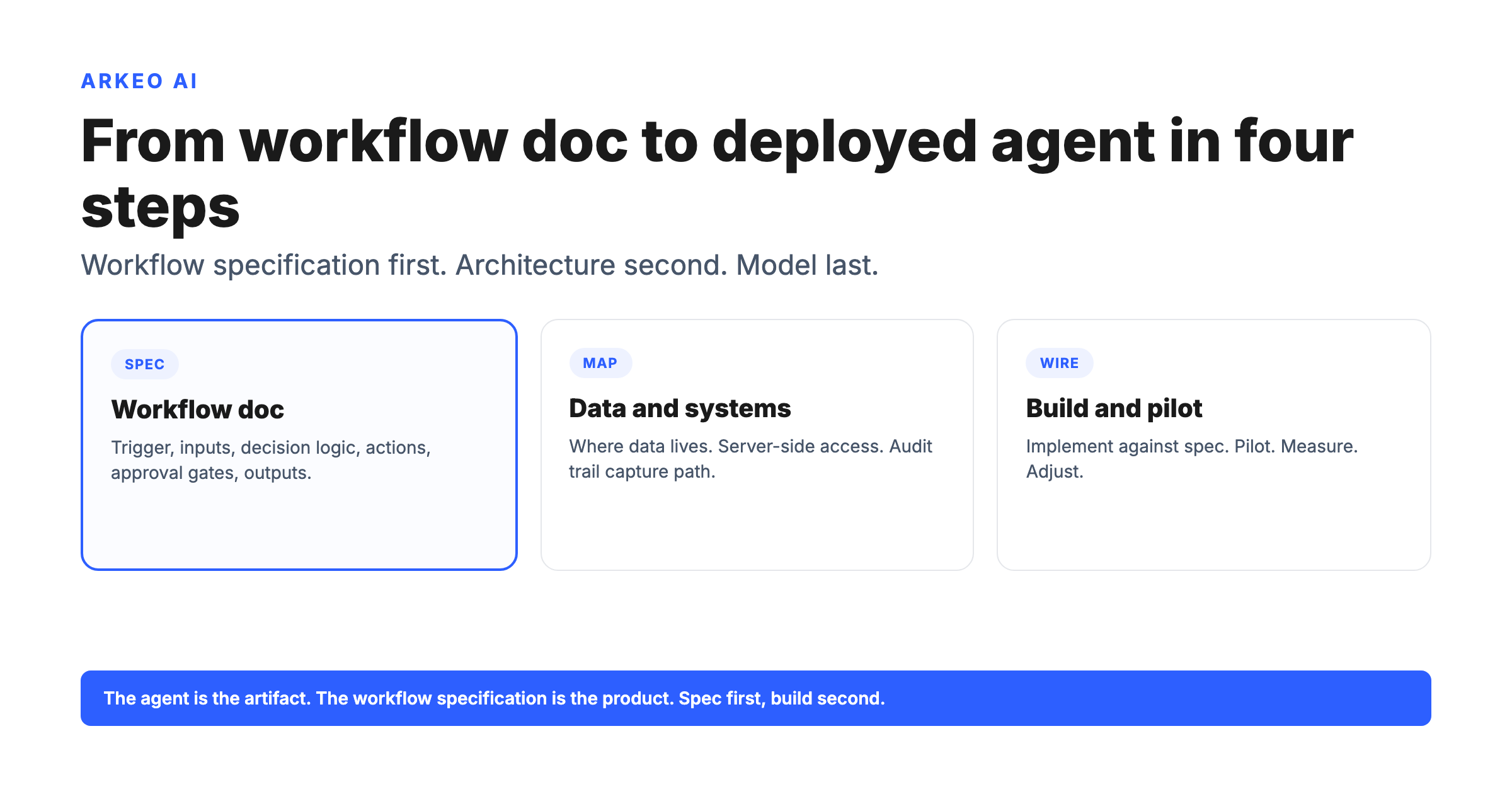
• Build path: Four steps: workflow lock, architecture, build-and-pilot, manage. Ships in 6 to 10 weeks (8 to 12 weeks for private).
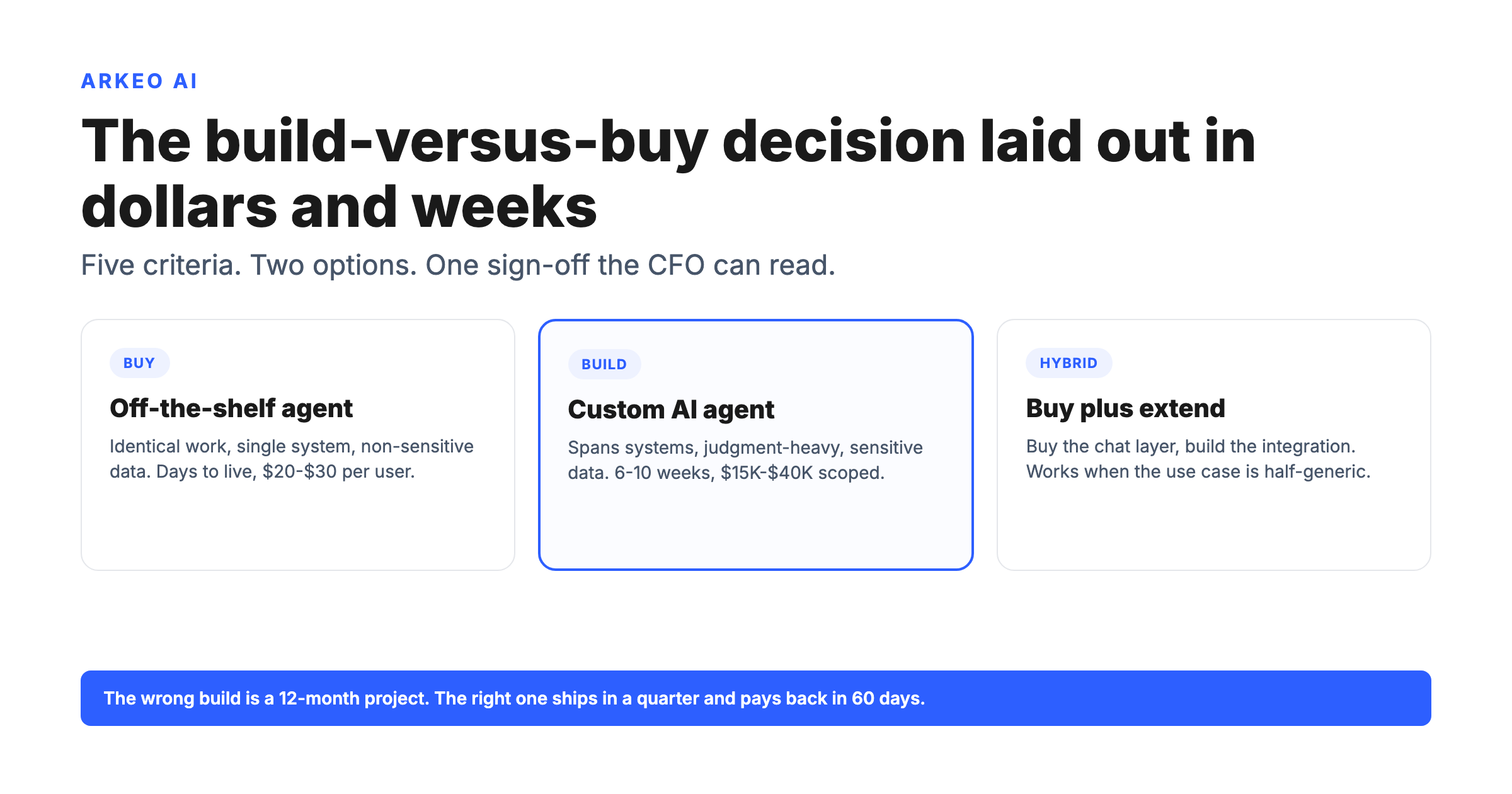
• Cost: A scoped single-workflow build costs about $15,000 to $40,000. Autonomous builds are $25,000 to $60,000 because of the guardrail and audit work.
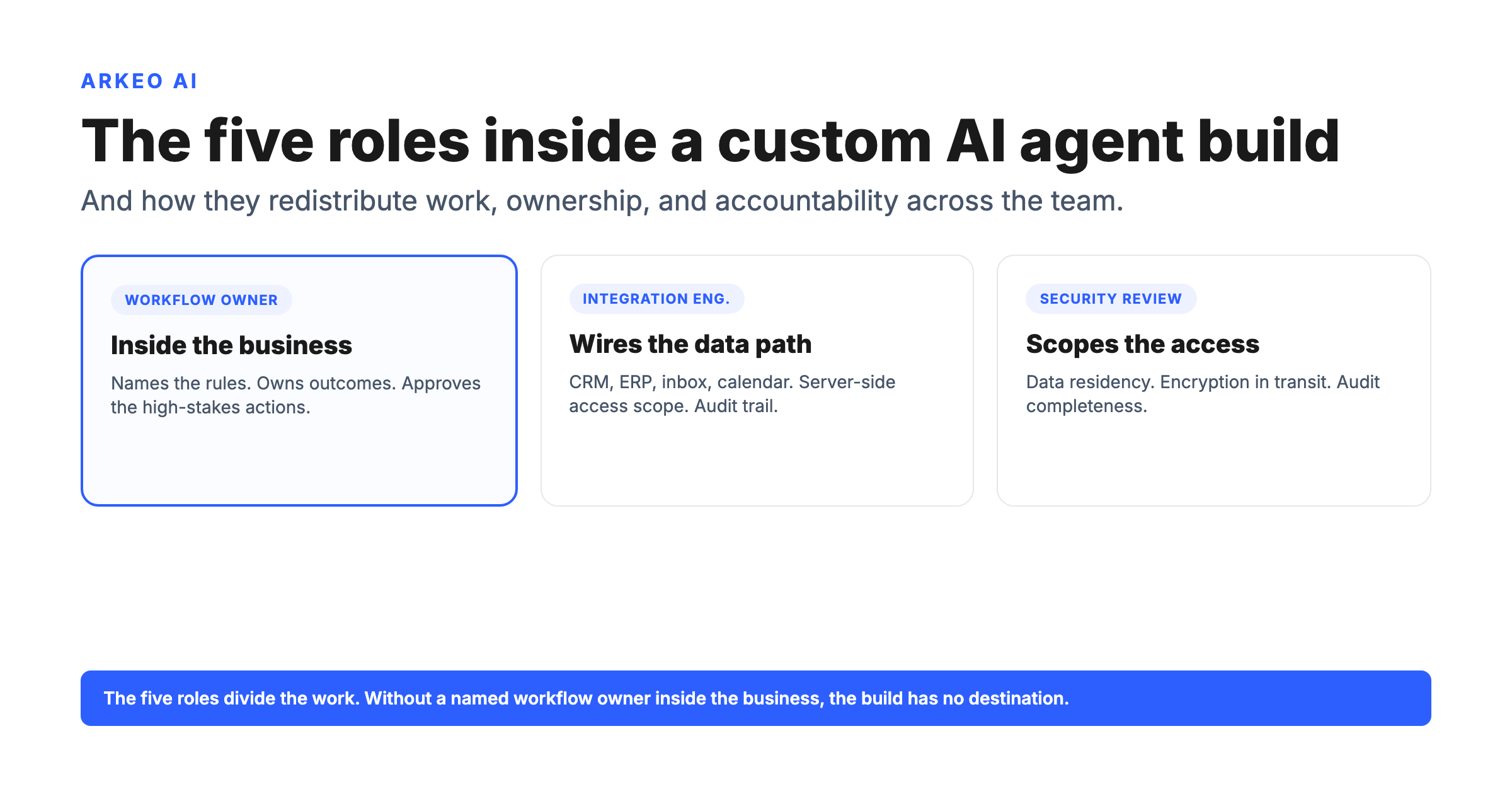
• Who builds: Workflow owner inside the business names the rules. Integration engineer wires the data path. Security reviewer scopes access. Partner runs Assess, Deploy, Manage.
• Next step: The free AI Assessment turns this framework into your first agent build plan.
What Does Building a Custom AI Agent Actually Mean?
Building a custom AI agent means commissioning software that runs one specific workflow inside your business: it reads from your systems, applies your decision rules, takes action across the systems where the work lives, and stops for human approval at the points that carry risk. The word custom means the integration depth, the approval logic, and often the deployment environment are specific to your operation, not shared across a vendor's installed base. PwC found 79% of organizations have already adopted AI agents and 88% plan to increase agent budgets in the next 12 months (PwC, 2025); the budget is moving toward custom builds for workflows that off-the-shelf tools cannot reach.
THE BUILD PATH
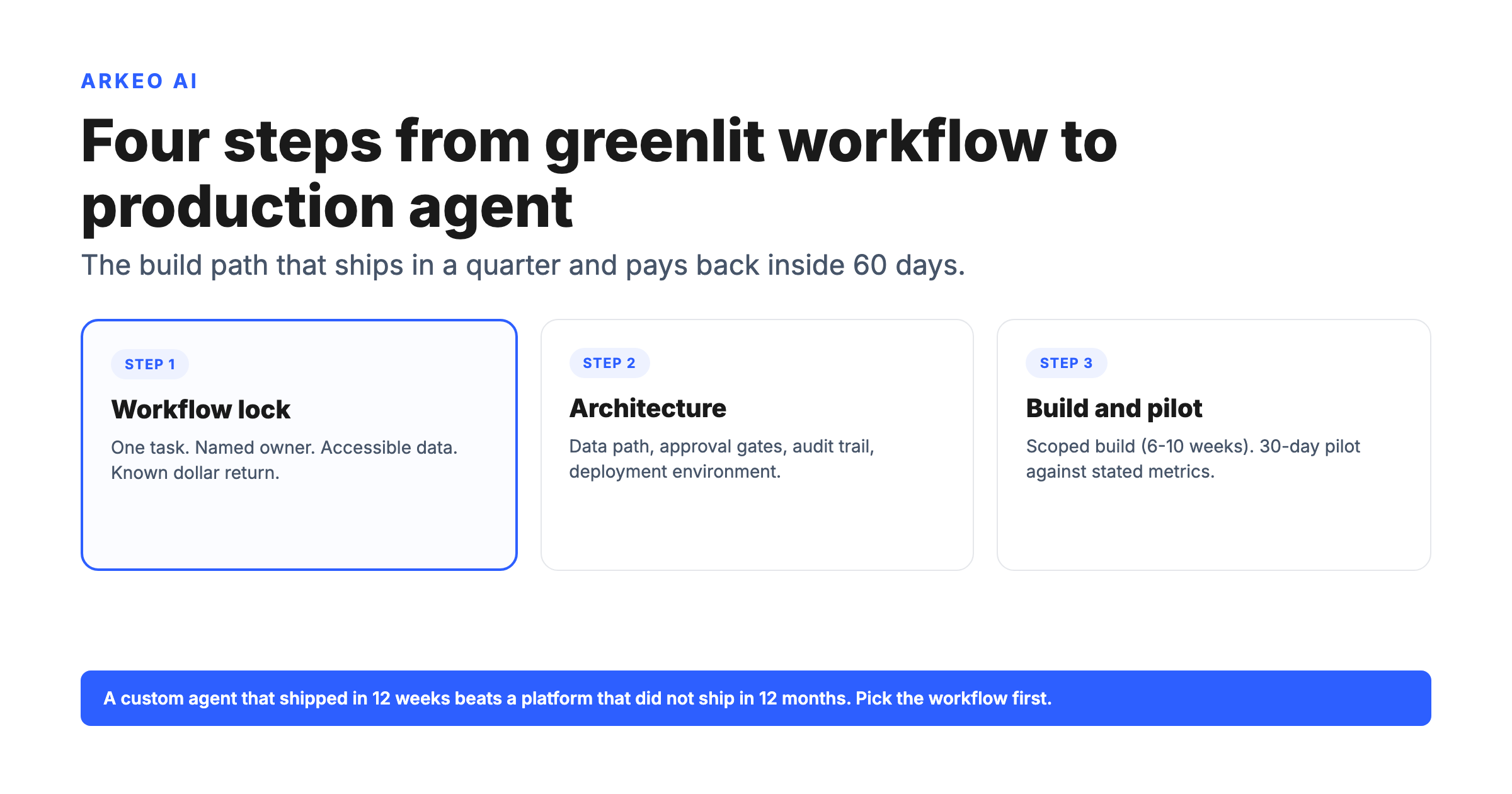
Four steps from greenlit workflow to production agent
Each step is a decision made before the next begins.
01
Workflow lock
One task. Named workflow owner inside the business. Accessible source data. Clear approval rules. Known dollar return per recovered hour. If any one is missing, build readiness before code.
02
Architecture
Four sub-decisions, all named before code:
• Data path scope , which database, which row-level filters, which fields the agent reads and writes.
• Approval gates , what triggers human review, who has authority, what is logged on every approval.
• Audit trail , what events get logged, retention window, who can query it.
• Deployment env , dev / pilot / production, who deploys, rollback procedure.
03
Build and pilot
Scoped build in 6 to 10 weeks (8 to 12 weeks for private). 30-day pilot against stated metrics: hours returned, response time, error rate, ROI. Two of three moving is the green light for broader rollout.
04
Manage
Model updates, data-drift monitoring, exception review, audit-trail maintenance. The agent is not a project that ends at launch; it is an ongoing operating system that needs the manage layer to stay reliable.
A custom AI agent project that names its workflow, its architecture, its pilot metrics, and its manage layer before kickoff ships in a quarter. Skip any one and it lands in pilot purgatory.
Build your first custom agent on a workflow that pays backThe free AI Assessment runs this four-step path against your business and names the first agent build, the architecture behind it, and the pilot metrics.
Book Your Free AI Assessment →
Want a walk-through against your own workflow? The free AI Assessment runs this framework on your data.
Who Is Responsible for Building and Deploying Custom AI Agents?
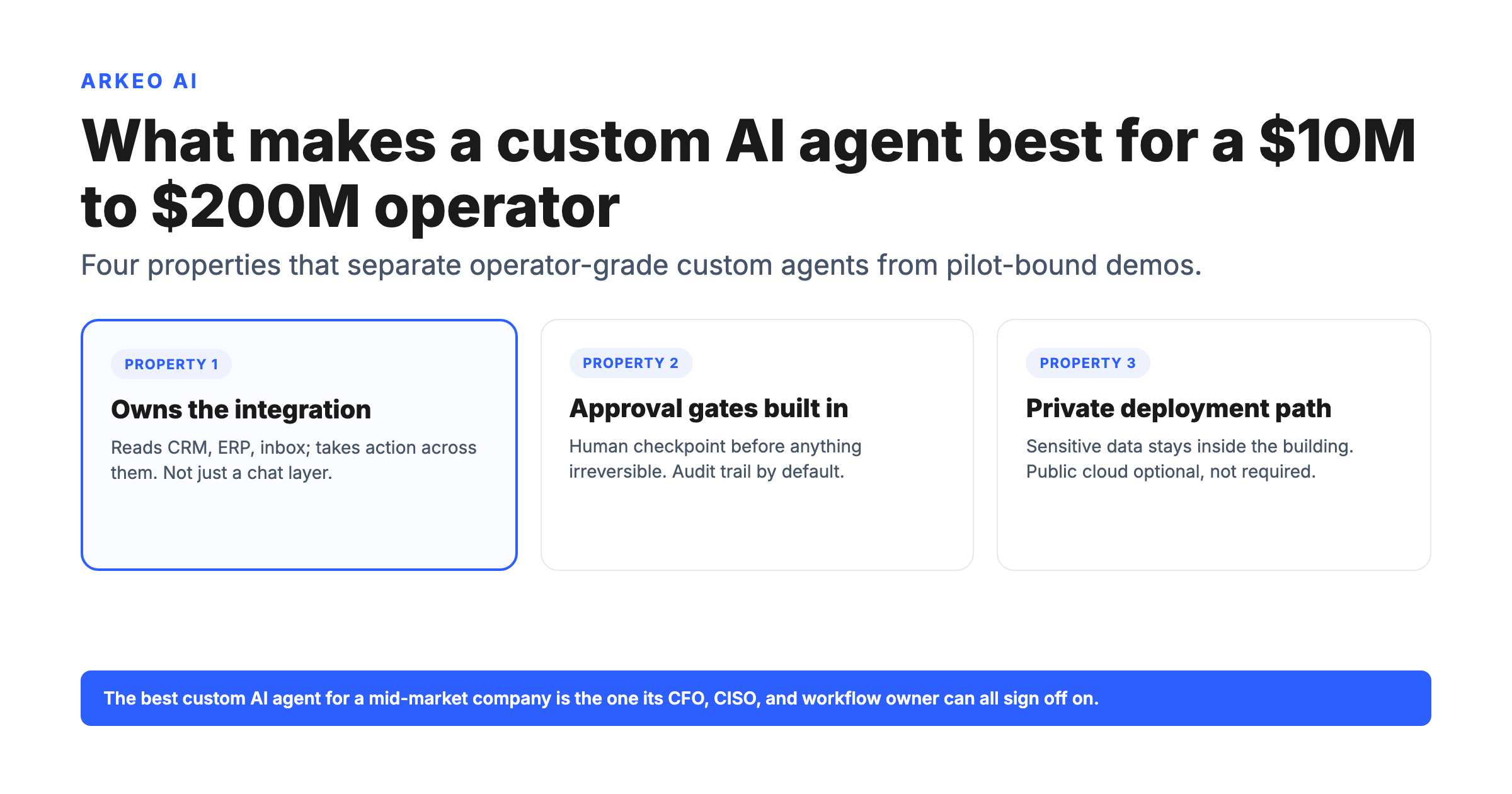
The ownership map decides whether the build reaches production. Capgemini reports only 14% of organizations have any AI agent in production at all (Capgemini, 2025); the recurring failure is no named owner of the workflow the agent is supposed to automate.
Five roles get a custom agent to production: workflow owner, integration engineer, security reviewer, operator validator, and build partner. Each one carries a specific deliverable across the four steps. The deeper team handoff and accountability pattern lives in making custom AI agents , read that next if you are staffing the build.
Build the agent in-house or with a partner?
A senior engineering leader can give 50% of their time for a quarter, the team has prior agent-architecture experience, and the workflow is the company's competitive logic. Cost: roughly $50,000 to $150,000 of internal time. Timeline: 12 to 20 weeks for the first build.
The workflow is named but the team has not built an agent before, the deployment needs private or on-premise, or the time-to-value matters more than the in-house IP. Cost: $15,000 to $40,000 scoped. Timeline: 6 to 10 weeks. Partner runs Assess, Deploy, Manage.
estimated agentic AI economic value across surveyed markets by 2028. The builds that ship in a quarter capture more of it than the ones still piloting.
A custom agent that shipped in 12 weeks beats a platform that did not ship in 12 months. Pick the workflow first.
Where Do Custom AI Agent Builds Fail in Mid-Market Companies?
Architecture-layer failures decide whether the build reaches production. The four sub-decisions inside step 2 , data path scope, approval gates, audit trail, deployment environment , either land before code or unravel during pilot. The state of those four decisions sorts every build into one of three buckets.
Data path scope is named (which database, which row-level filters, which fields). Approval gates are codified before code. Audit trail is complete from day one. Deployment environment is decided at greenlight.
Data path is unclear (which DB? which row scope?). Approval gates are not codified. Audit trail is a bolt-on planned after the build. Deployment environment is decided late. Pilot stalls until each gap is closed.
Agent reaches pilot without a documented data path. No approval gates exist. No audit trail is in place. The agent is deployed where it should not be. Stop, lock the architecture, restart against it.
For the broader operator view, the cluster pillar on ai agents for business covers the five lanes and the build-versus-buy math. The post on best custom AI agents for mid-market drills into the partner selection criteria.
Ship your first custom agent inside a quarterThe free AI Assessment names the first workflow, the architecture, the pilot metrics, and the ownership map.
Book Your Free AI Assessment →