Category
The Best Custom AI Agents for Mid-Market Companies
Last updated: June 2026
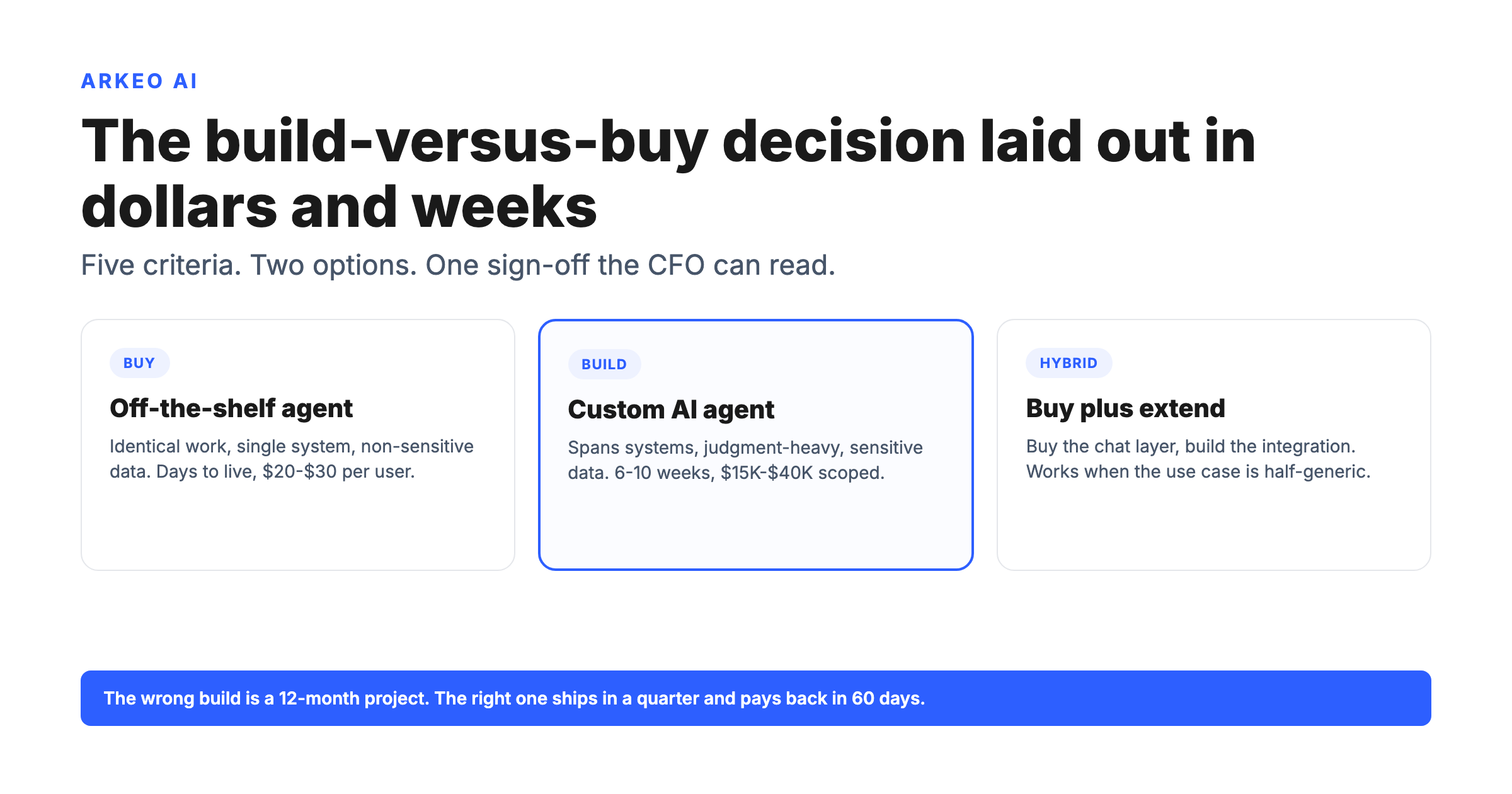
If you run a $10M to $200M business and your team is evaluating custom AI agents instead of off-the-shelf copilots, the question is no longer whether to build, it is which custom agent counts as best for an operator who needs to keep data inside the building and ROI on the next budget cycle. Pick the wrong custom build and you fund a 12-month custom-software project for a workflow that turns out to be wrong. Pick the right one and the agent ships in a quarter and pays back inside 60 days. This guide is the mid-market view of the best custom AI agents: the four properties that separate operator-grade custom agents from pilot-bound demos, the four lanes where custom wins over off-the-shelf, and the build-versus-buy math.
Arkeo runs custom AI agents on its own operations before recommending them: 25 years of operating experience, three years deploying agents on a private, on-premise stack, founded in 2023. The same agent stack runs the business that builds yours. Capgemini reports that only 2% of organizations have deployed agents at scale and 14% have any agent in production (Capgemini, 2025); the gap is operational readiness, not the technology.
Quick Answer
• What it is: A custom AI agent is software you commission to read your data, decide what to do, take action across your systems, and stop for human approval. It is built for your workflow, not someone else's.
• Why custom: Off-the-shelf agents fit identical-every-time work in one system. Custom agents fit workflows that span systems, require judgment on variable input, or touch sensitive data.
• Cost: A scoped single-workflow custom agent costs about $15,000 to $40,000 to build (6 to 10 weeks; 8 to 12 weeks for private).
• Best for: Mid-market operators ($10M to $200M revenue) with a high-volume workflow, a named owner, accessible data, and a known dollar return per recovered hour.
• Next step: The free AI Assessment names the custom agent worth building first.
What Are Custom AI Agents and Why Do Mid-Market Operators Care?
Custom AI agents are software built for one company's specific workflow that read its data, decide what to do, take action across its systems, and stop for human approval at the points that carry risk. The word custom carries weight: it means the integration depth, the approval logic, and often the deployment environment are specific to one operator, not shared across a vendor's installed base. PwC found 79% of organizations have already adopted AI agents and 88% plan to increase agent budgets in the next 12 months (PwC, 2025), and Deloitte projects 25% of enterprises using generative AI will deploy AI agents in 2025, rising to 50% by 2027 (Deloitte, 2025). The mid-market budget is moving toward custom; the question is which custom build deserves it.
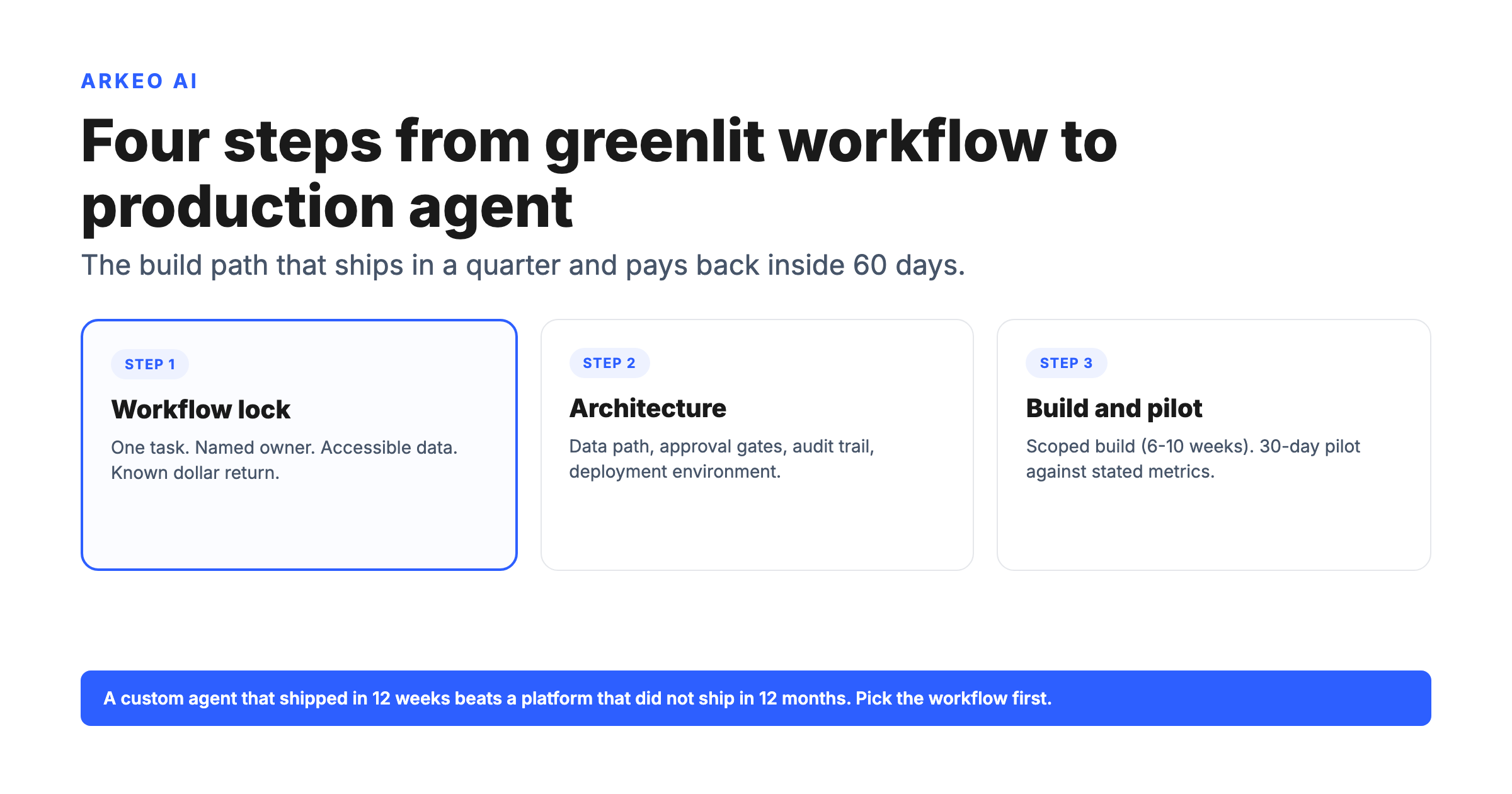
The pattern that wins: pick the workflow with the largest dollar bleed, the cleanest data, and a named owner. Build a scoped custom agent on that workflow. Ship inside a quarter. Use the ROI from the first build to fund the second. The pattern that fails: greenlight a 12-month custom platform with no specific workflow attached. Custom platforms without workflows are slide decks.
OPERATOR-GRADE PROPERTIES
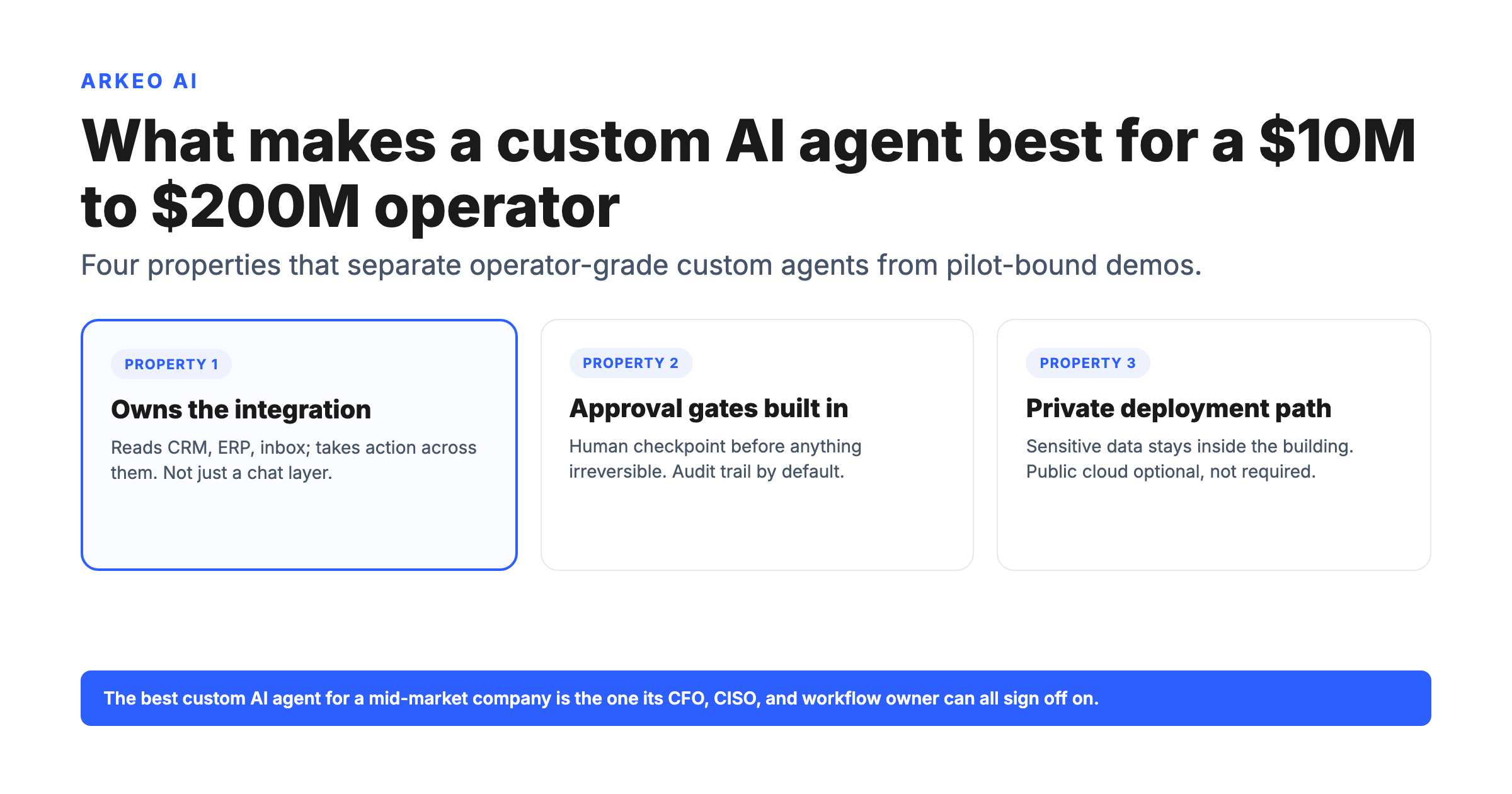
Four properties that make a custom AI agent best for the mid-market
If any one is missing, the agent is a demo that stalls at integration or governance.
01
Owns the integration, not just the chat
Reads and writes the CRM, ERP, inbox, and whatever workflow tool holds the work. A custom agent that only chats is a chatbot in a custom wrapper. The integration is where the value is.
02
Approval gates and audit trail by default
Human checkpoint before anything irreversible. Every action logged with reason and source. The agent is only as good as how it stops; the audit trail is what makes it auditable next year.
03
Private deployment path available
Sensitive data stays inside the building when the workflow demands it. Public cloud is fine for non-sensitive work, but the option for private or on-premise deployment is non-negotiable for regulated industries and proprietary processes.
04
Exit path written into the contract
If the partner who built the agent disappears, can you take the trained logic, the data flows, and the deployment with you? Custom builds with no exit are hostage contracts. Operator-grade builds publish the exit path.
A custom AI agent that fails any one of these is a pilot dressed up as a build. The four properties decide whether it reaches production.
Architect the right custom agent on your own workflowsThe free AI Assessment maps your workflows, your data, and your governance, then names the custom agent worth building first.
Book Your Free AI Assessment →
Want to talk about this against your specific situation? The free AI Assessment is a 30-minute working session, not a sales call.
Where Do Custom AI Agents Beat Off-the-Shelf for the Mid-Market?
The right question is not which custom agent ranks best. It is which workflows justify the custom build at all. Four mid-market lanes consistently pay back the custom-build investment, and a fifth lane increasingly does as well.
LANE 01
Sales and qualification across CRM and inbox
The custom agent reads the inbound, enriches against the CRM, scores against the ICP, drafts the reply with context, books the meeting. Off-the-shelf copilots stop at "draft an email"; custom owns the prep-and-pipeline-hygiene path.
LANE 02
Finance reconciliation across ERP and source documents
Three-way invoice matching, expense flagging, vendor verification. Off-the-shelf tools handle one source; custom handles the spread across ERP, document management, and bank feeds with the company's own GL rules.
LANE 03
Operations reporting across four-plus systems
Pull data from ERP, CRM, payroll, and the operations spreadsheet, normalize it, build the Monday board view. No off-the-shelf agent reads the company's specific spreadsheet definition without custom configuration.
LANE 04
Regulated knowledge work with private data
Contract review, policy lookup, audit prep, compliance evidence. Off-the-shelf tools require sending sensitive content to public cloud; custom agents run private or on-premise with full audit trail.
of organizations have deployed AI agents at scale; the gap is operational readiness, not technology.
The mid-market pattern is consistent: the lanes where custom wins are the ones where the workflow already has an owner, the data already exists in the company's systems, and the dollar return per recovered hour is calculable. The lanes where off-the-shelf wins are the ones where one user, one app, and one task close the loop without crossing the company's integration boundary. The pillar on ai agents for business covers the build-versus-buy decision at the cluster level; the post on custom AI agents solutions (build vs buy) drills into the trade-offs.
Custom platforms without workflows are slide decks. Operator-grade custom agents have a workflow named before kickoff.
How Do You Vet a Partner Who Builds Custom AI Agents?
The vendor demo always works. The integration is where the truth surfaces. Capgemini's only 14% of organizations have any AI agent in production at all (Capgemini, 2025) is mostly about partners who could not get the agent past integration and governance. Three questions vet the partner before the contract.
The partner runs custom agents on their own operations, deploys to private or on-premise environments, publishes an exit path, and names the workflow owner inside the client business as a condition of kickoff.
The partner has a track record but only on public-cloud deployments, or only with specific platforms. Workable for non-sensitive workflows; constrained for regulated or proprietary work.
The partner ships only chat layers, cannot show a private deployment reference, refuses to write an exit path, or treats workflow ownership as the client's sole problem. That partner ships pilots, not production.
Pick the right custom AI agent build before the next cycleThe free AI Assessment names the custom agent worth building first, the partner conditions worth setting, and the ROI math behind the choice.
Book Your Free AI Assessment →