Category
Custom AI Agents Solutions: Build vs Buy
Last updated: June 2026
If you sit at a $10M to $200M company and the agentic AI conversation is now "build custom or buy off-the-shelf," the trap waiting on either side is large. Buy when you should have built and the agent cannot reach the workflow it was sold to fix; you pay annually for chat in a wrapper that never delivers the integration. Build when you should have bought and you fund a 12-month custom-software project for a workflow off-the-shelf would have automated in days. This guide gives you the five-criterion scorecard, the four lanes where build wins, the three lanes where buy wins, and the platform-by-platform reality on Oracle Fusion, Microsoft, Salesforce, and SAP.
Arkeo has spent three years deploying custom AI agents on a private, on-premise stack, founded in 2023 on 25 years of mid-market operating experience. We use what we sell. Deloitte's 2025 TMT Predictions projected that 25% of enterprises using generative AI will deploy AI agents in 2025, rising to 50% by 2027 (Deloitte, 2025).
Quick Answer
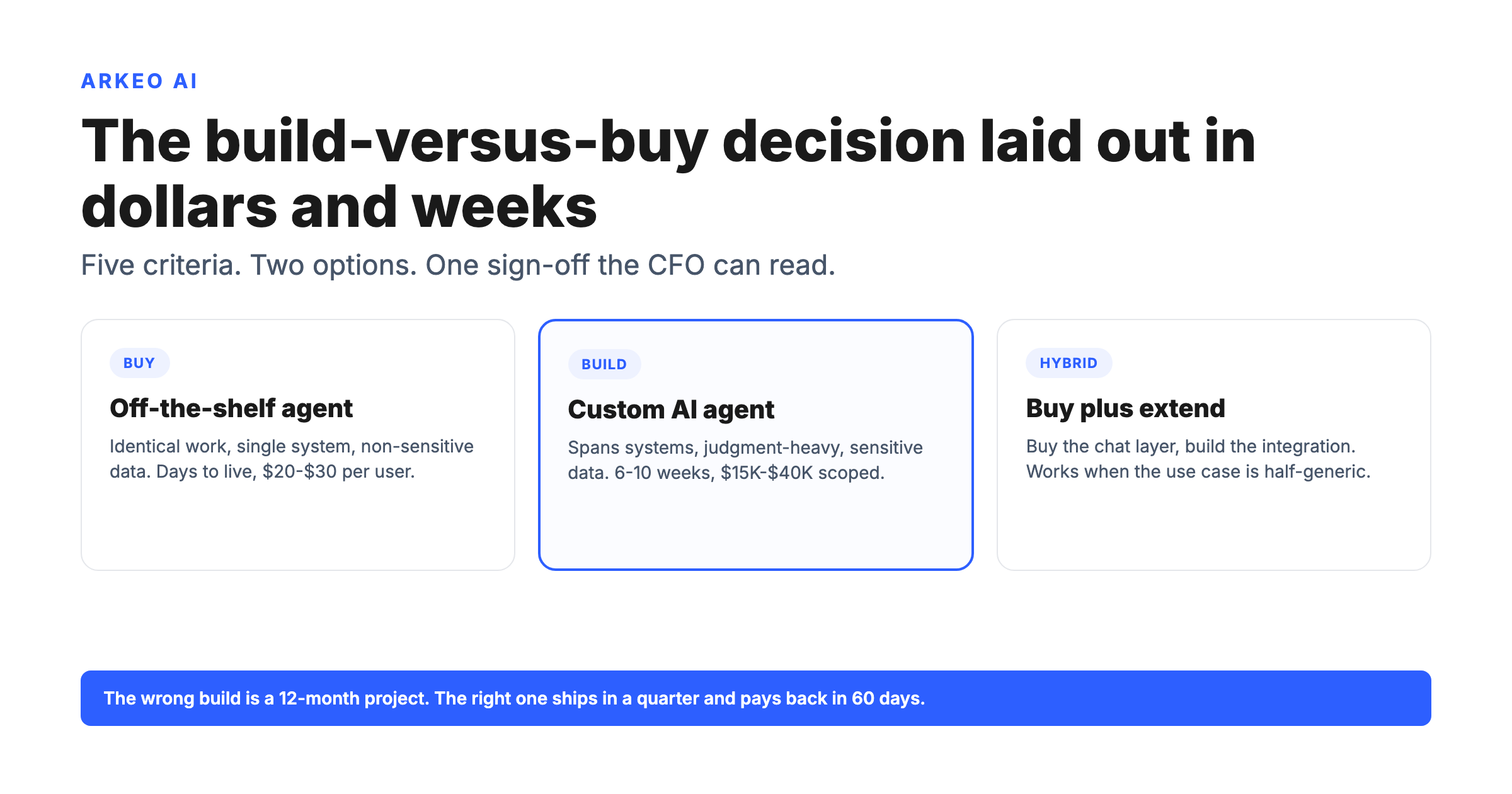
• What it is: Custom AI agents solutions are either off-the-shelf platforms you configure, custom builds you commission, or hybrid models where you buy the chat layer and build the integration.
• Buy when: The workflow is identical every time, lives in one system, and the data is not sensitive. Cost: about $20 to $30 per user per month. Live in days.
• Build when: The workflow spans systems, requires judgment on variable input, or touches sensitive data. Cost: $15,000 to $40,000 scoped (8 to 12 weeks if private).
• Hybrid when: The agent uses an off-the-shelf model and chat interface but needs custom logic on your CRM/ERP. The middle ground; check the integration depth carefully.
• Next step: The free AI Assessment runs this scorecard on your workflows.
What Are Custom AI Agents Solutions, and Why Does Build vs Buy Matter?
Custom AI agents solutions split into three categories: off-the-shelf platforms you configure for your data, custom builds you commission for one specific workflow, and hybrid models that combine a bought chat layer with a custom integration layer. The build-versus-buy decision is the largest cost lever in the agent rollout. Get it wrong on one workflow and you spend $50,000 to $150,000 over a year on the wrong category before the budget owner kills the project.
The Stanford HAI 2025 AI Index reports 78% of organizations used AI in 2024, up from 55% the year before (Stanford HAI, 2025), but Capgemini's data shows only 14% have any agent in production at all (Capgemini, 2025). The gap concentrates in companies that picked the wrong category for their workflow.
THE SCORECARD
Five criteria that decide build versus buy
Score each from your workflow. Three or more leaning one direction is the verdict.
CRITERION 01
Workflow specificity
Buy: Identical every time across companies. Build: Specific to your operation and your ICP/GL/SOP logic.
CRITERION 02
System span
Buy: Lives in one suite (Office, Salesforce, NetSuite). Build: Spans CRM, ERP, inbox, calendar, and the workflow tool.
CRITERION 03
Data sensitivity
Buy: Public cloud is acceptable; data residency is not material. Build: Sensitive enough to require private or on-premise deployment.
CRITERION 04
Approval logic depth
Buy: On/off per action is enough. Build: Per-record, per-field, per-amount approval rules that match how the business actually signs off.
CRITERION 05
Three-year run cost
Buy: Per-seat plus per-action stays under $25K/year. Build: Off-the-shelf at scale exceeds $40K/year, where custom build amortizes faster.
Three or more criteria leaning build is the verdict. Three or more leaning buy is the verdict. A 2-2 split is the hybrid case and needs an integration-depth sniff test before commitment.
Stuck between build and buy? Get the scorecard run on your workflowThe free AI Assessment runs this five-criterion scorecard against your data and names the right category for your first workflow.
Book Your Free AI Assessment →
Stuck between the two? The free AI Assessment picks the right path based on your stack and your data, not a vendor's incentive.
How Do Custom AI Agents Solutions Play Out on Each Platform?
Vendor reality varies by platform. The same workflow can be a buy on one platform and a build on another, depending on how deep the platform's native agent capability reaches and how much the company already paid for the platform itself.
ORACLE FUSION
Build, layered on platform services
Oracle Fusion exposes data and integration services that custom agents call into; the platform does not ship a generic agent for cross-Fusion workflows. The pattern: build the agent on top of Oracle's data access, layer the company's approval logic, and keep the audit trail inside Oracle's governance model.
MICROSOFT
Buy first, build the integration when off-the-shelf stalls
Microsoft Copilot Studio covers many single-workflow cases inside Microsoft 365. Build only kicks in when the workflow leaves Microsoft (third-party CRM, non-Microsoft ERP) or when the data residency requirement excludes public cloud.
SALESFORCE
Buy at the Agentforce layer, build when CRM data has to leave
Agentforce covers in-CRM workflows well. Build is the answer when the agent needs to act across Salesforce and a separate ERP, or when the company's ICP/qualification logic is its own competitive secret and should not live in a vendor's shared model.
SAP
Build on Joule integration, scoped to one process
SAP's Joule covers some agentic capability on top of SAP data. Cross-system workflows that touch SAP and a non-SAP system typically require a custom build for the integration logic and the approval gates.
What about the hybrid case? Buy the chat, build the integration?
The chat and reasoning layer is generic (so the off-the-shelf model handles it) but the integration to CRM/ERP/inbox is specific to the business. Cost: lower than full custom but higher than pure off-the-shelf. Watch the seat math at year three.
The off-the-shelf chat layer cannot expose the integration hooks the workflow needs, or the vendor lock-in clause makes the custom integration unportable. Then the project lands in pilot purgatory.
estimated agentic AI economic value by 2028 across surveyed markets. The build-versus-buy call decides which side captures it.
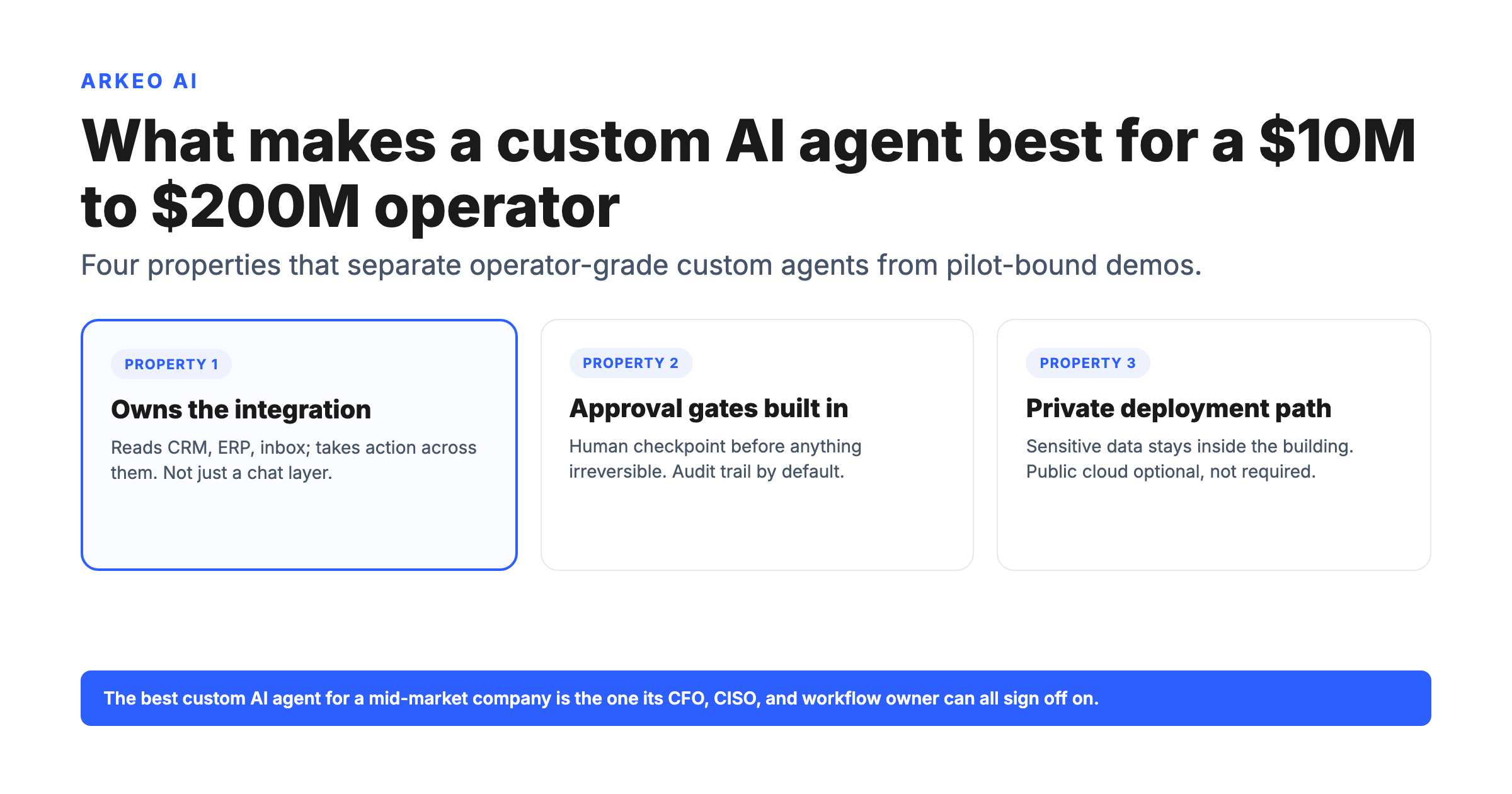
Buy what your business does the same as everyone else. Build what your business does differently than everyone else.
What Does an Honest Build-vs-Buy Process Look Like End to End?
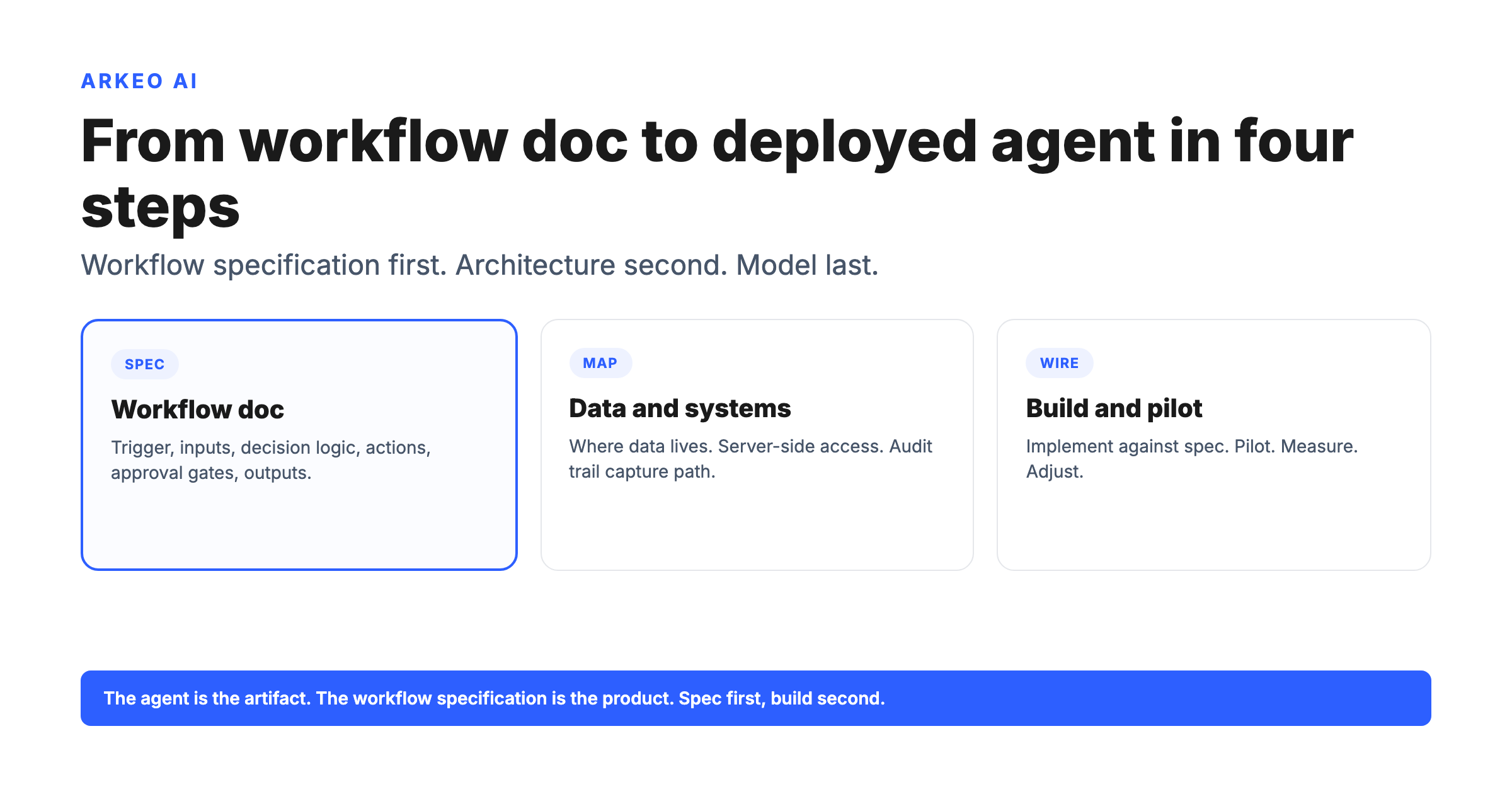
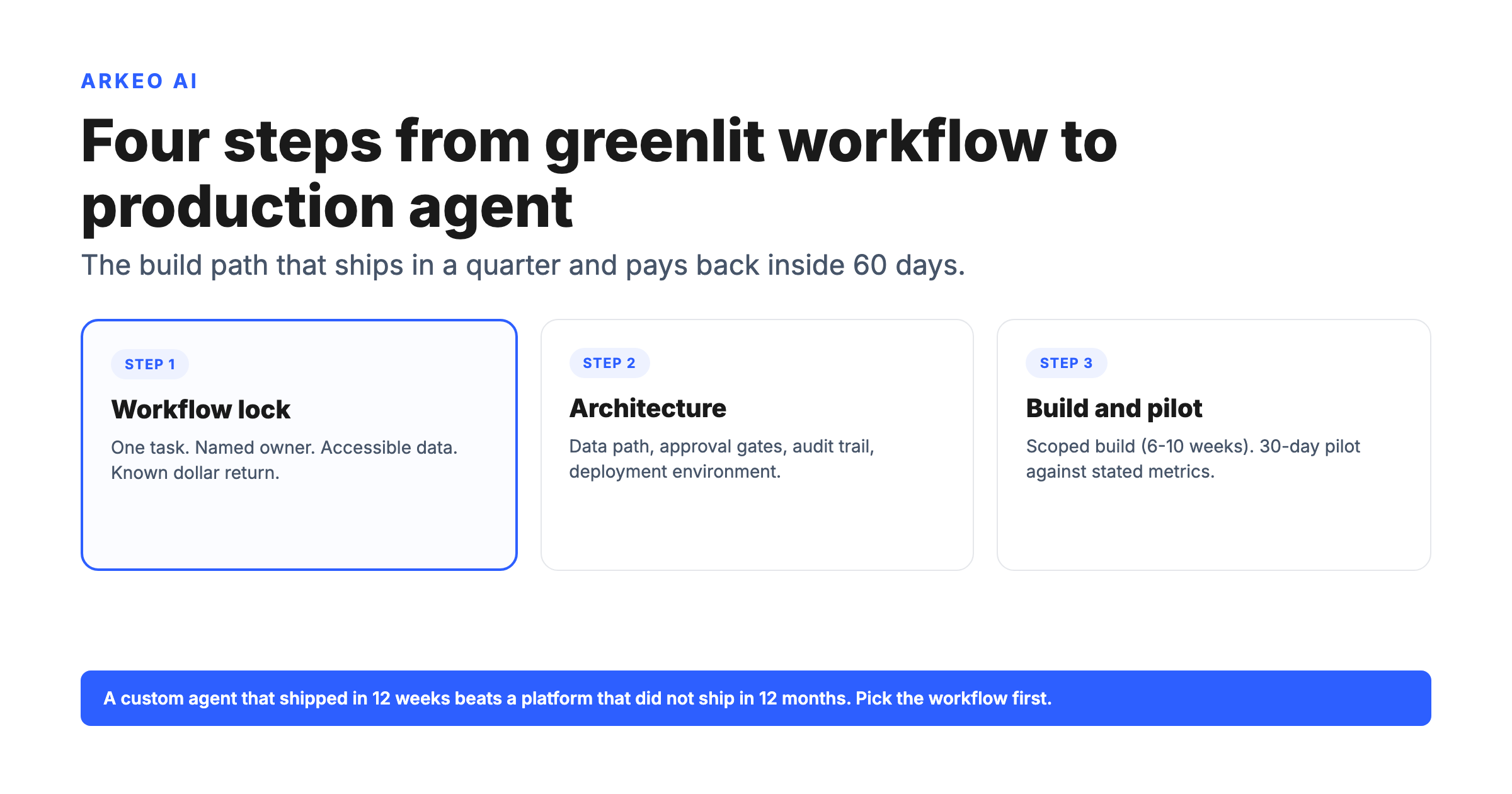
The process the Arkeo team runs is four steps. Step 1: Score the workflow against the five criteria. Three-plus leaning build is build, three-plus leaning buy is buy, 2-2 is hybrid. Step 2: Run a 30-day off-the-shelf trial. If buy or hybrid is the verdict, prove the off-the-shelf works on the actual workflow before signing the annual. Step 3: Scope a custom build against measured ROI. If build is the verdict, name the dollar return per recovered hour before any code. Step 4: Lock the deployment path early. Public cloud, private, or on-premise; that decision shapes vendor selection and partner choice.
The cluster pillar on ai agents for business covers the broader operator view, and the post on building custom AI agents walks the implementation path once build is the verdict.
Pick build, buy, or hybrid before the next budget cycleThe free AI Assessment scores your first workflow against the five criteria and names the right category, the dollar return, and the deployment path.
Book Your Free AI Assessment →