Category
Deploying Autonomous AI Agents for Business
Last updated: June 2026
If you run a mid-market business and the agentic AI conversation has moved from "should we try this" to "should it run autonomously," the trap waiting on both sides is large. Lock every action behind a human approval and you spend $40,000 on an agent that does not save the hours; the human becomes the bottleneck. Run the agent autonomously without the right guardrails and the first wrong action lands in a customer's inbox at 2 AM. This guide is the operator view of deploying autonomous AI agents for business: the three autonomy levels, the workflows where each level is right, the security model behind autonomous action, and the rollout pattern that does not collapse trust on the first incident.
Arkeo runs custom AI agents on its own operations before recommending them: 25 years of operating experience, three years deploying agents on a private, on-premise stack, founded in 2023. The same agent stack runs the business that builds yours. Capgemini reports that only 2% of organizations have deployed agents at scale and 14% have any agent in production (Capgemini, 2025); the gap is operational readiness, not the technology.
Quick Answer
• What it is: An autonomous AI agent runs end-to-end inside scoped guardrails, taking action across systems without per-step human approval. The autonomy is bounded by what the agent can do and what data it can touch.
• When autonomous fits: Workflows where the data is structured, the rules are unambiguous, the actions are reversible or low-stakes, and the audit trail is mandatory.
• When supervised fits: Workflows that span structured and ambiguous data, mix high-stakes and low-stakes actions, or touch a customer. Most mid-market starts here.
• Cost: An autonomous agent costs about $25,000 to $60,000 to build (8 to 12 weeks) due to the additional guardrail, monitoring, and audit work.
• Next step: The free AI Assessment names the right autonomy level for your first workflow.
What Does an Autonomous AI Agent for Business Actually Do?
An autonomous AI agent runs an entire workflow end to end inside scoped guardrails, taking action across systems without per-step human approval. Inside the guardrails it reads, decides, acts, logs every action, and surfaces only the exceptions for human review. Outside the guardrails it stops; the guardrails are how autonomy stays safe. The technology to run autonomously has been available for two years; the operational discipline to deploy it without losing trust is the constraint.
The Capgemini research is blunt: trust in fully autonomous agents fell from 43% to 27% in a single year, driven by deployments that skipped the guardrails (Capgemini, 2025). PwC found 79% of organizations have already adopted AI agents (PwC, 2025); the share running them autonomously is a small fraction of that, concentrated in companies with the operational discipline to do it right.
THE AUTONOMY LADDER
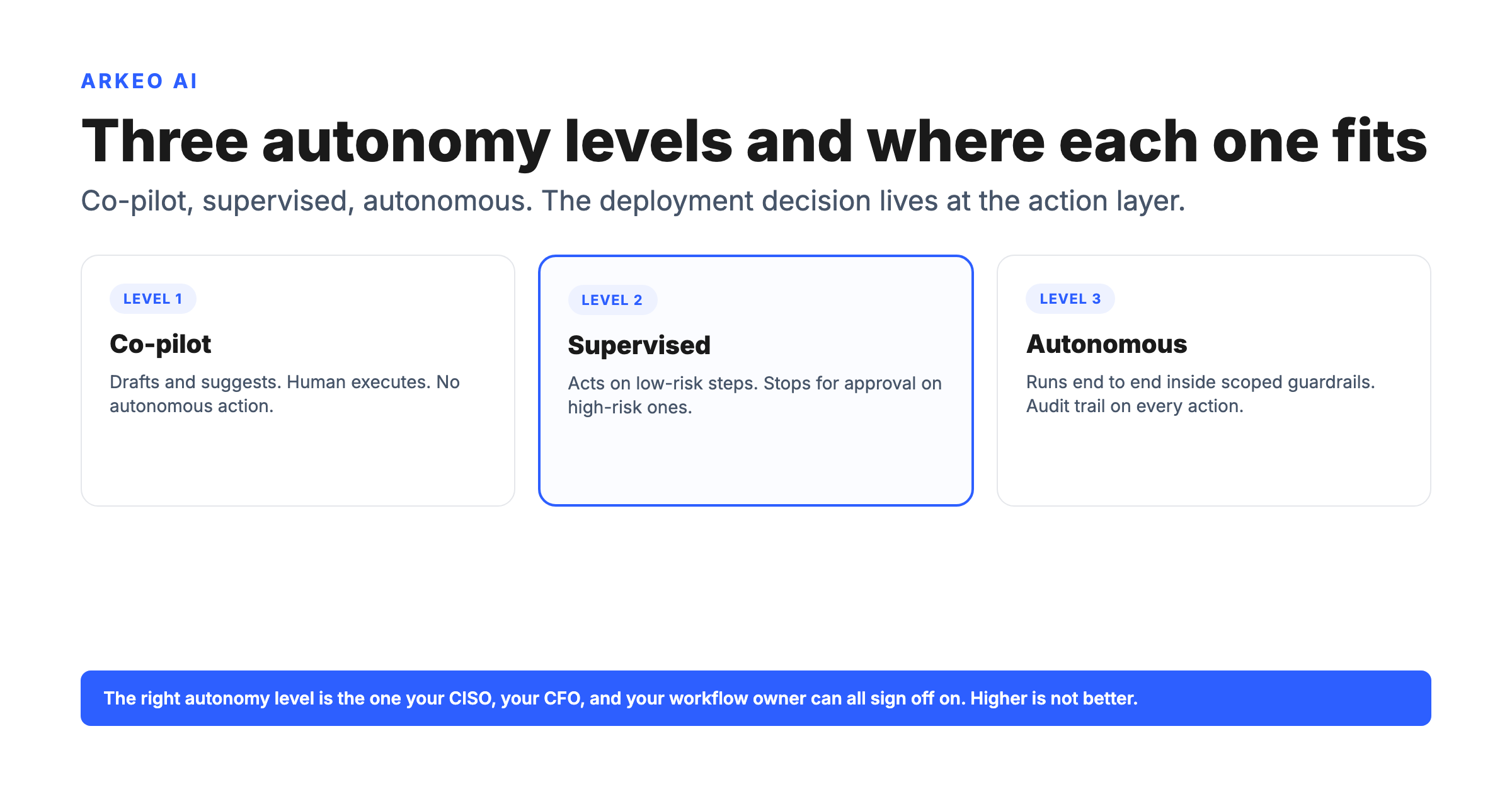
Three autonomy levels and where each fits
The right level depends on the data structure, the action stakes, and the audit requirements.
LEVEL 01
Co-pilot
Drafts and suggests; a human reviews and executes. Right for high-stakes actions, ambiguous data, or anything that touches a customer in version one. Cost: low. Risk: low. Capacity gain: modest.
LEVEL 02
Supervised
Acts autonomously on low-risk steps; stops for human approval on high-risk steps. The mid-market starting point for most workflows. Cost: medium. Risk: managed. Capacity gain: significant.
LEVEL 03
Autonomous
Runs end to end inside scoped guardrails. Surfaces only exceptions to humans. Right for high-volume, structured, unambiguous workflows with audit-trail-by-default. Cost: higher build, lower per-transaction. Risk: requires discipline. Capacity gain: large.
Autonomy is not a virtue. Pick the level that matches the workflow, the data, and the audit requirements. The Capgemini trust-drop happened because companies pushed to Level 3 without the discipline of Level 2.
Architect the right autonomy level for your first workflowThe free AI Assessment names the right autonomy level for your first workflow and the guardrails behind it.
Book Your Free AI Assessment →
Want to talk about this against your specific situation? The free AI Assessment is a 30-minute working session, not a sales call.
How Do You Secure Autonomous AI Agents for Business Without Losing the Capacity Gain?
Autonomous action without the right guardrails is the failure mode that took executive trust from 43% to 27% inside a year (Capgemini, 2025). The IBM Cost of a Data Breach 2025 report tracks the average breach cost at multimillion-dollar levels (IBM, 2025); an autonomous agent that misroutes sensitive data is an enterprise-grade risk. Four safeguards make autonomy safe.
SAFEGUARD 01
Server-side access scope
The agent's access to data and actions is enforced at the system layer, not the prompt. A misconfigured prompt cannot push the agent past its scope; the system refuses.
SAFEGUARD 02
Audit trail by default
Every action, every data read, every decision logged with timestamp, source, and reason. If a regulator, auditor, or customer asks why the agent did what it did, the log answers.
SAFEGUARD 03
Reversibility checks
Before any irreversible action (send email, post payment, update customer record), the agent confirms the action is inside the guardrails. Irreversible actions outside the rails still escalate to human approval even in autonomous mode.
SAFEGUARD 04
Monitoring and kill-switch
Real-time monitoring on action volume, error rate, and exception rate. A spike triggers an automatic pause and a human review. The agent should fail safe, not fail open.
For sensitive data and regulated industries, the autonomous deployment runs private or on-premise so the data never leaves the building. Public cloud is fine for non-sensitive autonomous workflows; the deployment decision is part of the autonomy decision. The enterprise AI agents post walks through the security architecture in depth.
of executives still trust fully autonomous AI agents, down from 43% the prior year. The drop concentrated in deployments that skipped guardrails.
Autonomy is not a virtue. The right autonomy level is the one the workflow, the data, and the audit requirements all agree on.
How Do You Roll Out Autonomy Without Collapsing Trust on the First Incident?
The Deloitte 2025 TMT Predictions project that 25% of enterprises using generative AI will deploy AI agents in 2025, rising to 50% by 2027 (Deloitte, 2025). Inside the mid-market, the rollouts that survive their first incident share three properties.
Started at Level 2 (supervised), audited the first 100 actions by hand, raised autonomy only after the audit confirmed zero unsafe actions. Trust survives the first error because the framework is visible.
Started at Level 3 (full autonomy) without the audit step. Works initially; one unsafe action surfaces and the executive team loses confidence faster than the metric supports.
Started at Level 3 without guardrails, server-side access scope, or kill-switch. First incident reaches a customer or regulator, the project is killed, the agent function loses budget for two cycles.
For the broader operator view of where agents fit a business, the cluster pillar on ai agents for business covers the five lanes. The post on building custom AI agents walks the implementation path for any autonomy level.
Pick the right autonomy level before the next deployment cycleThe free AI Assessment names the right autonomy level for your first workflow, the guardrails behind it, and the rollout that does not collapse on the first incident.
Book Your Free AI Assessment →