Category
What Makes an AI Agent Enterprise-Ready
Last updated: May 2026
You have seen the demo. An agent reads a request, pulls context, drafts the right action, and it looks ready to run your operation. Then the questions start. Which systems can it touch? Who approves the action before it fires? What happens when it gets one wrong, and can anyone reconstruct what it did? In a real enterprise, those questions decide everything, and most agents that pass the demo fail them. Arkeo has spent three years deploying agents inside operating businesses, and the gap between a working demo and a production deployment is almost never a smarter model. It is a stack of controls.
Quick Answer
• What they are: Enterprise AI agents are agents that meet the constraints of a real business environment, not just the demo: security, approvals, auditability, integration, and support.
• What matters: Enterprise-readiness is about controls, not features. The model is the easy part; the controls around it are what let it run in production.
• The risk: Most projects fail on governance, not capability. Adoption is racing ahead of the controls, so the gap shows up in production rather than in the demo.
• Where to start: Map your constraints before you pick a build path. A free AI Assessment does that mapping with you.
What makes an AI agent enterprise-ready?
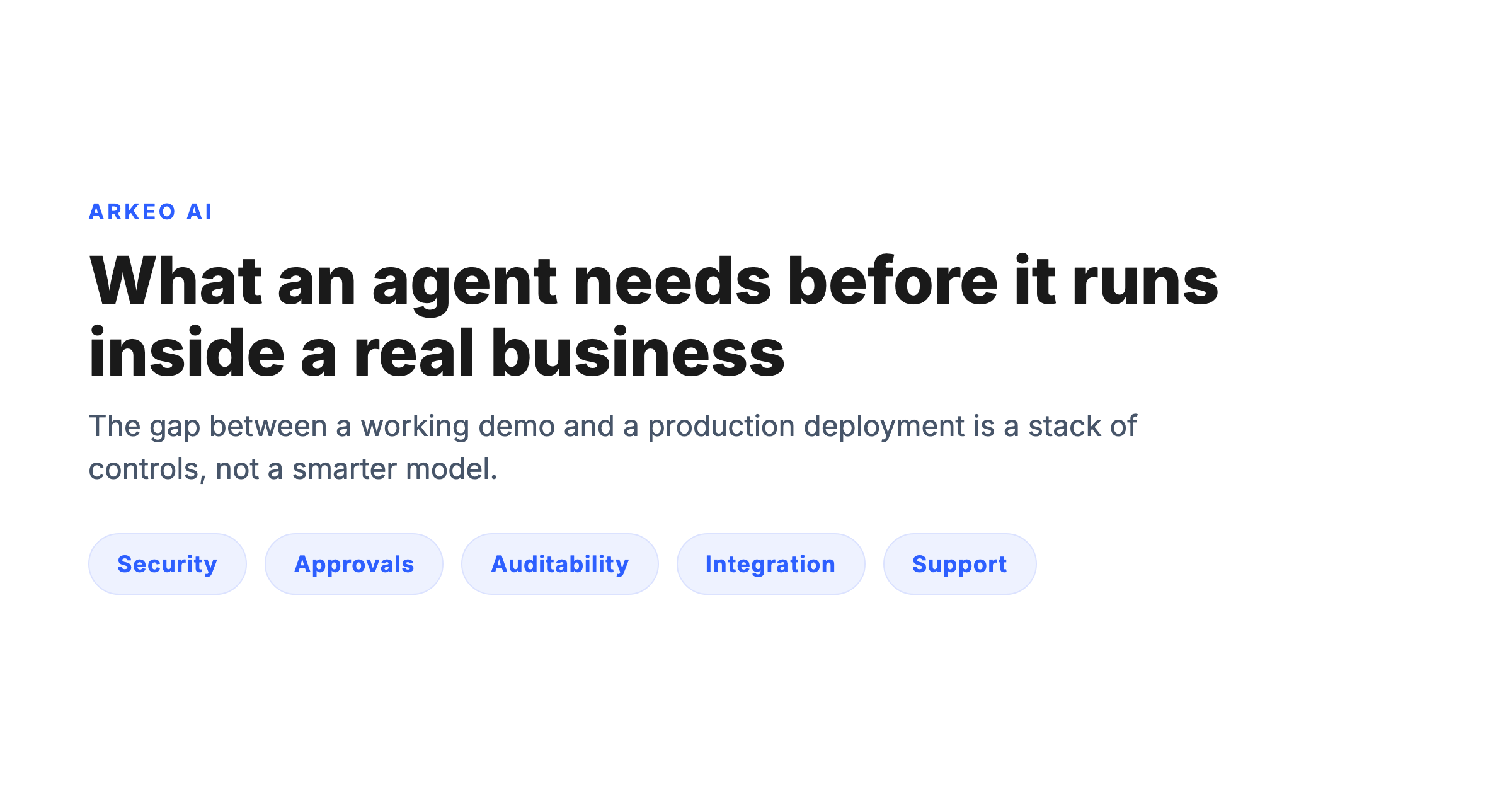
An enterprise AI agent is one that meets the constraints of a real business environment, not just basic functionality. Security and access control, human approval paths, auditability, integration with core systems, and supportability are the bar. Put plainly, enterprise-readiness is about controls, not features. The capability that wows in a demo is the easy part now. What separates an agent you can run from one you cannot is everything wrapped around it.
Adoption is the reason this matters now rather than later. Stanford's 2025 AI Index reports that 78% of organizations reported using AI in 2024, up from 55% the year before. The tools are arriving inside operations far faster than the governance around them, which is why so many agents look ready in a sales meeting and fall over the first week they touch a live system.
Most teams get this backwards. They evaluate agents the way they would evaluate a chatbot, asking how smart it is, when the questions that actually predict success are about constraints. Five control layers matter, and a weakness in any one of them is usually enough to stall a deployment or get it pulled after launch.
| Control area | What to require | Failure sign |
|---|---|---|
| Security | Scoped access per system, private data handling, no shared cloud keys | The agent runs on one broad admin token nobody can revoke cleanly |
| Approvals | A human sign-off before any irreversible or money-moving action | The agent acts end to end with no checkpoint a person can stop |
| Auditability | A logged trail of every prompt, decision, tool call, and output | Nobody can explain after the fact what the agent did or why |
| Integration | Read and write access to the systems where the work actually lives | The agent demos in a sandbox but cannot touch your ERP or CRM |
| Support | A named owner for failures, updates, and model changes over time | The agent ships, then quietly rots when a model or API changes |
Take each layer in operator terms. Security means the agent gets scoped access to the systems it needs and nothing more, with your data handled privately rather than shipped to a shared cloud key. Approvals mean a person signs off before anything irreversible happens, money moving, records changing, messages going out. Auditability means every prompt, decision, and tool call is logged so you can reconstruct what happened and why. Integration means the agent actually reads and writes the systems where work lives, not a sandbox copy of them. Support means someone owns the thing after launch, because models change, APIs change, and an unowned agent quietly rots.
Enterprise-readiness is about controls, not features
An agent that works in a demo is a model with a prompt. An agent that runs in production is wrapped by control layers your auditor and your CISO can read in five minutes. The four below carry the most weight. Support is the fifth — and the one teams skip.
Security
Boundary at the network edge. No agent action touches systems it has not been authorised for. Logged and attributable.
Approvals
Plan-before-execute. Confidence thresholds. Human review gates on regulated data. No silent autonomous action.
Auditability
Every action timestamped, attributable to a user, exported to your SIEM. Forensic-grade by default.
Integration
Native access to systems of record via MCP or equivalent. Not a screenshot demo, real wiring.
The data backs up where the risk concentrates. IBM's 2025 breach research found that 13% of organizations reported breaches of AI models or applications, and 97% of those lacked proper AI access controls. Capgemini's research on agentic AI is just as sobering on the readiness side: fewer than one in five organizations report high maturity in the data and technology infrastructure agents need, and trust in fully autonomous agents fell from 43% to 27% in a single year. The market is not short on capable models. It is short on the controls that make them safe to run.
Why do most enterprise AI agent projects fail?
Here is the blunt truth a vendor will not put in a brochure. Agents break, and they break more often inside complex enterprises, not less. The failures rarely trace back to the model being incapable. They trace back to three governance gaps that show up again and again.
The first is a tool-first approach: a team buys or builds an agent because it is impressive, then goes looking for a problem to point it at. That is backwards. The workflow should drive the agent, not the other way around. The second is no workflow owner. When nobody owns the end-to-end process the agent touches, nobody catches the edge cases, nobody updates it when the business changes, and nobody is accountable when it misfires. The third is weak governance, and this is where the numbers are stark. IBM found that 63% of breached organizations had no AI governance policy in place or were still developing one. An agent with broad access and no policy behind it is not a productivity gain. It is an incident waiting to be written up.
Most businesses think the hard part of an enterprise agent is getting it to work. They are wrong. Getting it to work is the demo. The hard part is getting it to work safely, repeatedly, inside systems it can damage, with people who trust it enough to let it act. That is a governance problem before it is a technology problem.
Map your enterprise constraints first
The free AI Assessment reviews your systems, permissions, and security needs, then shows where an agent fits and what controls it has to carry before it touches production.
Book Your Free AI Assessment →
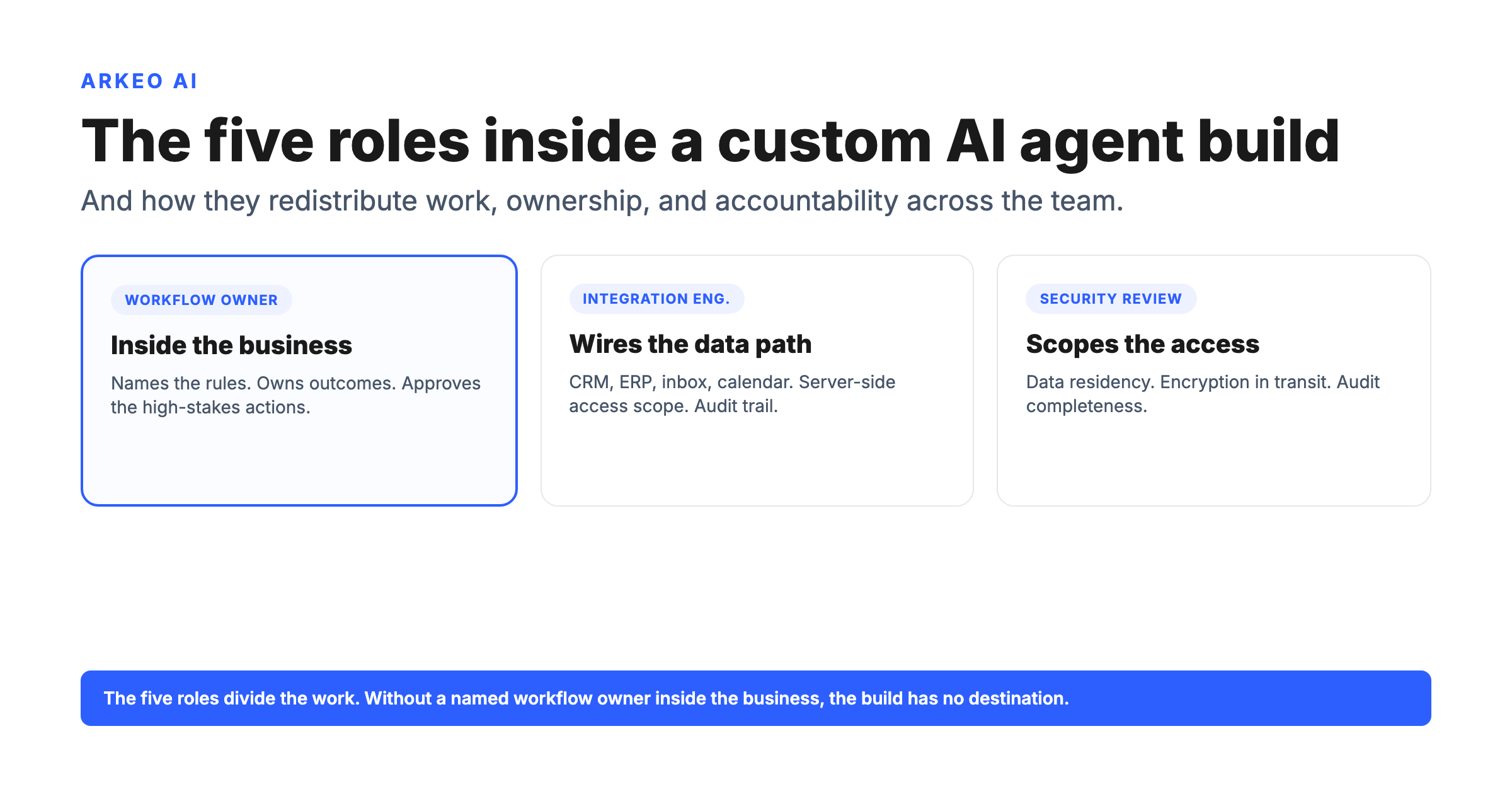
Three governance failures behind most enterprise AI agent collapses
The model is almost never the bottleneck. The reasons projects fail are operational and political. The three below show up in every postmortem we have read.
No named owner
Pilot owned by "innovation" with no business unit accountable for the outcome. Stalls at the first exception.
No measurable target
Project shipped without a baseline number to move. Six months later, nobody can answer "did it work?"
No control layer
Agent shipped without audit logs, approval gates, or rollback. Compliance kills it the moment regulated data is touched.
Where do enterprise AI agents create the most value?
The same complexity that makes enterprises hard to automate is exactly where a well-governed agent earns its keep. Three patterns show up consistently across deployments.
Document-heavy operations are the clearest win. Anywhere your team spends hours reading contracts, invoices, reports, or applications, extracting the same fields, and routing them, an agent can carry the load while a person reviews the exceptions. Multi-step approvals are the second. Processes that bounce between people and systems, each adding a check, are slow because of the handoffs, not the work. An agent can prepare each step and hold at the human checkpoint, which is faster without removing control. Cross-system coordination is the third. When a single request needs the CRM, the ERP, and a document store to all agree, the manual version is brittle and the agent version is durable, as long as it has scoped access to all three.
Notice the through-line. The high-value cases are not the flashy ones. They are the unglamorous, repetitive, multi-system workflows that drain capacity and never make it onto a roadmap. Arkeo builds agents for those, on the Arkeo Operating System, and runs the same approach internally before recommending it. We use what we sell.
Picture an enterprise that wants an agent to read inbound vendor invoices, match them against purchase orders, and queue payment. The demo handles a clean invoice in seconds. Production is messier. The first integration to the accounting system was granted a broad write token to move fast, and that scope had to be unwound and replaced with read-only access plus a held approval step before finance would sign off. The connection to the purchase-order system that looked like a one-day task in the demo took closer to three weeks once real edge cases and stale records surfaced. None of that is a model problem. It is the work of making an agent safe to run, and it is the part the demo never shows.
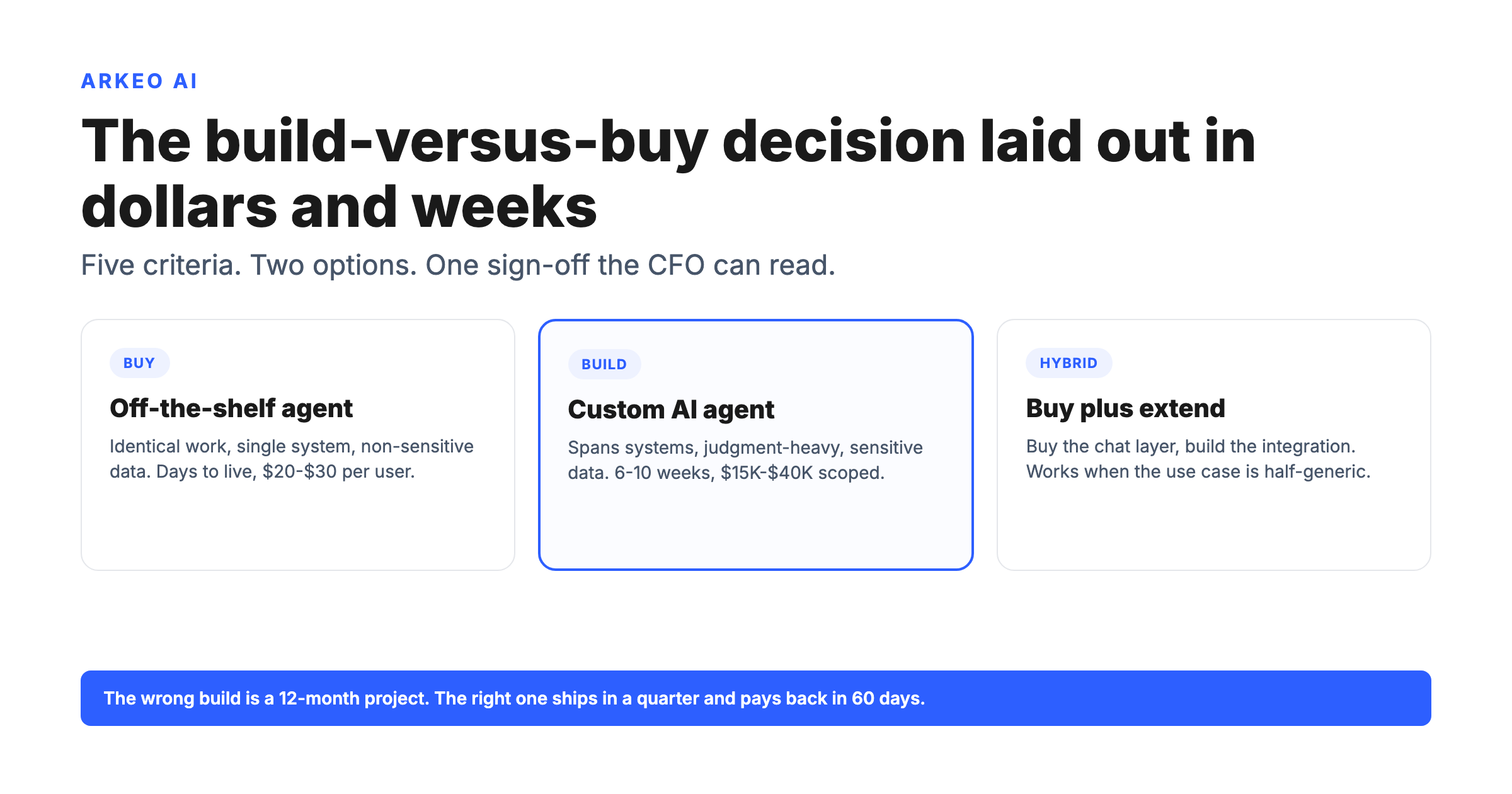
How do you evaluate build vs buy vs private deployment?
Once you accept that readiness is about controls, the build path is no longer a vendor checklist. It is a question of which constraint is binding for you. There are three honest options, and each fits a different situation.
| Question | Buy generic software | Custom agent | Private deployment |
|---|---|---|---|
| Fits your real workflow? | Rarely, you bend the process to the tool | Yes, built around how you actually operate | Yes, and it runs inside your environment |
| Where your data lives | Vendor cloud, shared infrastructure | Often the builder's cloud unless specified | Your stack, your data, under your control |
| Approval and audit controls | Whatever the vendor shipped | As designed, depends on the builder | Designed in from the start, owned by you |
| Time to first value | Fast to switch on, slow to fit | Weeks to a focused workflow | Weeks to months, depending on scope |
| Best when | The need is generic and low risk | One workflow has clear, high-value pain | Data, security, or compliance is the constraint |
Buying generic software is the right call when the need is common and low risk. You trade fit for speed, and for plenty of workflows that trade is fine. A custom agent earns its cost when one workflow has clear, high-value pain and an off-the-shelf product would force your process to bend around it. If that is your situation, the path to scope it well is covered in our guide to custom AI agents. Private deployment becomes the answer when data sensitivity, security, or compliance is the constraint that governs everything else. Running the agent on your own stack, with your data staying inside your environment, is not a luxury in those cases. It is the requirement, and our guide to private AI agents walks through what that looks like in practice.
The mistake is choosing the path first and rationalizing it after. Map the constraint, then let it pick the path. If you are still establishing what an agent even is and where it fits before getting this specific, start with the broader picture in AI agents for business, then come back to the build decision once the workflow is clear.
One more honest note on timelines. A private deployment is not a switch you flip. In Arkeo's experience, an enterprise-grade workflow agent with real integration and approvals typically takes 8 to 12 weeks to reach production, and a sober plan accounts for the integration and approval work, not just the model. Arkeo has been deploying agents since founding in 2023, on the back of 25 years operating real businesses, and the projects that succeed are the ones that treated the controls as the work rather than an afterthought.
See which build path fits your environment
In one free session the AI Assessment maps your constraints to build, buy, or private deployment, so you commit to a path with eyes open instead of discovering the gaps in production.
Book Your Free AI Assessment →
Three paths to an enterprise-ready agent, three different procurement decisions
Most mid-market firms eventually run a mix. The decision below is about the first workflow, not the whole portfolio. Pick the path that matches what the first deployment actually needs.
Buy from a vendor
Off-the-shelf agent for a common workflow on mainstream systems. Fast to deploy, vendor takes the support burden, lock-in is the cost.
Build internally
Custom agent on open frameworks against your own data. Highest control, highest engineering investment, longest path.
Private deployment
Managed private AI workforce on your hardware. Owned data, owned boundary, support handled. The middle path that ships.