Category
Custom AI Agents: When a Tailored Build Pays Off
Last updated: May 2026
You have tried the off-the-shelf AI tools. They demo well, then hit a wall the moment your real workflow shows up: the data lives in three systems that do not talk to each other, the work needs a manager sign-off before anything moves, and the sensitive records cannot leave your environment. Arkeo AI, founded in 2023 on top of 25 years of operating real businesses, has spent three years deploying agents into real operations, including its own, and the same wall shows up every time. The generic product was never built for that. The question is no longer whether AI can help. It is whether your situation justifies a custom AI agent built around your process instead of a product you bend your process to fit.
Quick Answer
• What it is: an AI agent built around your own workflow, systems, approvals, and data rules, not a generic product you adapt to.
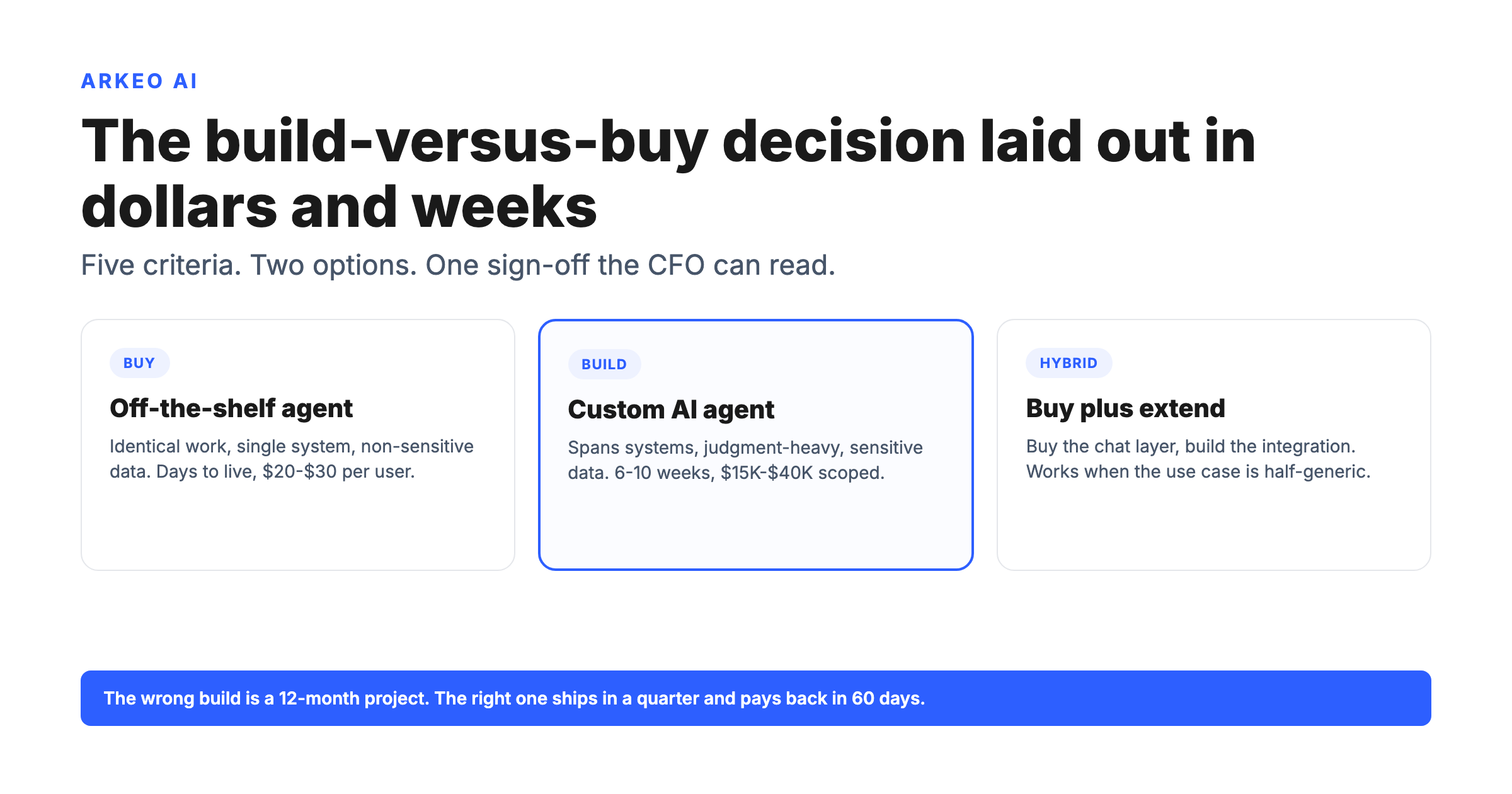
• Cost and timeline: a scoped single-workflow custom agent typically runs about $15,000 to $40,000 and 6 to 10 weeks to production; an off-the-shelf copilot at roughly $20 to $30 per user per month goes live in days.
• When it is worth it: multiple connected systems, approval-heavy work, sensitive data, and high-value repeat workflows.
• How to decide: a free AI Assessment identifies whether custom is warranted and which workflow to target first.
Adoption is climbing fast. The Stanford HAI 2025 AI Index reports 78% of organizations used AI in 2024, up from 55% the year before. But using AI and running agents at scale are different things. The Capgemini Research Institute, surveying 1,500 executives across 14 countries, found only 2% have deployed agents at scale and 12% at partial scale, while 61% are still exploring. Fewer than one in five report the data and tech maturity that agents actually need. Custom is not a default. It is a deliberate call you make when generic tools stop fitting.
What Are Custom AI Agents?
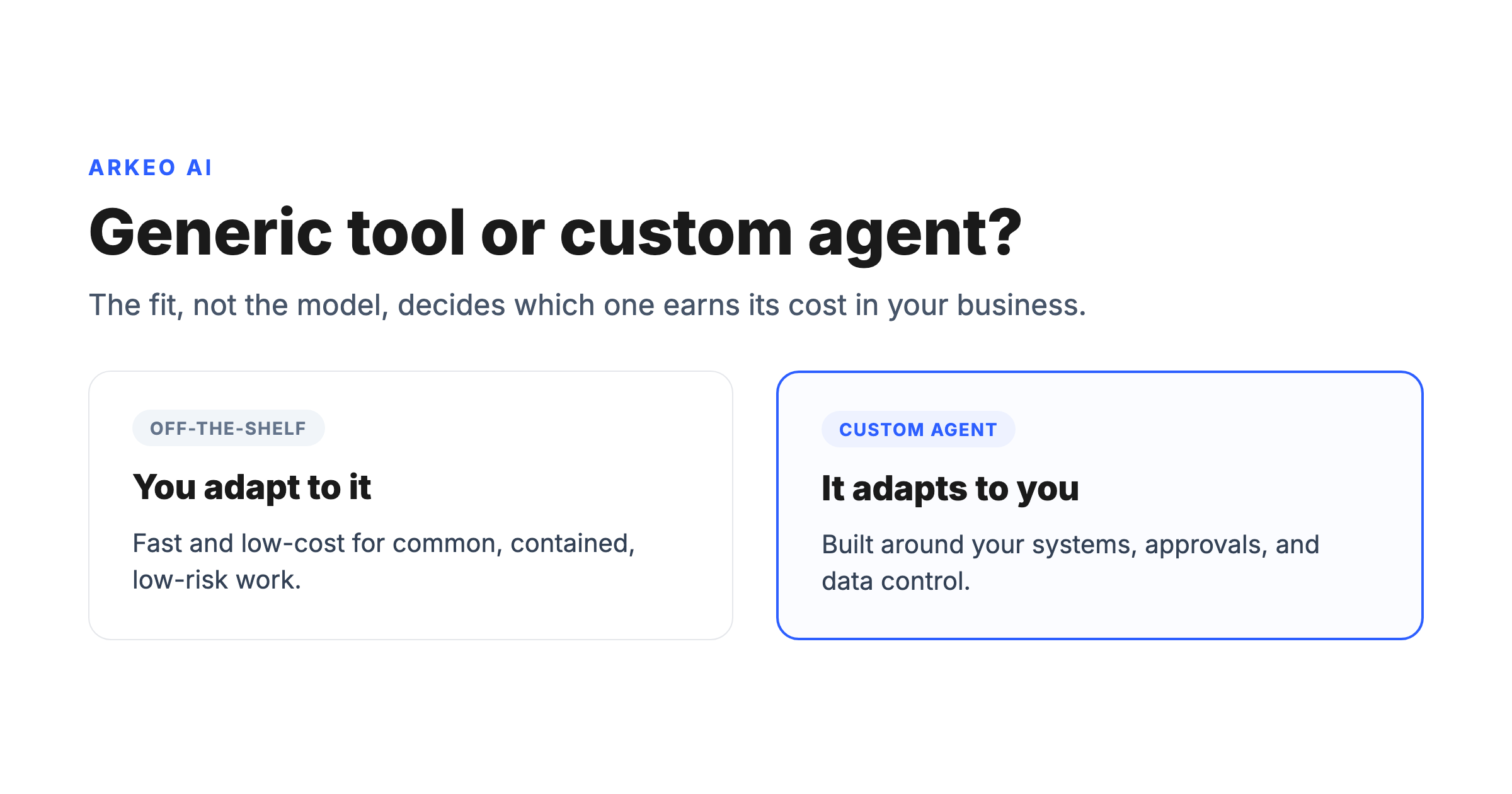
A custom AI agent is software built around your own workflow, systems, approvals, and data constraints, rather than a generic product you adapt your process to fit. It reads from the systems you actually use, applies your decision rules, and stops at your approval points. A generic chatbot answers questions. A custom agent does the work the way your business already does it, inside the guardrails your business already has.
The distinction is about fit, not sophistication. An off-the-shelf tool assumes a standard process and asks you to conform to it. A custom agent inherits your process: your CRM and ERP, your sequence of approvals, your rules about what data can move where. That inheritance is the whole point, and it is also why custom costs more.
How Do Custom Agents Differ From Generic Tools?
Most teams assume the gap is feature depth, that custom means a smarter model or more capability. That is wrong. The gap is integration and control. Generic tools are built for the average customer, so they handle the common path well and break at the edges where your business is actually different. Your approval chains, your legacy system, your data-residency rule: those edges are where generic tools quietly fail.
Here is the blunt truth a vendor will not put in a brochure: most off-the-shelf AI products are designed to keep your data flowing through their platform, because that is their business model. If your records are sensitive or regulated, that architecture is the problem, not a detail. A custom agent can be built to keep data inside your control by design. The comparison below is the decision in one view.
| Consideration | Off-the-shelf tool | Custom agent |
|---|---|---|
| Fits your systems and approvals | You adapt to its workflow | Built around your workflow |
| Keeps sensitive data in your control | Often routed through a vendor cloud | Can run on-premise or in your environment |
| Upfront cost | Low, subscription-based | Higher, project-based |
| Time to value | Fast for standard tasks | Slower, but fits the real process |
| Best for | Common, contained, low-risk work | Complex, integrated, high-value work |
For a broader view of how agents fit into operations before you weigh a custom build, the overview of AI agents for business sets the context this decision sits inside. The risk is not the model. It is committing budget to a build before anyone has confirmed the fit is real.
Is a custom build actually warranted for you?
A free AI Assessment maps your systems, approval points, and data rules against the custom-versus-generic decision, so you know whether a tailored agent is justified before you commit a budget.
Book Your Free AI Assessment →
Three ways custom agents differ from a generic copilot
A generic copilot is sold per seat and aimed at one user at a time. A custom agent is sold per workflow and aimed at an operation. The difference shows up in three places that procurement should price honestly.
Data boundary
Custom runs on your data, on your terms. Generic runs on vendor cloud, with vendor training rules.
System reach
Custom integrates with the systems your work actually crosses. Generic stays inside the vendor's native connectors.
Judgment
Custom learns the context that decides outcomes in your business. Generic gives every subscriber the same answer.
When Are Custom AI Agents Worth It?
Custom is justified by four business conditions, not by novelty. When two or more of these are true, a generic tool will keep failing at the edges and a custom build starts to pay off.
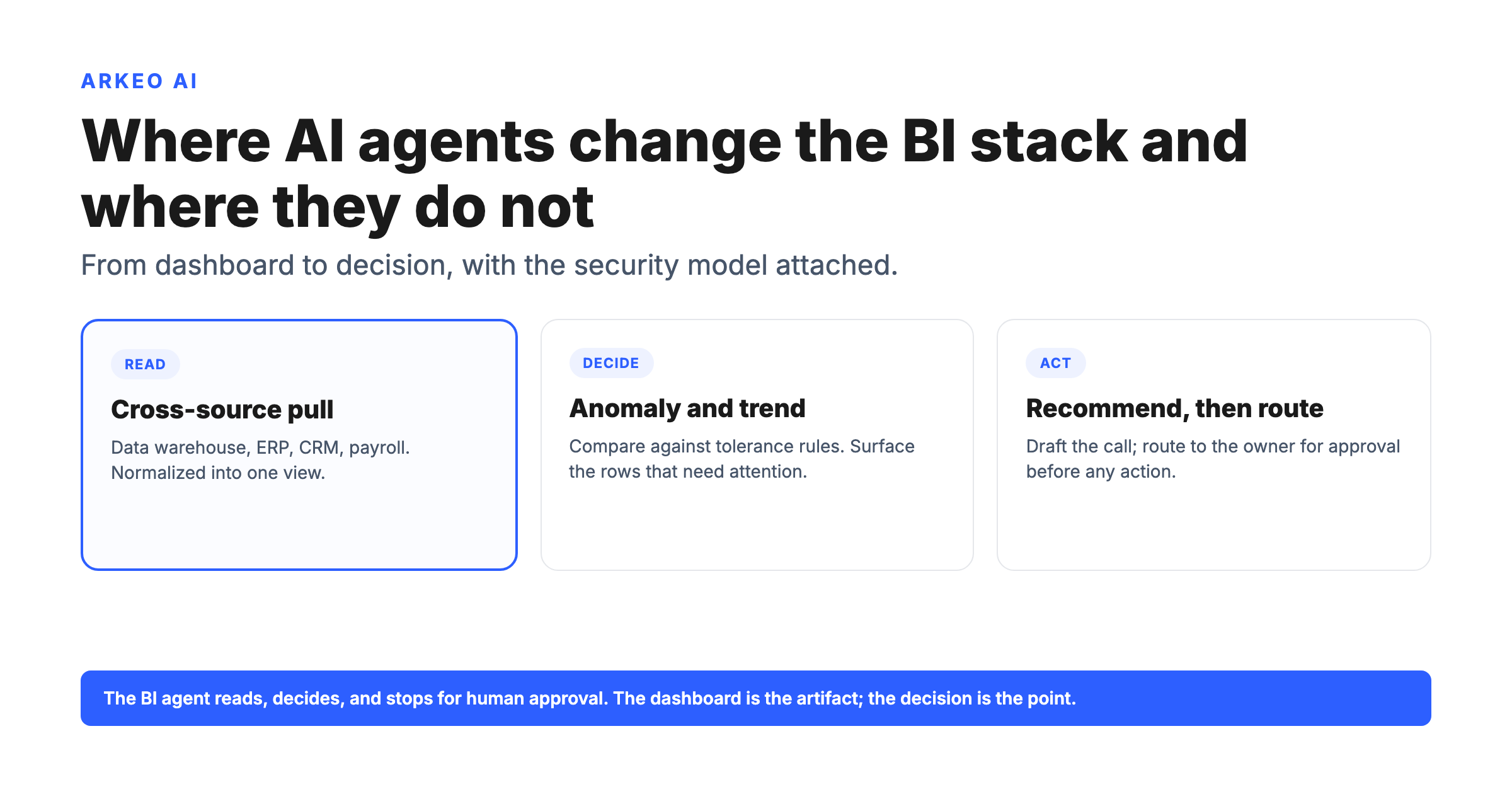
Multiple systems. If the work spans a CRM, an ERP, a ticketing system, and a spreadsheet that someone maintains by hand, no single product covers it. A custom agent reads from each system and stitches the workflow together. That orchestration is the value, and it is the thing generic tools are weakest at.
Approval-heavy work. If a step cannot proceed without a manager, a compliance check, or a second signature, the agent has to know exactly where to stop and who to route to. Off-the-shelf tools either ignore approvals or force a clumsy workaround. A custom agent encodes your approval logic as part of the workflow.
Sensitive data. If the work touches regulated records, customer PII, or proprietary information that cannot leave your environment, where the agent runs becomes a business requirement. Arkeo deploys agents on-premise and in private environments for exactly this reason, so the data never has to flow through someone else's platform.
High-value repeat workflows. Custom pays back fastest on work that happens often and matters a lot: the same complex process, dozens or hundreds of times a month. A one-time task does not earn the build cost. A daily revenue-critical workflow does. The upside at stake is large: Capgemini projects that by 2028, AI agents could generate up to $450 billion in economic value across surveyed markets, and that value lands with the teams who automate the right repeat work.
When Are Custom AI Agents Not Worth It?
Custom can be the wrong call, and an honest partner will tell you so. There are three conditions where a custom build burns money instead of returning it.
One-off tasks. If the work happens rarely, the build cost will never amortize. A prompt, a script, or an off-the-shelf tool is the right answer. Save custom for the workflows you run constantly.
Weak process definition. An agent automates a process. If nobody can clearly describe the steps, the inputs, and the decision rules, there is nothing stable to automate, and the project stalls in discovery. Be honest about one more thing too: AI agents break, regularly. They misread an edge case, an upstream system changes a field, a model update shifts behavior. A well-built agent is monitored and corrected, not set and forgotten. And it breaks worst of all when it is built on top of a process that was never actually defined. Fix the process first.
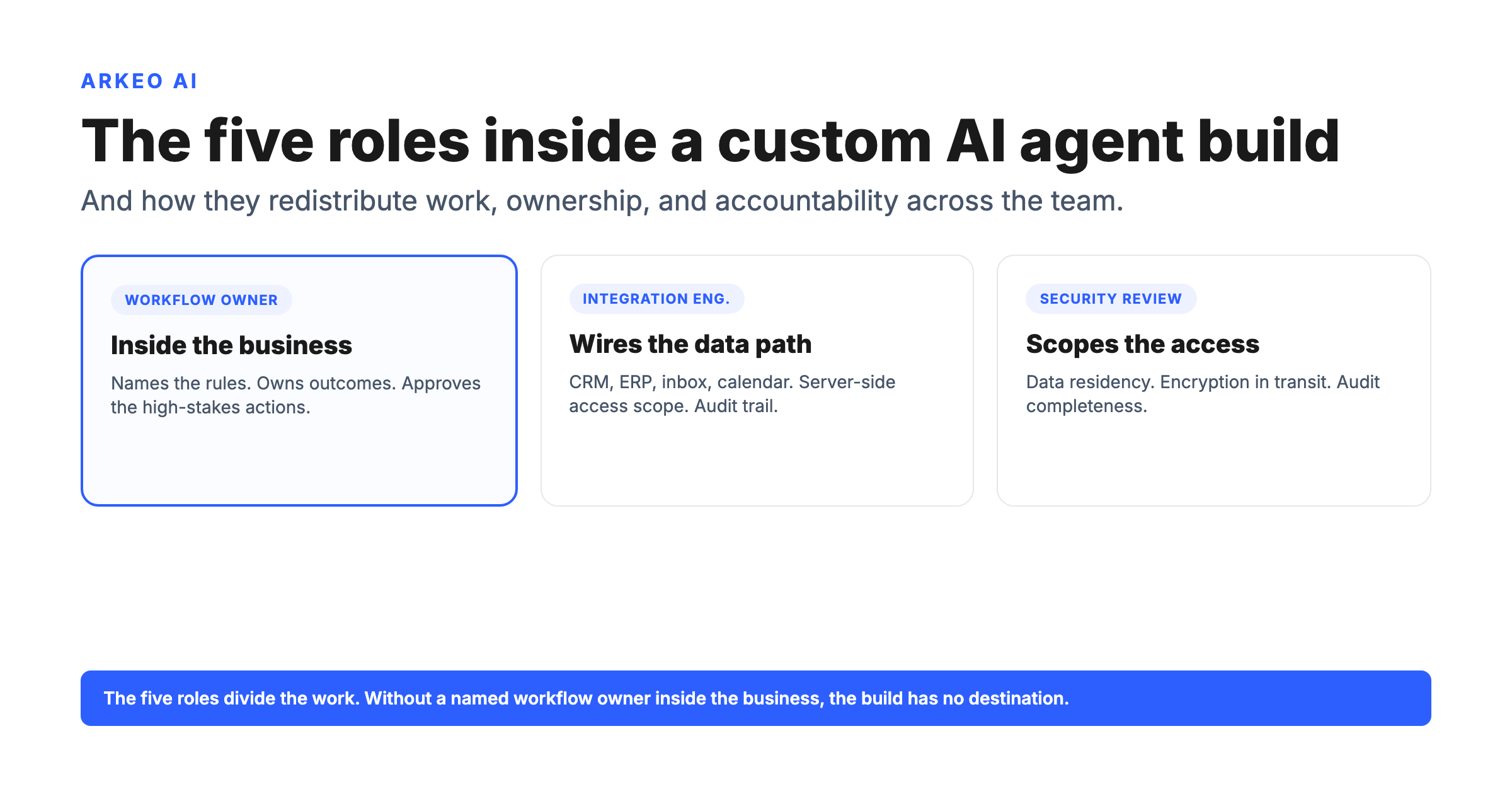
No ownership. A custom agent needs an internal owner who maintains the rules, watches the edge cases, and signs off on changes. Without that person, even a well-built agent drifts out of date within months. If no one will own it, do not build it yet.
When the tailored build pays off, and when off-the-shelf is the smarter call
Custom AI agents are heavier to build and heavier to support. The cost only makes sense when the workflow rewards customisation. The fork below maps the most common decision a mid-market operator faces.
Mainstream workflow, generic data
Owned data, system reach, judgment
What Does a Good Custom Agent Project Include?
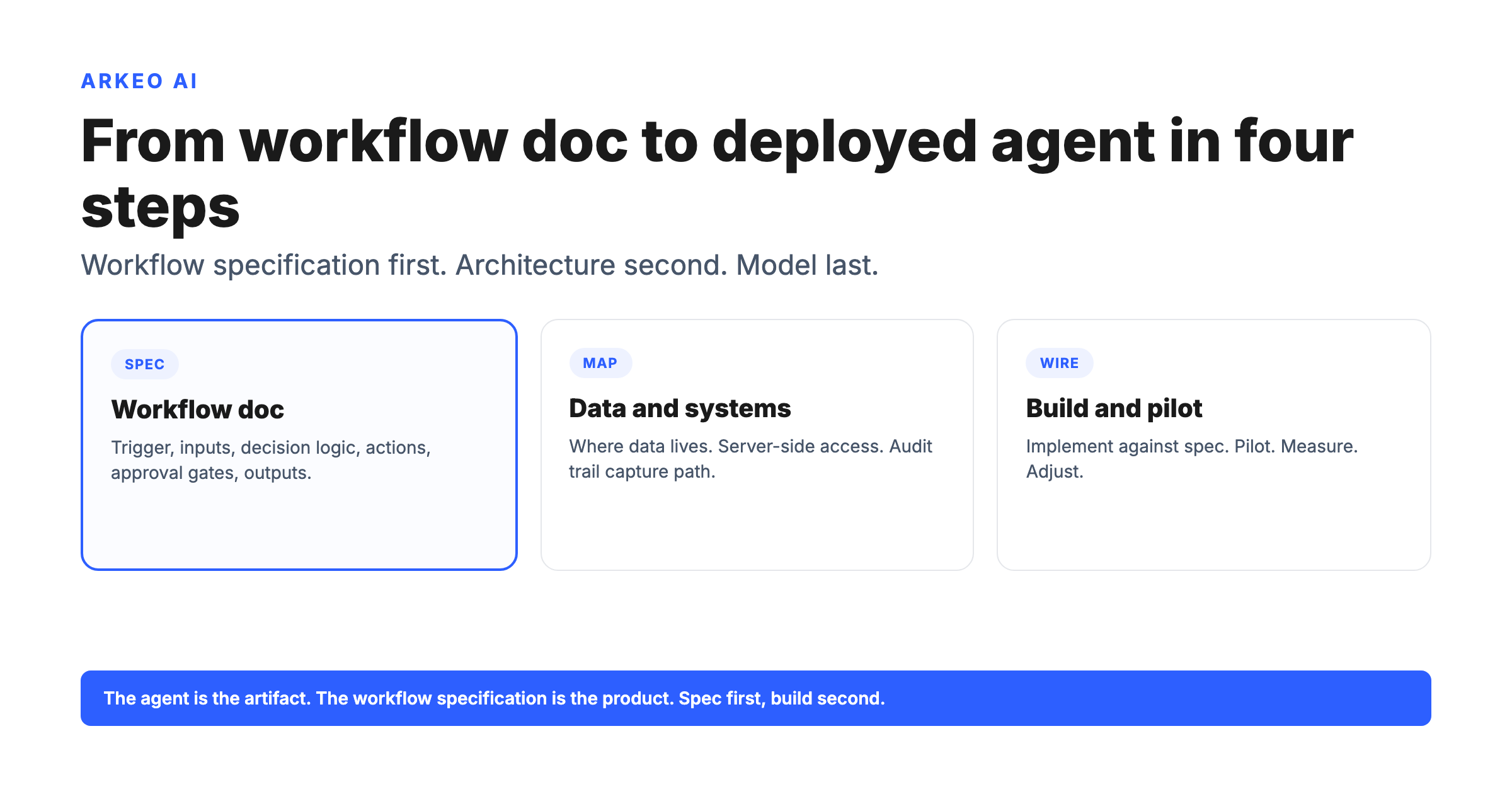
A custom agent worth building rests on four artifacts. If a vendor proposes a build without these, that is a warning sign.
Workflow map
Every step of the process, the inputs, and the decision points, written down before any code.
System map
Which systems the agent reads from and writes to, and how it authenticates to each one.
Approval logic
The exact points where the agent stops, who it routes to, and what it is never allowed to do alone.
ROI case
The hours, errors, or delays the agent removes, with a number you can hold the build accountable to.
Why this discipline matters is easiest to see in the messy middle. Consider a finance team that wants an agent to process vendor invoices end to end. On paper the workflow looked like four clean steps. In practice, discovery surfaced an approval step nobody had written down: anything over a threshold quietly went to a second manager by email, off-system. Mapping that hidden gate took longer than the team planned, and the lesson is the rule. The work has to be defined before the build, or the agent automates the wrong process. This is the pattern behind the Arkeo Operating System: the projects that succeed start with a map, not a model. The value is sourced in the survey data too. PwC's AI Agent Survey of 308 US executives found 66% of adopters report measurable value through productivity, and 88% plan to raise AI budgets because of agentic AI. The returns are real, but they accrue to the teams who define the work first.
How Do You Choose the First Custom Agent?
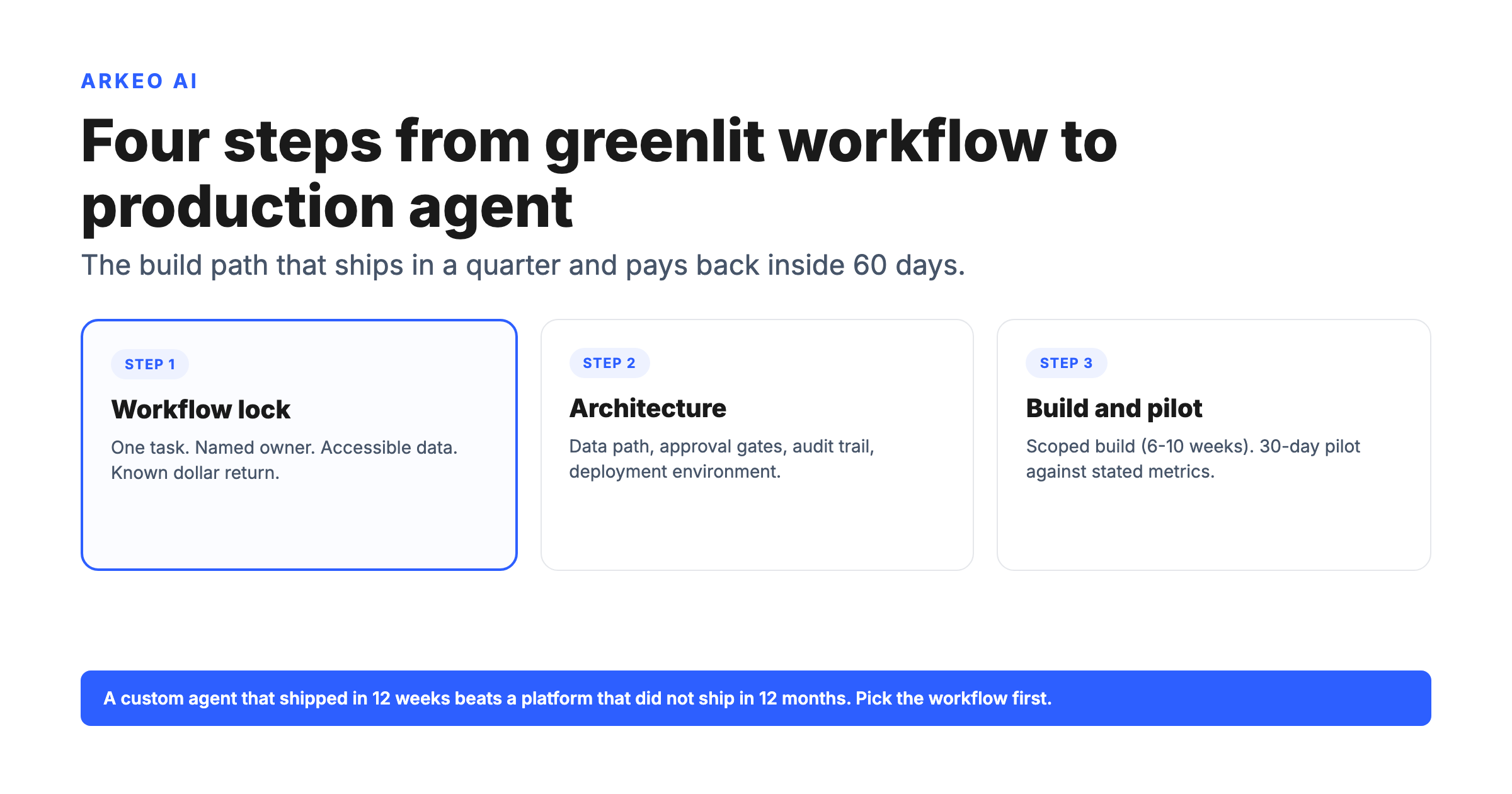
You do not start with the hardest, highest-stakes workflow. You start with the one that proves the model and builds internal trust. The selection axis is simple: low risk, high friction, fastest time to value.
Low risk means a mistake is recoverable and visible, not catastrophic or silent. High friction means the work is genuinely painful today, so the team feels the relief immediately. Fastest time to value means you can ship something useful in weeks, not quarters, and point to a result. Get one workflow working, prove the ROI, then expand. That sequence is also why trust matters: the Capgemini data shows confidence in fully autonomous agents fell from 43% to 27% in a single year, largely because teams over-reached on the first build. A contained first win is how you avoid that.
If you are weighing scale, the considerations differ for larger deployments. See how this plays out across an organization in enterprise AI agents, and for the operational specifics of tailoring agents to a company's stack, custom AI agents for business goes deeper on the build itself.
Arkeo uses what it sells: the same agents that run on the conditions above run inside Arkeo's own operation. That is the test of whether a custom approach holds up. If it would not survive in your own business, it should not be sold into someone else's.
Not sure where to start your first build?
A free AI Assessment pinpoints the low-risk, high-friction workflow with the fastest payback, so your first custom agent is the one most likely to earn its cost.
Book Your Free AI Assessment →
Four stages in a good custom agent project
The projects that ship follow the same shape. The ones that stall skip the first or the last stage. Discipline at the bookends is what separates a working agent from a pilot artifact.
Scope
One owned workflow. Baseline measured. Owner named. Systems mapped. No agent built until the scope is honest.
Build
Wire the agent to the systems. Write the rules and judgment. Stand up the control layer. Ship a usable v1.
Pilot
Run alongside the existing process. Measure against baseline. Tune the prompts and the thresholds.
Hand over
Operator takes the agent. Support model in place. Next workflow on the runway. Project is over, agent is live.