Category
AI Agents for Business: A Practical Guide

Last updated: May 2026
You keep hearing the term, but the question underneath it is the practical one: can an AI agent actually fix a real bottleneck in your operation, or is this another tool that demos well and dies in a pilot? Arkeo answers that from the operator's chair, not the lab. Founded in 2023 by a builder with 25 years running real businesses, Arkeo has spent three years deploying agents inside live operations, including its own, before recommending a single one to a client. That vantage point is worth stating up front, because the market data points the same direction. In the PwC AI Agent Survey of 308 US executives, 79% said AI agents are already being adopted in their companies and 66% of adopters report measurable value through increased productivity (PwC, 2025). That is not theory. It is operators reporting capacity they did not have a year ago.
Quick Answer
• What it is: An AI agent reads data from your systems, applies rules and judgment, takes an action, and pauses for human approval where it matters.
• Where it fits: Sales qualification, email and admin triage, finance workflows, and operations reporting.
• Cost: A general-purpose copilot runs about $30 per user per month with no custom build; a scoped single-workflow custom agent typically costs about $15,000 to $40,000 to build, depending on integration complexity.
• Timeline: Off-the-shelf tools go live in days; a custom workflow agent with one integration typically reaches production in 6 to 10 weeks.
• Why it matters: Agents add capacity without headcount, but only when a workflow owner, system access, approval logic, and an ROI model exist first. A free AI Assessment identifies which agent to build first.
What Are AI Agents for Business?
An AI agent is software that reads information from your systems, decides what to do with it, takes an action, and pauses for human approval at the points that carry risk. That is the whole idea, stated in operator terms rather than model terms. An agent pulls a lead from your CRM, reads the inbound email thread, checks the account history, drafts a qualified response or routes it to the right rep, updates the record, and stops short of anything that needs a human signature. It handles variable input, it makes a decision, and it works across more than one system. That last part is what separates an agent from the tools you already know.
Adoption is not a fringe activity anymore. The Stanford HAI 2025 AI Index reported that 78% of organizations used AI in 2024, up from 55% the year before (Stanford HAI, 2025). Deloitte projects that 25% of enterprises using generative AI will deploy AI agents in 2025, rising to 50% by 2027 (Deloitte, 2025). The curve is steep and it is short. The companies treating agents as a 2027 problem are already behind the ones treating them as a 2026 capability.
How Are AI Agents Different From Chatbots and Automations?
Most businesses lump three different things under the word AI, and that confusion is exactly why pilots stall. A chatbot answers. It responds to a question with text and then waits for the next question. A rules-based automation follows a fixed script: when this happens, do that, every single time, with no judgment. An AI agent is the only one of the three that handles a message it has never seen before, decides what the situation calls for, and acts across the systems where the work actually lives.
Here is the distinction laid out as the asset worth bookmarking. If you remember one thing from this guide, make it this table.
| Capability | Chatbot | Rules-based automation | AI agent |
|---|---|---|---|
| Handles variable input? | Limited | No | Yes |
| Makes decisions? | No | Only fixed branches | Yes, within guardrails |
| Works across systems? | Rarely | Point to point only | Yes, CRM, ERP, inbox |
| Needs human approval? | No action to approve | No, it just runs | Yes, at risk points |
| Best for | FAQ and support deflection | Repetitive, identical steps | Messy, multi-step workflows |
The reason this matters operationally: a chatbot cannot close your follow-up gap, and an automation breaks the moment an email arrives in a format it did not expect. The agent is the layer that copes with the mess of real business, which is also why it carries real risk and needs the checkpoints built in from day one.
See where AI agents fit your operation
The free AI Assessment maps your current workflows, data, and systems to find the first agent worth building and the quick wins worth turning on now.
Book Your Free AI Assessment →
AI agents are not chatbots and they are not automations
The vocabulary blurs in marketing copy. The operating difference is concrete. Chatbots answer questions. Automations run scripts. Agents read, decide, act, and pause for approval — the loop a human assistant runs.
Answers or runs a recipe
Reads, decides, acts, escalates
Where Do AI Agents Help a Business Most?
Agents earn their keep in workflows that are high-volume, judgment-light at the routine level, and currently eating hours from people who should be doing higher-value work. Four areas map directly to how operations actually run.
Sales and qualification
An agent watches inbound leads, enriches each one against the CRM and public data, scores it against your qualification criteria, drafts the first reply, and books the meeting or routes it to a rep. The rep stops triaging and starts selling.
Admin and email triage
A shared inbox is a swamp of requests, scheduling, and noise. An agent reads each message, classifies it, drafts responses to the routine ones, files the rest, and surfaces only what needs a human.
Finance workflows
Invoice intake, three-way matching, expense flagging, and reconciliation prep are structured enough for an agent to handle the first pass and route exceptions to a person.
Operations reporting
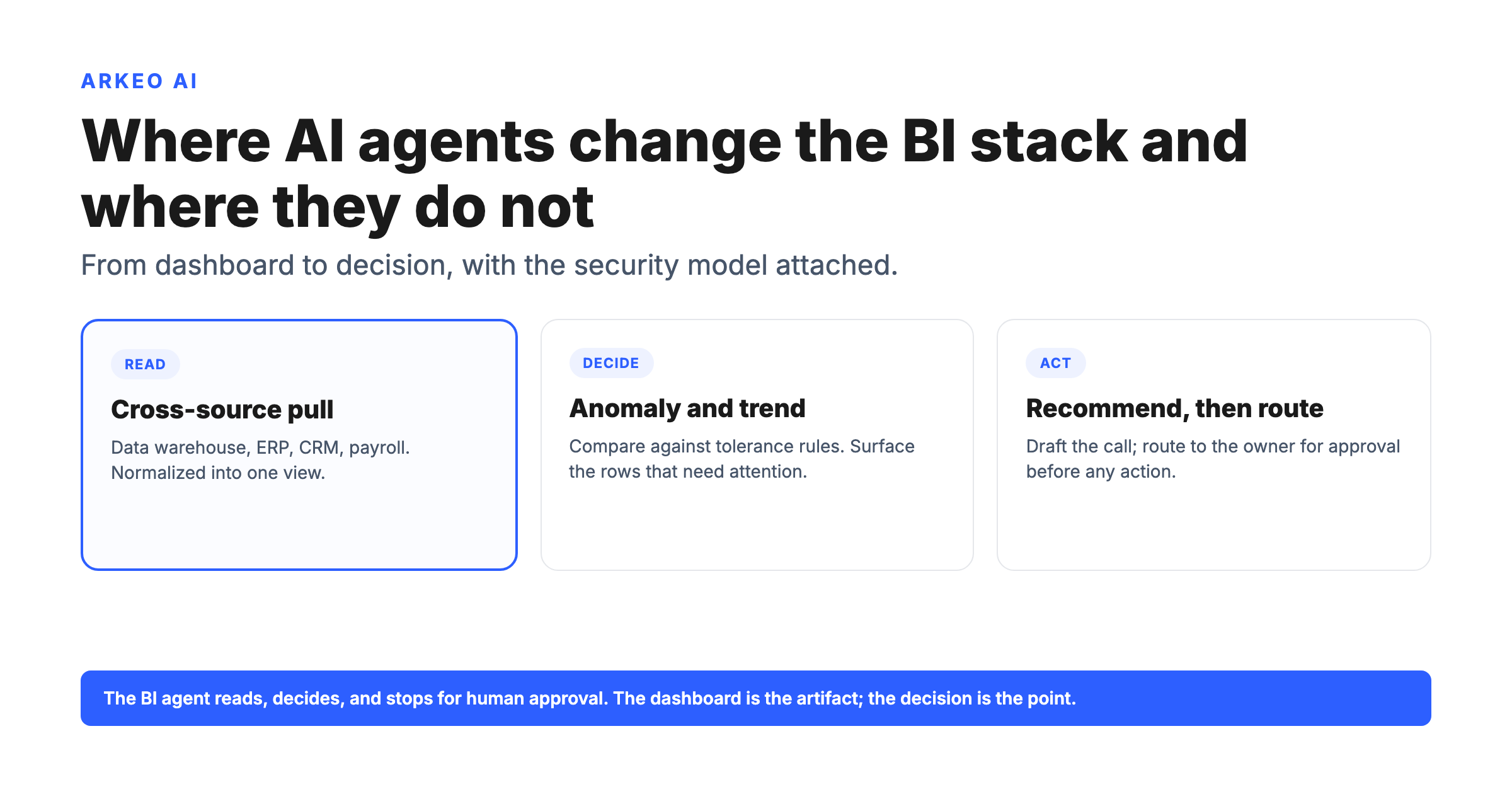
Instead of a person stitching numbers from four systems into a Monday deck, an agent pulls the data, builds the report, and flags the anomalies for review.
The diagram below shows what this looks like end to end: one agent moving a piece of work from the inbox, into the CRM and ERP, and stopping at a human-approval gate before anything irreversible happens.
An agent reads, decides, acts, and pauses for approval where it matters
The shape is the same across every business workflow we have shipped agents into. The data moves left to right across systems. The decision and approval gates are where judgment lives. Skipping any of these is how agents ship confident wrong answers.
Read
Agent ingests inbound signals: inbox, CRM events, documents, ticket updates, database rows. Messy inputs welcome.
Decide
Agent applies rules and judgment, scores its confidence, picks the next action. Routes uncertainty to a human.
Act
Agent writes back into the systems of record. Updates the CRM, posts to the ERP, files the ticket, drafts the response.
Approve
High-stakes or low-confidence cases pause for a human review with the full context attached. No silent autonomous risk.
Notice the checkpoint. That human-approval gate is not a limitation to engineer away. It is the design choice that makes an agent safe to put in front of customer data and money. The agents that survive in production are the ones that know exactly where to stop and ask.
Where Do Businesses Get AI Agents Wrong?
Here is the part the vendor brochures leave out: AI agents break, regularly, and the breakage is almost never the model's fault. It is the surrounding business that was not ready. The data backs this up bluntly. The Capgemini Research Institute, surveying 1,500 executives across 14 countries, found that only 2% of organizations have deployed agents at scale and roughly 14% in production at all, while 23% are piloting and 61% are still exploring (Capgemini, 2025). Fewer than one in five reported the data and infrastructure maturity that agents actually need. Trust in fully autonomous agents fell from 43% to 27% in a single year, because companies rushed deployment and got burned.
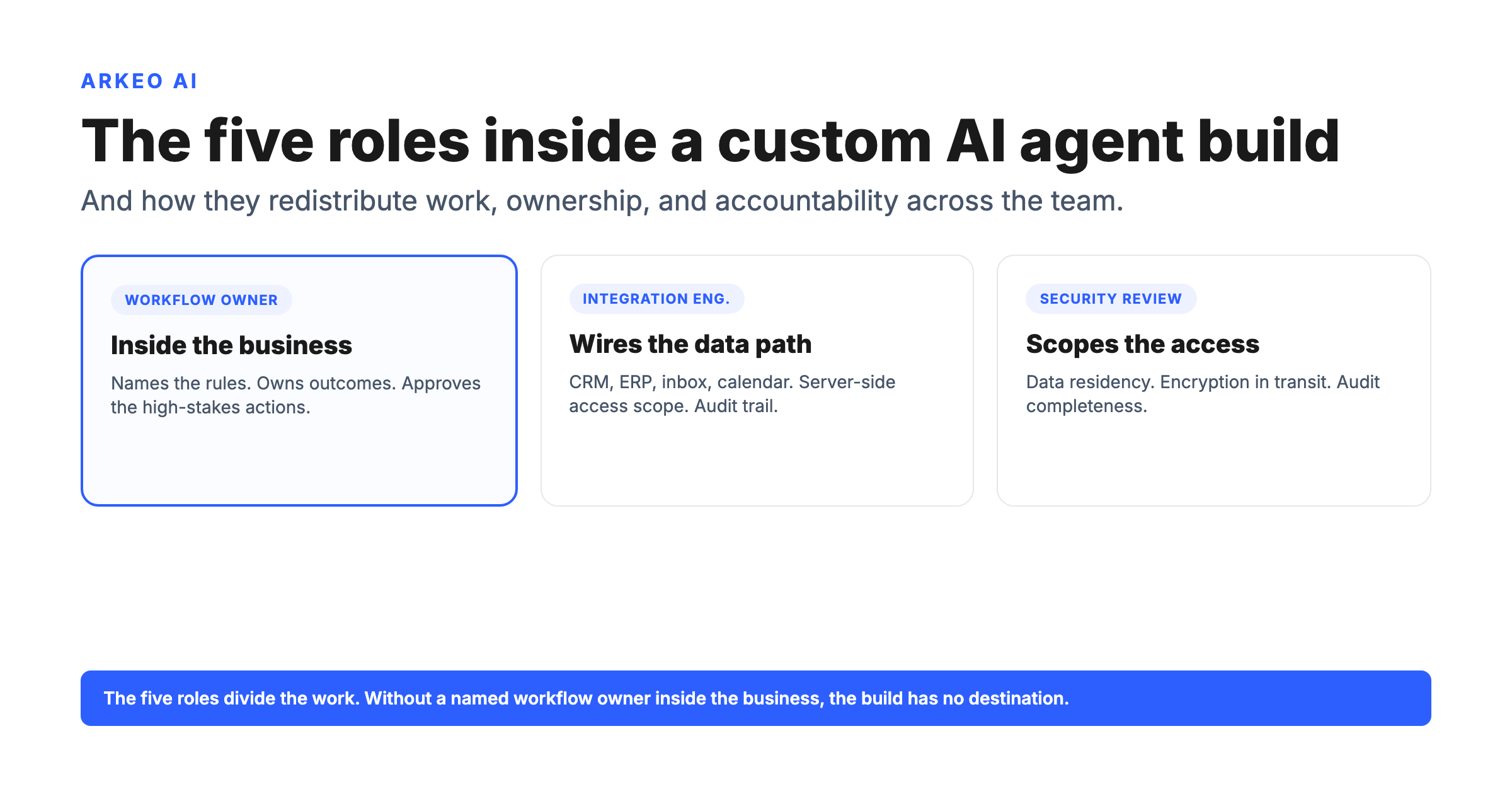
Most businesses think the hard part is choosing the right AI model. They are wrong. The model is the easy part. The four things that sink an agent are all organizational, and every one of them is fixable before a line of code is written.
No workflow owner. An agent automates a process, so someone has to own that process end to end: its rules, its exceptions, its definition of done. If nobody owns the workflow, nobody can tell the agent what good looks like, and it drifts. No system access. An agent that cannot read your CRM or write to your ERP is a chatbot with extra steps. The integration work is where the value is, and where the security questions live. No approval logic. Skip the checkpoints and you get an agent that takes confident, wrong actions at speed. That is the failure mode that destroyed trust in the Capgemini numbers. No ROI model. If you cannot say which hours an agent gives back or which revenue it protects, you cannot tell whether the pilot worked, so it quietly dies.
When Is a Company Ready for AI Agents?
Readiness is not about company size or tech budget. It is about whether a specific workflow has the four ingredients above. There are clear signals on both sides.
Signs you are ready: you can name a single high-volume workflow that is costing real hours; one person can describe its rules and its exceptions without a meeting; the systems it touches have APIs or accessible data; and you can state, in dollars or hours, what success looks like. When those line up, an agent is a build, not a science project.
Signs you need planning first: your data lives in spreadsheets and people's heads; the workflow changes depending on who runs it that week; the systems do not talk to each other and nobody knows the access rules; or leadership wants agents everywhere but cannot point to one workflow to start. None of these is a stop sign. They are a sign to map the ground before you build, which is exactly what a structured assessment does. The companies stuck in the 61% still exploring are almost always stuck here, not on technology.
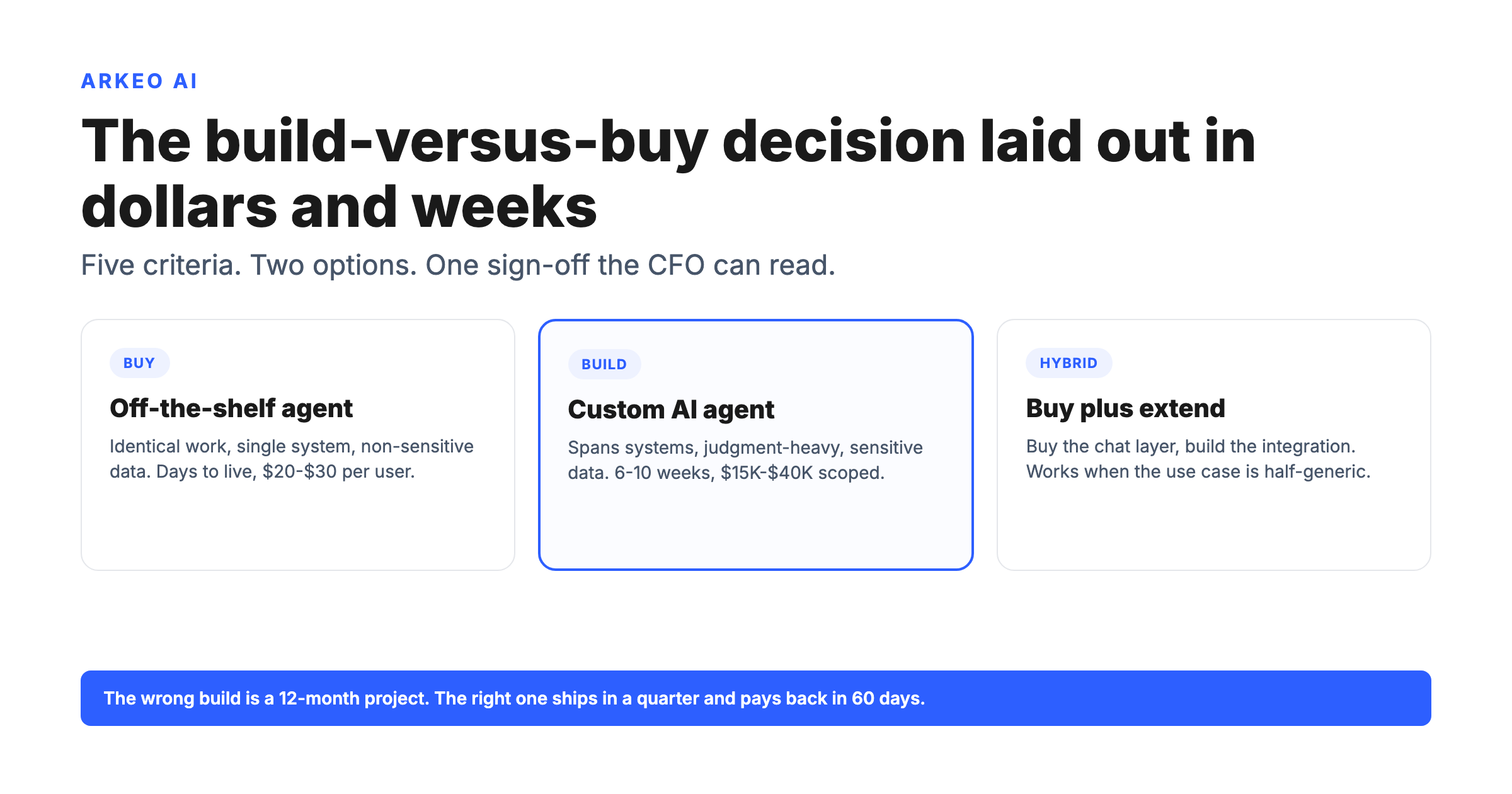
This is also where the build-versus-buy question gets answered honestly, and it helps to put real numbers against it. A general-purpose copilot such as Microsoft Copilot runs about $30 per user per month for email and admin help, with no custom build and a go-live measured in days. That is the right tool when the workflow is identical every time and lives inside one system: use it, and do not pay to build what a setting can do. A custom AI agent is a different commitment. Scoped to a single workflow, one typically costs about $15,000 to $40,000 to build depending on integration complexity, and a version with one integration usually takes 6 to 10 weeks to reach production. It is warranted when the workflow spans systems, requires judgment on variable input, and touches data you cannot send to a public cloud. For larger organizations, the integration, access control, and governance demands push toward enterprise-grade agent deployments that fit existing security and audit requirements rather than working around them.
Three signals that a company is ready for AI agents
Companies push themselves into agent projects before they are ready. The three signals below tell you whether your operation can absorb the change. Without all three, the project usually stalls in pilot.
Stable workflow
The workflow is well-mapped and repeatable. Junior staff can describe it without inventing steps.
Reachable data
The data the agent needs sits in systems it can access. No six-month data project before the build.
Owner who runs it
A named operator who runs the workflow today and will own the agent tomorrow. Not the innovation team.
How Do You Decide What to Build First?
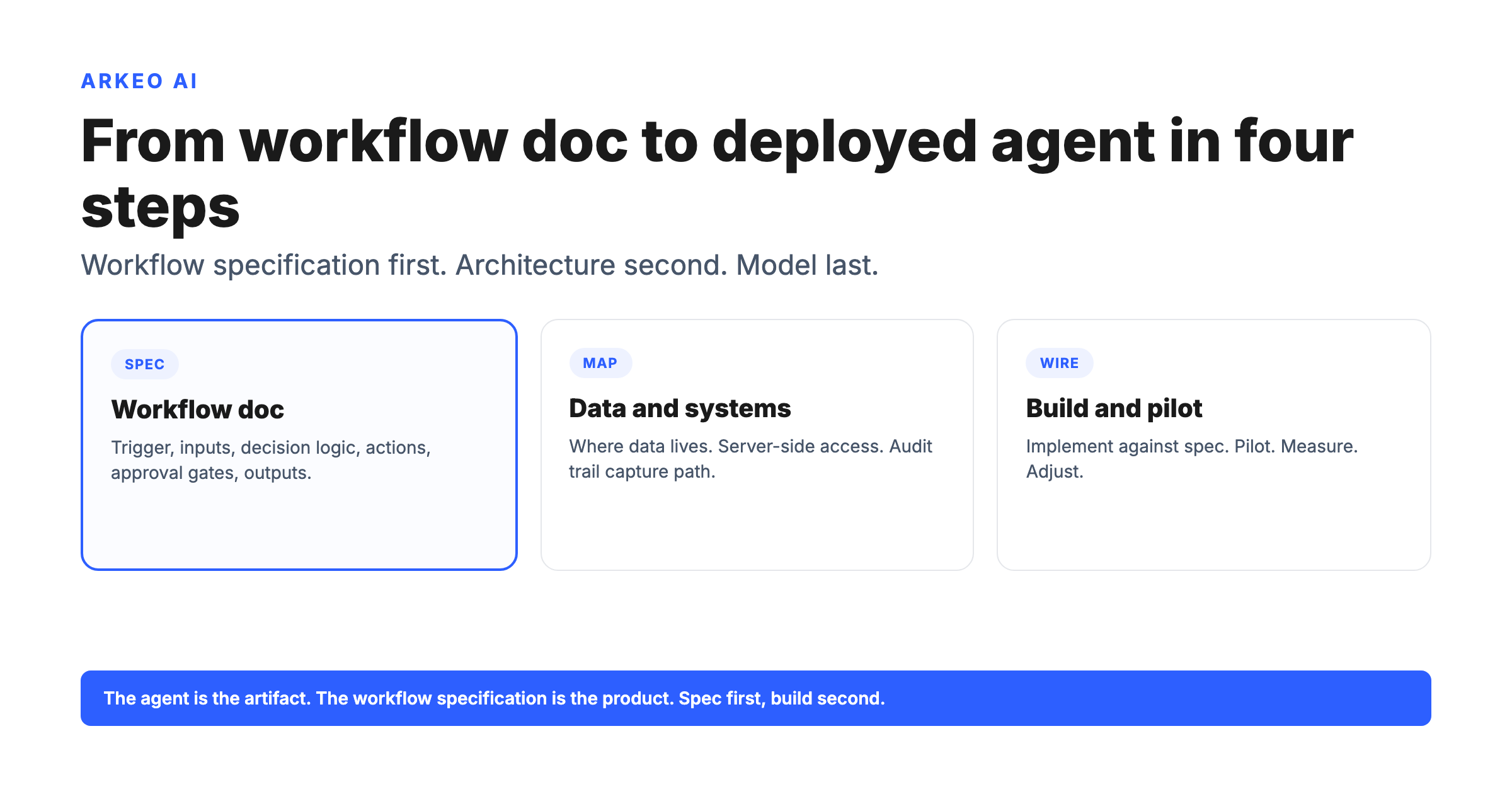
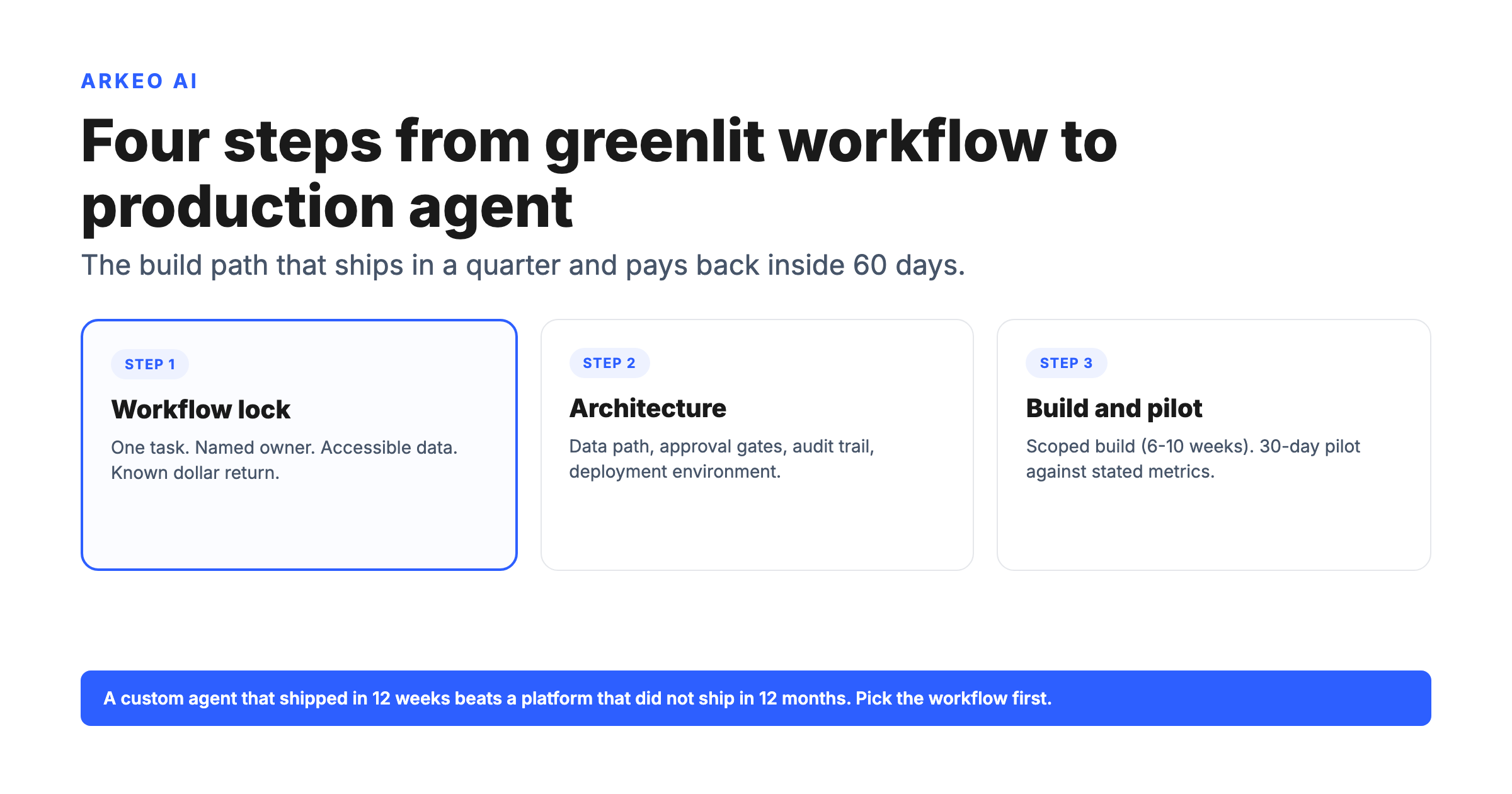
The mistake is trying to boil the ocean. The discipline is sequencing. Arkeo runs this as a four-stage path, and it works because it pays for itself before the expensive part begins.
Current State. Map the bottlenecks and the data. Where do hours go, what systems hold the truth, where does work pile up waiting on a person. 30-to-90-Day Easy Wins. Turn on prompts and off-the-shelf tools that need no custom build. These typically land in 30 to 90 days and start returning hours almost immediately, which is what funds the rest. Mid-Term Agent Opportunities. Pick the top three custom workflow agents where the ROI is provable, build them with owners and approval gates, and measure the hours returned. The first custom agent is typically in production within 60 to 90 days of a green-lit workflow. Long-Term Architecture. Move toward a private AI operating system: a coordinated set of agents working inside your own environment, on your stack, with your data, over a 12-month horizon.
That last stage is where Arkeo's posture matters. Arkeo builds on-premise and private AI, so your customer records, financials, and proprietary processes never leave your control. We use what we sell: the same agent stack runs Arkeo's own operations before it is recommended to a client. For companies in regulated industries or handling sensitive IP, that private AI deployment model is the difference between an agent you can trust with the real data and one you can only demo with fake data. You can see the broader picture of how the pieces fit on the Arkeo AI homepage.
The honest summary: AI agents are real, the value is real, and the gap between using AI and getting value from it is also real. The upside that has executives moving is large: Capgemini estimates that by 2028, AI agents could generate up to $450 billion in economic value across surveyed markets (Capgemini, 2025). PwC found that 88% of executives plan to increase AI budgets in the next twelve months because of agentic AI. The budget is coming. The question is whether it lands on a planned sequence of agents with owners and ROI, or on another pilot that demos well and dies. The first agent you build should be the one you can prove, not the one that sounds most impressive in a meeting.
Find your first agent worth building
The free AI Assessment turns the four-stage path above into a concrete plan: your quick wins, your first three agent candidates, and the ROI behind each one.
Book Your Free AI Assessment →