Category
How to Choose the Best AI Agents for Business
Last updated: June 2026
If your shortlist for the best AI agents for business currently lives in a vendor demo deck, the trap waiting for you is buying the loudest model on the market and discovering inside the first integration that it cannot reach the data where your work actually lives. The wrong choice locks you into a $40,000 to $120,000 platform commitment for a workflow you could have automated with $20,000 of custom build, plus a vendor lock-in clause that surfaces at renewal. The right one ships in a quarter, returns capacity inside 60 days, and lets you keep the data inside the building. This guide gives you the four-step shortlist process, the seven evaluation criteria that separate operators-grade agents from demoware, and the question only a human still has to answer.
Arkeo has been deploying custom AI agents on its own operations since 2023, on 25 years of running mid-market businesses, and on a private, on-premise stack so client data never leaves the building. Stated as fact: we use what we sell. The Stanford HAI 2025 AI Index reported 78% of organizations used AI in 2024, up from 55% the year before (Stanford HAI, 2025).
Quick Answer
• What it is: The best AI agent for your business is the one tied to your largest dollar bleed in a workflow with a named owner and accessible data, not the highest-ranked agent on a vendor list.
• Top three lanes: Sales qualification, finance reconciliation, and operations reporting are the three lanes mid-market companies see the first measurable return.
• Cost: A scoped single-workflow custom agent costs about $15,000 to $40,000 (6 to 10 weeks; 8 to 12 weeks if private). Off-the-shelf copilots run $20 to $30 per user per month.
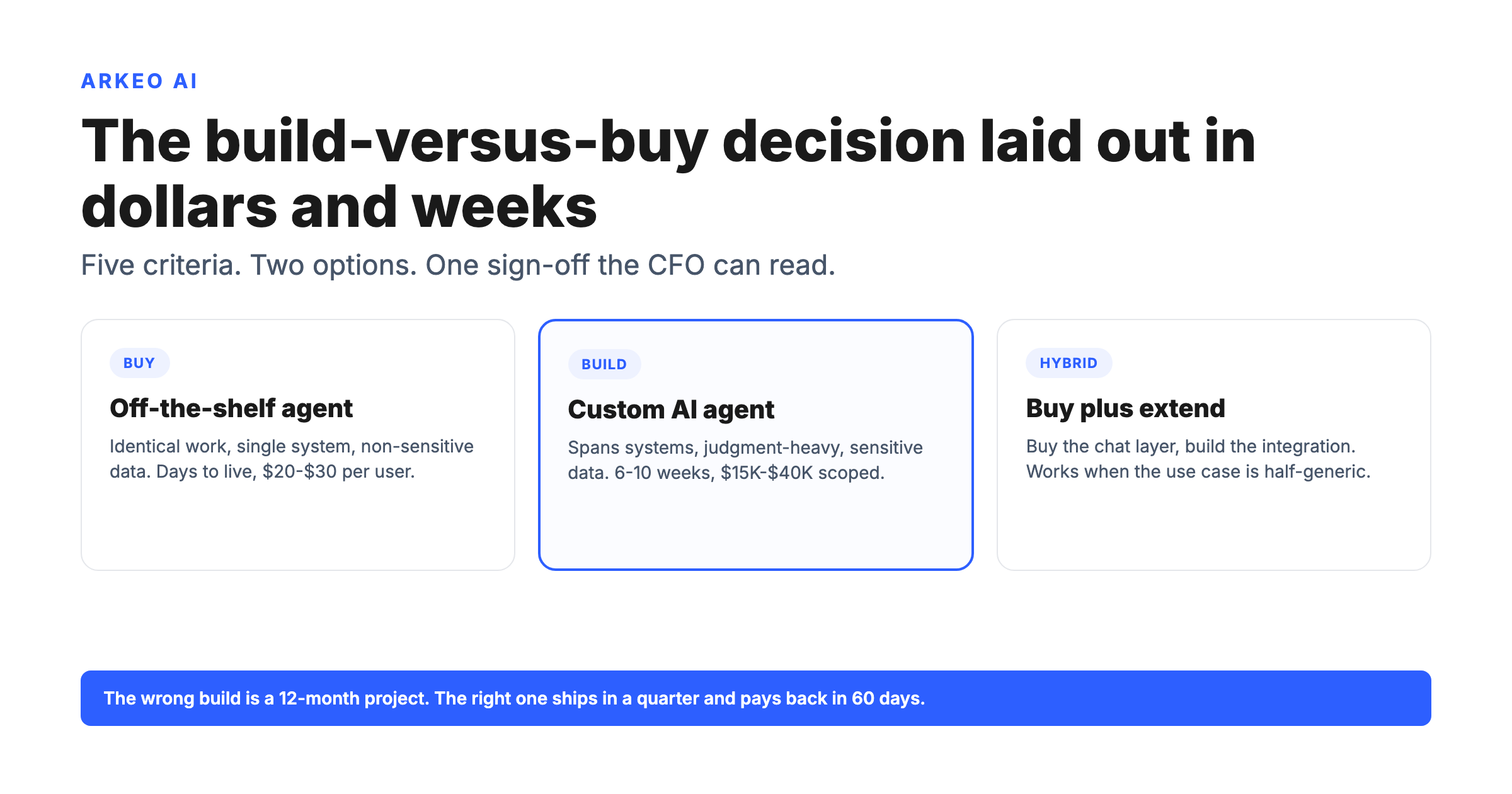
• Pick rule: If the work is identical every time and lives in one system, buy. If it spans systems or touches sensitive data, build custom. Skip anything that needs three integrations to do the job.
• Next step: The free AI Assessment scores your shortlist against your workflows and data.
What Are the Best AI Agents for Business Right Now?
The best AI agent for a business is the one tied to its largest dollar bleed in a workflow with a named owner, accessible data, and a clear approval path, not the agent at the top of a vendor list. The answer changes by company, which is why the operator-grade approach starts from the workflow and works back to the tool, not the other way around. PwC found 79% of organizations have already adopted AI agents and 66% of adopters report measurable productivity value (PwC, 2025); the returns concentrate in companies that matched the agent to the workflow.
The most common mid-market mistake: treating chatbots and agents as the same category. A chatbot answers questions and waits for the next one. A general copilot drafts inside one app. An AI agent reads from multiple systems, decides what to do, takes action across them, and stops for human approval. When the vendor pitch blurs the three, the buyer ends up with a chat tool that cannot reach the workflow it was sold to fix.
THE SHORTLIST PROCESS
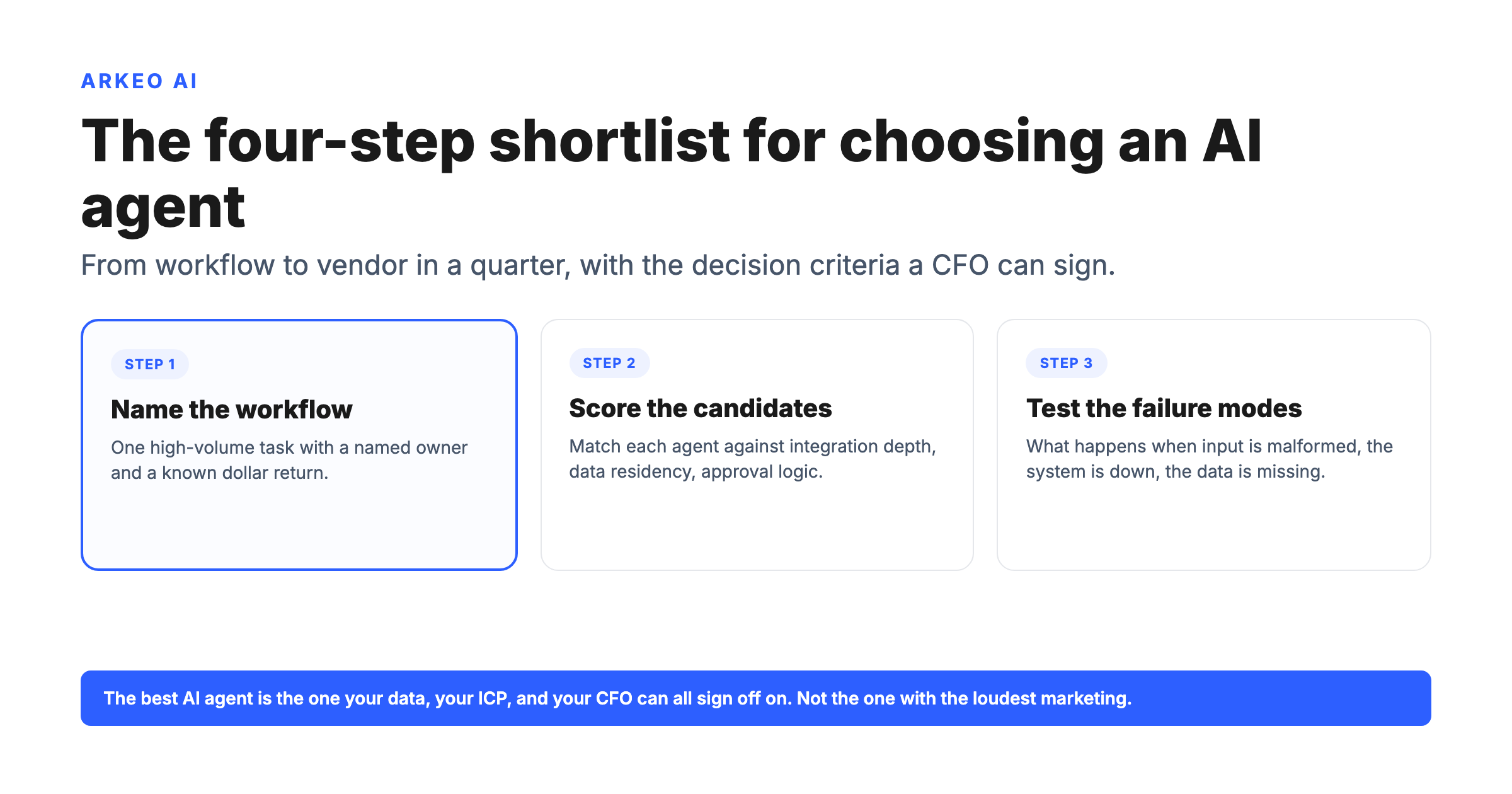
A four-step shortlist for choosing an AI agent
From workflow to vendor in 4 to 6 weeks; the decision criteria a CFO can sign.
01
Name the workflow
One task, named owner, accessible data, clear approval logic, known dollar return. If any one is missing, build readiness before choosing a vendor.
02
Score the candidates
Integration depth, data residency, approval logic, audit trail, cost at three-year run, vendor stability, exit path. Seven criteria; nothing else.
03
Test the failure modes
What happens when input is malformed, the source system is down, the data the agent needs is missing, the model returns the wrong answer? The agent is only as good as how it fails.
04
Pilot one workflow against ROI
Run a 30-to-60-day pilot on the named workflow with stated metrics. Hours returned, response time, error rate. If two of three do not move, the workflow was wrong.
A best-of-list ranking that ignores your data, your ICP, and your approval logic is a marketing artifact. The shortlist starts with your workflow.
Architect your shortlist on your own workflowsThe free AI Assessment runs this four-step process against your data and names the agent worth piloting first.
Book Your Free AI Assessment →
Want a walk-through against your own workflow? The free AI Assessment runs this framework on your data.
What Are the Seven Evaluation Criteria That Separate Operator-Grade Agents From Demoware?
The vendor demo always works. The integration is where the truth surfaces. Capgemini reports only 14% of organizations have any AI agent in production at all (Capgemini, 2025), with most pilots stalling at integration and governance rather than model performance. Seven criteria predict which agents actually reach production.
CRITERION 01
Integration depth
Does the agent reach the systems where your work lives, or only the ones in the vendor's logo wall? Watch for connectors marked "available" that require a $50,000 services engagement to actually run.
CRITERION 02
Data residency
Where does your data go when the agent processes it? Public cloud is fine for non-sensitive work; sensitive workflows need private or on-premise deployment with documented residency.
CRITERION 03
Approval logic
Can you define what the agent drafts versus what it executes? Granularity matters; per-action approval gates beat blanket on/off switches.
CRITERION 04
Audit trail
Every decision, every action, every data read logged with timestamps and reasons. If a regulator asks why the agent did what it did, the answer should not be a screenshot.
CRITERION 05
Cost at three-year run
Per-seat plus per-action plus integration plus support. The cheapest in year one is often the most expensive in year three.
CRITERION 06
Vendor stability
Funding stage, customer count, churn signal, roadmap discipline. The AI agent market will consolidate; pick a vendor that survives it.
CRITERION 07
Exit path
Can you take your data and your trained logic with you if the vendor disappears or you want to bring it in-house? An agent platform with no exit is a hostage contract.
Buy the best off-the-shelf agent or build a custom one?
The work is identical every time, lives in one suite, and the data is not sensitive. Cost: about $20 to $30 per user per month. Live in days. Right answer for writing, summarization, single-system productivity.
The work spans systems, requires judgment, or touches sensitive data. Cost: $15,000 to $40,000 to build (8 to 12 weeks if private). Right answer when the workflow is your competitive logic and not a generic productivity task.
Posts on custom AI agents solutions and build versus buy and on the cluster pillar ai agents for business drill further into the criteria above and the decision logic that turns them into a build plan.
A best-of-list that ignores your data is a marketing artifact. The shortlist starts with your workflow.
drop in executive trust in fully autonomous agents inside a single year (43% to 27%), driven by deployments that skipped the approval gate.
What Does an Honest Agent Rollout Look Like After You Pick?
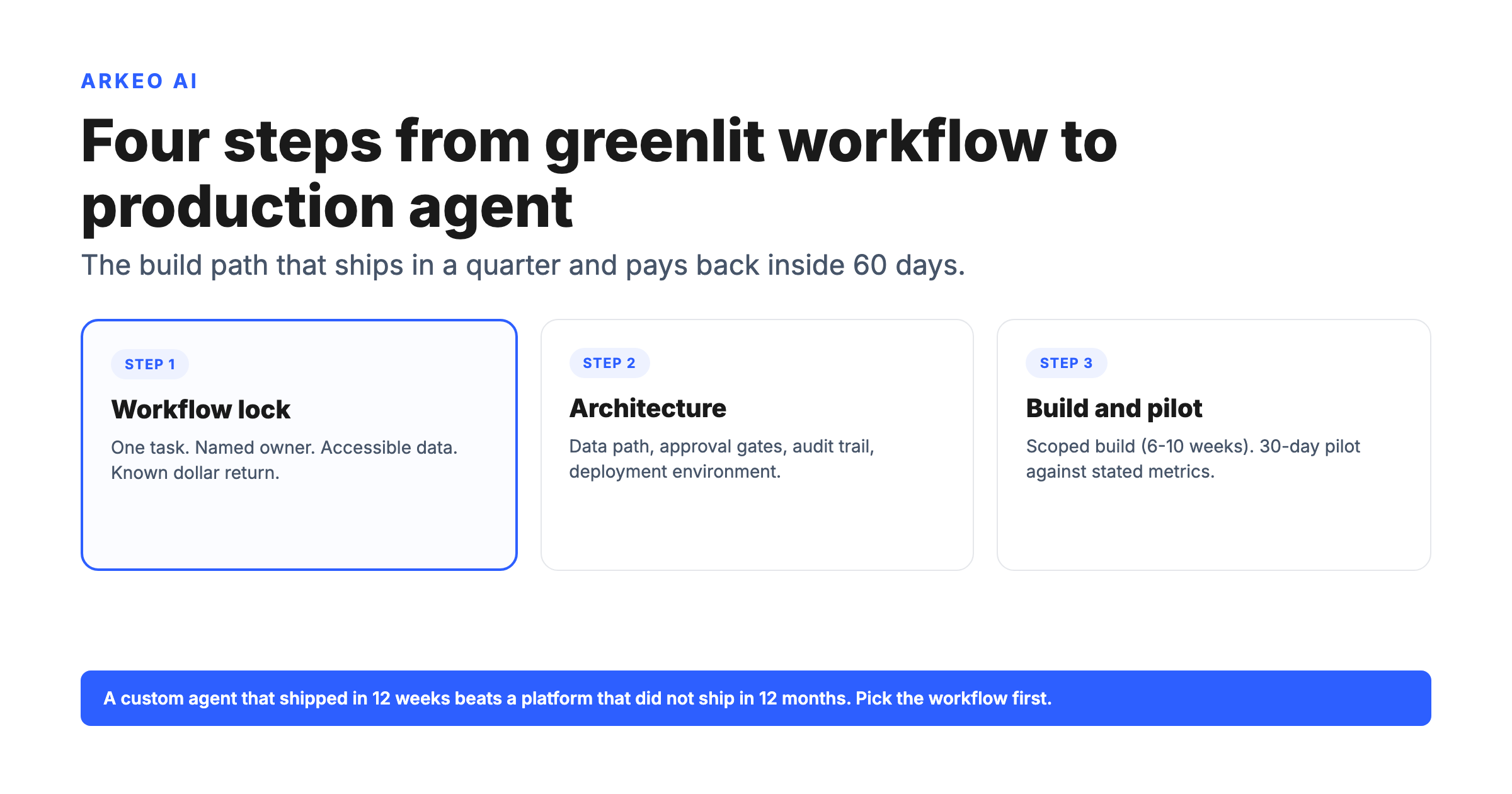
The honest answer: short pilot, named owner, clear ROI, and the data path locked before any vendor touches a system. In Arkeo's own builds, the first custom agent is typically in production inside 60 to 90 days of a green-lit workflow, with the first quick win on the same task landing inside 30 days using prompts and off-the-shelf tools. That timing is the pattern that paid for the rest of the rollout.
For larger organizations, integration and governance demands push the conversation toward private deployments that fit existing security and audit requirements rather than work around them. The deep dive on the build itself sits in the post on building custom AI agents.
Pick the right agent against your own workflowsThe free AI Assessment scores your shortlist against your data, your ICP, and your approval logic, and names the first agent worth piloting.
Book Your Free AI Assessment →