Category
The Competitive Edge Only 2% of Construction Firms Are Using
Last updated: April 2026
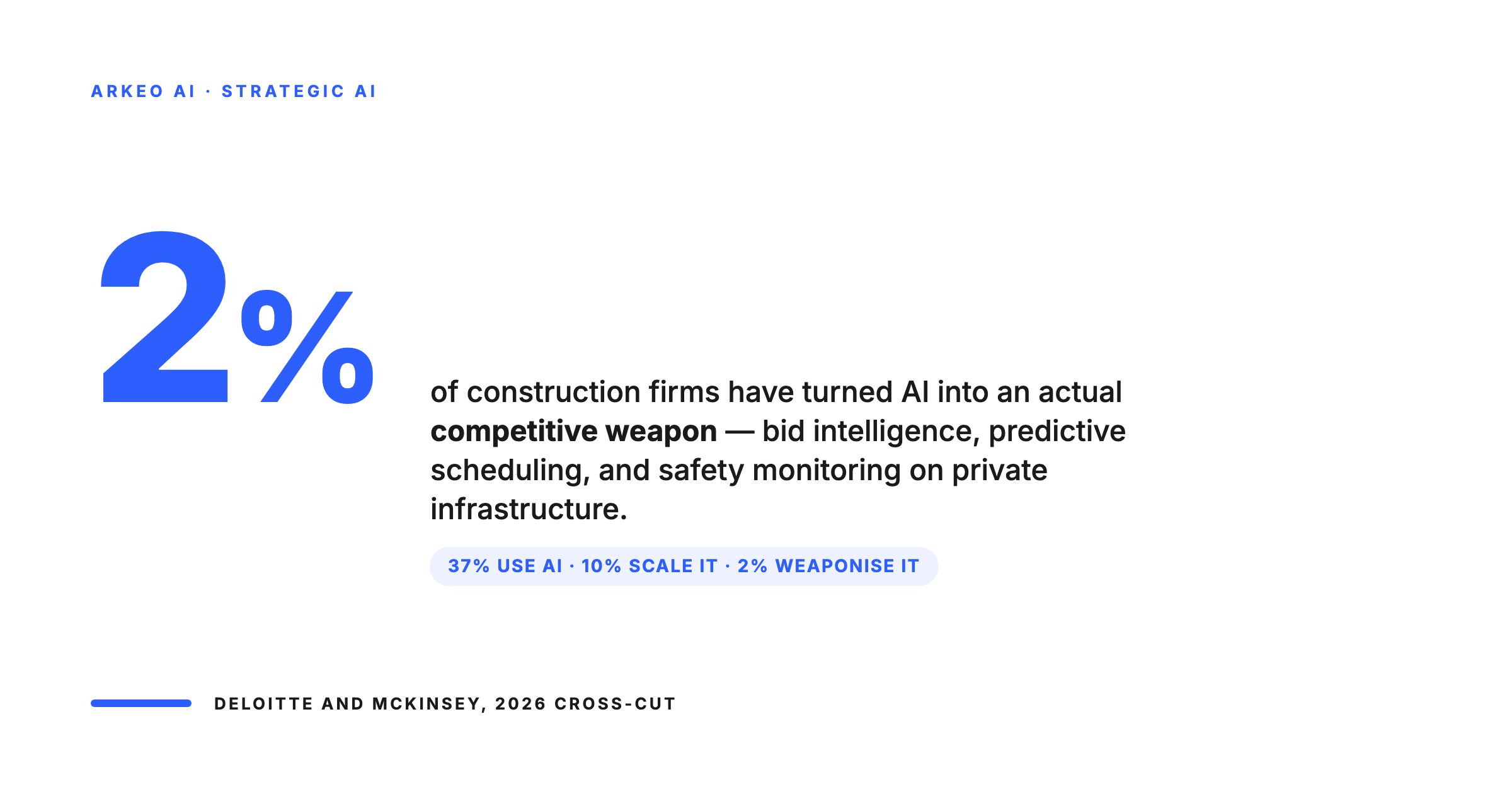
When this article was first published, AI adoption in construction sat around 2%. Deloitte's 2025 survey now puts it at 37%. But most of that adoption is surface-level. The competitive edge in construction AI is not using it: it is deploying it strategically on your own data, on your own infrastructure, so your bid pricing, project history, and operational intelligence compound with every project you complete.
⚡ Quick Answer
- Adoption: 37% of construction firms now use AI (Deloitte), but no more than 10% have scaled it into core operations (McKinsey).
- Advantage: The top firms use AI for bid intelligence, predictive scheduling, and safety monitoring, trained on their own data, running on their own infrastructure.
- ROI: Early adopters reclaim 500-1,000 hours on critical tasks (Bluebeam). 89% report measurable profitability gains.
- Timeline: Assessment to production deployment takes 90 days. No data science team required.
How They Are Winning: Three Areas That Matter Most
Three areas where private AI turns into a measurable competitive moat
Generic AI tools give every subscriber the same capability. Private AI trained on your projects compounds. The firms pulling away are running these three loops on their own data.
Smarter bid pricing
Win rate climbs as the model learns your true cost basis, your historical margins, and the bids you actually closed.
Predictive risk flags
Schedule slips, weather windows, and supplier delays surface weeks ahead instead of after the critical path goes red.
Real-time safety monitoring
Vision models catch PPE, posture, and proximity violations live. Incident rates drop and client audits go cleaner.
1. Bidding Smarter, Not More
The top firms are using AI to analyse their historical win/loss data, competitor patterns, and project specifications. Instead of bidding on everything, they are identifying their most winnable projects and pricing them with precision.
AI surfaces patterns humans miss: which project types you close at the highest margin, which clients are most likely to award, which bid ranges win in your region. The firms doing this on private infrastructure have an additional advantage: their pricing intelligence stays completely internal.
2. Reducing Delays with Predictive Project Insights
Schedule slippage and cost overruns remain the industry's most expensive problems. AI changes the equation by monitoring project timelines, flagging risks before they become crises, and optimising resource allocation in real time.
Firms running these systems on their own infrastructure get the added benefit of compounding intelligence. The AI learns from every project you complete. Your predictions get sharper over time because the model is trained exclusively on your data.
3. Running Leaner, Safer Job Sites
AI-powered safety monitoring, predictive equipment maintenance, and automated compliance reporting are production-ready and delivering measurable results. Bluebeam's 2025 report found that 89% of early AI adopters reported measurable profitability gains.
For firms operating under Canadian data residency requirements or handling sensitive government project data, running these systems on private infrastructure is not just a competitive choice. It is a compliance requirement.
Where Is Your Competitive Edge?
Book a free 30-minute AI Assessment. We will map your highest-impact opportunities, assess your data exposure, and outline a phased 90-day deployment plan. No obligation.
Why Most Firms Have Not Made the Move
"We do not know where to start." The starting point is simpler than you think: figure out where you are losing time and money, and apply AI there first.
"We are too busy to take on another system." The busiest firms are usually burning the most hours on manual estimating, chasing RFIs, and managing schedules by hand. Those are exactly the tasks AI handles best.
"It feels like something for bigger companies." A 50-person contractor can deploy a private AI system in under 90 days. You do not need a dev team or a data centre.
"We are worried about our data." You should be. If your team is already using cloud AI tools, your bid data, client information, and project details are flowing through third-party servers right now. Private AI is how you fix that.
What It Is Costing You to Wait
The AI in construction market is projected to reach $6.02 billion in 2026, growing to $35.53 billion by 2034 (Fortune Business Insights). This is accelerating, not plateauing.
Firms that wait are falling behind: losing winnable bids to competitors with sharper AI-powered pricing, burning hours on manual work that AI-enabled firms automated months ago, absorbing preventable delays that predictive systems would have flagged, and exposing sensitive data every time an employee uses cloud AI for project work.
Every project you complete without a strategic AI system is a missed opportunity to build compounding intelligence.
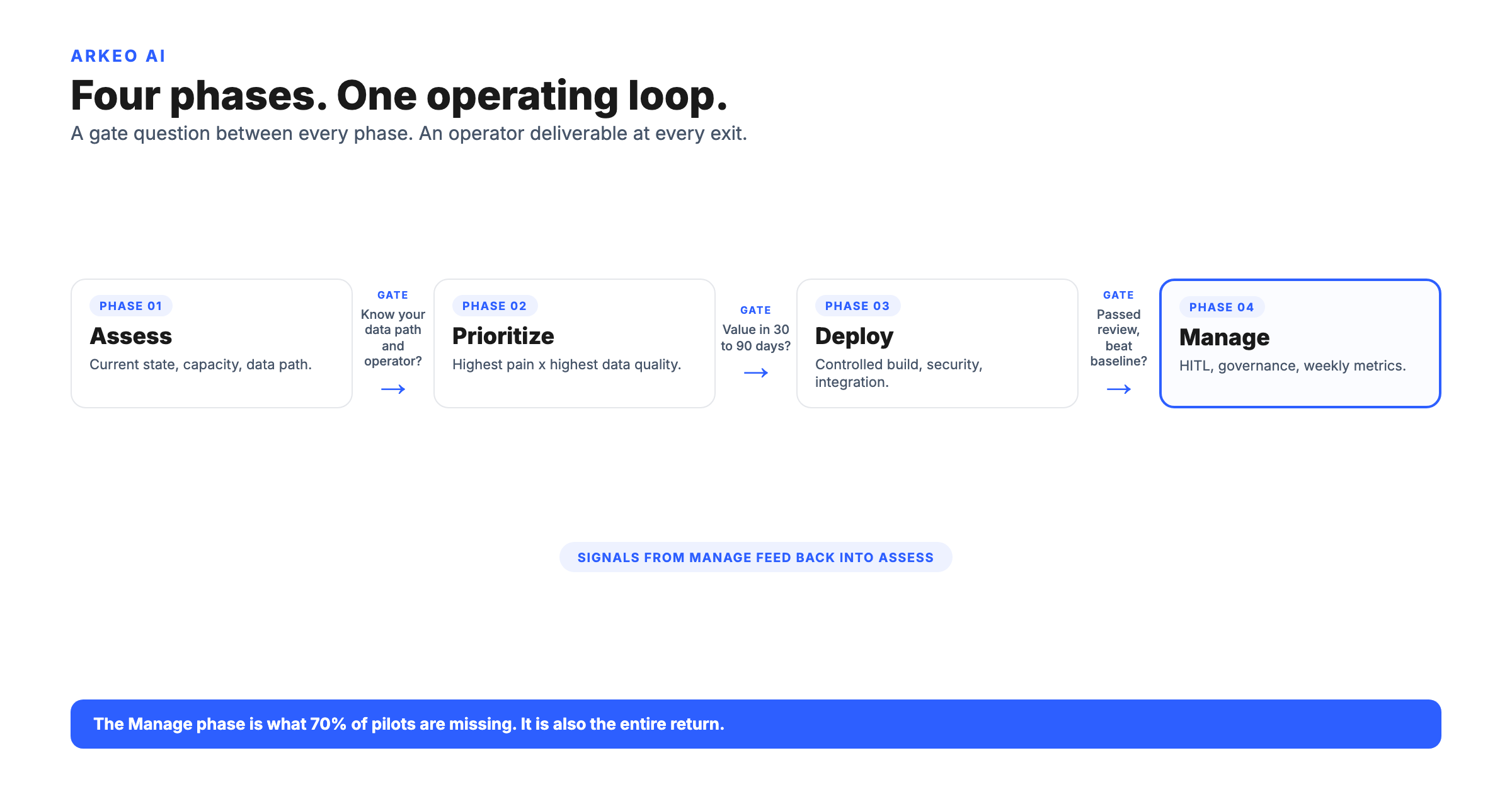
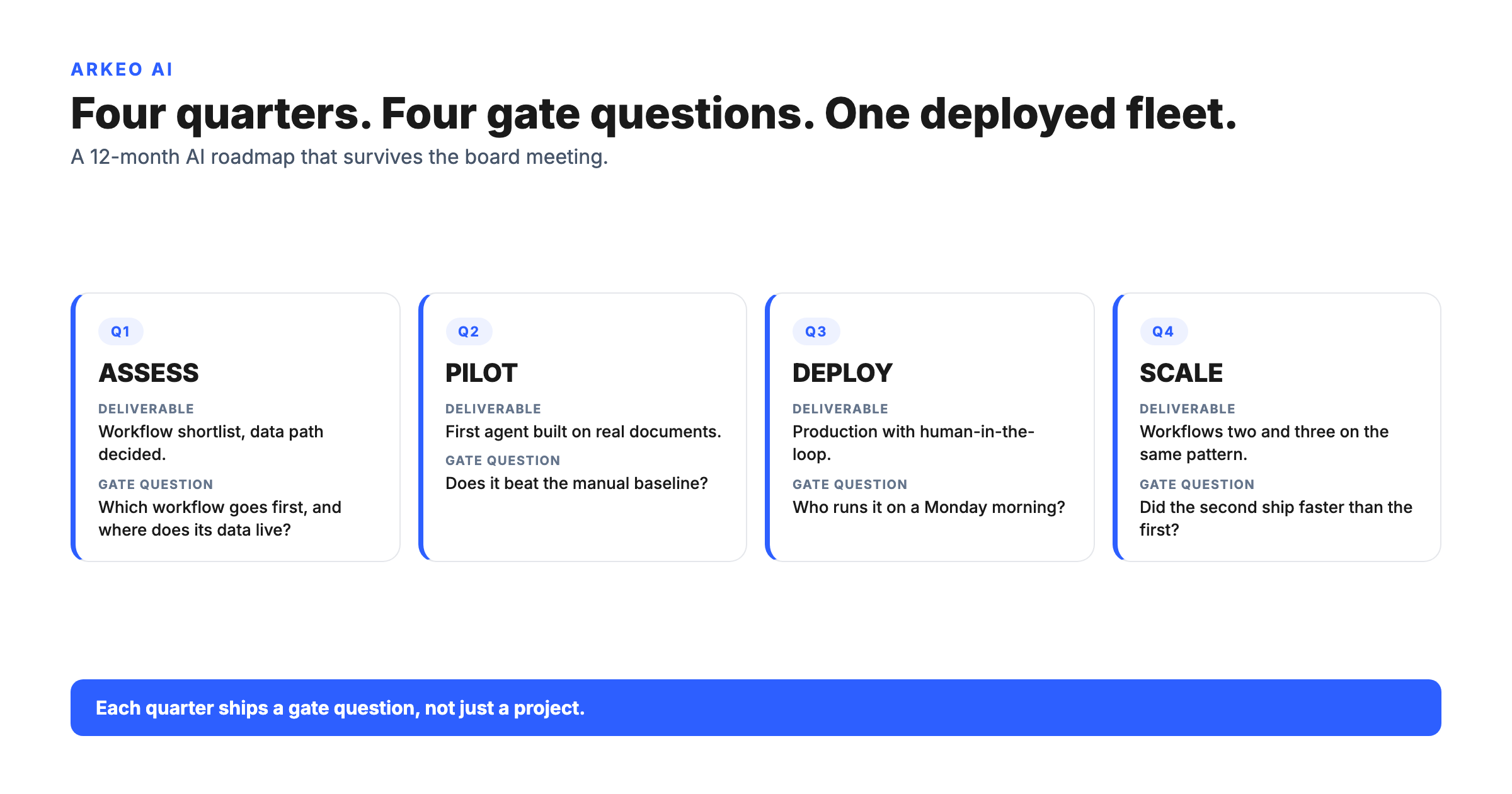
From assessment to a deployed private AI system in one quarter
No data science team required. The firms doing this are mid-market contractors. They run the same three-stage pattern, in the same order, every time.
Audit and use case
Map current AI usage and data exposure, pick the one workflow with the highest payback. Measure the baseline.
Pilot deployment
Stand up the private system on your data, tune to your standards, ship a first version to a single team and measure.
Scale and govern
Roll out across teams, add the second workflow, lock down access and audit logs. The system pays for itself by day 90.
Ready to Build Your Competitive Edge?
Book a 30-minute AI Assessment. We will walk through your current workflows, identify where you are exposed to cloud AI risk, and map out the highest-impact opportunities. Real numbers, not generic recommendations.