Category
What Self-Hosted AI Means for Business
Last updated: May 2026
You want the speed and leverage of AI inside your business, but every time a team member pastes a contract, a patient record, or a pricing model into a public chatbot, that data leaves your control and lands on infrastructure you do not own. Arkeo AI has spent three years deploying AI agents into live operations and building the Arkeo Operating System (AOS), and the pattern holds across every engagement: where your AI runs is a business decision, not a hobbyist project. For a regulated firm, a company with real trade secrets, or any operator who has read their cloud AI vendor terms of service closely, that exposure is not theoretical. It is a daily reality. Self-hosted AI is the deployment model built to close that gap, and the question on the table is whether it is worth what it costs you to run.
Before you commit hardware, headcount, or a multi-year roadmap, it is worth understanding what self-hosted AI gives you, what it takes from you, and where it genuinely fits. The right deployment model is rarely the loudest one in the market. Start by booking a free AI Assessment to map your data paths and pick the model that matches your risk, or read on first.
Quick Answer
• What it is: AI models that run on infrastructure your organization controls, so prompts and data never transit a vendor's shared systems.
• Cost shape: High upfront capital (hardware, setup) plus fixed ongoing cost (power, staffing); marginal inference cost approaches zero, so it pays off above a certain usage volume.
• Best fit: Regulated industries, sensitive data, high-volume workloads, and strict data-residency requirements.
• Why it matters: The global average cost of a data breach hit USD 4.88 million in 2024, and where your AI runs is now a compliance variable, not just a security preference.
What Does Self-Hosted AI Mean for a Business?
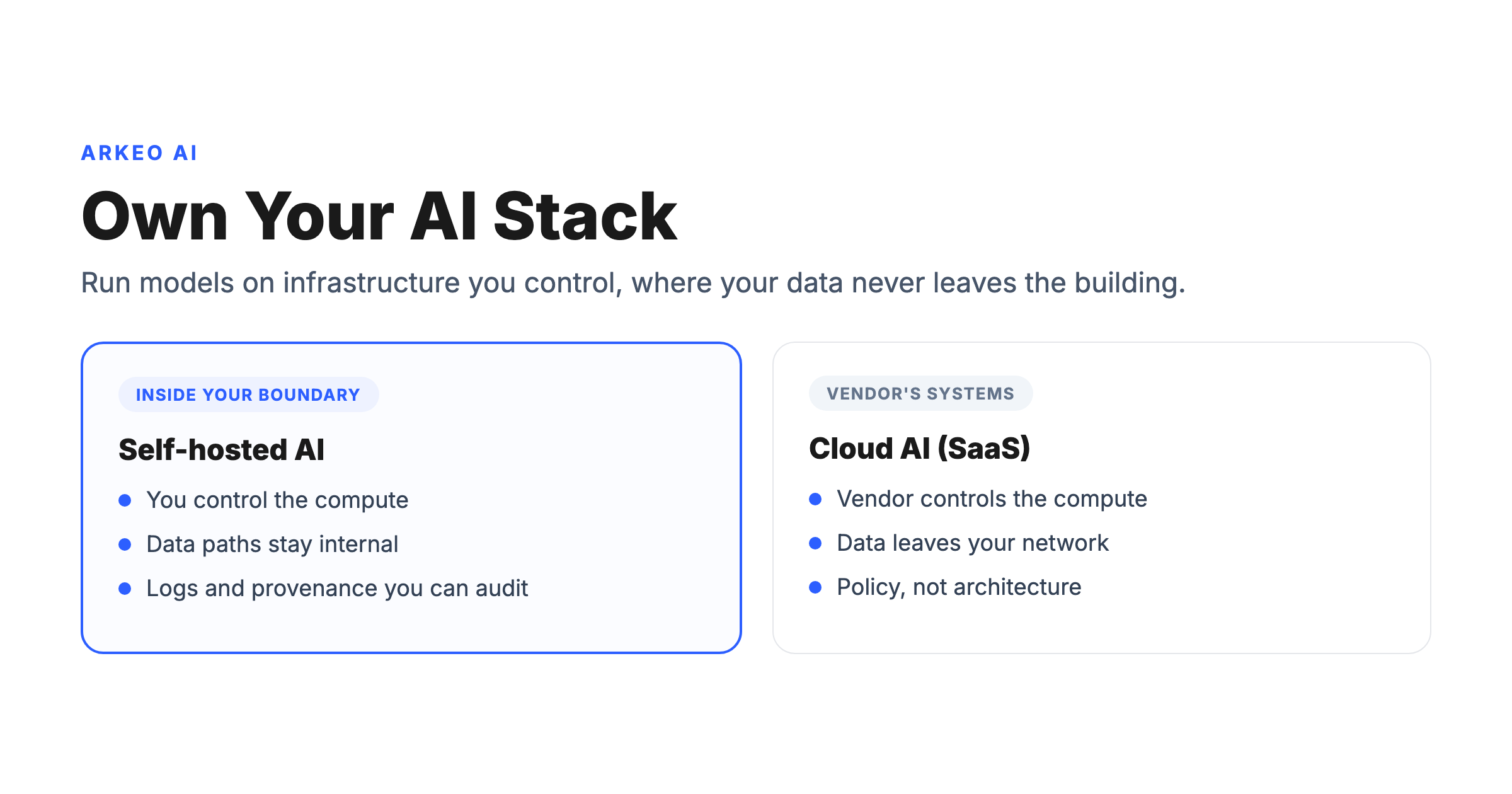
Self-hosted AI means the model runs on infrastructure the organization controls, so prompts, documents, and outputs never transit a vendor's shared systems. That control can take the shape of a server rack in your own data center, a dedicated machine at a colocation facility, or a private cloud tenant carved out for you alone. What it is not is a shared multi-tenant API endpoint where every request travels through a vendor's pipes and sits, even briefly, in systems you cannot audit.
The business framing matters more than the technical one. Self-hosting is not about owning servers for the sake of it. It is about owning four things: where inference happens, who can access the system, which data paths your information travels, and what your compliance posture looks like when an auditor asks you to prove it. A SaaS chatbot answers to its vendor's roadmap and terms. A self-hosted system answers to you.
Adoption has made this an urgent decision rather than an academic one. According to Stanford HAI's AI Index Report 2025, 78% of survey respondents reported AI use by their organizations in 2024, up from 55% the year before, a 23-percentage-point jump in a single year. Gartner forecasts that by 2026 more than 80% of enterprises will have used generative AI APIs or deployed generative AI applications in production, up from less than 5% in 2023. The tools are already inside your business. The only open question is where the data they touch actually goes.
How Is Self-Hosted AI Different From SaaS AI?
The cleanest way to see the difference is to follow the data. With a SaaS AI product, your prompt leaves your network, travels to the vendor's infrastructure, gets processed by compute the vendor owns, and returns an answer. The vendor's policies govern retention, logging, and access. With self-hosted AI, that entire round trip happens inside a boundary you define and control.
That distinction is not abstract. Cisco's 2024 Data Privacy Benchmark Study, a survey of 2,600 privacy and security professionals across 12 geographies, found that 48% of organizations admitted to entering non-public company information into generative AI tools, and 45% entered employee information, even though 68% worried that data could be disclosed to competitors or the public. That is the SaaS data path in action: information flowing out of the building faster than governance can keep up. Self-hosting eliminates the leak at the source because there is no external system for the data to flow into.
The cost shape is the other half of the comparison, and it runs in the opposite direction. SaaS AI charges per seat or per token, a variable cost that scales with every query and every new user you add. Self-hosted AI front-loads a capital cost in hardware and setup, then carries a fixed ongoing cost in power and staffing, while the marginal cost of each additional inference falls toward zero. Above a certain usage volume, or below a certain latency tolerance, that math flips in favor of running your own stack. The two models are not just priced differently; they are shaped differently, and the shape is what determines where each one wins.
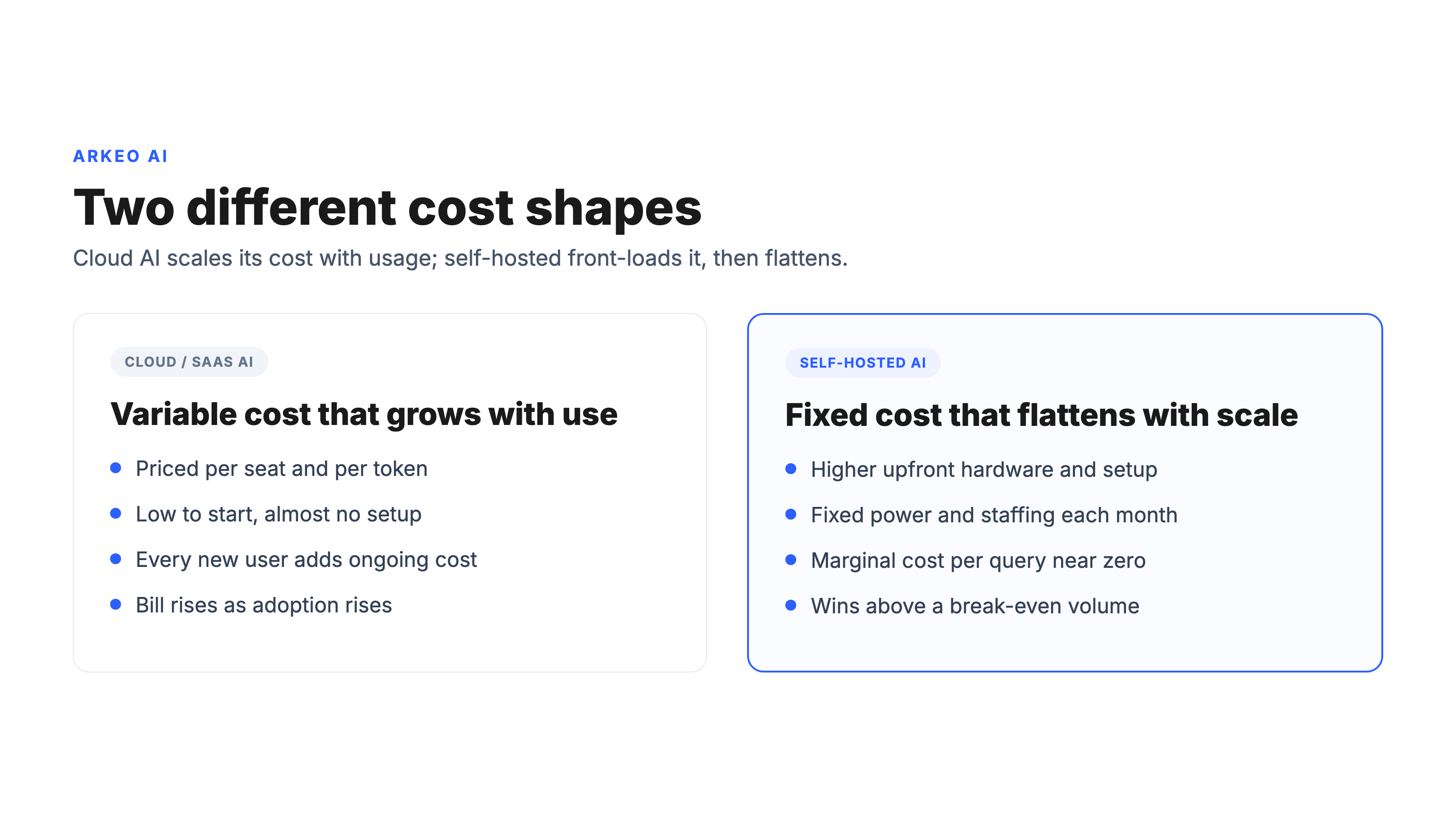
Usage volume sits at the center of that math. A team running a handful of queries a week rarely out-earns the cloud's variable pricing; a team pushing thousands of documents through AI every day crosses the break-even point and keeps going.
Isn't 'Private Mode' in Your AI Tool the Same Thing?
Here is a false belief worth correcting directly. Most businesses assume that flipping on the enterprise privacy tier or the data-retention opt-out in their hosted AI tool is functionally the same as self-hosting. It is not, and treating it that way is how compliance gaps get written into contracts.
Enabling private mode in a SaaS tool changes the vendor's data-use policy. It does not change where inference happens, who controls the compute, or which jurisdiction the request travels through. Your data still leaves your environment. You are now relying on a contractual promise instead of an architectural fact. For many use cases that promise is acceptable. For a regulated workload, a contractual assurance you cannot independently verify is a thinner shield than it looks. The confidence gap is real: in a Gartner survey of 360 IT leaders in 2025, only 23% said they were very confident in their organization's ability to manage security and governance when deploying generative AI tools.
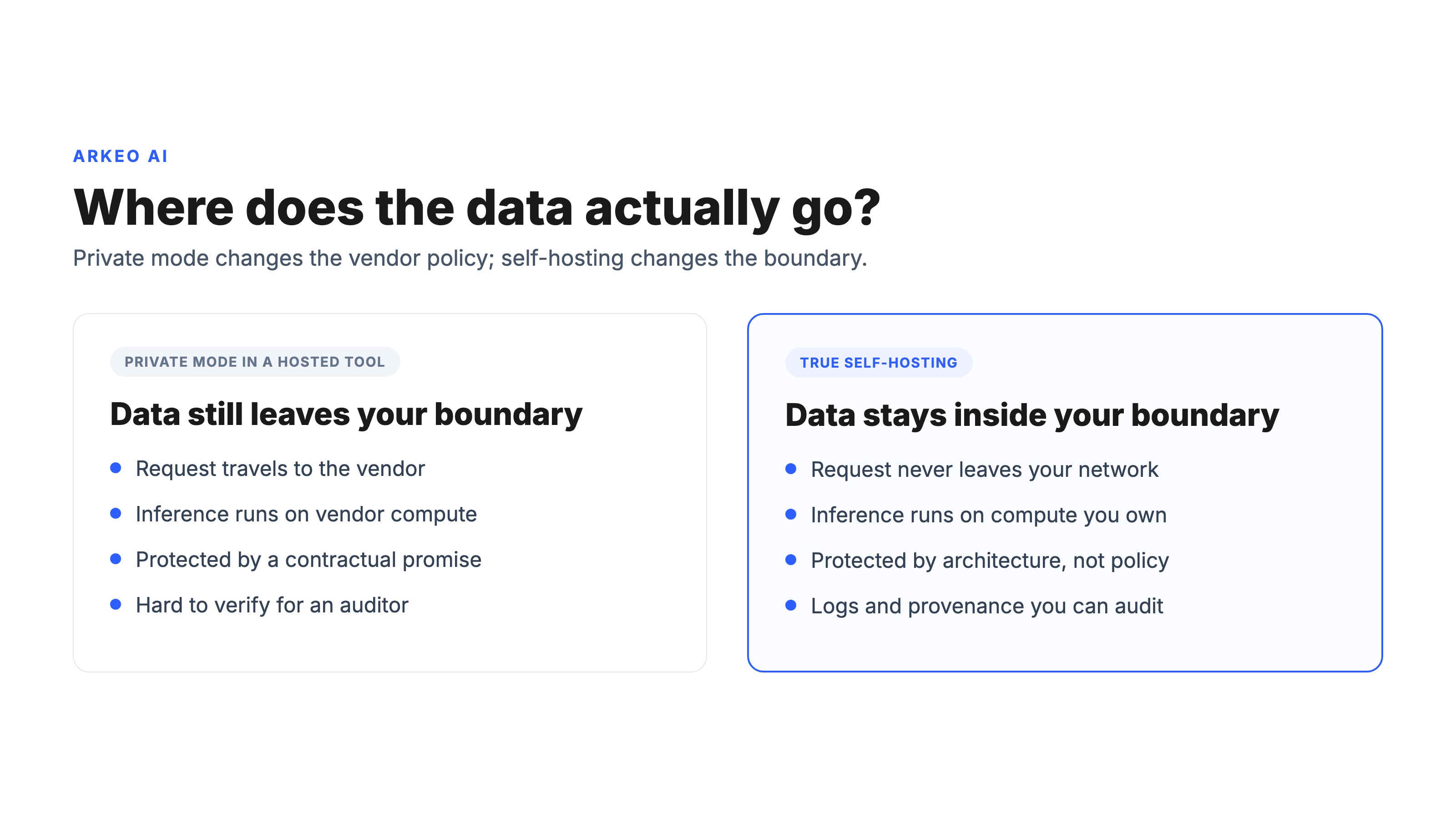
The boundary is the whole point. In private mode the request still crosses out of your environment; the setting only governs what the vendor promises once it arrives. In a true self-hosted deployment the request never crosses that line. For a team that has to prove to an auditor where its data physically went, that distinction decides the audit.
Why Do Businesses Choose Self-Hosted AI?
Four drivers push businesses toward self-hosting, and they usually arrive bundled.
Compliance. Regulation has caught up with the technology. The EU AI Act entered into force on 1 August 2024 and classifies AI systems used in healthcare, financial services, law enforcement, critical infrastructure, and justice as high-risk, subject to mandatory logging, human oversight, risk assessment, and transparency obligations. Compliance failures compound: Thales's 2024 Data Threat Report, drawing on roughly 3,000 respondents across 18 countries, found that 43% of enterprises failed a compliance audit in the prior twelve months, and among those that failed, 31% suffered a data breach that same year, versus only 3% of those that passed.
See where AI actually fits your operation
The free AI Assessment maps your data paths, bottlenecks, and compliance posture, then tells you whether self-hosted, private, hybrid, or cloud AI is the right model for your business, before you commit a dollar of capital.
Book Your Free AI Assessment →
That gap between passing and failing is why a self-hosted deployment is worth the work for regulated teams: it gives you direct access to the logs, model provenance, and data-flow controls that make audit-readiness easier to hold. Those same controls are what Arkeo AI configures and runs on its own systems, because the on-premise and private AI deployments it recommends are the ones it operates itself.
Sensitive data. When the information your AI touches is the thing your business is built to protect (patient records, source code, deal terms, customer financials), keeping it inside your boundary stops being a preference. IBM's Cost of a Data Breach Report 2024 put the global average breach at USD 4.88 million, a 10% year-over-year increase and the largest yearly jump since the pandemic. Healthcare carried the costliest breaches for the 14th consecutive year at USD 9.77 million per incident, and financial services averaged USD 6.08 million, 22% above the global mean. For organizations in those sectors, the cost of getting data exposure wrong dwarfs the cost of running your own infrastructure.
System control. Self-hosting means you decide which model version runs, when it updates, and how it behaves. No surprise deprecations, no overnight policy changes that break a workflow your business depends on.
Custom workflows. Internal assistants, document search across your own corpus, knowledge systems wired into your databases, and workflow agents that act inside your tools all benefit from running where your data already lives, with no external dependency to negotiate.
When Is Self-Hosting Actually Worth It?
Self-hosted AI is not the default answer, and any honest advisor will tell you that. It is the right answer for specific situations and the wrong answer for others. Match the model to the reality of your operation.
Good-fit environments share a few traits: data that is sensitive, regulated, or genuinely proprietary; query volume high enough that per-token cloud pricing becomes a real line item; latency or availability requirements that a public API cannot guarantee; data-residency rules that dictate where information may physically sit; and an internal or partner team capable of running the system. If three or more of those are true, self-hosting deserves serious evaluation.
Poor-fit environments are just as clear: low or sporadic usage where capital sits idle; no sensitive data and no compliance pressure; a small team with no appetite to operate infrastructure; or a need to move fast on experimentation before any deployment model is locked in. Forcing self-hosting onto an environment like this buys you cost and complexity with little to show for it.
Here is the blunt truth a vendor brochure leaves out: self-hosted AI systems require real operational ownership. Models need patching. Hardware fails. Capacity has to be planned. The system that runs flawlessly in a demo will, at some point, fall over in production, and someone on your side has to be ready to bring it back. The savings and the control are real, and so is the work. Three years of deploying these systems into live operations has made that the first thing Arkeo AI tells a prospective client, not the last. You can read deeper on the broader category in this guide to private AI and the infrastructure-level view in this overview of on-premise AI.
What Are the Real Tradeoffs of Self-Hosted AI?
Every deployment model trades one set of constraints for another. Self-hosting is no exception, and naming the costs honestly is the only way to make a sound decision.
Infrastructure. The good news is that the hardware floor has dropped sharply. With open-weight models, a single NVIDIA A100 or H100 GPU server can run 7B to 70B parameter models at usable throughput; larger models need multiple GPUs but are now routinely deployed by enterprise infrastructure teams, not just research labs. This is not fringe. Meta reported on its official Llama blog that its open-weight models reached roughly 350 million cumulative downloads by mid-2024, with monthly token usage growing tenfold from January to July 2024, and enterprises including Goldman Sachs, Shopify, and AT&T running Llama on-premises or through private cloud. Self-hosting frontier-quality open weights is production-viable today.
Maintenance. Capital is the visible cost; operations is the recurring one. Patching, monitoring, capacity planning, and incident response are ongoing obligations that fall on your team or your partner, not the vendor.
Governance. Control cuts both ways. Self-hosting hands you the logs, access controls, and data-flow visibility that auditors love, but you are now the party responsible for configuring and maintaining them. The architecture makes good governance possible; it does not make it automatic.
Support. When something breaks at 2 a.m., there is no vendor SLA absorbing the hit unless you have built one with a deployment partner. This is where the discipline of working with a team that operates these systems daily earns its keep. Arkeo AI was built for exactly this gap: an operator-led firm with 25 years of business experience behind it, applying the same private AI stack it runs internally to the systems it stands up for clients.
How Do You Choose Between Self-Hosted, Private, Hybrid, and Cloud AI?
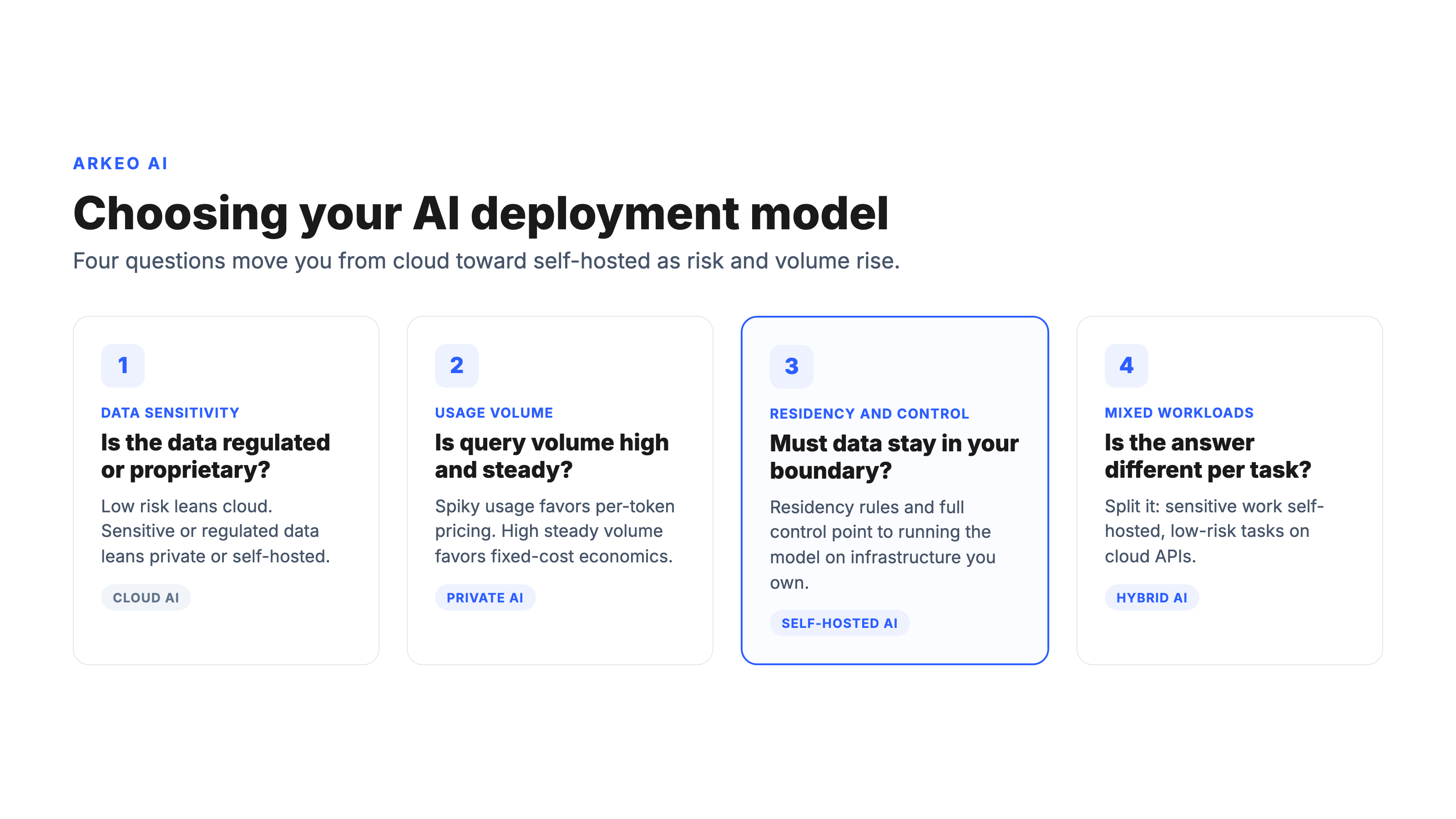
The choice is not ideological. It is a fit assessment, and it runs along a few decision criteria. Start with data sensitivity: the more regulated or proprietary your data, the further you move from public cloud toward private or self-hosted. Layer in usage volume: high, steady volume favors the fixed-cost economics of self-hosting, while low or spiky usage favors variable cloud pricing. Add data-residency rules, latency requirements, and the operational capacity you can realistically commit. Many businesses land on hybrid, keeping sensitive workloads self-hosted or private while routing low-risk tasks to cloud APIs.
This is also where the forward-looking risk matters. Gartner forecasts that by 2027 more than 40% of AI-related data breaches will stem from improper cross-border use of generative AI, as unintended data transfers outpace governance frameworks. Where your AI runs, and where its data travels, is becoming a defining compliance variable. The deployment decision you make now sets the ceiling on how well you can answer for it later.
Picture an operations lead at a 40-person professional services firm whose teams have quietly started leaning on a public chatbot for client work. Usage is climbing, the data is sensitive, and a client audit lands on the calendar six weeks out. The first surprise is the bill: what felt like a few dollars a head has crept past two thousand dollars a month as more people lean on it. The second is the timeline, because standing up a self-hosted stack properly is closer to a three-month project than a weekend one. The instinct is to either ban the tools (which pushes the activity onto personal devices and erases all visibility) or to do nothing. The durable answer is neither: it is to give people a deployment model that is at least as fast, sits inside the boundary, and produces the audit trail the business needs, and to start the build before the audit forces the timeline. Roughly 27% of organizations have already banned generative AI tools at least temporarily over privacy and security risk, per the Cisco study, and bans alone rarely hold.
This is the staged path Arkeo AI has used since 2023: map your current state and bottlenecks, ship 30-to-90-day easy wins, build the top custom workflow agents, then move toward a long-term private AI architecture, all coordinated through the Arkeo Operating System. For the agent-specific layer of that architecture, this guide to self-hosted AI agents goes deeper.
Decide your deployment model with a clear head
The free AI Assessment is a 60-minute planning session that maps your data, risk, and usage, then recommends whether self-hosted, private, hybrid, or cloud AI fits, with a phased roadmap and no obligation.
Book Your Free AI Assessment →