Category
OpenClaw Skills: Building Your Custom AI Workforce
Last updated: May 2026
Most operations leaders are exhausted by the daily routine of pasting the same massive instruction sets into a chat interface just to get a usable output. If your team is relying on memory and saved text files to guide an AI through your internal processes, you do not have an automated workflow. You have an incredibly fragile dependency.
A true enterprise agent does not wait for a human to remember the right prompt. An OpenClaw skill is a modular, self-contained package of procedural instructions, executable scripts, and domain knowledge that permanently teaches an agent how to execute a specific workflow. By treating these skills as structural infrastructure rather than temporary conversations, mid-market companies are finally moving past chatbot experiments and deploying OpenClaw as a secure, private AI workforce.
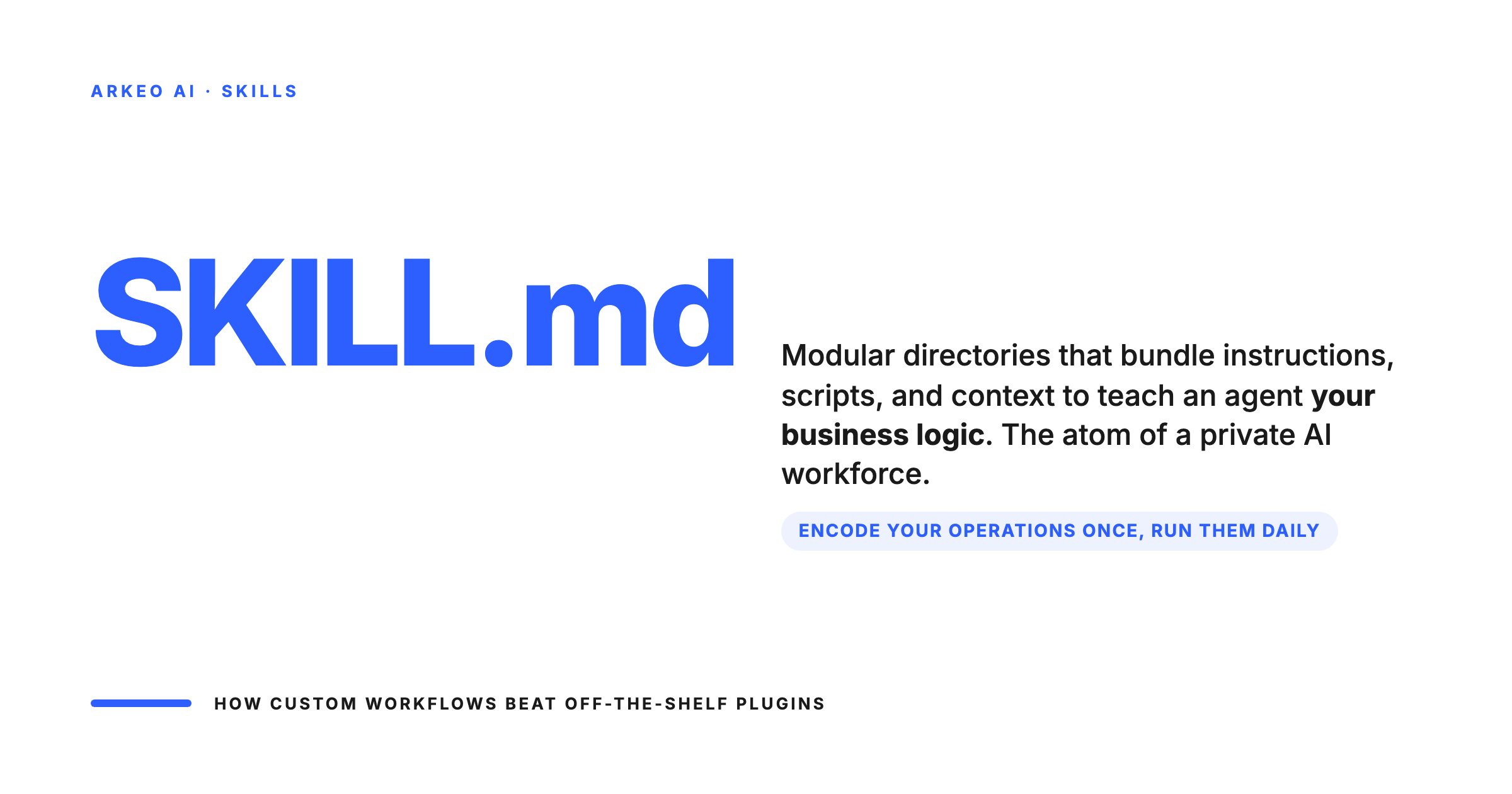
- What they are: Modular directories that bundle instructions, scripts, and context files to teach an AI agent how to perform a specialized task.
- The Core Component: A central
SKILL.mdfile that dictates the exact workflow steps, formatting rules, and approval logic the agent must follow. - Why they matter: Skills replace manual prompting. They act as permanent "digital onboarding" for your AI, ensuring strict adherence to your company's standard operating procedures.
The Difference Between Chat Prompts and AI Skills
Most people think deploying an AI agent simply means giving a language model access to your internal tools. They are wrong. A general-purpose AI with access to your CRM is a massive liability. Without strict procedural guardrails, an agent will guess at how a task should be completed, leading to corrupted data and broken automations.
A prompt is a temporary request. An OpenClaw skill is a permanent architecture. When you ask a new human employee to reconcile a vendor invoice, you do not just point them to the accounting software and hope for the best. You give them a standard operating procedure (SOP) manual. You show them the specific cost codes, the approval thresholds, and what to do when a purchase order does not match.
Building an OpenClaw skill is exactly the same process. It is the digital onboarding manual for your AI workforce. Once a skill is loaded into your private node, the agent possesses that specialized capability permanently. It knows the exact steps to take, which internal databases to query, and precisely when it needs to stop and ask a human for approval.
The Anatomy of an OpenClaw Skill
Understanding exactly what OpenClaw is requires looking under the hood of its skill architecture. You do not need to be a developer to understand how a skill is constructed. At its core, an OpenClaw skill is just a directory folder containing three vital components.
The first and most critical component is the SKILL.md file. This is the brain of the workflow. It contains the written instructions detailing exactly how the task must be executed. If your safety reporting process requires a supervisor sign-off on any incident marked "High Severity", that logic is explicitly written here.
The second component is the scripts/ directory. Language models are excellent at reasoning, but they are terrible at executing highly fragile, deterministic tasks. If your workflow requires rotating a massive PDF or parsing a legacy Excel file, the agent shouldn't try to write that code on the fly. The scripts folder provides the agent with reliable, pre-written code tools to handle fragile technical steps flawlessly every time.
The final piece is the references/ directory. This is where domain knowledge lives. Instead of bloating the main instructions with hundreds of pages of company policy, you place your API documentation, your specific legal templates, or your approved brand guidelines in the references folder. The OpenClaw agent is smart enough to pull this context into its active memory only when the specific task requires it.
See Where AI Fits in Your Business
Book a free 30-minute AI Assessment. We'll map your highest-value automation opportunities, estimate ROI, and build a 90-day deployment roadmap. No obligation, no pitch deck.
Why Community Plugins Cannot Replace Custom Business Logic
There are currently over 5,700 community-built OpenClaw skills available on public registries. These off-the-shelf plugins are fantastic for generic tasks like scheduling meetings or drafting basic emails. However, relying on public skills for core business operations is a critical mistake.
Here is the blunt truth about enterprise AI: unmanaged, generic agents stall out or hallucinate the moment they encounter your company's specific friction points. A downloaded invoice processing skill does not know that your VP of Operations needs to manually approve any equipment rental over $5,000. It does not know the specific nomenclature your field teams use on their daily logs.
Consider a messy, lived-in reality. Your operations team relies on a legacy, web-based logistics portal. When the vendor updates their button layout by three pixels, or a client replies to a billing thread with a scanned PDF instead of text, an unmanaged community agent will fail. A custom OpenClaw skill, built specifically for your environment, includes the exception-handling logic to recognize the error and immediately route a notification to the right manager in Slack.
How to Define Your First Agent Workflow
Before you write a single line of a custom skill, you must map the human workflow. You cannot code a process that you cannot draw on a whiteboard.
Start by observing your team. Document every single click, every database check, and every mental decision an employee makes during a specific task. To build effective OpenClaw use cases, you must identify where the human judgment is actually required versus where the employee is simply acting as a human router moving data from one system to another.
Once you map the current state, you can define the boundaries of the AI skill. You dictate the exact data the agent is allowed to access. Because OpenClaw runs on your private infrastructure, this data never leaks to public models. The skill becomes a tightly governed, hyper-efficient digital worker executing your exact standard operating procedures day and night.
Ready to Deploy AI on Your Infrastructure?
Arkeo builds private AI systems for mid-market companies. No cloud dependencies, no data leaving your building, no per-token pricing. Start with a free 30-minute assessment.