Category
Deploying OpenClaw: The Guide to a Private AI Workforce
Last updated: May 2026
Every mid-market CEO knows their team is using public LLMs to write emails, draft proposals, and debug code. The problem isn't that they are using AI. The problem is that the company has zero visibility into what data is leaving the building, and no structural way to turn those individual prompts into repeatable business workflows. Your company is running on shadow AI.
Deploying an open-source agent operating system like OpenClaw solves the data leakage problem by running locally on your own private infrastructure. But simply installing a Docker container doesn't magically create an AI workforce. Real operational value requires mapping your bottlenecks, defining approval logic, and establishing secure data boundaries.
Quick Answer: Deploying OpenClaw
• What it is: An open-source agent operating system that runs entirely on private infrastructure, ensuring no data leaks to public LLMs.
• Data Security: 100% on-premise or private cloud. You retain total control over your intellectual property.
• The Hard Part: Installing the node is easy; defining the workflow governance, approval logic, and secure data paths is where implementations fail.
• First Step: Map your current state and identify 30-day easy wins before spinning up any containers or writing code.
Why Mid-Market Companies Are Moving to Private AI
Most mid-market operators think the goal of AI is faster output. They're wrong. The goal is scalable capacity without adding payroll overhead, while maintaining absolute control over your intellectual property. When employees paste client financials or proprietary bid data into public chat interfaces, you lose that control immediately.
Most consumer-grade public tools train on user inputs, and even enterprise tiers leave proprietary data sitting on third-party servers. That means your operational truth (your margins, your unique processes, your client friction points) becomes part of a public model. This is the reality of shadow AI.
Moving to a private AI infrastructure, like OpenClaw, physically separates your data from the public internet. The models run on your dedicated hardware or private cloud (VPC). The data never leaves your building. But the real advantage isn't just security; it's the ability to connect those secure models directly to your internal CRM, ERP, and document stores to do actual, multi-step work without exposing your proprietary database structure to the open web.
A private AI deployment allows you to build custom agents that execute tasks according to your exact business logic. It transforms AI from a basic writing assistant into an integrated, secure digital employee capable of accessing your internal databases, verifying records, and generating reports completely independently.
The Architecture of an OpenClaw Deployment
To understand how to deploy an OpenClaw use case, you have to look past the code repository and look at the business architecture. An OpenClaw deployment relies on three primary components to execute tasks securely.
First, the Node. This is the engine. It runs on your hardware and processes the agent logic. It acts as the brain that directs traffic, managing which agent handles which task, processing incoming API requests, and managing the queue of background jobs. Because the Node sits entirely behind your firewall, it has native access to your active directories and local databases.
Second, the Workspaces. These are isolated context environments. You don't want your HR agent having access to the same file paths as your Finance agent. Workspaces ensure strict data boundaries. They are the digital equivalent of department silos, ensuring that each AI agent only operates with the context, credentials, and files required for its specific role. This is vital for compliance and maintaining internal data integrity.
Finally, the Browser Control Relays. Agents need to interact with web-based software (like your SaaS tools) just like humans do. A browser relay allows an agent to securely navigate a web interface, extract data, or click buttons, without needing complex API integrations for every legacy system you run. It acts as the hands of the AI, allowing it to perform visual navigation, scrape on-screen data, and submit forms inside closed portals.
Three OpenClaw components, all inside the firewall
No part of the OpenClaw stack touches public infrastructure unless you explicitly route it there. The whole point of an Agent OS is to draw the boundary at your network edge.
Node engine
The orchestrator. Routes work to agents, holds the schedule, manages identity, owns the audit log.
Isolated workspaces
One workspace per agent. Per-agent file scope, credentials, and tool permissions. Cross-agent leakage is structurally impossible.
Browser relay
Server-Side Request Forgery (SSRF) controlled outbound web access for agents that need to interact with web portals.
Departmental Use Cases for OpenClaw
When deploying a Private AI Workforce, the value is proven through highly specific, departmental use cases. Broad mandates fail. Pinpoint, workflow-specific agents succeed. Here is how different departments within a growing company utilize OpenClaw agents to eliminate administrative bottlenecks.
Finance and Accounting
The finance department is often the first area to see immediate ROI from a private AI deployment. OpenClaw agents handle invoice processing with exceptional accuracy. Instead of a human clerk downloading a PDF, reading the line items, and manually entering them into an ERP, an OpenClaw agent does this automatically. It monitors the accounts payable inbox, extracts the data regardless of the invoice format, matches the line items against the purchase order, and flags discrepancies. Crucially, because this happens on a private node, sensitive vendor pricing and company bank details never pass through a public model.
Operations and Project Management
Operations teams drown in status updates, schedule parsing, and resource allocation mapping. An operations agent built on OpenClaw connects directly to your project management software. It pulls daily field logs, cross-references them against the project baseline schedule, and generates a unified daily status report for the VP of Operations. If a subcontractor is delayed, the agent automatically drafts the necessary RFI or delay notification, routing it to the project manager for a single-click approval. The agent works overnight, ensuring that the operational truth is waiting in your inbox every morning at 6:00 AM.
Human Resources
Human Resources workflows involve massive amounts of Personally Identifiable Information (PII). Shadow AI is catastrophic here. If a recruiter drops a stack of resumes into ChatGPT to find the best candidate, they have just leaked applicant data. OpenClaw provides a localized, secure environment for HR. Agents can execute candidate screening logic, parse resumes against job descriptions, and rank candidates, all entirely on-premise. Furthermore, an internal HR Q&A agent can securely ingest your company handbook and employee policies, answering routine questions from staff via Slack without hallucinating or exposing private employee records.
Sales and Marketing
Sales teams spend an estimated 30 percent of their time actually selling; the rest is spent on CRM hygiene, research, and drafting emails. OpenClaw agents automate the administrative burden of the sales cycle. An agent can research a prospect's company, pull their latest public filings, summarize recent news events, and draft a hyper-personalized outreach email. It then updates the CRM with this intelligence. Because it utilizes Browser Control Relays, the agent can navigate complex industry databases that lack native APIs, pulling the exact data points your sales team needs to close the deal.
Four departments where private agents pay back inside a quarter
These are the deployments we have seen ship and stay shipped. Not because they are easy, but because the manual work being replaced is high-volume and well-structured.
Finance
Invoice processing, AP reconciliation, expense categorization, vendor onboarding records.
Operations
Daily status reports, project rollups, weekly client briefs, exception flagging.
HR
Document review, onboarding kits, compliance attestations, knowledge base updates.
Sales
CRM hygiene, deal research, follow-up drafting, proposal assembly from past wins.
Stop Guessing on AI Strategy
Not sure where your operational bottlenecks actually stand? Book your Free AI Assessment and get a clear roadmap before you write a single line of code.
Book Your Free AI Assessment →
Detailed Deployment Timeline: From Zero to Private AI
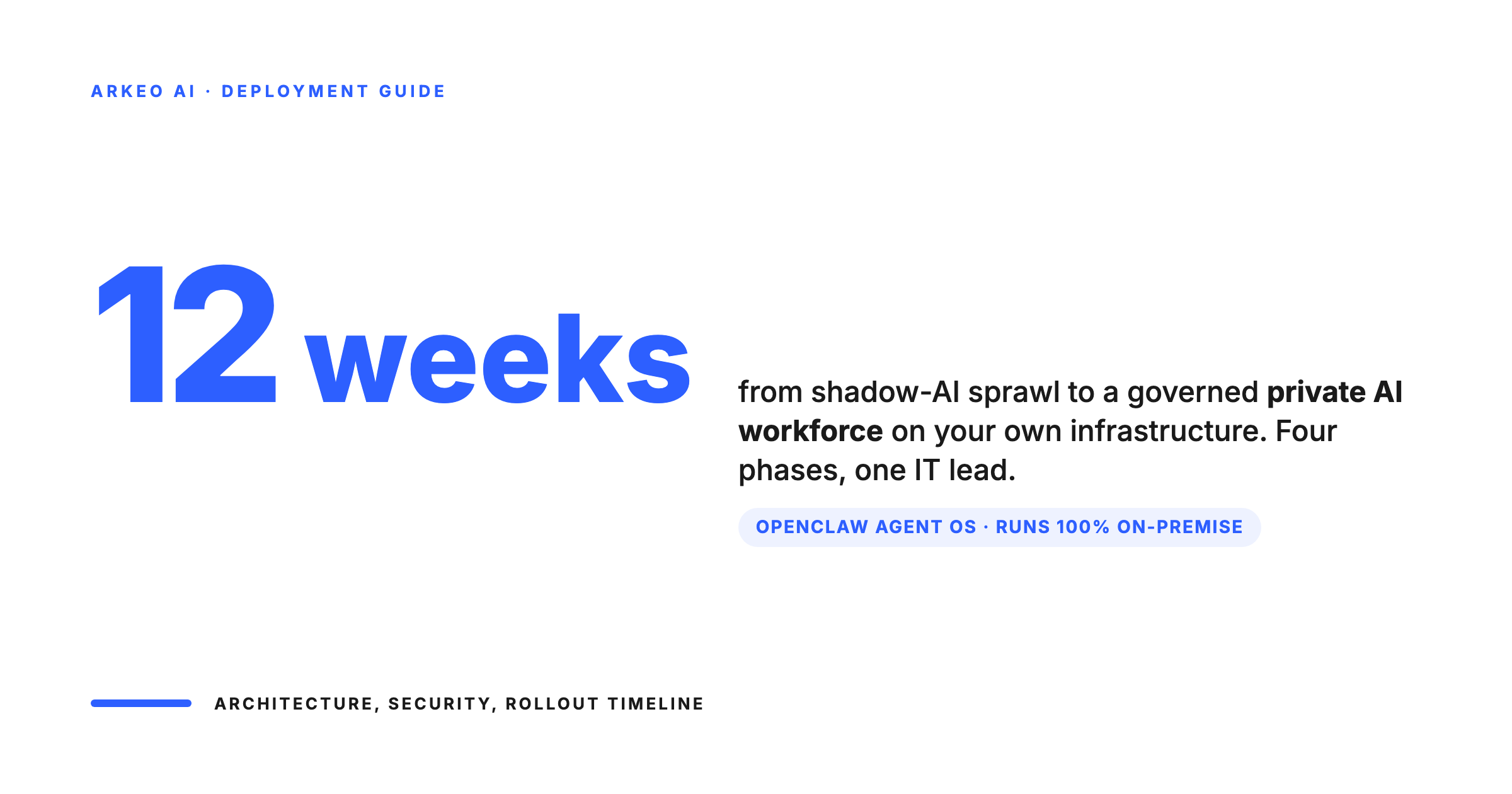
The transition from manual processes to an automated Private AI Workforce does not happen overnight. Treating OpenClaw like a weekend IT project is the fastest route to a failed deployment. A successful rollout requires a disciplined, phased timeline.
Four phases from kickoff to a governed agent workforce
The thing that fails is not the install. It is the governance: who can run what, against which data, with which approval gate. The phases below put the governance work first.
Assessment and architecture
Map current shadow AI use, sensitive data flows, and the first three workflows to migrate.
Deploy and harden
Stand up the Node, configure workspaces, set RBAC, wire audit logs to your SIEM.
First workflow live
Ship the highest-volume workflow into production with a single department. Measure baseline.
Scale and govern
Add the next two workflows, enable cross-department routing, lock approval logic into policy.
Phase 1: Assessment and Architecture (Weeks 1-2)
This phase requires zero software installation. The focus is exclusively on mapping the current state of your business operations. You must document the systems you use, identify the specific workflow bottlenecks, and locate where your sensitive data lives. This is where you calculate the hard costs of manual labor versus the potential ROI of an agent. You also finalize the infrastructure architecture, deciding between a dedicated on-premise server or a secure Virtual Private Cloud (VPC) deployment.
Phase 2: Initial Setup and "Easy Wins" (Weeks 3-4)
In the second phase, the technical foundation is laid. The OpenClaw Node is spun up, and the first Workspaces are configured to ensure data boundaries are firmly in place. This is also when you deploy your "easy wins." These are lightweight, off-the-shelf agents that do not require complex integrations. Examples include simple text summarization tools or localized document retrieval agents. The goal here is to reclaim 8 to 15 hours per week for your team immediately, proving the system's value and driving early adoption.
Phase 3: The First Custom Workflow (Weeks 5-8)
This is where the heavy lifting happens. Your team begins integrating API tools, configuring browser relays, and mapping complex approval logic. You take one of the high-ROI workflows identified in Phase 1, like the automated invoice processing or the HR candidate screening, and build the custom agent to execute it. This phase involves rigorous testing. You must define what happens when the agent encounters an error or an edge case. Does it fail silently? Does it page a human in Slack? The approval gates and human-in-the-loop mechanisms are stress-tested extensively.
Phase 4: Optimization and Management (Weeks 9-12+)
By Phase 4, your first custom workflow agent is live and paying for itself. The focus shifts from building to managing. This involves monitoring the agent's performance, analyzing audit logs, and refining prompts to increase accuracy. You establish a continuous improvement cycle, tracking the time saved and error rates. Once the first agent is stable, you look to your backlog to begin deploying the next agent in the queue, systematically scaling your Private AI Workforce across the company.
Change Management: Getting Your Team on Board
Software is easy; human adoption is hard. One of the most overlooked aspects of deploying OpenClaw is the change management required to get your employees to actually use it. When you announce an "AI workforce," the immediate internal reaction is often fear of job replacement.
Leadership must clearly frame the deployment not as a replacement strategy, but as an augmentation strategy. The goal is to remove the administrative drudgery that your employees hate doing. No operations manager enjoys spending four hours manually parsing daily field logs. No sales rep wants to spend their Friday updating CRM records. By positioning OpenClaw agents as tools that eliminate this specific friction, you turn resistance into enthusiastic adoption.
Furthermore, establishing clear "human-in-the-loop" approval gates is critical for building trust. Employees need to know they maintain control. If an agent drafts an important client communication, it should not send it autonomously. It must route the draft to the employee for a final review and a single-click approval. When employees see that the AI is doing the heavy lifting but they hold the steering wheel, adoption rates skyrocket.
Strict Security Protocols and Governance
The primary driver for an OpenClaw deployment is data security. But data sovereignty goes far beyond just running a local language model. A true enterprise-grade deployment requires strict security protocols at every layer of the architecture.
First, Role-Based Access Control (RBAC) must be rigidly enforced. An AI agent is a digital employee, and just like a human employee, it should operate on the principle of least privilege. An agent should only have access to the specific databases, file paths, and API endpoints necessary to complete its assigned task. If an agent is compromised or hallucinates, RBAC ensures the blast radius is contained entirely within its isolated Workspace.
Second, comprehensive audit logging is non-negotiable. Every prompt, every tool call, every file accessed, and every automated click made by a Browser Relay must be logged and preserved. If an incorrect invoice is paid or an erroneous report is generated, you must be able to trace the exact decision path the agent took. This level of traceability is impossible with public shadow AI, but it is a native capability of a properly configured OpenClaw Node.
Finally, governance requires explicit human approval gates for high-risk actions. While a private AI workforce is powerful, it lacks human judgment. Any action that modifies financial records, commits the company to a contract, or communicates externally must be gated behind a mandatory human sign-off. The agent does 99 percent of the work, but a human must click "Approve" for the final 1 percent.
Four security layers your audit team can read in five minutes
OpenClaw was built so that the security posture is provable by inspection, not by promise. Every layer is a deliberate choice your CISO can defend in any review.
Role-based access
Least-privilege agent permissions. Finance agent cannot read HR workspace, ever.
Audit logging
Every action by every agent logged, timestamped, attributable. Ships to your SIEM by default.
Human approval gates
Configurable thresholds. Agent drafts, human signs. No surprise actions on regulated data.
Workspace isolation
Container-level boundaries per agent. Compromise of one agent does not propagate.
Stop Installing. Start Planning Your AI Workforce.
We see technical teams make the same mistake every week. They spend three days fighting with dependencies, get an OpenClaw node running, connect a local language model, and then look around asking, "Okay, what should it do?"
They built the engine before they knew where the car needed to go. The technology is not the bottleneck; the workflow definition is. If you cannot draw the exact steps a human takes to complete a task, including every system they check, every person they ask for approval, and every edge case they handle, an AI agent will fail at that task.
The 4-Step Framework for Deploying Agents
If you want to avoid wasting six figures on failed AI experiments, you need a structured path. At Arkeo, we run every client through the same four-part framework to transition from scattered chatbots to a managed AI workforce.
Step 1: Current State. Map how your business runs today. Document the systems you use, identify the specific workflow bottlenecks (like proposal generation or invoice reconciliation), and locate where your sensitive data lives. This tells you exactly where AI saves you the most hours.
Step 2: 30-to-90 Day Easy Wins. Don't wait for a complex OpenClaw setup to start seeing ROI. Identify the exact prompts, off-the-shelf tools, and lightweight automations your team can turn on Monday morning to reclaim 8 to 15 hours per week, per role.
Step 3: Mid-Term Agent Opportunities. Identify your top three custom workflow agents. Map the systems they need to touch, calculate a rough ROI, and build the 90-day path to getting the first one live and paying for itself.
Step 4: Long-Term Architecture. Build your 12-month strategic plan. This is where you map out the scale of your private AI operating system, whether that's dedicated cloud, hybrid, or entirely on-premise hardware. Just as importantly, define the expensive AI bets you will not fund.
From current-state shadow AI to a 24 month strategic roadmap
Most firms try to skip step one. The result is a year of pilots that never reach production. The pattern that works is honest about where you are before it gets clever about where you are going.
Current state
Map shadow AI use, sensitive data exposure, and the workflows soaking the most senior time.
30 to 90 day easy wins
Ship one workflow with measurable payback. Build trust with the operating team.
Mid-term opportunities
Add two to three workflows that compound on the first deployment. Tighten governance.
24 month roadmap
Cross-department agent network. Private model fine-tuned on your data. Compounding moat.
Why Governance is the Hardest Part of OpenClaw
Here is the blunt truth: AI agents break. When a SaaS vendor updates their button layout by three pixels, or a client replies to an invoice with a PDF instead of text, an unmanaged agent will stall or hallucinate.
Running OpenClaw requires more than just deploying code; it requires active governance and security management. Approval logic must be visible. Inputs, permissions, checkpoints, and escalation paths must be defined upfront. When your automated invoice processing agent gets confused by a new tax format, does it fail silently and drop the invoice, or does it ping a human manager in Slack for intervention?
This is the difference between an open-source toy and a production-ready AI workforce. You are not just deploying software; you are deploying digital employees. They need managers, they need boundaries, and they need a secure environment to operate within.
Don't Build Without a Blueprint
Map your path from chatbots to a Private AI Workforce. Book your Free AI Assessment today.
Book Your Free AI Assessment →