Category
OpenClaw Browser Relay: Secure Web Automation
Last updated: May 2026
Most mid-market operations run on a tangled web of legacy SaaS tools, vendor portals, and custom CRM dashboards that refuse to talk to each other cleanly. The conventional approach is to spend six figures building custom API integrations that break every time a vendor updates their software. Meanwhile, your employees are quietly copying and pasting proprietary client data into public chat interfaces just to get their work done, leaving your intellectual property totally exposed.
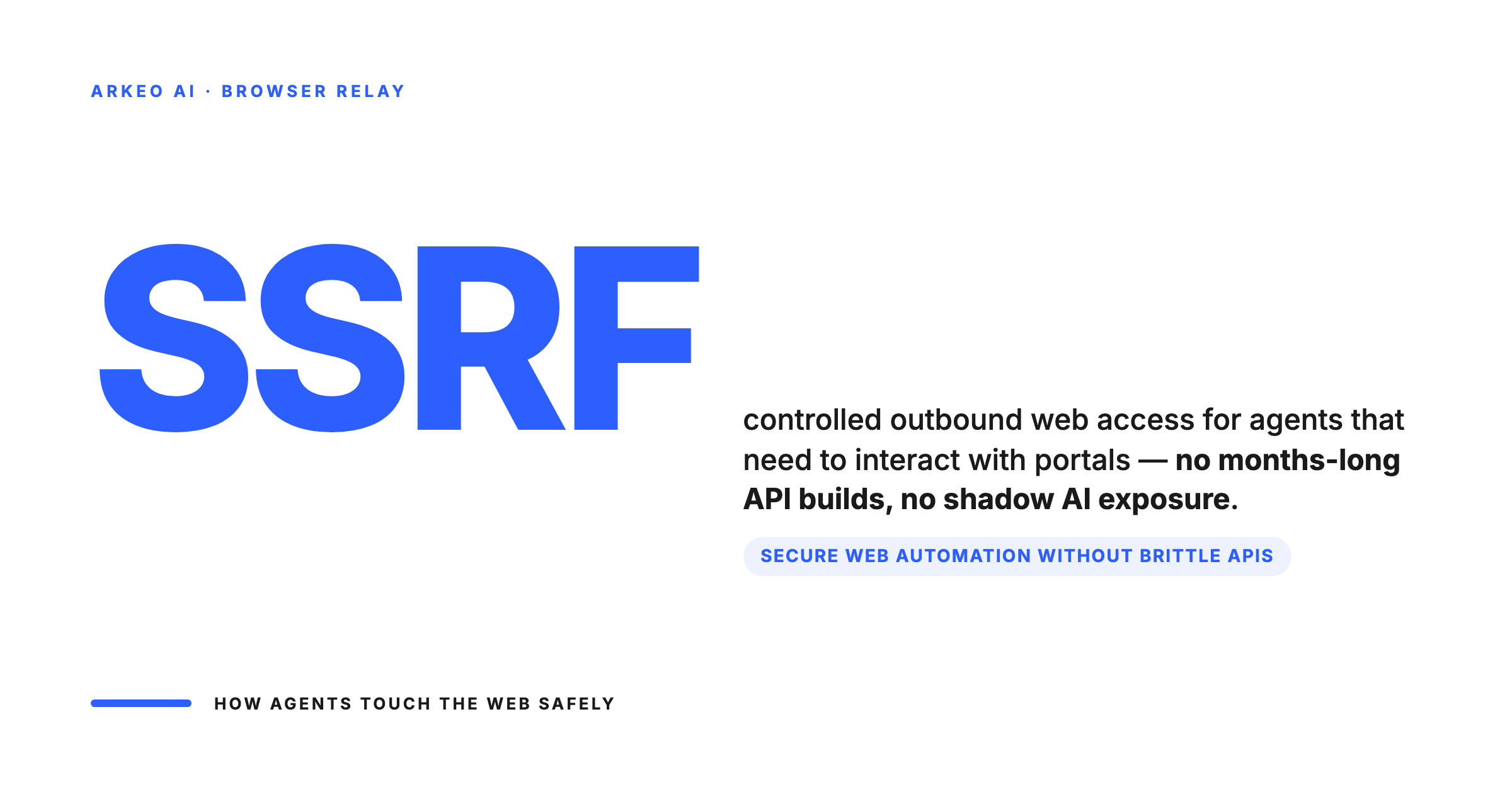
There is a better way. The OpenClaw Browser Relay is an isolated, managed browser profile that acts as the secure "hands" for your AI agents, allowing them to navigate web applications and extract data exactly like a human does, without relying on brittle APIs.
- What it is: A dedicated, OpenClaw-managed browser profile that allows your AI agents to interact with web portals securely.
- Data Security: Governed by strict Server-Side Request Forgery (SSRF) policies, ensuring agents only access what you explicitly authorize.
- The Alternative: Waiting months for expensive API builds, or risking data leaks by letting staff paste sensitive information into public LLMs.
The API Problem in Mid-Market Operations
Many business leaders think that deploying an open-source agent operating system like OpenClaw means you immediately have access to all your company data. They are wrong. If your critical operational data is locked inside a web-based ERP with a broken or non-existent API, your AI agent is effectively blind.
Building point-to-point API integrations for every web tool is expensive and slow. Vendors change their endpoints, authentication tokens expire, and the technical debt piles up. When the integration breaks, the automation stops. This is why so many automation projects fail to deliver a measurable return on investment.
Browser Relay bypasses the API problem entirely. It allows an AI agent to interact with software visually. It can click buttons, select dropdowns, and read the accessibility tree of a complex web app just like your operations manager does every morning.
How OpenClaw Browser Relay Actually Works
The Browser Relay is not a generic, unsecured web scraper. It is a highly controlled, deterministic browser profile (typically named openclaw) running on your private node. When you assign an agent a task, it does not use your employee's active Chrome session. It uses its own isolated workspace.
Under the hood, the Relay captures accessibility tree snapshots rather than relying on brittle pixel coordinates. The OpenClaw agent analyzes the snapshot, decides what action to take based on your defined business logic, and sends back discrete commands: click this button, type into this field, or navigate to this specific URL. It even runs a bundled recovery loop to handle stale references or unexpected manual blockers.
Because the agent operates in an isolated environment, it never touches personal browser data. It handles the web tasks cleanly, predictably, and securely.
Bring Your AI In-House.
Your employees are already using AI; you just don't control the data. Book a Free AI Assessment to map your shadow AI exposure and get a step-by-step plan to deploy a secure, private AI workforce on your own infrastructure.
Why Security and Governance Demand an Isolated Profile
The blunt truth is that giving an AI agent unrestricted access to the open web on your corporate network is a massive security vulnerability. This is exactly why OpenClaw security risks must be managed proactively.
Browser Relay mitigates these risks through strict Server-Side Request Forgery (SSRF) protections. Before the agent navigates to any URL, the request is SSRF-guarded to prevent unauthorized access to your private local network. You configure explicit allowlists, ensuring the agent can only reach the specific SaaS portals required for its job.
While OpenClaw does offer an attach-profile that hooks into a user's signed-in Chrome session, enterprise governance requires the isolated managed profile. By running the Relay in headless mode on a dedicated node, you guarantee absolute data boundaries. There is no cross-contamination with employee passwords, and every automated click is logged for compliance auditing.
Browser Relay in Action: Real Operations Use Cases
When you connect a secure Browser Relay to your private AI workforce, the OpenClaw use cases expand exponentially. Here is how mid-market operators are using it today.
Competitor and Vendor Monitoring: An agent logs into a gated B2B supplier portal every morning at 4:00 AM, navigates to the pricing sheet, and extracts the latest material costs. It updates your internal pricing models before your sales team even logs on.
Legacy ERP Updates: Imagine a complex inventory system that requires manual data entry across five different screens. A Browser Relay agent takes the incoming purchase order, navigates the web forms, selects the correct dropdowns, and submits the data flawlessly. It handles the rote administrative burden that burns out your operations staff.
Audit and Compliance Checking: For compliance teams, an agent can securely access multiple disconnected dashboards, take verified screenshots of system statuses, and compile a single audit report. No more wasting Friday afternoons manually checking boxes.
Bring Your AI In-House.
Your employees are already using AI; you just don't control the data. Book a Free AI Assessment to map your shadow AI exposure and get a step-by-step plan to deploy a secure, private AI workforce on your own infrastructure.