Category
What Are ChatGPT Agents? An Operator's Guide
Last updated: May 2026
Your team is already using ChatGPT agents to get their work done faster, and you have a visibility problem you probably cannot see: you do not know what company data they are feeding into a public model. Arkeo AI has been building and running autonomous agents since 2023, on the back of 25 years of operating real businesses, and the same systems run Arkeo's own operations every day. That vantage point makes one thing clear. The shift from unmanaged public AI tools to a controlled Private AI Workforce is no longer optional. When OpenAI introduced ChatGPT agent, it described a system that thinks and acts, choosing tools to complete tasks on its own. Put plainly, a ChatGPT agent is an autonomous AI system that can execute multi-step tasks, use external tools, and make decisions without constant human prompting. Useful, fast, and when it runs on a public cloud against your proprietary data, a genuine liability.
Quick Answer
• What it is: A ChatGPT agent is an autonomous AI system that executes multi-step tasks, uses external tools, and decides next steps without constant prompting.
• The risk: Shadow AI data leakage, where staff paste proprietary IP into public-cloud models that may retain or train on it.
• The fix: A Private AI Workforce that runs on-premise or in isolated infrastructure, so your data never leaves the building.
• Why it matters: Agents can read and write to your live systems, so where they run is now a governance decision, not an IT preference.
What Exactly Is a ChatGPT Agent?
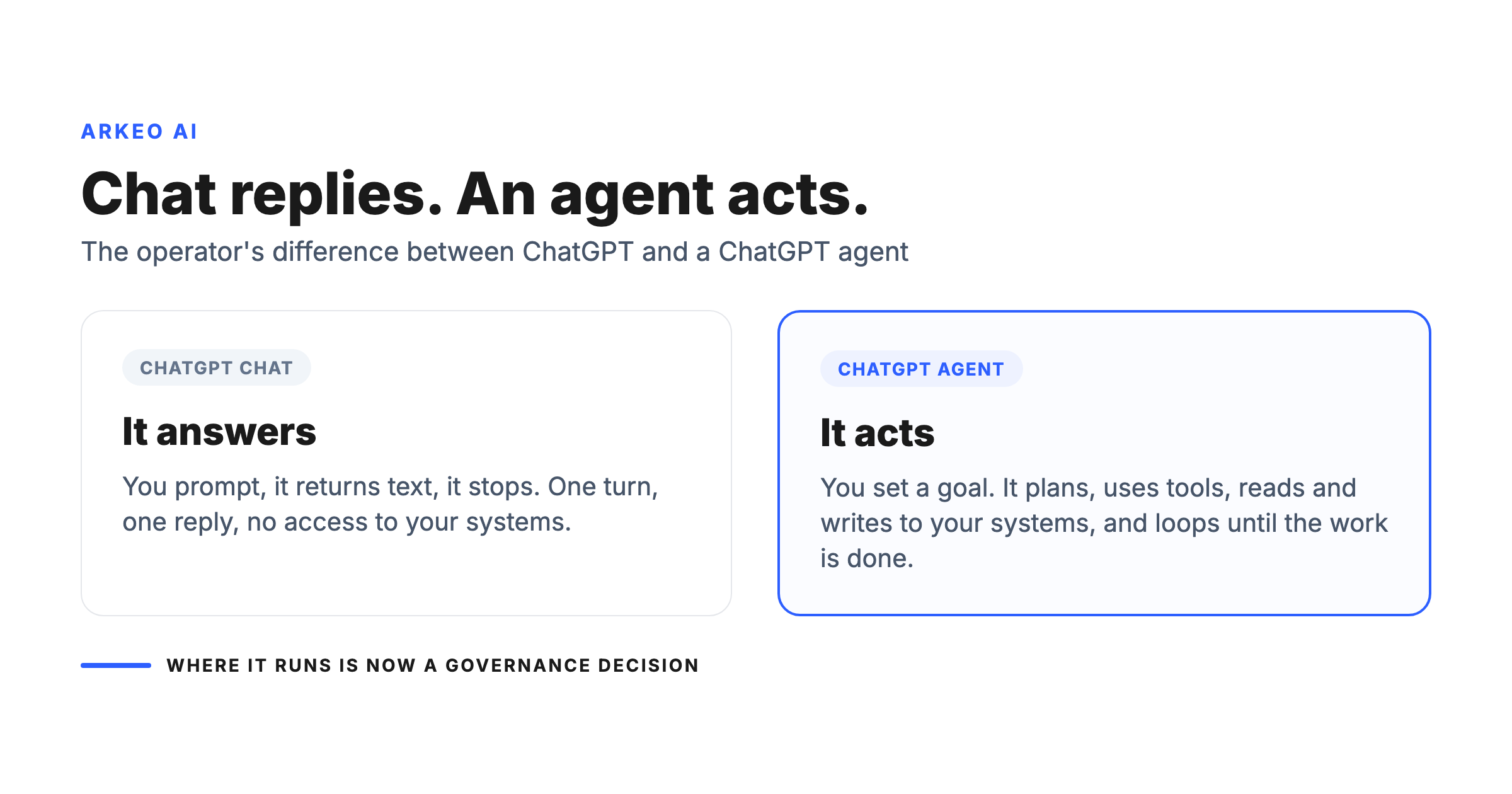
Standard ChatGPT is a reactive chatbot. You type a prompt, it generates text, and it stops. A ChatGPT agent operates differently. It is proactive and goal-oriented: you give it an objective, and it works out the steps needed to reach it. OpenAI's own research on a computer-using agent shows the direction of travel: a model that perceives a screen, reasons, and takes actions like a person would. That single shift, from answering a question to pursuing a goal, is what turns a chat window into something that can act on your business systems.
Here is a false belief worth correcting up front. Most leaders think an acceptable use policy or a blocked URL stops unauthorized AI use. It does not. Policy controls intent. It does nothing about a tool an employee can reach from a personal phone on the same desk. The control point that actually works is architecture, and that is where the agent conversation has to start.
How Does a ChatGPT Agent Actually Work?
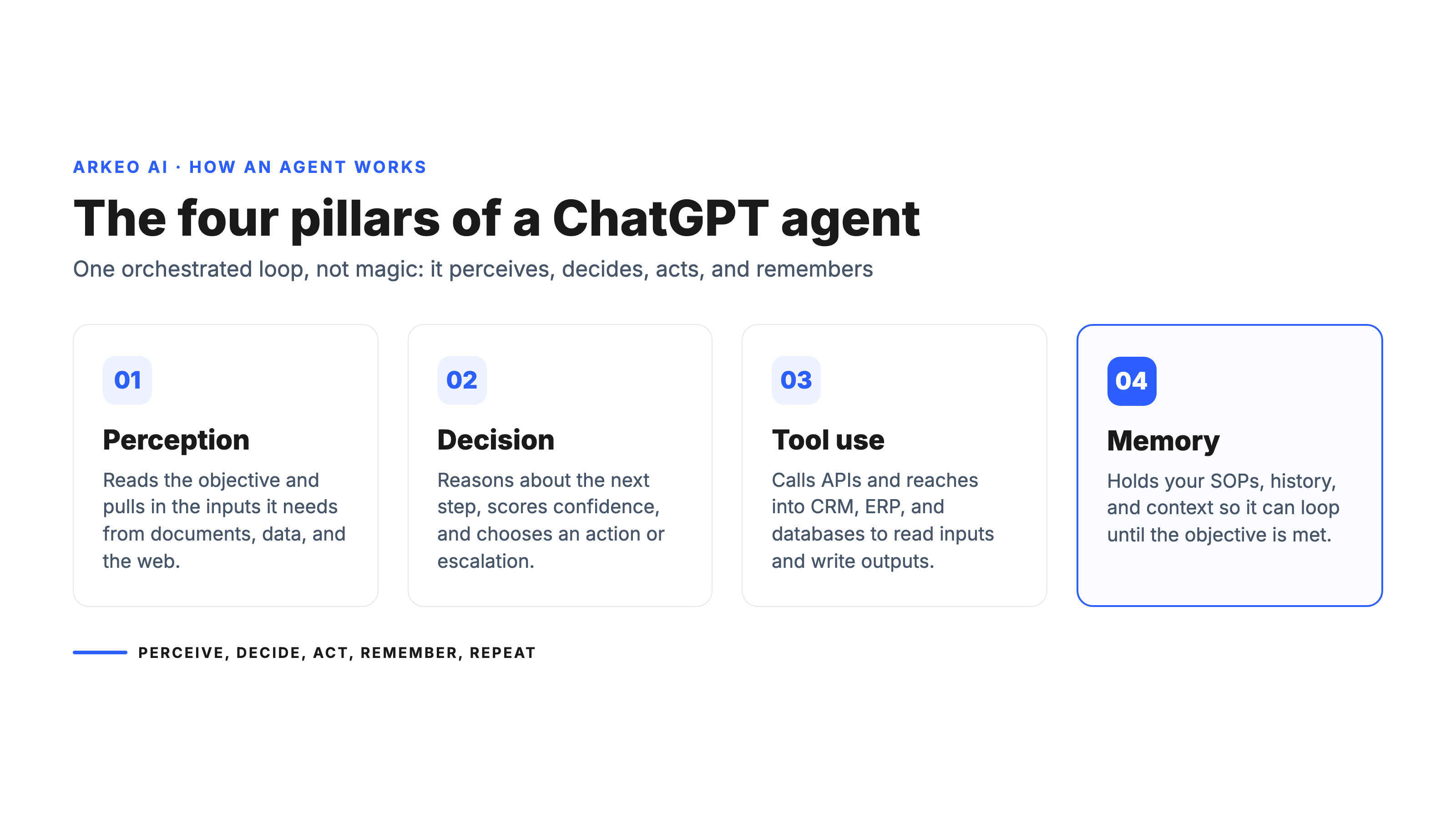
To understand why a Private AI Workforce matters, you first have to understand the mechanics underneath a ChatGPT agent. It is not magic. It is an orchestrated software loop built on four pillars: perception, decision, tool use, and memory.
1. Reasoning loops. When you ask standard ChatGPT a question, it predicts the next sequence of words from its training data and stops. An agent uses a reasoning-and-acting loop instead. It receives an objective, reasons about what it needs, takes an action, observes the result, and reasons again. The loop repeats until the objective is met. That loop is what makes an agent autonomous, and it is also what makes it computationally expensive and risky when it iterates over sensitive data.
2. Persistent memory and context. A chatbot forgets everything when you close the tab. A business agent needs persistent memory: your standard operating procedures, past emails, client histories. That means large volumes of proprietary data get loaded into the agent's context. If the agent is hosted on a public cloud, that data is constantly passing through someone else's servers.
3. Tool use and API execution. An agent's real power is its hands, its ability to use external tools. A ChatGPT agent can be granted access to your CRM, your ERP, and your secure databases, where it can read, write, and execute. Connect a public model directly to core business systems, and you create a wide attack surface. If a guardrail fails, or the model acts on a bad instruction, it has the authorization to alter live data.
4. Decision-making. A real agent scores its own confidence, picks the next action, and escalates the cases that need a human. That judgment is the difference between an agent and a script. It is also why oversight cannot be an afterthought.
Three traits that separate a real agent from a fancier chatbot
The word "agent" is everywhere in 2026 vendor copy. The three traits below are the ones that matter operationally. If a product is missing any of them, it is a chatbot in agent clothing.
Autonomy
Executes multi-step tasks without constant prompting. Plans, acts, and reports without a human at the keyboard for every move.
Tool use
Reaches across your systems, including CRM, ERP, documents, and the web, to read inputs and write outputs. Not stuck in one chat window.
Decision-making
Scores its own confidence, picks the next action, escalates the cases that need a human. Not a script.
Why Are Public ChatGPT Agents a Shadow AI Risk?
If you assume your company is not using AI, you are most likely already exposed. Shadow AI is the use of AI tools without IT approval or oversight, and it bypasses your security stack entirely. This is not a fringe worry. IBM's Cost of a Data Breach 2025 found that 13 percent of organizations reported breaches of AI models or applications, and 97 percent of those breached lacked proper AI access controls. The same research puts shadow AI at the center of higher breach costs, adding roughly 670,000 US dollars on average to incidents where it was a factor. The risk is not theoretical; it is already showing up in the breach data.
The most cited public example remains Samsung in 2023, where, as widely reported at the time, engineers pasted confidential source code into ChatGPT to debug it, and the company restricted generative AI use internally as a result. Whether or not that exact episode applies to your industry, the pattern behind it is the part that should concern you.
The pattern is simple and predictable. Give a team heavy workloads and tight deadlines, and people will reach for the fastest tool available. Relying on employees to police their own AI use is a strategy that fails by design. That is why a number of large enterprises, as reported across 2023, restricted staff use of public ChatGPT. Those decisions were not about hating efficiency. They were about security leadership recognizing a risk they could not control. The adoption picture makes the gap worse: PwC's AI Agent Survey found agent adoption is broad but shallow, with most organizations still early in moving from experiments to governed, production-grade deployment. Broad usage with thin controls is precisely the condition under which shadow AI thrives.
How Does Company Data Actually Leak?
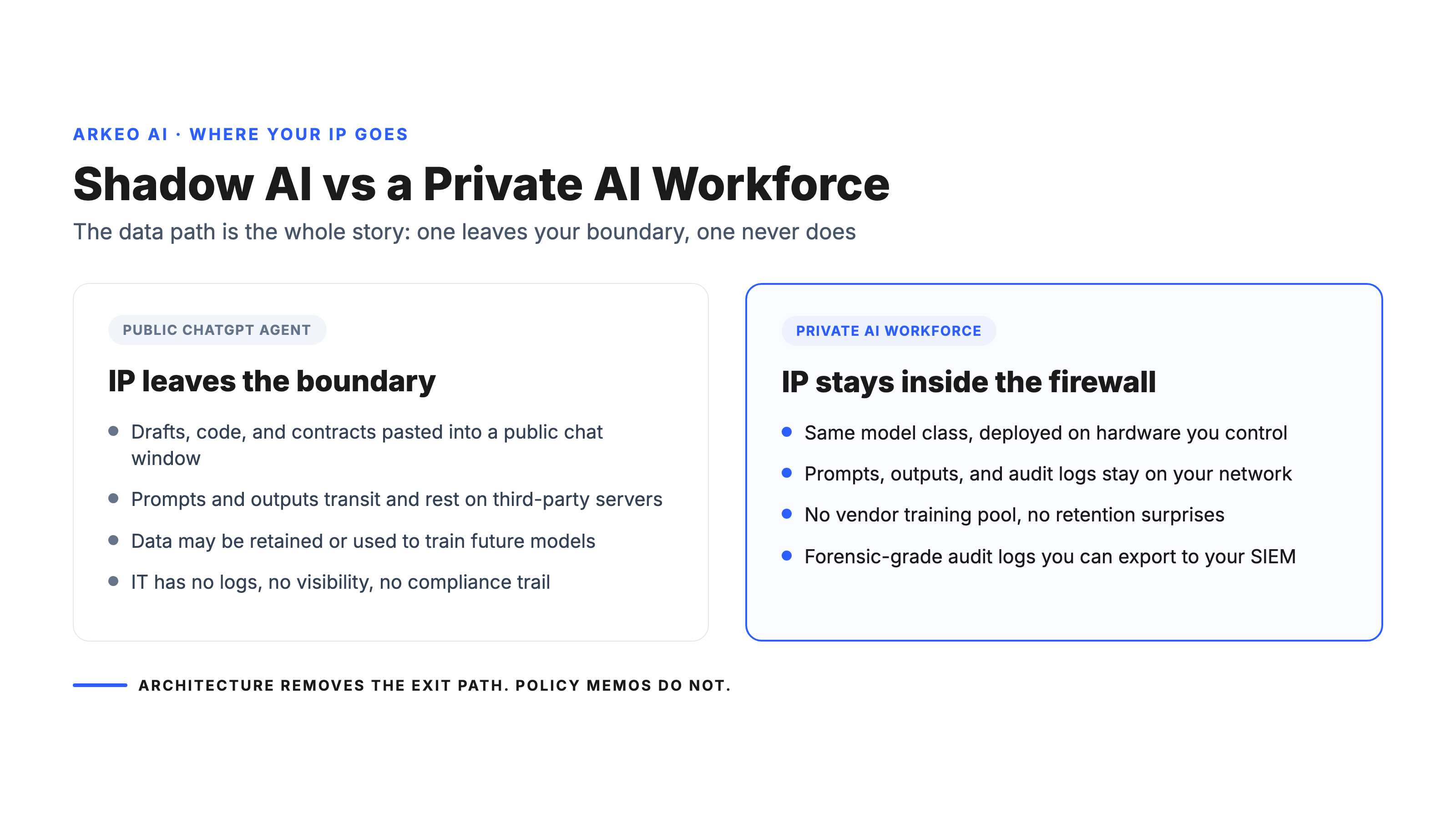
Operators often misread how AI data leakage happens, so it is worth being precise. There are two main mechanisms. The first is training-data ingestion. When an employee pastes a proprietary financial model or contract into a public-cloud agent, the provider can, depending on the terms of service in force, use that data to improve future versions of the model. Your IP becomes part of a shared system you do not control.
The second is context-window exposure. Even when a provider commits not to train on your data, that data is still transmitted, processed, and temporarily held on third-party infrastructure. If that provider suffers a breach, or a tenant-isolation flaw surfaces, your information sits in the blast radius. The blunt truth a vendor brochure will not print: a contractual promise not to train on your data does not move your data off their servers. Only architecture does that.
That is exactly what the free AI Assessment maps first. It identifies where shadow AI is already operating inside your business and how to give your team a faster, safe path before a leak happens.
See where AI fits your operation
Book a free AI Assessment. The session maps where shadow AI is already running in your business, scores your highest-value automation opportunities, and outlines a secure 90-day deployment path.
Book Your Free AI Assessment →
Public Cloud Agents vs a Private AI Workforce: What Is the Real Difference?
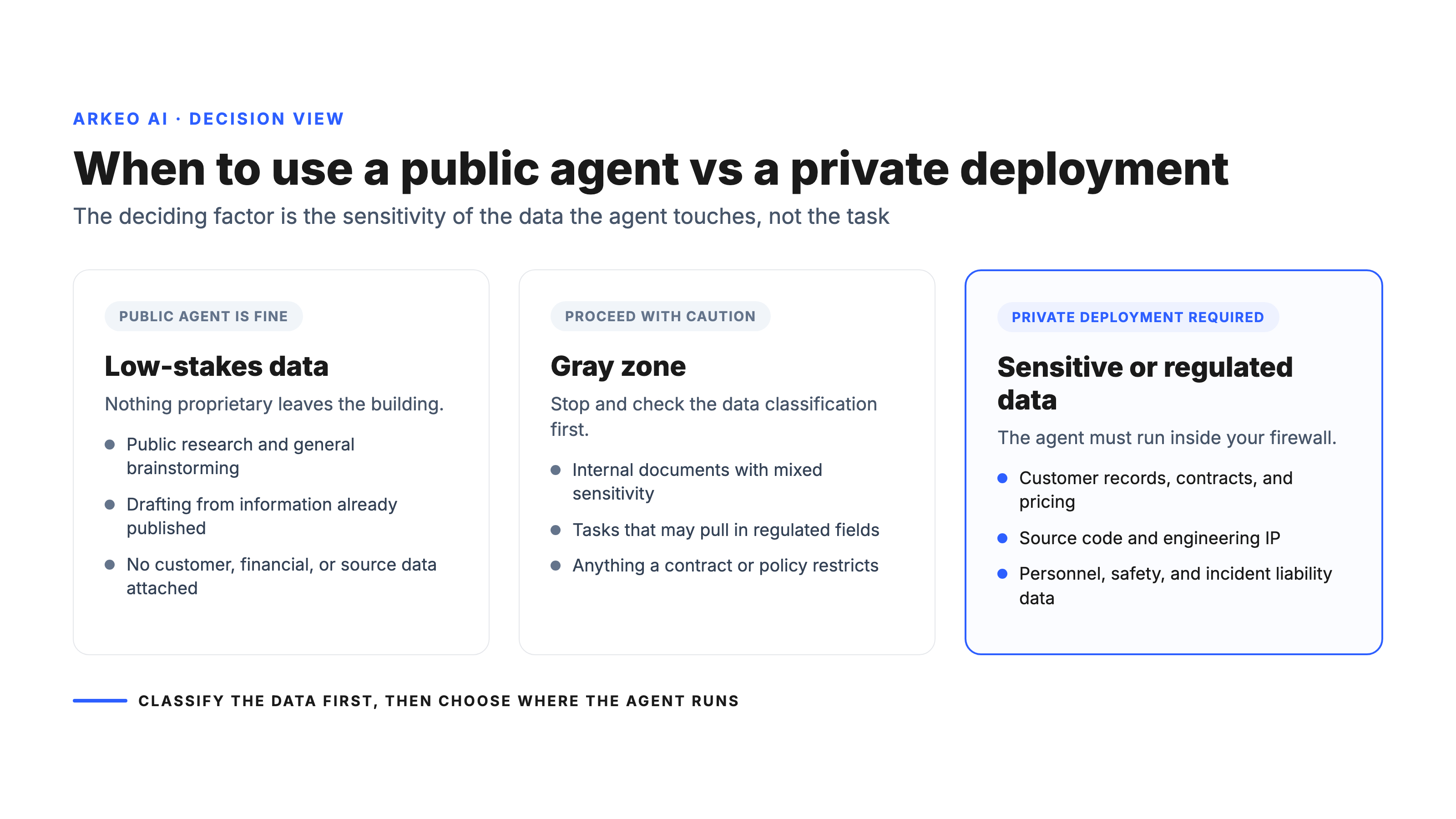
There is a fundamental difference between public-cloud agents and a Private AI deployment. Enterprise subscriptions offer policy promises. Operational security requires a different architecture. The contrast comes down to two things you can measure: where your data lives, and how your costs behave.
Data Sovereignty First
Your data should never be the training ground for a public model. A Private AI Workforce runs on-premise or inside your isolated infrastructure, so the data never leaves your building. You keep full sovereignty over your intellectual property while still getting the automation benefits of advanced AI. This is the line Arkeo holds in every deployment, and it is the same architecture Arkeo runs its own companies on. Arkeo operates what it sells.
Fixed Costs vs Per-Token Pricing
Here is another truth most vendors gloss over: cloud API costs scale unpredictably. When a public-cloud agent gets stuck in a loop trying to solve a problem, you pay for every token it burns. A Private AI deployment uses fixed infrastructure costs. You buy or allocate the hardware, and your costs stay flat no matter how hard the agent works.
How Token Costs Inflate With Agents
Look at the math, with one illustrative calculation. Public AI platforms charge by the token, roughly a fragment of a word. Frontier models commonly land in the range of a few US dollars per million input tokens and around ten US dollars per million output tokens. With a reactive chatbot, token usage is predictable. With an autonomous agent, it climbs fast, because the agent runs internal reasoning loops you never see.
Picture a hypothetical agent assigned to draft a single response to a complex 200-page RFP. It reads the document, realizes it needs more context, queries a database, drafts a version, checks that draft against your SOPs, and only then produces output. In this illustration, that one task burns roughly 500,000 tokens across its hidden internal steps, which at the pricing above lands near 2 to 3 US dollars per run. That looks trivial until you scale it: run 150 agent tasks a day across several departments and the same illustrative rate compounds to somewhere around 9,000 to 13,000 US dollars a month, before a single loop stalls. These figures are illustrative, not a quote, and your real numbers depend on model and workload. The point holds regardless: the bill does not grow linearly with the work you can see; it grows with the work the agent does to think. A Private AI Workforce changes that equation entirely. Costs move from variable operating expense to fixed capital expense, and your servers do not charge you per thought. You can run agents around the clock without watching a meter spin.
For a deeper side-by-side of capability and cost, this guide on AI agents versus ChatGPT breaks down where each one fits.
What Real Operations Can a Private AI Workforce Run?
Move past the hype and look at concrete operator use cases. A Private AI Workforce handles the heavy, repetitive work that drains skilled hours: complex bid processing, safety compliance auditing, and legacy data migration. None of the examples below are speculative. They are the categories of work that ship and stay shipped, because the volume is high and the output is easy to score.
Use Case 1: Complex RFP and Bid Processing
An agent tasked with RFP processing does not write a tidy summary in a vacuum. It has to pull from last year's messy, poorly formatted bid packages, ignore outdated pricing tables, and format output for a specific vendor portal. It is messy work with bad formatting and missing files. A managed agent can ingest a 200-page RFP, cross-reference it against your historical winning bids, flag non-standard legal clauses for human review, and draft the initial technical response using only your localized engineering data, all behind your firewall.
Use Case 2: Safety Compliance and Incident Auditing
For industrial and construction operators, safety compliance generates mountains of paperwork. A Private AI Workforce can act as an autonomous auditor. It can continuously ingest daily field-level hazard assessments, cross-reference them against site-specific safety plans, and flag discrepancies. If a worker notes a missing harness on a site, the agent can draft an alert to the supervisor and update the compliance dashboard. Because this data involves personnel records and incident liability, it should not be processed by a public ChatGPT agent.
Use Case 3: Legacy Data Migration and Structuring
Mid-market companies sit on decades of unstructured data: thousands of PDFs, old drives full of Word documents, inconsistent spreadsheets. Putting people on that structuring work is cost-prohibitive. A Private AI agent can crawl legacy drives, extract key metadata, map records to a new CRM or ERP schema, and execute the migration, logging its confidence scores for human verification. That unlocks the value of historical data without exposing it to public models.
The takeaway across all three: you manage an AI workforce the way you manage people, with clear boundaries, specific instructions, and regular oversight. Worth noting the difference between the public product and a managed deployment, which this breakdown of building agents with the ChatGPT agent builder covers in detail.
Four high-volume workflows where private agents run today
These are the workflow categories that ship into mid-market operations. None are speculative. Each one stays shipped because the work is high-volume, high-signal, and easy to score.
Document processing
Invoice extraction, contract parsing, RFI triage. Volume work that used to consume junior hours.
Report generation
Weekly client briefs, exec dashboards, compliance filings. Boring, recurring, load-bearing.
Client communications
Drafting routine updates, replying to common questions, routing escalations to the right human.
Operations reporting
Status rollups, exception flagging, cross-system reconciliation. The work that used to need two or three people.
How Do You Deploy a Private AI Workforce Safely?
Deploying AI is not about buying software; it is about onboarding a new workforce. Arkeo runs a disciplined process built on the Arkeo Operating System (AOS): assess, deploy, then manage. The journey from manual operations to autonomous agents cannot be rushed, and the roadmap is designed to protect live operations while the new systems come online.
Phase 1: Assess and Map
The work does not start with code. It starts by auditing operations: where shadow AI is already creating risk, and which high-friction workflows drain the most human capital. From there comes a specific agent architecture, a compute-infrastructure estimate, and a hard ROI model. This phase typically takes 2 to 4 weeks, and it is the same ground the free assessment covers.
Phase 2: Deploy and Sandbox
Infrastructure is provisioned securely on-premise or in your isolated private cloud. The agents are built and connected to your data sources: ERP, CRM, secure drives. Critically, they run in a sandbox first. They execute their reasoning loops and produce outputs, but a human-in-the-loop approves every action before it touches live data. The sandbox phase typically runs 4 to 8 weeks before live handover, which trains the agents on your operational edge cases without risking disruption.
Phase 3: Manage and Scale
Here is the part most vendors leave out, and it is the blunt operational reality: AI agents break. APIs change, data formats shift, edge cases appear. You need an operator to maintain them, not someone who deploys the system and walks away. As the agents prove reliable, the human-in-the-loop restrictions ease and autonomy widens. Performance is monitored continuously, models are updated as open technology advances, and the workforce keeps running profitably.
Reddit threads on the agent mode are full of operators hitting exactly these reliability walls. This roundup of what operators report about ChatGPT agent mode is a useful reality check before you commit a workflow to it.
Ready to deploy AI on your own infrastructure?
Arkeo builds private AI systems for mid-market companies: no cloud dependency, no data leaving your building, no per-token surprises. Start with a free AI Assessment and a 90-day plan.
Book Your Free AI Assessment →