Category
Building a ChatGPT Agent? Why DIY Fails
Last updated: May 2026
You have an operational bottleneck. You know AI can solve it. So you open a ChatGPT agent builder, connect a few APIs, write some prompts, and map a workflow. It works in testing. Then you roll it out, and three days later the API connection breaks, the agent starts inventing data, and your CTO notices sensitive company information flowing through a public cloud server. The promise is real: OpenAI's own ChatGPT agent can browse, run code, and complete multi-step tasks, building on the computer-using agent research that lets a model operate software the way a person does. The gap is not capability. The gap is what it takes to run that capability reliably inside a fifty-person company. Arkeo AI was founded in 2023 by an operator with 25 years of business experience, and has spent the last three years deploying AI agents into mid-market operations, including the private agents that run Arkeo itself. That track record is the lens for everything below.
If you run a mid-market company, the DIY approach to building AI agents is a trap. It feels free up front, then bills you later in maintenance, security exposure, and downtime, a pattern consistent enough to be predictable. The fix is to move from experimental DIY tools to a managed private AI system. Before going further, a free Arkeo AI Assessment maps your highest-value automation opportunities so you build the right thing once.
Quick Answer
• What it is: A ChatGPT agent builder is a tool for creating custom AI assistants with instructions, documents, and software connections.
• The hidden cost: Mid-market teams spend more time fixing broken connectors and prompt drift than they save from the automation.
• The security risk: Feeding company IP and customer data into a public builder creates shadow-AI exposure outside your control.
• The alternative: A managed private AI workforce keeps data on your infrastructure with fixed costs, uptime, and named support.
What Is a ChatGPT Agent Builder?
A ChatGPT agent builder is a tool that lets you create custom AI assistants by defining instructions, uploading reference documents, and connecting to external software like your CRM or project management system. The appeal is obvious: you do not need a computer science degree. A VP of Operations can spin up an agent to summarize weekly reports; a sales director can build one to draft follow-up emails.
But there is a wide gap between a tool that works for one person and a system that works reliably across a fifty-person team. That gap is where most mid-market deployments quietly fall apart. For a deeper look at what these tools can and cannot do, the breakdown of how ChatGPT agents work in a business setting is a useful companion read.
What Are the Hidden Costs of DIY Agent Building?
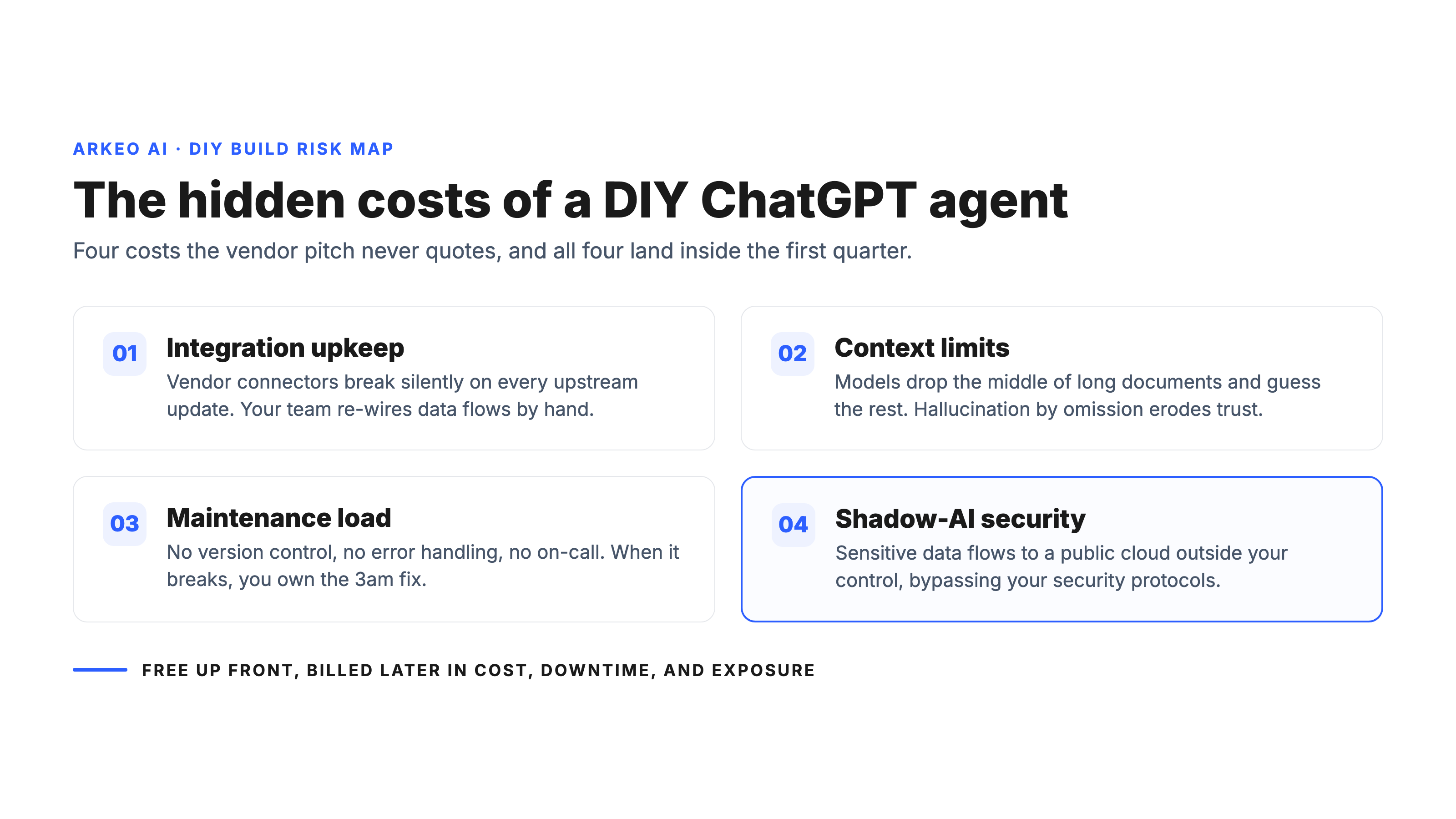
When you build an agent yourself using public tools, you also become the IT support desk for that agent. Here is what happens when a DIY build meets the real world.
1. The integration nightmare
Public agent builders lean on standard API connectors to talk to your existing software. Those connections are brittle. When Microsoft updates a Teams endpoint or HubSpot changes a data structure, the agent breaks. Your team waits while someone digs through error logs trying to work out why the agent stopped pulling data.
2. The context window trap
Every AI model has a limit on how much information it can hold at once. DIY builders tend to hide that limit. You upload a 500-page standard operating procedure manual expecting the agent to understand all of it. Instead it leans on the first ten pages and the last five and guesses the rest. That is hallucination by omission, and it destroys trust in the system fast.
3. Brittle prompts and weak error handling
Writing a prompt that works nine times out of ten is easy. Writing a system prompt that handles edge cases, unexpected inputs, and timeouts is software engineering. Here is the blunt truth a vendor will not print in a brochure: AI agents break, regularly, and DIY builders do not ship the error-handling infrastructure that business-critical operations require.
See where AI fits your operation
A free 30-minute Arkeo AI Assessment maps your highest-value automation opportunities, estimates ROI, and outlines a 90-day deployment roadmap. No obligation, no pitch deck.
Book Your Free AI Assessment →
Why Do Public Builders Fail on Data Security?
The most dangerous part of a DIY agent builder is where the data goes. When an employee uploads a sensitive contract or a client list into a public cloud AI tool, that data leaves your control. This is the definition of shadow AI: your team adopts powerful tools to do their jobs better, but bypasses your security protocols to do it. The cost is not theoretical. IBM's 2025 Cost of a Data Breach study found that 13 percent of organizations reported breaches of AI models or applications, and 97 percent of those lacked proper AI access controls. That is the shadow-AI gap measured in real incidents, not opinion.
Most businesses think a usage policy is enough to contain this. They are wrong. Public AI vendors change their terms of service frequently, and relying on those terms to protect your IP is a gamble, not a control. A mid-market manufacturer or a regional construction firm cannot afford proprietary processes sitting in a public cloud. Governance frameworks exist precisely for this: the NIST AI Risk Management Framework treats access control, traceability, and accountability as baseline requirements, none of which a personal-productivity builder ships by default. Identifying where data is leaking, and how to lock it down, is exactly what an Arkeo assessment maps first.
Where DIY ChatGPT builds fall down on data security
The DIY builder was designed for personal productivity, not enterprise data. The two profiles below show exactly where the architecture gap lives. The mid-market mistake is assuming DIY can be hardened with policy alone.
Personal-productivity architecture
Enterprise-grade architecture
This is also why the choice of underlying model matters less than people assume. The deeper comparison of AI agents versus plain ChatGPT shows that the agent layer, not the chat box, is where reliability and control are won or lost.
When Should You Build DIY vs Deploy Private AI?
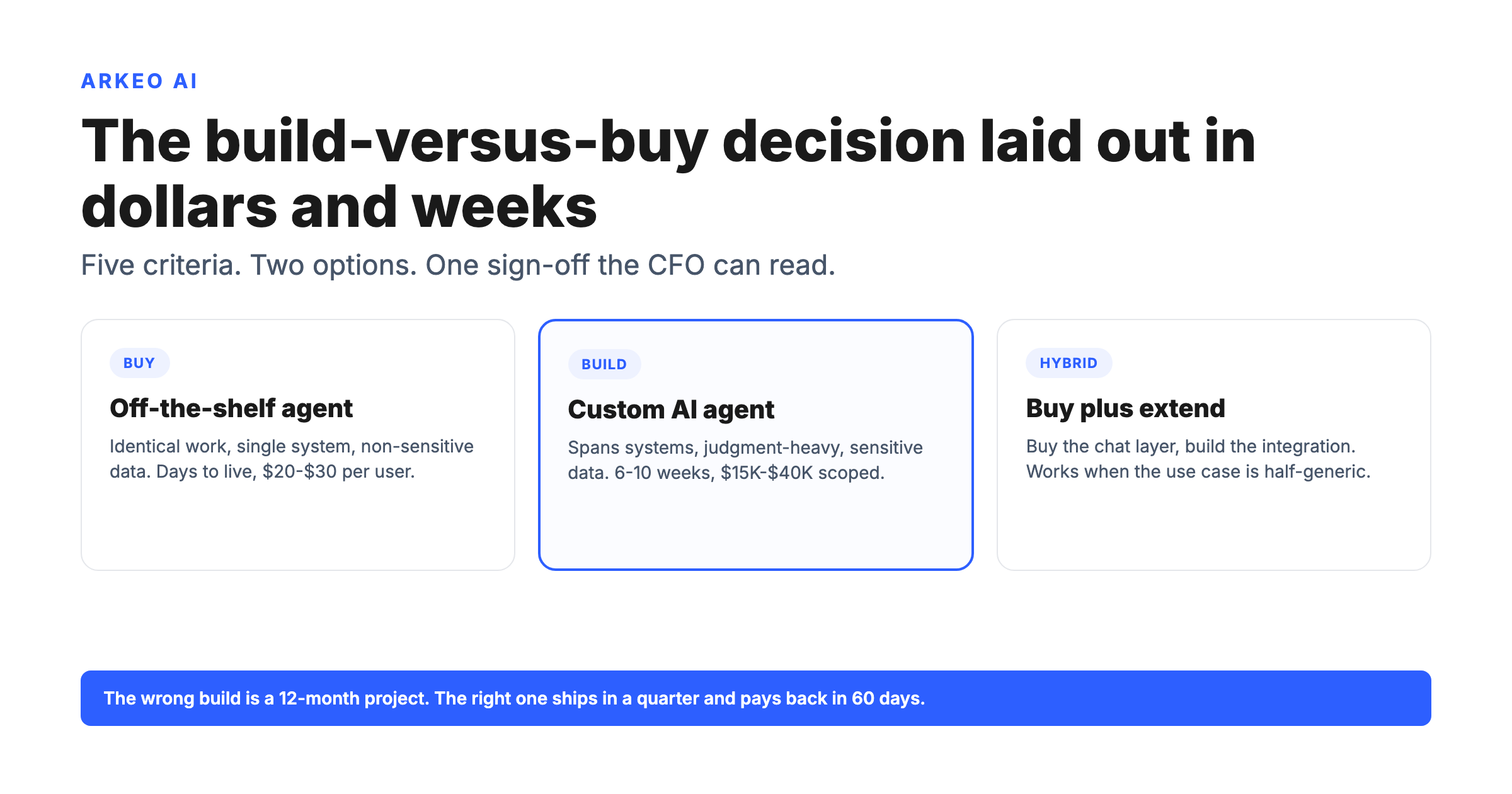
There is a real place for DIY tools. For a solo consultant automating email triage, a public builder is cheap and effective. The honest fork: DIY fits personal productivity and contained experiments; a private AI workforce is the right call when any of the following are true.
1. The process is business-critical. If the agent going down costs money or delays a client deliverable, DIY is the wrong foundation.
2. The data is sensitive. If the agent needs financial records, HR data, or proprietary client information, it must run on private infrastructure.
3. Multiple people depend on it. A system used by five people needs access controls, audit logs, and version management. Public builders lack those enterprise features.
It is worth noting that the public-tool hype can run far ahead of production reality. The honest accounting of what users actually report about ChatGPT agent mode lines up with this fork more often than not.
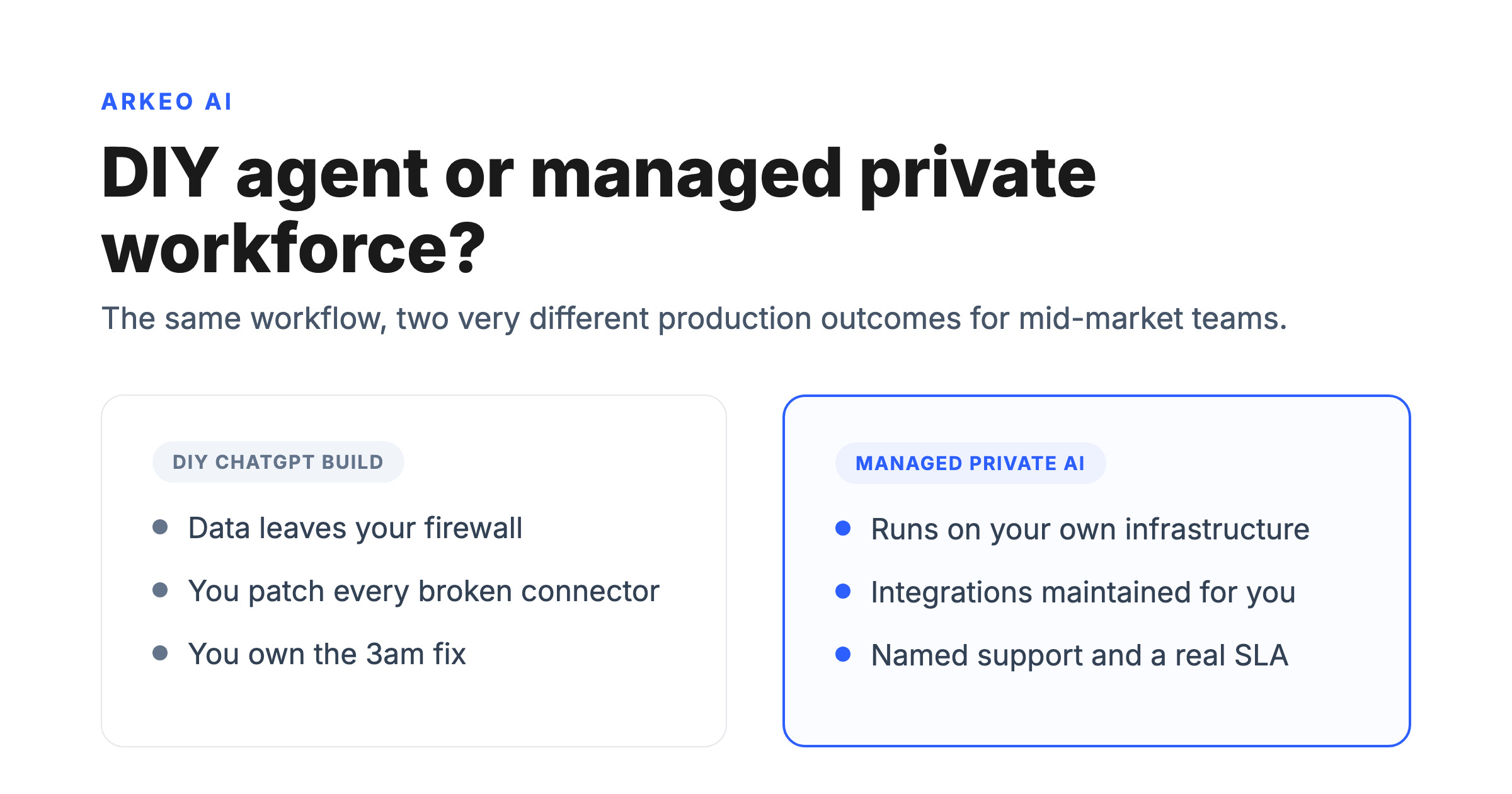
DIY vs managed private AI: a side-by-side
| Factor | DIY ChatGPT build | Managed private AI workforce |
|---|---|---|
| Where data lives | Public cloud, outside your control | Your infrastructure, behind your firewall |
| Integration upkeep | You patch every broken connector | Maintained and monitored for you |
| Access and audit | Minimal; whatever the vendor exposes | Role-based access plus forensic audit logs |
| Cost shape | Free up front, unpredictable upkeep | Fixed, predictable, no per-token surprises |
| When it breaks | You own the 3am fix | Named support team and a documented SLA |
The cost line deserves a closer look, because per-token pricing is where DIY math gets surprising. OpenAI publishes its rates on its API pricing page, and the model is usage-based: you pay for every token in and every token out. A short illustrative calculation makes the point. Suppose one agent run feeds a long document plus instructions and gets a detailed answer back, and a busy team triggers thousands of those runs a month. Because each run bills separately and a heavy document inflates the input every single time, the monthly total scales with usage rather than sitting flat. The figures vary with the model and the workload, so treat this as illustrative, not a quote, but the shape is the lesson: DIY cost is a variable you do not control, while a managed private deployment converts it into a fixed line item.
What Does the Managed Private AI Alternative Look Like?
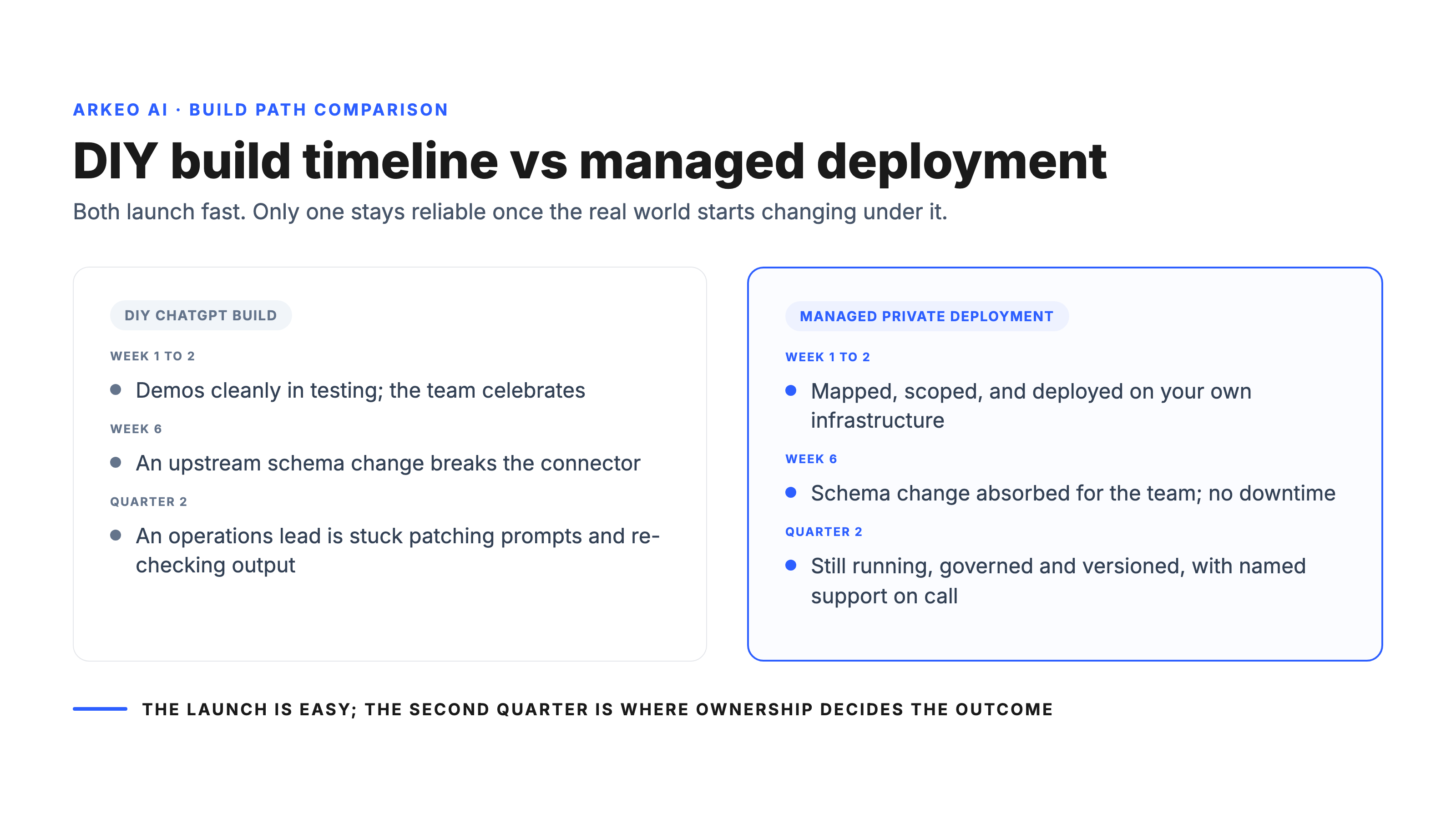
Instead of duct-taping an agent together with public tools, mid-market companies need a managed system. That is what Arkeo AI deploys: an AI workforce that runs on your infrastructure, so your data never leaves your building. Consider an illustrative example of the failure mode this fixes. A 60-person manufacturer builds a DIY agent to draft purchase-order approvals from supplier emails. It demos cleanly. Then, roughly six weeks in, the ERP system pushes a routine schema change, and the agent starts returning empty approvals every time a line item carries the new tax field. Nobody owns the fix, so an operations lead spends the better part of two quarters patching the connector, re-writing prompts, and manually re-checking approvals on Friday nights. The workflow that was supposed to save time becomes a second job. Deployed privately and managed, the same workflow has the schema change absorbed for the team, and the operations lead goes back to running the business.
The difference is ongoing ownership. When an API changes, Arkeo fixes it. When a model needs tuning, Arkeo handles it. You get the efficiency of an advanced AI system without standing up a six-figure data-science hire to keep it alive (industry-estimate salary levels for senior data scientists sit well into six figures, and that is before benefits and ramp time). Arkeo runs its own operations on the same private-AI stack it deploys for clients; it uses what it sells. The work is delivered through the Arkeo Operating System (AOS) so agents stay governed, versioned, and accountable, and follows a clear methodology: map current state, capture 30-to-90-day easy wins, identify the top mid-term workflow agents, then build toward a long-term private AI architecture.
Ready to deploy AI on your own infrastructure?
Arkeo builds and manages private AI systems for mid-market companies, with no cloud dependency, no data leaving your building, and no per-token pricing. Start with a free 30-minute assessment.
Book Your Free AI Assessment →