Category
ChatGPT Agent Mode: Top Reddit Complaints, Fixed
Last updated: May 2026
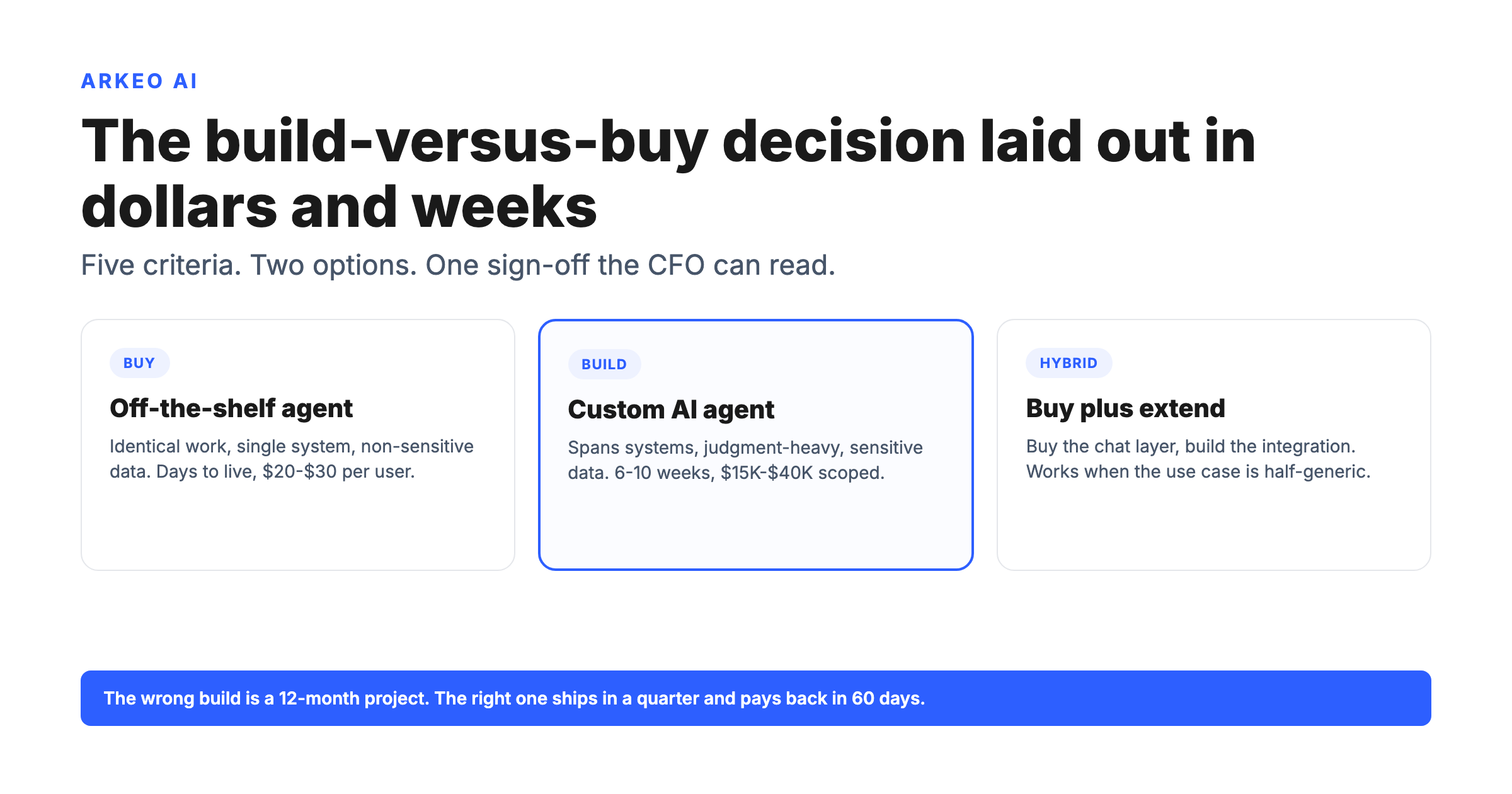
You gave ChatGPT agent mode a real job, a multi-step workflow that touches your data and your customers, and somewhere in the middle it forgot the instructions, looped on its own mistake, or quietly produced an answer that looked right and was wrong. You are not imagining it, and you are not alone. Arkeo AI has spent the last three years deploying production AI agents for operators, including the internal agents that run our own company, and the failures surfacing in ChatGPT agent mode Reddit threads line up almost exactly with what breaks when general-purpose tools get pointed at real business work. Arkeo was founded in 2023 on top of 25 years of operating experience, and that vantage point is the whole reason this post exists.
Quick Answer
• The complaints: Reddit users report context loss, confident wrong answers, data-leak anxiety, and no accountability when an agent fails at scale.
• The real cause: these are operating-envelope failures, not model failures. A consumer tool runs on shared infrastructure with no controls.
• The fix: a Private AI Workforce runs the same class of model on infrastructure you own, with persistent context, approval gates, and your data inside your firewall.
• Why it matters: better prompts cannot fix an architecture problem. The reliability you want is an infrastructure decision.
What is ChatGPT agent mode actually failing at?
ChatGPT agent mode is a consumer feature that lets the model take multi-step actions on your behalf, such as browsing, filling forms, and chaining tasks, inside OpenAI's shared, general-purpose environment. That last part is the problem. It is built to serve millions of unrelated requests, not to remember your standard operating procedures or guard your proprietary data. When you read the feedback about ChatGPT agent mode on Reddit, a clear pattern emerges: the technology is impressive for personal errands and falls apart under the weight of real business operations.
Here is the false belief worth retiring early. Most operators assume that if the agent keeps failing, the fix is a better prompt or a more detailed system message. That is wrong. None of the loudest complaints are about the model's intelligence. They are about the envelope it runs in, and you cannot prompt your way out of an architecture decision. If reliable agents are the goal, the first move is to see where AI actually fits your operation, which is exactly what a free AI Assessment is built to map before you commit budget.
Four complaints that show up over and over in ChatGPT agent mode threads
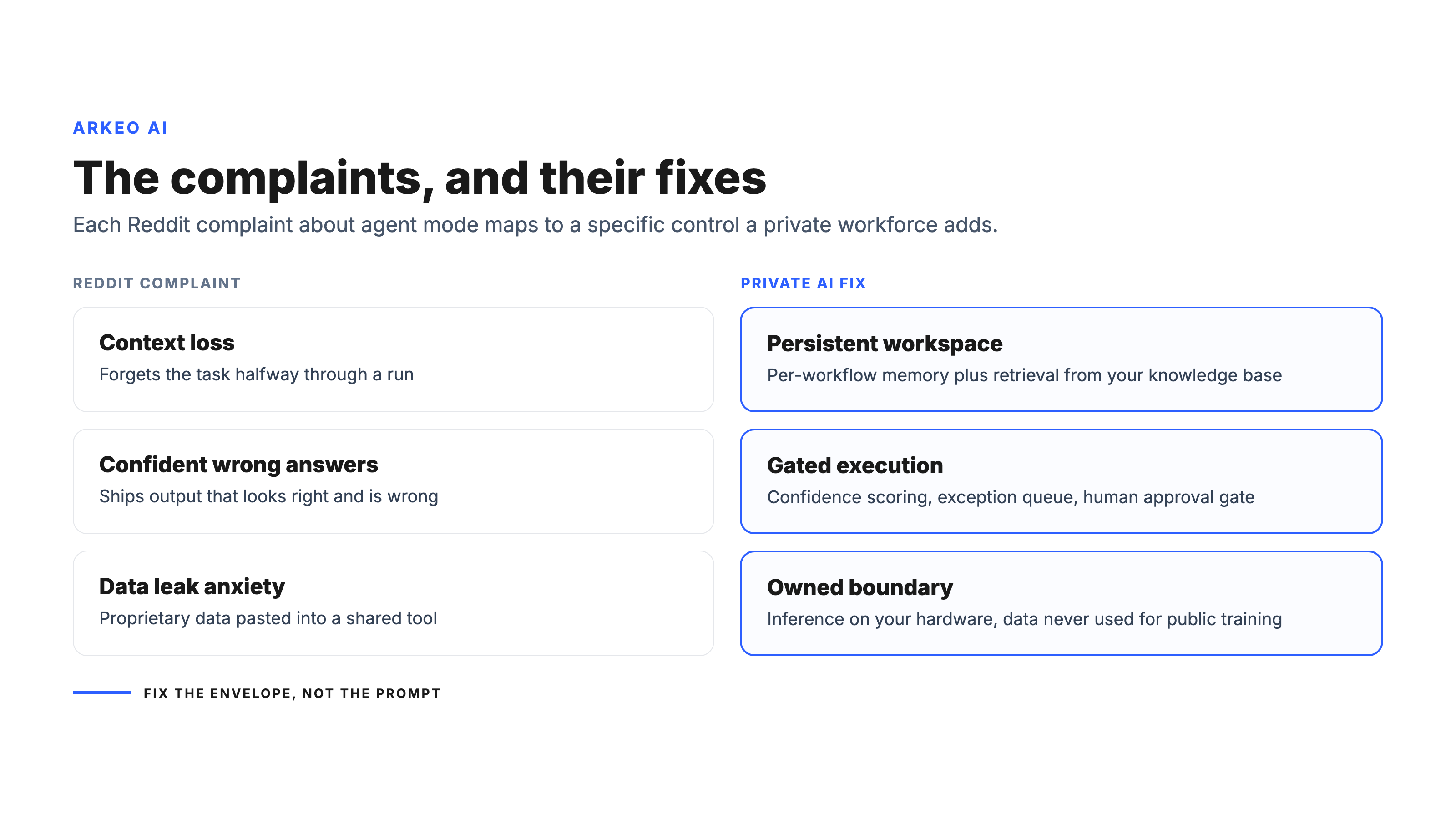
Pull a hundred Reddit threads on agent mode and the same four complaints dominate. None of them are about the model itself. All four are about the operating envelope the public product runs in.
Context loss
Agent forgets the task halfway through. Long-running workflows reset mid-execution. No persistent project state.
Confident wrong answers
Agent ships output that looks right and is wrong. No confidence scoring, no exception queue, no human review gate by default.
Data leak anxiety
Posters report pasting client data or proprietary IP into prompts and immediately regretting it. No clear retention story.
No accountability path
When the agent makes a mistake at scale, there is no SLA, no escalation, no named team. Just a help-center article.
Why do agents lose context and loop on their own mistakes?
1. Context amnesia mid-task
The most common complaint is memory loss. Users report that after a handful of interactions, the agent drops the original instructions. You spend twenty minutes defining how it should act, with specific formatting rules and constraints, and partway through the task it reverts to generic behavior. In a business setting that means constant supervision. You are not automating a task if you have to babysit the agent at every step.
2. The endless apology loop
Reddit threads are full of agents stuck in logic loops. The agent makes a mistake. You correct it. The agent apologizes, promises to fix it, and immediately makes the exact same mistake. This happens because the agent lacks deterministic execution pathways. It is predicting the next likely token rather than following a fixed operational playbook. For critical processes, unpredictable execution is worse than no execution at all.
3. Data privacy and shadow AI
Operators are increasingly worried about data leakage. When employees feed proprietary code, financial figures, or customer information into a public agent, they are exposing company assets through unsanctioned tools, which is the definition of shadow AI. Here is the blunt truth a vendor brochure will not print: AI agents break, regularly, and on a public platform you have no audit trail showing what data went where when they do. You cannot build a durable workflow on a platform whose retention and training terms you do not control.
4. The moving target
Workflows built on public agents break without warning. The provider updates the underlying model, and the prompt structure that worked yesterday no longer produces the same result today. Business automation needs stability. Relying on an agent whose behavior shifts under you introduces operational risk that most teams only discover after it has already cost them a deliverable.
Stop babysitting fragile agents
A free AI Assessment maps your highest-risk workflows and shows exactly where a private deployment removes the context loss, the looping, and the data exposure you are fighting today.
Book Your Free AI Assessment →
How does a Private AI Workforce fix these complaints?
A Private AI Workforce is a set of AI agents deployed inside your own secure environment, on infrastructure you control, wired into your systems with persistent context, approval gates, and an audit log. The model class can be the same one you already trust. What changes is the operating posture around it, and that posture is where every Reddit complaint actually lives.
Context loss is solved by giving each workflow a persistent workspace and connecting the agent to your knowledge base through retrieval, so the instructions and source material do not fall out of a shrinking window. The looping and silent-failure problem is solved with confidence scoring, exception queues, and mandatory human approval gates at the points that matter, so a low-confidence output goes to a person instead of straight into production. The data problem is solved structurally: inference runs on your hardware, your data never leaves your boundary, and nothing you process is used to train someone else's public model. The moving-target problem is solved because you own the version, so updates ship on your schedule, not a vendor's. This is the on-premise, private-AI approach Arkeo builds on, and it is the same Arkeo Operating System we run internally, because we use what we sell.
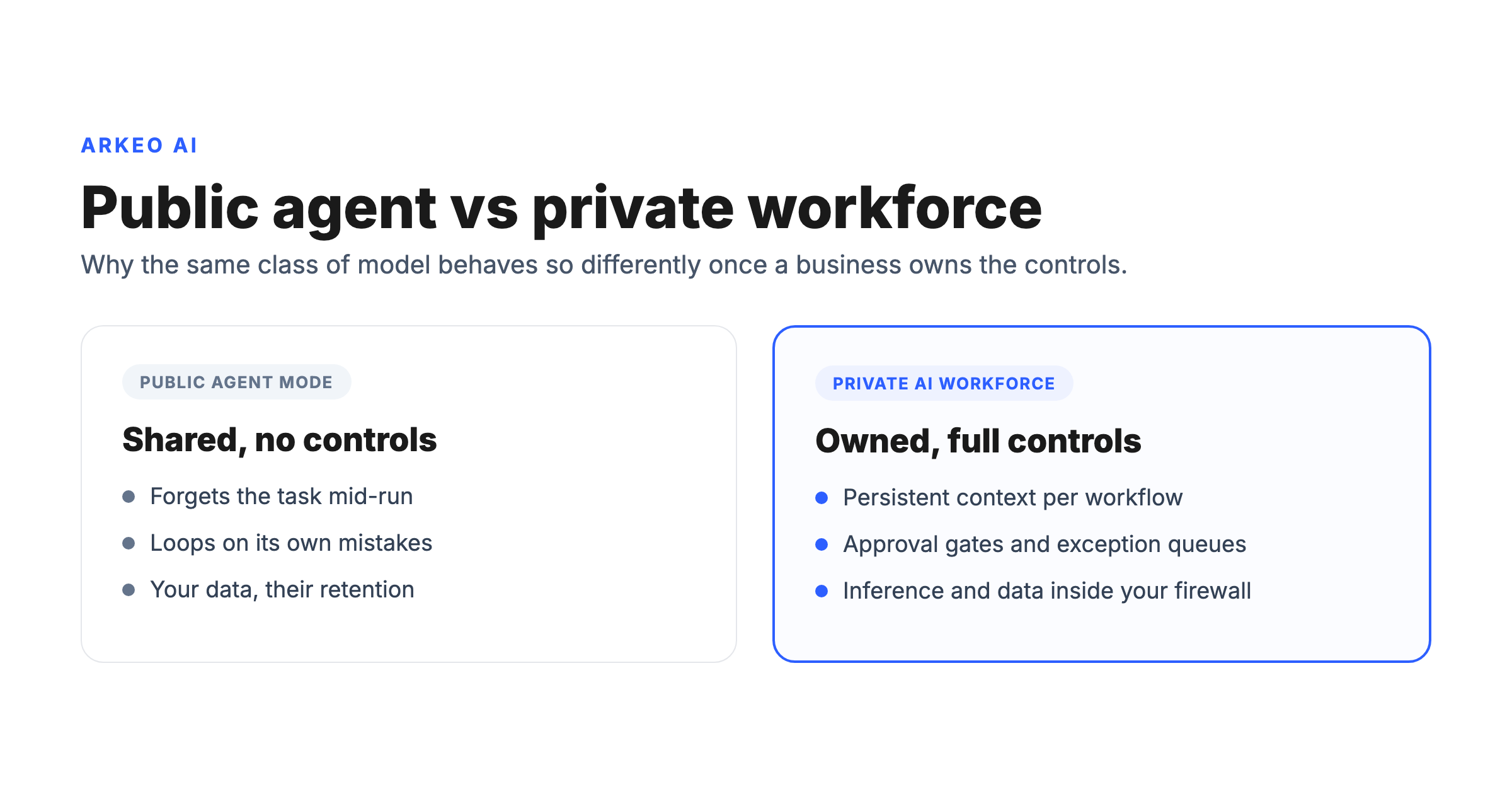
Same model class, very different operating posture
Most Reddit complaints disappear the moment the same model class runs on owned infrastructure with the controls a business actually needs. The contrast below shows the parts of the operating envelope that change.
Shared infrastructure, no controls
Owned infrastructure, full controls
What does the move from public agents to a private workforce look like?
The solution is not to write better prompts. The solution is architecture. To understand the gap, it helps to separate the consumer feature from the underlying capability: there is a real difference between AI agents and ChatGPT as a chat product, and the public agent feature sits awkwardly between the two. If you want to dig into how the feature itself behaves, the deeper mechanics of deploying ChatGPT agents at scale and the trade-offs of using the ChatGPT agent builder to assemble custom flows are worth reading alongside this post.
Picture an operations lead who has three people quietly running customer-facing workflows through a public agent because it is faster than the official process. That is the hypothetical, but the shape is common: the productivity is real, the exposure is invisible, and no one owns the risk. Migration is the move from that scattered personal-productivity tooling to a managed workforce. It is not a vendor swap, and treating it like one is how teams end up with the same fragility under a new logo.
Three milestones for moving from public agents to a private workforce
Migration is not a vendor swap. It is the move from personal-productivity tooling to a managed workforce. The three milestones below are the ones that actually ship: quick wins first, owned data second, full workforce third.
Audit shadow AI
Map current public AI use across the team. Identify the workflows where data exposure is unacceptable.
Ship first private agent
Pick the highest-payback workflow with the worst data exposure. Stand up the private deployment.
Expand the workforce
Add the next two workflows. Tighten governance. Retire the public-AI workarounds the team had built.
Where should you start if the complaints sound familiar?
Start by being honest about which workflows are already running through public agents and what data they touch. That single audit usually reframes the whole conversation, because the question stops being which tool is best and becomes which exposure is unacceptable. From there the path is narrow and practical: prove one private workflow, then expand. The free AI Assessment is the fastest way to run that first pass with someone who has shipped private deployments before, rather than guessing internally.
See where AI fits your operation
The free AI Assessment is a focused planning session that turns the complaints in this post into a concrete, prioritized plan for a private deployment you control.
Book Your Free AI Assessment →