Category
AI Workflow Automation Services: A Buyer's Guide
Last updated: May 2026
You are weighing a decision that most software demos quietly skip over: whether to hire a partner for AI workflow automation, or keep relying on off-the-shelf tools and internal experimentation. The pressure is real. McKinsey's 2025 State of AI survey found that high performers are roughly 2.8 times more likely to fundamentally redesign their workflows, and that redesign is one of the strongest predictors of measurable impact. That single finding reframes the buying decision. The work that moves the needle is redesign, not installation, and redesign is exactly what a thin license-reseller will not do for you.
This guide is built to help you judge service quality, not to pitch you. By the end you will know what a strong engagement actually delivers, when the spend is justified, what separates a real partner from a tool reseller, and the red flags that should make you walk. If you would rather start by mapping where automation fits your own operation, the fastest path is a free 60-minute planning session at Arkeo's AI Assessment.
Quick Answer
• What it is: A scoped engagement that maps your workflows, prioritizes wins, recommends platform fit, and plans a controlled rollout, not just a tool install.
• When it's worth it: When the work spans multiple systems, touches sensitive data, or you lack internal bandwidth to design and own the change.
• What to look for: A partner who leads with your workflows and an ownership model, gives you a written workflow map and a handoff plan, and may tell you that you do not need a new platform.
• Why it matters: McKinsey's 2025 State of AI survey found high performers are roughly 2.8 times more likely to fundamentally redesign their workflows, and that redesign is among the strongest predictors of impact. The right service does that redesign; a tool install does not.
What Do AI Workflow Automation Services Include?
Good AI workflow automation services deliver a workflow map, a prioritized set of quick wins, system and platform-fit recommendations, a rollout path, and the controls and ownership model that keep the work running, not just a tool that gets switched on. If a proposal stops at the tool, you are buying a setup fee dressed as a strategy.
A real engagement moves through four phases. Discovery comes first: a partner sits with the people who actually run the process and documents how work moves today, including the undocumented exceptions that break automations later. Workflow mapping turns that into a clear picture of inputs, decisions, handoffs, and the data each step touches. Tool and platform fit comes only after the map exists, because the right choice depends on what you already run and where your data must stay. Implementation planning then sequences the rollout, names owners, and defines the success metrics you will judge it against.
The order matters more than any single deliverable. Mapping the workflow before choosing the tool is the difference between automating the right work and paying to speed up the wrong process. A common pattern Arkeo sees in the market is the reverse: a recommended platform appears on slide three, before anyone has mapped a single workflow or named who will own the result. That is the clearest tell that you are looking at a reseller, not a partner.
When Do AI Workflow Automation Services Make Sense?
Not every automation need justifies an outside engagement. A single-team, single-system task is often best handled by a capable internal owner and an off-the-shelf tool. Services earn their cost in three specific situations.
The first is cross-system complexity. When a workflow threads through your CRM, your finance system, and a document store, the integration and exception handling are where most projects quietly fail. The second is sensitive workflows: anything touching customer records, contracts, or regulated data needs governance designed in from the start, not bolted on after launch. The third is a simple bandwidth problem: you have the use case and the appetite, but no internal capacity to design the change, build it, and own it through the messy first months.
The urgency is not hypothetical. McKinsey's 2025 State of AI survey found 62% of organizations are already experimenting with AI agents, but only 23% are scaling them in even one function. That gap is the hard part of automation made visible: getting from a working pilot to something that runs reliably across the business is where teams stall, and it is exactly the gap a service engagement is meant to close.
Here is the blunt truth a brochure will not print. AI agents break, regularly, and they break in production where the cost is highest. Across three years of deploying agents, the pattern Arkeo sees again and again is that the projects which fail were the ones that bought a tool before mapping the work. Gartner expects over 40% of agentic AI projects to be canceled by the end of 2027, citing escalating costs, unclear value, and inadequate risk controls. Gartner also warns of "agent washing," estimating that only around 130 of the thousands of vendors claiming agentic capability are real. A service engagement is worth paying for precisely when it lowers your odds of joining that 40%, by exposing the complexity and risk before you commit, not after. A focused assessment typically runs a few weeks before any build begins, which is a small cost set against the price of automating the wrong process at scale.
See where automation actually fits your operation
The free assessment maps your highest-value workflows, flags the ones worth automating first, and shows where a tool is enough and where custom agent work is justified.
Book Your Free AI Assessment →
How Do You Evaluate AI Workflow Automation Services?
Most buyers assume a good automation partner leads with the platform they resell. That belief is backward. A good partner leads with your workflows, and a great one will sometimes tell you that you do not need a new platform at all. Three signals separate the real ones.
Workflow understanding comes first. Can the partner describe your process back to you, including the exceptions, before recommending anything? System experience is next: have they integrated the specific systems you run, and can they speak to the failure modes rather than the demo path? Implementation credibility is the third: ask to see a rollout plan, an ownership model, and how they hand the work back to your team. The deeper context on choosing tooling lives in our pillar overview of AI workflow automation, and if you are comparing buy-versus-build, the breakdown of an AI workflow automation platform is a useful companion read.
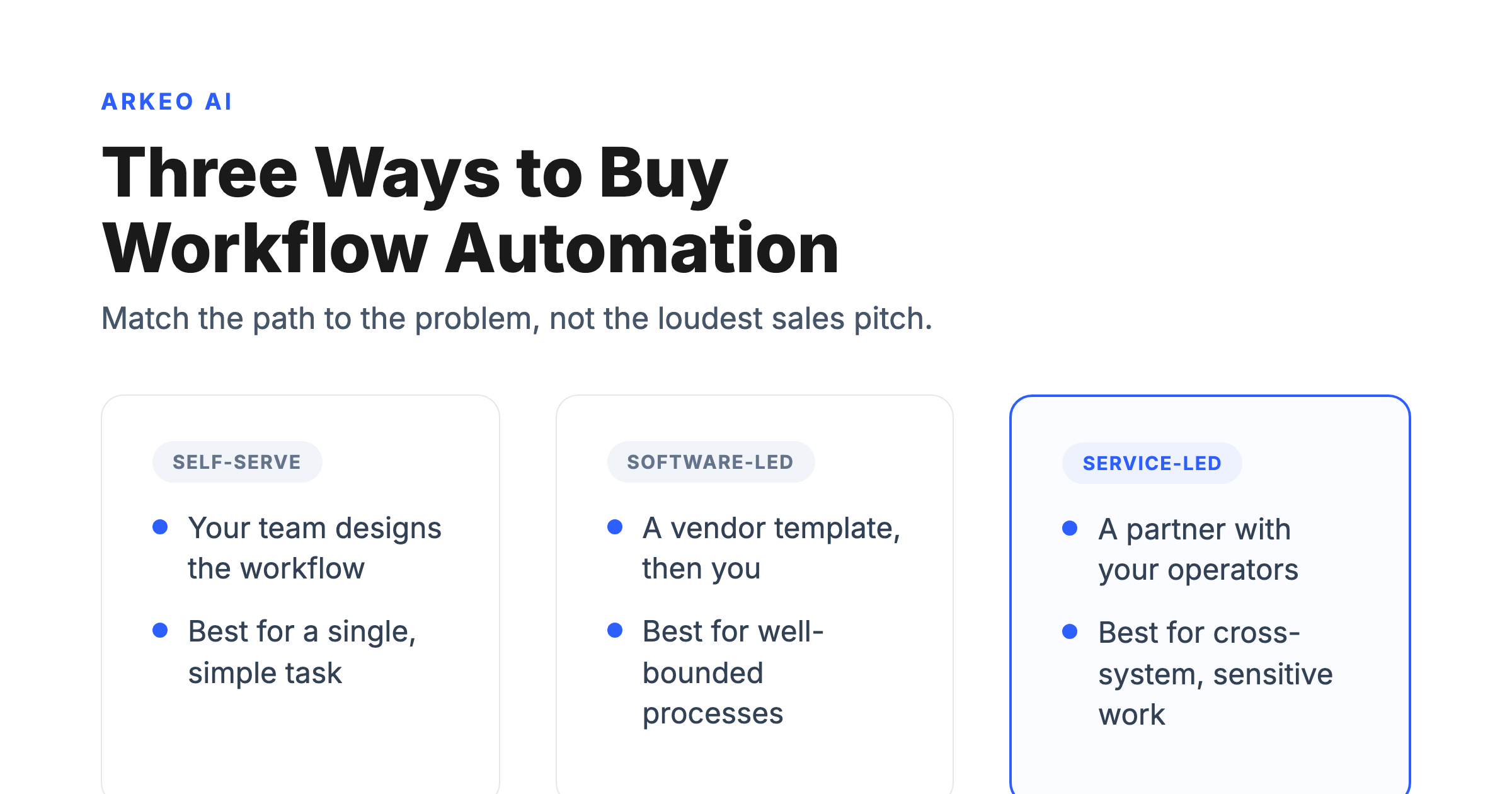
The comparison below frames the three buying paths most teams choose between, so you can match the path to the problem rather than to the loudest sales motion.
| Dimension | Self-serve | Software-led | Service-led |
|---|---|---|---|
| Who designs the workflow | You and your team | The vendor's template, then you | The partner, with your operators |
| Cost | Lowest, but your time | License plus internal effort | Highest up front, scoped to value |
| Speed to first win | Slow, learning curve | Fast for templated cases | Fast where the map is clear |
| Best fit | Single team, simple task | Common, well-bounded process | Cross-system or sensitive work |
| Main risk | Stalls without expertise | You bend work to fit the tool | Paying for slideware, not delivery |
What Are the Red Flags in AI Automation Services?
Three patterns should make you slow down. The first is a tool-first recommendation: a named platform before anyone has mapped your workflow. The second is no operating model, meaning no answer for who runs, monitors, and fixes the automation once the consultants leave. This is the most common gap and the most expensive one: Deloitte's 2025 research on AI agents found that only about 1 in 5 companies has a mature model for governing autonomous agents, so most teams are scaling automation faster than the controls that keep it safe. The third is no handoff plan, which traps you in a dependency where every change requires another invoice. Many engagements that wear the "AI services" label are reselling licenses with a setup fee, and the three red flags above are how you spot them before the contract.
To make the positive case concrete, here is what a strong engagement should put in front of you in writing. If a proposal cannot produce most of this, treat the gaps as risk you will absorb later.
What a strong engagement delivers
• A documented workflow map, including exceptions and handoffs.
• A prioritized list of quick wins, ranked by value and effort.
• System and platform-fit recommendations tied to your existing stack.
• A sequenced rollout path with named owners for each step.
• Controls and an ownership model, with governance built in from the start.
• Success metrics you will judge the work against.
How Does Arkeo's Assessment-Led Approach Fit?
Arkeo was founded in 2023 on a simple discipline: we use what we sell. Across three years of deploying agents and 25 years of operating businesses, the lesson that holds is that workflow comes before tooling, every time. That conviction is built into the Arkeo Operating System (AOS) and shows up in an assessment-led path rather than a license pitch. For teams who want the agents themselves to do the work rather than just trigger it, our look at agentic AI workflow automation covers where that line sits.
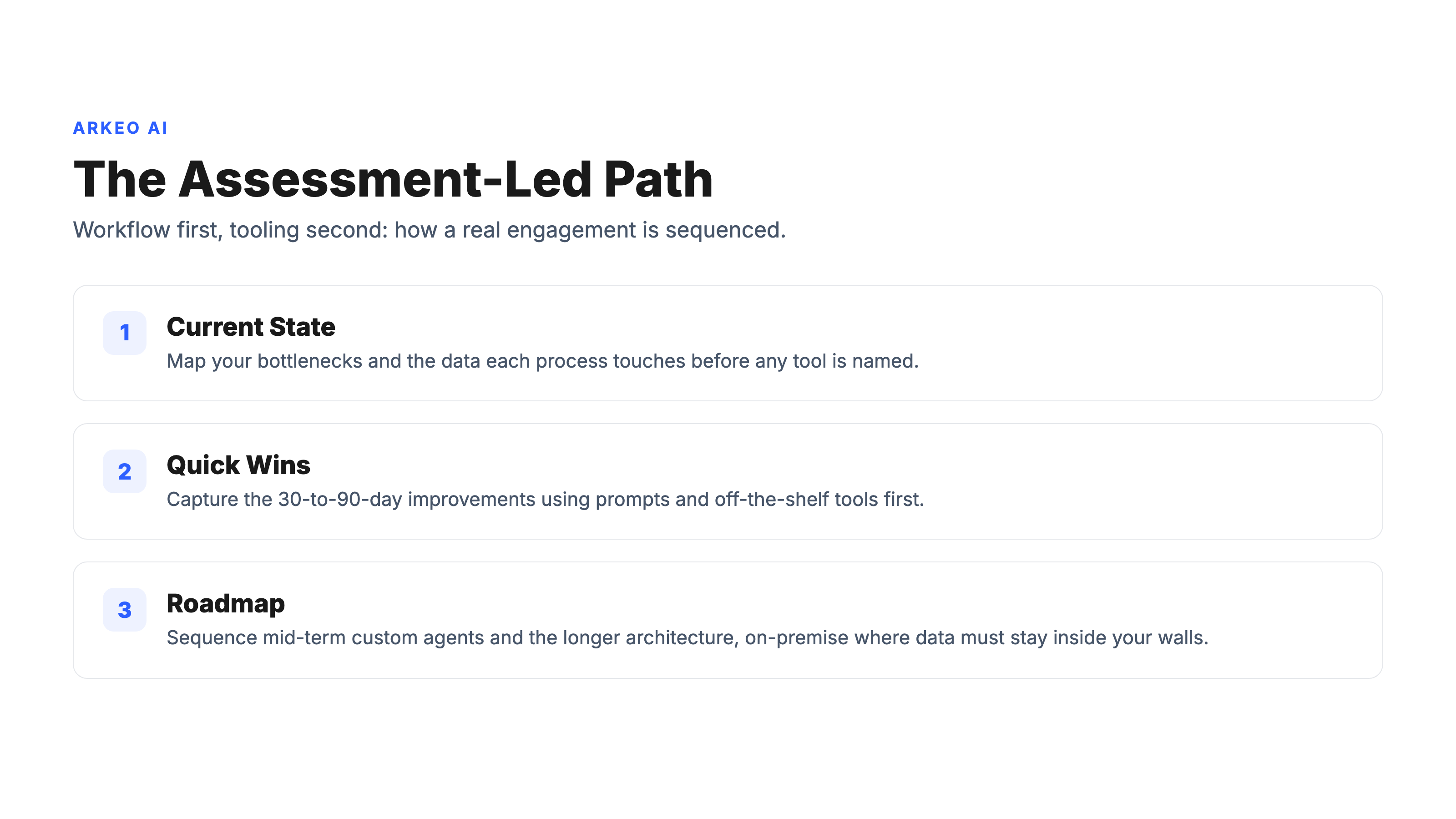
The path is deliberately staged. Current State maps your bottlenecks and the data each process touches. Quick Wins surfaces the 30-to-90-day improvements you can capture with prompts and off-the-shelf tools before any custom build. The Roadmap then sequences mid-term custom agents and the longer architecture, including on-premise and private AI where your data must stay inside your walls (you can book the free AI Assessment to see this path drawn against your own operation). The diagram below shows how those three stages connect.
The free AI Assessment is where this starts, and it is genuinely free: a 60-minute planning session that gives you the workflow view and the prioritized wins. If the assessment surfaces a deeper diagnostic need, the paid Consult is the logical next step after it, never a hidden cost inside the free session. You leave the assessment with a clearer picture whether or not you ever engage further.
Start with the workflow, not the tool
The free assessment gives you a prioritized map of automation wins, platform fit, and where custom agent work is actually needed before you spend a dollar on a license.
Book Your Free AI Assessment →